
2021 AMC 12A Spring Solutions
Scroll down to view professionally curated solutions from LIVE by Po-Shen Loh, print PDF solutions, view answer key, or take the full timed exam.
All problems are used with official legal permission of the Mathematical Association of America (MAA).
1.
What is the value of
Small Hint:
First add the exponents:
Big Hint:
Evaluate and separately, then subtract
Solution:
The exponent in the first term is so the first term is The parenthesized sum is Therefore the value is
Thus, the correct answer is B.
2.
Under what conditions is true, where and are real numbers?
It is never true.
It is true if and only if
It is true if and only if
It is true if and only if and
It is always true.
Small Hint:
The left side is a square root, so it can never be negative; this forces
Big Hint:
Squaring gives so
Solution:
Because is never negative, equality requires Squaring both sides gives which simplifies to i.e.
Conversely, if then and if additionally then So both conditions together are exactly what is needed.
Thus, the correct answer is D.
3.
The sum of two natural numbers is One of the two numbers is divisible by If the units digit of that number is erased, the other number is obtained. What is the difference of these two numbers?
Small Hint:
Erasing the units digit of a multiple of divides it by
Big Hint:
If the smaller number is the larger is so
Solution:
The larger number ends in and erasing that digit divides it by to give the smaller number. So the larger number is times the smaller. Writing the smaller number as the sum is giving
The two numbers are and whose difference is
Thus, the correct answer is D.
4.
Tom has a collection of snakes, of which are purple and of which are happy. He observes that
• all of his happy snakes can add,
• none of his purple snakes can subtract, and
• all of his snakes that can’t subtract also can’t add.
Which of these conclusions can be drawn about Tom’s snakes?
Purple snakes can add.
Purple snakes are happy.
Snakes that can add are purple.
Happy snakes are not purple.
Happy snakes can’t subtract.
Small Hint:
Chain the implications: purple can’t subtract can’t add
Big Hint:
Happy snakes can add, but purple snakes cannot add; compare these two facts
Solution:
A purple snake cannot subtract, and any snake that cannot subtract also cannot add. So every purple snake cannot add.
Every happy snake can add. Since purple snakes cannot add, no happy snake can be purple; that is, happy snakes are not purple.
Thus, the correct answer is D.
5.
When a student multiplied the number by the repeating decimal where and are digits, he did not notice the notation and just multiplied by the terminating decimal Later he found that his answer was less than the correct answer.
What is the two-digit integer
Small Hint:
Write Then and
Big Hint:
The difference of the two products is
Solution:
Let be the two-digit integer. Then while the terminating value is The correct product minus the student’s product is
Setting gives
Thus, the correct answer is E.
6.
A deck of cards has only red cards and black cards. The probability of a randomly chosen card being red is When black cards are added to the deck, the probability of choosing red becomes How many cards were in the deck originally?
Small Hint:
Let be the number of red cards; the original deck has cards
Big Hint:
Adding black cards keeps red out of and this equals
Solution:
Let be the number of red cards and the total. From we get After adding black cards, so
Substituting gives so and
Thus, the correct answer is C.
7.
What is the least possible value of for real numbers and
Small Hint:
Expand fully; the cross terms and cancel
Big Hint:
The expression equals a product of two factors each at least
Solution:
Expanding, This factors as
Each factor is at least so the product is at least with equality when
Thus, the correct answer is D.
8.
A sequence of numbers is defined by and for What are the parities (evenness or oddness) of the triple of numbers where denotes even and denotes odd?
Small Hint:
Only parities matter, so compute the sequence with each term as or using
Big Hint:
The parity sequence repeats with period reduce modulo
Solution:
Working modulo the terms have parities which repeat with period starting from (indeed have the same parities as ).
Since and the parities match those of namely
Thus, the correct answer is C.
9.
Which of the following is equivalent to
Small Hint:
Multiply the whole product by to start a telescoping cascade
Big Hint:
Repeatedly apply
Solution:
Since multiplying the product by does not change it. Then and multiplying by the next factor gives and so on. Each step doubles the exponent.
After using all seven factors, the product telescopes to
Thus, the correct answer is C.
10.
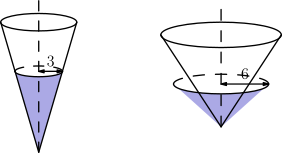
Two right circular cones with vertices facing down as shown in the figure below contain the same amount of liquid. The radii of the tops of the liquid surfaces are cm and cm. Into each cone is dropped a spherical marble of radius cm, which sinks to the bottom and is completely submerged without spilling any liquid. What is the ratio of the rise of the liquid level in the narrow cone to the rise of the liquid level in the wide cone?
Small Hint:
The liquid in each cone is itself a cone; with equal starting volumes, the narrow cone (radius ) is four times as tall as the wide cone (radius )
Big Hint:
Adding the same marble volume scales the height by the same factor in both cones, so the rises are in the ratio of the original heights
Solution:
The liquid in each cone forms a smaller cone similar to the container. Let the narrow liquid cone have radius and height and the wide one radius and height Equal volumes give so
Dropping the marble raises the volume by the same amount in each cone, and both start with the same volume Because a cone’s volume scales as the cube of its height, the new height is so each rise equals This factor is identical for the two cones, so the rises are in the ratio
Thus, the correct answer is E.
11.
A laser is placed at the point The laser beam travels in a straight line. Larry wants the beam to hit and bounce off the -axis, then hit and bounce off the -axis, then hit the point What is the total distance the beam will travel along this path?
Small Hint:
A bounce off a line means reflecting one endpoint across that line straightens the path
Big Hint:
Reflect the start across the -axis and the end across the -axis, then take the straight-line distance between the images
Solution:
Reflecting the path at each bounce turns it into a single straight segment. Reflect the start across the -axis to and reflect the target across the -axis to The total travel distance equals the straight-line distance between these two images:
Thus, the correct answer is C.
12.
All the roots of the polynomial are positive integers, possibly repeated. What is the value of
Small Hint:
The six positive integer roots sum to and multiply to find the multiset
Big Hint:
The roots are equals times the sum of products of the roots taken three at a time
Solution:
By Vieta’s formulas the six roots sum to (the negative of the coefficient) and multiply to Thus every root is a power with Since the roots have sum at least Equality holds only when every is or so the roots must be
So the polynomial is Expanding, The coefficient of is
Thus, the correct answer is A.
13.
Of the following complex numbers which one has the property that has the greatest real part?
Small Hint:
Every choice has modulus so has modulus only the angle matters
Big Hint:
For angle the real part of is find which is closest to a multiple of
Solution:
Each listed number has modulus so has modulus and its real part is where is the argument of The arguments are and
Multiplying by gives and The largest cosine is from giving real part
Thus, the correct answer is B.
14.
What is the value of
15.
A choir director must select a group of singers from among his tenors and basses. The only requirements are that the difference between the number of tenors and basses must be a multiple of and the group must have at least one singer. Let be the number of groups that can be selected. What is the remainder when is divided by
Small Hint:
Count pairs with using a roots of unity filter with
Big Hint:
The count is then subtract for the empty group
Solution:
Choosing tenors and basses is weighted by To keep only apply a roots of unity filter with
The term is The term has factor The and terms are and which cancel. So the sum is and
This count includes the empty group, so and
Thus, the correct answer is D.
16.
In the following list of numbers, the integer appears times in the list for
What is the median of the numbers in this list?
Small Hint:
The list has terms, so the median averages the th and st
Big Hint:
The numbers through fill positions up to find the containing position
Solution:
The list has terms, so the median is the average of the th and st terms.
The value occupies positions up to Since and positions through all equal Both middle positions fall in this block, so the median is
Thus, the correct answer is C.
17.
Trapezoid has and Let be the intersection of the diagonals and and let be the midpoint of Given that the length can be written in the form where and are positive integers and is not divisible by the square of any prime. What is
Small Hint:
Place at the origin with along one axis and along the other, since
Big Hint:
Using forces to be the midpoint-type point with parameter then divides so that
Solution:
Place with on one axis and on the other, so that Since write for some Then and Setting gives so
Thus and gives The diagonal meets (the -axis) at while Hence so
Then so With and we get
Thus, the correct answer is D.
18.
Let be a function defined on the set of positive rational numbers with the property that for all positive rational numbers and Suppose that also has the property that for every prime number For which of the following numbers is
Small Hint:
The rule makes additive over prime factors, and
Big Hint:
For compute (with negative exponents for denominators)
Solution:
The functional equation makes completely additive: for we have where a prime in the denominator contributes a negative exponent (since ).
Evaluating: and Only the last is negative.
Thus, the correct answer is E.
19.
How many solutions does the equation have in the closed interval
Small Hint:
Rewrite the right side using
Big Hint:
Equal sines give or each has range
Solution:
Write the right side as Equal sines require either or
The first reduces to since only works, giving with solutions and in The second reduces to whose only solution in is
The distinct solutions are and for a total of
Thus, the correct answer is C.
20.
Suppose that on a parabola with vertex and a focus there exists a point such that and What is the sum of all possible values of the length
Small Hint:
Put at the origin with focal distance then equals the distance from to the directrix
Big Hint:
With use and with to get a quadratic in
Solution:
Let focus and directrix where A point on the parabola satisfies and so Also
Substituting By Vieta’s formulas, the sum of the two possible values of is
Thus, the correct answer is B.
21.
The five solutions to the equation may be written in the form for where and are real. Let be the unique ellipse that passes through the points and The eccentricity of can be written in the form where and are relatively prime positive integers. What is
(Recall that the eccentricity of an ellipse is the ratio where is the length of the major axis of and is the distance between its two foci.)
Small Hint:
The five roots are and they are symmetric about the -axis
Big Hint:
Fit through the points, then read off and to find
Solution:
The roots are and giving the points and By symmetry about the -axis, the ellipse has the form
Substituting the points yields Completing the square gives so (along ) and Then so
With and we get
Thus, the correct answer is A.
22.
Suppose that the roots of the polynomial are and where angles are in radians. What is
Small Hint:
The three cosines are the roots of
Big Hint:
Divide by to match reading off directly
Solution:
Let the three roots be The seventh roots of unity give Doubling the three angles merely permutes their cosines, so Hence equals
The product-to-sum identity gives so Therefore their monic polynomial is
Matching coefficients, Therefore
Thus, the correct answer is D.
23.
Frieda the frog begins a sequence of hops on a grid of squares, moving one square on each hop and choosing at random the direction of each hop: up, down, left, or right. She does not hop diagonally. When the direction of a hop would take Frieda off the grid, she “wraps around” and jumps to the opposite edge. For example, if Frieda begins in the center square and makes two hops “up,” the first hop places her in the top row middle square, and the second hop causes her to jump to the opposite edge, landing in the bottom row middle square. Suppose Frieda starts from the center square, makes at most four hops at random, and stops hopping if she lands on a corner square. What is the probability that she reaches a corner square on one of the four hops?
Small Hint:
Group squares into three states: center, edge-middle, and corner (absorbing); find the transition probabilities from each
Big Hint:
From an edge square, Frieda reaches a corner with probability returns to center with or moves to another edge with
Solution:
Classify squares as center edge-middle or corner (absorbing). From every hop lands on an square. From an square, two of the four neighbors are corners, one is the center, and one is another square, so
Let be the probability of reaching a corner within hops starting from an edge square, and let be the corresponding probability from the center. Set Then and Thus and
Starting from the center with four hops available, the probability equals (the first hop reaches an edge, leaving three hops).
Thus, the correct answer is D.
24.
Semicircle has diameter of length Circle lies tangent to at a point and intersects at points and If and then the area of is where and are relatively prime positive integers and is a positive integer not divisible by the square of any prime. What is
Small Hint:
In circle which gives the radius
Big Hint:
Set center the radical axis of the two circles locates and the area is
Solution:
In circle the chord subtends the inscribed angle so giving hence
Place with (upper half). Since is tangent to at its center is Subtracting the two circle equations gives the line and the distance from the center to must equal This yields so (the root places outside ).
With the distance from to line is Thus So and
Thus, the correct answer is D.
25.
Let denote the number of positive integers that divide including and For example, and (This function is known as the divisor function.) Let
There is a unique positive integer such that for all positive integers What is the sum of the digits of
Small Hint:
is multiplicative, so maximize independently for each prime
Big Hint:
For the best exponent is for it is for it is and for it is
Solution:
Since is multiplicative, its value factors over prime powers as a product of terms for each prime power We maximize each term separately.
If then This ratio decreases with so checking where it first falls below finds the unique maximum. It gives for for for and for every prime
Hence whose digit sum is
Thus, the correct answer is E.