
2020 AMC 12B Solutions
Scroll down to view professionally curated solutions from LIVE by Po-Shen Loh, print PDF solutions, view answer key, or take the full timed exam.
All problems are used with official legal permission of the Mathematical Association of America (MAA).
1.
What is the value in simplest form of the following expression?
Small hint:
The sum of the first odd numbers is
Big hint:
Each term simplifies to and
Solution:
The sum of the first odd numbers equals so each radicand is a perfect square:
Thus, the correct answer is C.
2.
What is the value of the following expression?
Small hint:
Big hint:
Factor and , then look for cancellation
Solution:
Using the difference of squares, and The expression becomes
Thus, the correct answer is A.
3.
The ratio of to is the ratio of to is and the ratio of to is What is the ratio of to
Small hint:
Rewrite each ratio as a fraction involving the same variables
Big hint:
Express as
Solution:
The ratios give Then Therefore
Thus, E is the correct answer.
4.
The acute angles of a right triangle are and where and both and are prime numbers. What is the least possible value of
Small hint:
The acute angles satisfy
Big hint:
Try the smallest primes for and check whether is also prime
Solution:
Since the angles are complementary, To minimize try small primes and require to be prime as well.
For the value is not prime. For we get which is prime. So the least possible value is
Thus, the correct answer is D.
5.
Teams and are playing in a basketball league where each game results in a win for one team and a loss for the other team. Team has won of its games and team has won of its games. Also, team has won more games and lost more games than team How many games has team played?
Small hint:
Let play games and play games, then write both the win and loss conditions
Big hint:
Wins: losses:
Solution:
Let be the number of games team played and the number team played. Team wins and loses team wins and loses The conditions give and
Subtracting the equations gives so Substituting into the loss equation: i.e. so and
Thus, the correct answer is C.
6.
For all integers the value of
is always which of the following?
a multiple of
a multiple of
a prime number
a perfect square
a perfect cube
Small hint:
Factor out of the numerator
Big hint:
Solution:
Factor from the numerator:
Dividing by leaves which is always a perfect square.
Thus, the correct answer is D.
7.
Two nonhorizontal, non-vertical lines in the -coordinate plane intersect to form a angle. One line has slope equal to times the slope of the other line. What is the greatest possible value of the product of the slopes of the two lines?
Small hint:
The tangent of the angle between lines of slopes is
Big hint:
With slopes and set and maximize
Solution:
Let the slopes be and The angle between the lines satisfies so giving or
The first yields or the second yields the negatives of these. The product of the slopes is which is largest when giving
Thus, the correct answer is C.
8.
How many ordered pairs of integers satisfy the equation
infinitely many
Small hint:
Complete the square in
Big hint:
The equation forces so only a few integer -values are possible
Solution:
Move all terms to one side and complete the square: Because we must have Since is an integer,
If then so If then so or This gives ordered pairs.
Thus, D is the correct answer.
9.
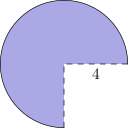
A three-quarter sector of a circle of radius inches together with its interior can be rolled up to form the lateral surface of a right circular cone by taping together along the two radii shown. What is the volume of the cone in cubic inches?
Small hint:
The sector arc becomes the circumference of the cone base
Big hint:
The sector radius becomes the slant height of the cone
Solution:
The sector’s arc becomes the base circumference, so if the base radius is then giving The sector radius becomes the cone’s slant height, so the cone’s height is
Hence the volume is Thus, C is the correct answer.
10.
In unit square the inscribed circle intersects at and intersects at a point different from What is
Small hint:
Place so the circle has center and
Big hint:
Substitute the line into the circle’s equation; the two roots give and
Solution:
Let The inscribed circle has center and radius touching at
Line is Substituting into gives with roots (point ) and (point ).
So and
Thus, the correct answer is B.
11.
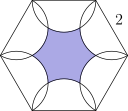
As shown in the figure below, six semicircles lie in the interior of a regular hexagon with side length so that the diameters of the semicircles coincide with the sides of the hexagon. What is the area of the shaded region—inside the hexagon but outside all of the semicircles?
Small hint:
Use the symmetry of the regular hexagon to split the shaded region into six equal pieces
Big hint:
Each piece is two equilateral triangles minus a sector of radius
Solution:
By symmetry, the shaded region is made of six congruent pieces. One such piece is the union of two equilateral triangles with side length minus a sector of a circle of radius
The two equilateral triangles have total area The sector has area Thus one shaded piece has area and the total shaded area is
Thus, D is the correct answer.
12.
Let be a diameter in a circle of radius Let be a chord in the circle that intersects at a point such that and What is
Small hint:
Put the center at the origin with on the -axis and parametrize the chord from at
Big hint:
If are the signed distances from to then
Solution:
Place the center at the origin with on the -axis; the radius is so Then with (its exact value is not needed).
Parametrize the chord as Substituting into gives whose roots are the signed distances to and
By Vieta, and so
Thus, the correct answer is E.
13.
Which of the following is the value of
Small hint:
Write and
Big hint:
Compare with using
Solution:
Let so Then
Meanwhile which equals the expression above.
Taking square roots,
Thus, the correct answer is D.
14.
Bela and Jenn play the following game on the closed interval of the real number line, where is a fixed integer greater than They take turns playing, with Bela going first. At his first turn, Bela chooses any real number in the interval Thereafter, the player whose turn it is chooses a real number that is more than one unit away from all numbers previously chosen by either player. A player unable to choose such a number loses. Using optimal strategy, which player will win the game?
Bela will always win.
Jenn will always win.
Bela will win if and only if is odd.
Jenn will win if and only if is odd.
Jenn will win if and only if
Small hint:
Consider what happens if Bela plays exactly at the midpoint of the interval first
Big hint:
After claiming the center, Bela can mirror each of Jenn’s moves through the midpoint
Solution:
Bela first plays the midpoint This choice makes the configuration symmetric about the center of the interval.
Thereafter, whenever Jenn picks a number Bela responds with its mirror image Since Bela has already chosen Jenn’s legal move satisfies Therefore so Bela’s response is far enough from Jenn’s new point. Symmetry shows that it is also far enough from every earlier point. Thus Bela always has a move whenever Jenn does, so Jenn is the first to be stuck. Bela always wins.
Thus, the correct answer is A.
15.
There are people standing equally spaced around a circle. Each person knows exactly of the other people: the people standing next to her or him, as well as the person directly across the circle. How many ways are there for the people to split up into pairs so that the members of each pair know each other?
Small hint:
Classify pairings by how many opposite pairs are used
Big hint:
Once the opposite pairs are chosen, the remaining people must be matched along arcs of the circle
Solution:
Label the people around the circle. Count by the number of pairs of opposite people.
With no opposite pairs, everyone must be paired with a neighbor around the -cycle. There are exactly alternating neighbor matchings.
With one opposite pair, choose that pair in ways. The remaining people form two paths of four vertices, and each path has only one perfect matching by neighbor pairs, so this gives matchings.
With two or four opposite pairs, the remaining neighbor-pairing paths have odd length somewhere, so no perfect matching is possible.
With three opposite pairs, the two opposite pairs not chosen must be adjacent around the five opposite-pair positions; otherwise the remaining people cannot be matched by neighbor pairs. There are adjacent choices for the two unchosen opposite pairs, so there are matchings.
With all five opposite pairs, there is matching. The total is
Thus, the correct answer is C .
16.
An urn contains one red ball and one blue ball. A box of extra red and blue balls lies nearby. George performs the following operation four times: he draws a ball from the urn at random and then takes a ball of the same color from the box and returns those two matching balls to the urn. After the four iterations the urn contains six balls. What is the probability that the urn contains three balls of each color?
Small hint:
The final urn has three of each color exactly when the four draws contain two red and two blue
Big hint:
Each fixed color order with two red draws and two blue draws has the same probability
Solution:
The urn ends with three red and three blue balls exactly when the four draws contain two red draws and two blue draws. There are possible color orders of this type.
For any fixed order with two red draws and two blue draws, the probability is because the first and second draws of each color have numerators and while the total number of balls before the four draws is
Thus the desired probability is
Thus, the correct answer is B .
17.
How many polynomials of the form where and are real numbers, have the property that whenever is a root, so is (Note that )
Small hint:
is a primitive cube root of unity, so nonzero roots come in triples
Big hint:
With five roots the distinct roots form one triple with multiplicities summing to real coefficients force conjugate symmetry
Solution:
Here is a primitive cube root of unity. Since is not a root, the set of distinct roots is closed under multiplication by so it consists of triples equally spaced in argument. Five roots cannot fill two such triples, so there is exactly one triple, with multiplicities summing to
Real coefficients require the root multiset to be closed under conjugation. This is possible only when the triple’s arguments are symmetric about the real axis, which happens for the two configurations and
The product of the roots must equal In the first configuration the real root is positive, forcing a positive product, which is impossible. In the second, the real root is negative and the product is setting works, and the two conjugate-symmetric multiplicity patterns and each give a valid polynomial. Hence there are
Thus, the correct answer is C.
18.
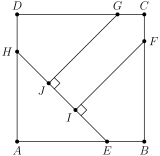
In square points and lie on and respectively, so that Points and lie on and respectively, and points and lie on so that and See the figure below. Triangle quadrilateral quadrilateral and pentagon each has area What is
Small hint:
The four given regions fill the square, so the square’s side length is known
Big hint:
Extend the perpendicular through to meet and compare the two resulting right isosceles triangles
Solution:
The four named regions fill the square and each has area so the square has area and side length Since triangle is right isosceles with area we have
Extend to meet at and set and Because has slope line has slope so If were on segment then region would lie inside triangle whose area would be at most a contradiction. Thus lies to the left of and
Triangle is right isosceles with area Triangle is right isosceles with hypotenuse so its area is Since their difference is region Therefore
Also, and so It follows that
Thus, the correct answer is B .
19.
Square in the coordinate plane has vertices at the points and Consider the following four transformations:
• a rotation of counterclockwise around the origin;
• a rotation of clockwise around the origin;
• a reflection across the -axis; and
• a reflection across the -axis.
Each of these transformations maps the square onto itself, but the positions of the labeled vertices will change. For example, applying and then would send the vertex at to and would send the vertex at to itself. How many sequences of transformations chosen from will send all of the labeled vertices back to their original positions? (For example, is one sequence of transformations that will send the vertices back to their original positions.)
Small hint:
After an odd number of allowed moves, a vertex always lies on the opposite parity of square corners
Big hint:
For any first transformations, exactly one final transformation returns the square to its original labeling
Solution:
Each of moves every vertex to an adjacent corner of the square. Therefore after an odd number of transformations the labeling is in one of the four odd-parity states, and after an even number it is in one of the four even-parity states.
After any first transformations, the square is in an odd-parity state. From each odd-parity state, exactly one of sends the labeled vertices back to their original positions. Thus every sequence of the first transformations has exactly one valid final transformation.
There are choices for the first transformations, so there are valid sequences.
Thus, C is the correct answer.
20.
Two different cubes of the same size are to be painted, with the color of each face being chosen independently and at random to be either black or white. What is the probability that after they are painted, the cubes can be rotated to be identical in appearance?
Small hint:
The probability equals , where the sum is over rotation-equivalence classes of colorings
Big hint:
Group colorings by number of black faces and find each class’s orbit size (e.g. two black faces: opposite gives size adjacent gives size )
Solution:
For a fixed first cube, the number of second cubes matching it (up to rotation) equals the size of its rotation orbit. So the desired probability is
Grouping by black-face count, the orbit sizes are: or black or black or black (opposite) and (adjacent); black (corner) and (band). Then
The probability is
Thus, the correct answer is D.
21.
How many positive integers satisfy
(Recall that is the greatest integer not exceeding )
Small hint:
Let so must satisfy
Big hint:
This gives and count integer
Solution:
The right side is an integer, so let Then and requires
The lower bound gives i.e. The upper bound gives i.e. or
Intersecting, giving values of
Thus, the correct answer is C.
22.
What is the maximum value of
for real values of
Small hint:
Let then
Big hint:
The expression becomes a downward parabola in
Solution:
Split the fraction: Let so and the expression is
This parabola has maximum at with value Since is continuous and attains the value the maximum is achieved.
Thus, the correct answer is C.
23.
How many integers are there such that whenever are complex numbers such that and then the numbers are equally spaced on the unit circle in the complex plane?
Small hint:
Check small cases: forces antipodal points and forces an equilateral triangle
Big hint:
For build a counterexample by combining a smaller balanced configuration with an antipodal pair
Solution:
For forces which is equally spaced. For three unit vectors summing to zero must form an equilateral triangle, so they are equally spaced.
For every even choose antipodal pairs at generic angles that do not form a regular -gon. For every odd choose the vertices of an equilateral triangle together with generic antipodal pairs. Each construction has sum but is not equally spaced.
Hence only and work, giving values.
Thus, the correct answer is B.
24.
Let denote the number of ways of writing the positive integer as a product where the are integers strictly greater than and the order in which the factors are listed matters (that is, two representations that differ only in the order of the factors are counted as distinct). For example, the number can be written as and so What is
Small hint:
Write
Big hint:
For a product with factors, choose which factor contains the single and distribute the five factors of
Solution:
Write Suppose an ordered factorization has factors. Exactly one factor contains the single prime factor ; choose its position in ways.
The other factors must each contain at least one factor of while the factor containing may contain any number of factors of Distributing the five factors of under these conditions can be done in ways. Therefore the number of ordered factorizations with factors is where
Thus Letting this becomes
Thus, A is the correct answer.
25.
For each real number with let numbers and be chosen independently at random from the intervals and respectively, and let be the probability that What is the maximum value of
Small hint:
The condition is which holds inside the square whose vertices are the midpoints of the unit square’s sides
Big hint:
is the area of that region with divided by maximize it with AM-GM
Solution:
Since the condition is Here and with both angles in where sine increases. So the condition is the point lies inside the tilted square with vertices and which has area
The point is uniform on a rectangle of area so is the area of the part of the tilted square with divided by For that part is a triangle of area so For it is the tilted square minus a triangle with base and height so
By AM-GM, with equality at which lies in So the maximum is which beats
Thus, the correct answer is B.