
2019 AMC 12A Solutions
Scroll down to view professionally curated solutions from LIVE by Po-Shen Loh, print PDF solutions, view answer key, or take the full timed exam.
All problems are used with official legal permission of the Mathematical Association of America (MAA).
1.
The area of a pizza with radius inches is percent larger than the area of a pizza with radius inches. What is the integer closest to
Small Hint:
The areas are in the ratio
Big Hint:
The percent increase is
Solution:
The areas are proportional to the squares of the radii, so the ratio of the larger area to the smaller is
The percent increase is The closest integer is
Thus, the correct answer is E.
2.
Suppose is of What percent of is
Small Hint:
Write
Big Hint:
Compute and convert to a percentage
Solution:
Since we have
As a percentage, is of
Thus, the correct answer is D.
3.
A box contains red balls, green balls, yellow balls, blue balls, white balls, and black balls. What is the minimum number of balls that must be drawn from the box without replacement to guarantee that at least balls of a single color will be drawn?
Small Hint:
Consider the worst case: draw as many as possible without ever reaching of one color
Big Hint:
Take of each color that has at least and all balls of the smaller colors
Solution:
In the worst case, we draw each of red, green, and yellow, plus all of the blue white and black without reaching of any color.
That is balls.
The next ball must complete a set of so balls are needed.
Thus, the correct answer is B.
4.
What is the greatest number of consecutive integers whose sum is
Small Hint:
The integers are allowed to be negative
Big Hint:
Adding contributes so extend the run just past
Solution:
Negative integers are allowed. The integers from to sum to so the integers from to sum to
This run has integers. Conversely, if consecutive integers have sum then twice their sum is times an integer, so is a multiple of Hence proving that this run is longest.
Thus, the correct answer is D.
5.
Two lines with slopes and intersect at What is the area of the triangle enclosed by these two lines and the line
Small Hint:
Find where each line meets
Big Hint:
The three vertices are and use the shoelace formula
Solution:
The two lines are and Intersecting each with gives the points and
The triangle has vertices and By the shoelace formula,
Thus, the correct answer is C.
6.
The figure below shows line with a regular, infinite, recurring pattern of squares and line segments.
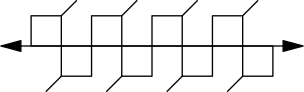
How many of the following four kinds of rigid motion transformations of the plane in which this figure is drawn, other than the identity transformation, will transform this figure into itself?
• some rotation around a point of line
• some translation in the direction parallel to line
• the reflection across line
• some reflection across a line perpendicular to line
Small Hint:
A translation by one period clearly works
Big Hint:
Test a rotation about a point on and check that neither reflection maps the diagonal segments correctly
Solution:
A translation by one full period maps the figure to itself, so translation works.
A rotation about a suitable point on sends each square above the line to the square below it, with the diagonal segments matching, so this rotation works.
Reflection across sends the top-right diagonals to top-right diagonals below the line, but the actual below-line diagonals point to the bottom-left, so it fails. A reflection across a perpendicular line fails for the same reason. Only of the four transformations work.
Thus, the correct answer is C.
7.
Melanie computes the mean the median and the modes of the values that are the dates in the months of Thus her data consist of s, s, s, s, s, and s. Let be the median of the modes. Which of the following statements is true?
Small Hint:
The modes are through each appearing times, so is their median
Big Hint:
The median is the rd value; compute directly from the totals
Solution:
The values through each appear times and are the modes, so
The rd of the ordered values is the median. Values through fill the first positions, so position is thus
The total of all values is so
Therefore
Thus, the correct answer is E.
8.
For a set of four distinct lines in a plane, there are exactly distinct points that lie on two or more of the lines. What is the sum of all possible values of
Small Hint:
The maximum is when the lines are in general position
Big Hint:
Enumerate configurations using parallel classes and concurrences; check which counts from to are achievable
Solution:
The values and occur when all four lines are parallel or all four are concurrent. Three parallel lines crossed by a fourth give points. Three concurrent lines together with a fourth line not through their common point give One parallel pair with no three concurrent gives and four lines in general position give
The value is impossible. Once two lines meet at a third line not through creates at least one new intersection; a fourth distinct line must then create another new point. If every remaining line passes through there is only one intersection point instead. Thus the achievable values are whose sum is
Thus, the correct answer is D.
9.
A sequence of numbers is defined recursively by and
for all Then can be written as where and are relatively prime positive integers. What is
Small Hint:
Take reciprocals of both sides
Big Hint:
Setting gives an arithmetic sequence
Solution:
Taking reciprocals,
Let Then so is arithmetic with and common difference
Thus so Since these are relatively prime,
Thus, the correct answer is E.
10.
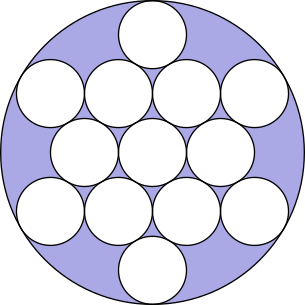
The figure below shows circles of radius within a larger circle. All the intersections occur at points of tangency. What is the area of the region, shaded in the figure, inside the larger circle but outside all the circles of radius
Small Hint:
A central circle is ringed by six circles, then six more sit in the outer notches
Big Hint:
The outermost centers are at distance from the center, so the big radius is
Solution:
Place a unit circle at the center, six around it with centers at distance (a hexagon), and six more with centers at distance in the outer gaps. That is circles.
The outermost circles are tangent to the big circle, whose radius is therefore Its area is
Subtracting the unit circles leaves
Thus, the correct answer is A.
11.
For some positive integer the repeating base- representation of the (base-ten) fraction is What is
Small Hint:
A two-digit repeating block in base equals
Big Hint:
Set and clear denominators
Solution:
The repeating block gives
Cross-multiplying, so
The quadratic formula gives
Thus, the correct answer is D.
12.
Positive real numbers and satisfy and What is
Small Hint:
Let and then
Big Hint:
You get and note
Solution:
Let and Then so giving
Since we have
Therefore
Thus, the correct answer is B.
13.
How many ways are there to paint each of the integers either red, green, or blue so that each number has a different color from each of its proper divisors?
Small Hint:
Numbers and are unconstrained; handle the chain and the constraints on
Big Hint:
The color of must avoid both and so count depends on whether and share a color
Solution:
The primes and have no proper divisors here, giving choices each.
Along the chain there are colorings. Number must differ from giving choices once is set.
Number must differ from both and Summing over the colors of and (equal in pairs, unequal in pairs), the combined factor for totals
Multiplying by the ways for and gives
Thus, the correct answer is E.
14.
For a certain complex number the polynomial
has exactly distinct roots. What is
Small Hint:
The first and third factors give roots and
Big Hint:
For only distinct roots, must reuse two of these; its roots multiply to
Solution:
The factors and have roots and which are distinct values.
For to have exactly distinct roots, the roots of must lie among these. Their product must equal and the only such pair is one root from each factor, for example
Then so
Thus, the correct answer is E.
15.
Positive real numbers and have the property that
and all four terms on the left are positive integers, where denotes the base logarithm. What is
Small Hint:
Let and then must be an integer
Big Hint:
With the equation becomes
Solution:
Let and so and For this to be an integer, is even; likewise
Writing the equation becomes
The only solution is giving
Therefore
Thus, the correct answer is D.
16.
The numbers are randomly placed into the squares of a grid. Each square gets one number, and each of the numbers is used once. What is the probability that the sum of the numbers in each row and each column is odd?
Small Hint:
There are odd and even numbers; each row and column needs an odd count of odd numbers
Big Hint:
The odd entries must fill one entire row and one entire column, forming a plus shape of cells
Solution:
There are odd and even numbers. Each row and column must contain an odd number of odd entries.
The only way to place odd entries with every row and column odd is to fill one complete row and one complete column (a plus shape of cells). There are such patterns.
Each pattern admits placements of the odd numbers and of the even numbers, so the probability is
Thus, the correct answer is B.
17.
Let denote the sum of the th powers of the roots of the polynomial In particular, and Let and be real numbers such that for What is
Small Hint:
Each root satisfies
Big Hint:
Multiply by and sum over the roots to read off
Solution:
Every root satisfies so
Summing over the three roots gives so
Therefore
Thus, the correct answer is D.
18.
A sphere with center has radius A triangle with sides of length and is situated in space so that each of its sides is tangent to the sphere. What is the distance between and the plane determined by the triangle?
Small Hint:
The sphere meets the plane in a circle tangent to all three sides, so that circle is the incircle
Big Hint:
If is the distance, the cross-circle has radius which equals the inradius
Solution:
The sphere intersects the triangle’s plane in a circle of radius where is the distance from to the plane. Since each side is tangent to the sphere, this circle is the triangle’s incircle.
The triangle has area and semiperimeter so its inradius is
Thus giving and
Thus, the correct answer is D.
19.
In with integer side lengths,
What is the least possible perimeter for
Small Hint:
Find from the given cosines
Big Hint:
By the Law of Sines the sides are proportional to
Solution:
Each sine is
By the Law of Sines the sides are in ratio The smallest integer sides are which satisfy the triangle inequality.
The least perimeter is
Thus, the correct answer is A.
20.
Real numbers between and inclusive, are chosen in the following manner. A fair coin is flipped. If it lands heads, then it is flipped again and the chosen number is if the second flip is heads and if the second flip is tails. On the other hand, if the first coin flip is tails, then the number is chosen uniformly at random from the closed interval Two random numbers and are chosen independently in this manner. What is the probability that
Small Hint:
Each number is with probability with probability and uniform on with probability
Big Hint:
Split into the nine type-combinations; for two uniforms,
Solution:
Each variable equals with probability equals with probability and is uniform on with probability
Considering the nine combinations of types: the pairs and each contribute Each of the four point-versus-uniform cases contributes The uniform-versus-uniform case contributes
The total is
Thus, the correct answer is B.
21.
Let What is
Small Hint:
so depends only on
Big Hint:
Over the exponent is six times, three times, and three times
Solution:
Since we have depending only on
For to the residue is (giving ) six times, (giving ) three times, and (giving ) three times. So the first sum is
The second sum is likewise Their product is
Thus, the correct answer is C.
22.
Circles and both centered at have radii and respectively. Equilateral triangle whose interior lies in the interior of but in the exterior of has vertex on and the line containing side is tangent to Segments and intersect at and Then can be written in the form for positive integers with What is
Small Hint:
Let Since we have and
Big Hint:
Place at the origin with horizontal; lies on line at distance from and from
Solution:
Let Since we have and Put at the origin with on the -axis, and apex
Points are collinear, so for some scalar Two conditions pin it down: is at distance from line giving and is on giving since
Solving, and The valid configuration has and on opposite sides of so Therefore
Then
Thus, the correct answer is E.
23.
Define binary operations and by
and
for all real numbers and for which these expressions are defined. The sequence is defined recursively by and for all integers To the nearest integer, what is
Small Hint:
Apply then
Big Hint:
Writing the recurrence becomes
Solution:
Let Then and
So and The product telescopes:
Hence which rounds to
Thus, the correct answer is D.
24.
For how many integers between and inclusive, is an integer? (Recall that )
Small Hint:
Compare the exponent of a prime in numerator and denominator using
Big Hint:
Failure requires to be a prime power with
Solution:
Fix a prime By Legendre’s formula, the difference between the exponent of in the numerator and its exponent in the denominator is If is the remainder of modulo the th summand is
Let The first summands are If is not a power of write with When the next summand is at least and all later summands are nonnegative; when every summand is already nonnegative. Thus unless is a power of
For Legendre’s formula reduces the requirement to Among prime powers at most this fails exactly when (so is prime) and when There are primes at most plus giving failures. Hence values of work.
Thus, the correct answer is D.
25.
Let be a triangle whose angle measures are exactly and For each positive integer define to be the foot of the altitude from to line Likewise, define to be the foot of the altitude from to line and to be the foot of the altitude from to line What is the least positive integer for which is obtuse?
Small Hint:
For an acute triangle, the orthic triangle has angles
Big Hint:
Track the deviation from each step multiplies it by and the triangle turns obtuse when a deviation exceeds
Solution:
For an acute triangle, the orthic triangle (feet of the altitudes) has angles for each original angle
Writing an angle as the new angle is so each deviation from is multiplied by The initial deviations are
After steps a deviation has magnitude degrees. The triangle first becomes obtuse when this exceeds i.e. Since and the least such is
Thus, the correct answer is E.