
2017 AMC 12A Problems
Scroll down and press Start to try the exam! Or, go to the printable PDF, answer key, or professional solutions curated by LIVE by Po-Shen Loh.
All problems are used with official legal permission of the Mathematical Association of America (MAA).
Or jump straight to a single problem with its solution: 1 · 2 · 3 · 4 · 5 · 6 · 7 · 8 · 9 · 10 · 11 · 12 · 13 · 14 · 15 · 16 · 17 · 18 · 19 · 20 · 21 · 22 · 23 · 24 · 25
Want to learn professionally through interactive video classes?
Timed
1:15:00
1.
Pablo buys popsicles for his friends. The store sells single popsicles for each, -popsicle boxes for and -popsicle boxes for What is the greatest number of popsicles that Pablo can buy with
Answer: D
Small Hint:
The best value is the -popsicle box, at for
Big Hint:
Spend on two -boxes, then use the remaining on a -box
Solution:
The cheapest popsicles come from the -popsicle box, at each. Even at that rate, popsicles would cost more than
So Pablo can buy at most and he achieves this with two -boxes for and one -box for giving popsicles.
Thus, the correct answer is D.
2.
The sum of two nonzero real numbers is times their product. What is the sum of the reciprocals of the two numbers?
Answer: C
Small Hint:
The sum of reciprocals is
Big Hint:
Divide the equation by
Solution:
Let the numbers be and so
Dividing both sides by gives and the left side is exactly So the sum of the reciprocals is
Thus, the correct answer is C.
3.
Ms. Carroll promised that anyone who got all the multiple choice questions right on the upcoming exam would receive an A on the exam. Which one of these statements necessarily follows logically?
If Lewis did not receive an A, then he got all of the multiple choice questions wrong.
If Lewis did not receive an A, then he got at least one of the multiple choice questions wrong.
If Lewis got at least one of the multiple choice questions wrong, then he did not receive an A.
If Lewis received an A, then he got all of the multiple choice questions right.
If Lewis received an A, then he got at least one of the multiple choice questions right.
Answer: B
Small Hint:
An implication is logically equivalent to its contrapositive, not to its converse or inverse
Big Hint:
Negating “got all right” gives “got at least one wrong”
Solution:
The promise is “all right A.” An implication is equivalent only to its contrapositive: “not A not all right.”
“Not all right” means at least one question was wrong, which is exactly statement B. The converse and inverse do not follow, and getting “all wrong” is a much stronger claim than the negation.
Thus, the correct answer is B.
4.
Jerry and Silvia wanted to go from the southwest corner of a square field to the northeast corner. Jerry walked due east and then due north to reach the goal, but Silvia headed northeast and reached the goal walking in a straight line. Which of the following is closest to how much shorter Silvia’s trip was, compared to Jerry’s trip?
Answer: A
Small Hint:
Let the side be ; Jerry walks and Silvia walks the diagonal
Big Hint:
The diagonal is so the fraction saved is
Solution:
If the square has side Jerry walks while Silvia walks the diagonal
The fraction by which Silvia’s trip is shorter is
This is closest to
Thus, the correct answer is A.
5.
At a gathering of people, there are people who all know each other and people who know no one. People who know each other hug, and people who do not know each other shake hands. How many handshakes occur?
Answer: B
Small Hint:
The acquaintances only shake hands with the strangers
Big Hint:
Add up each person’s handshakes and divide by
Solution:
Each of the people who know each other shakes hands with only the strangers. Each of the strangers shakes hands with all other people.
Summing handshake counts and dividing by (each handshake involves two people) gives
Thus, the correct answer is B.
6.
Joy has thin rods, one each of every integer length from cm through cm. She places the rods with lengths cm, cm, and cm on a table. She then wants to choose a fourth rod that she can put with these three to form a quadrilateral with positive area. How many of the remaining rods can she choose as the fourth rod?
Answer: B
Small Hint:
Four lengths form a quadrilateral exactly when the longest is less than the sum of the other three
Big Hint:
This gives ; then remove the rods already on the table
Solution:
Four lengths form a quadrilateral with positive area if and only if the longest is strictly less than the sum of the other three. With a fourth rod of length this requires and so
The integers from to give values, but the rods of length and are already on the table, leaving choices.
Thus, the correct answer is B.
7.
Define a function on the positive integers recursively by if is even, and if is odd and greater than What is
Answer: B
Small Hint:
Compute and look for a pattern
Big Hint:
Check that satisfies both recursive rules
Solution:
Listing values: suggesting
Both rules are consistent with for even and for odd Since the recursion determines uniquely,
Thus, the correct answer is B.
8.
The region consisting of all points in three-dimensional space within units of line segment has volume What is the length
Small Hint:
The region is a cylinder of radius with a hemisphere capping each end
Big Hint:
The two hemispheres combine into a full sphere:
Solution:
Let The region is a cylinder of radius and height with a hemisphere of radius on each end.
The cylinder has volume and the two hemispheres together form a sphere of volume So giving
Thus, the correct answer is D.
9.
Let be the set of points in the coordinate plane such that two of the three quantities and are equal and the third of the three quantities is no greater than this common value. Which of the following is a correct description of
a single point
two intersecting lines
three lines whose pairwise intersections are three distinct points
a triangle
three rays with a common endpoint
Answer: E
Small Hint:
Set two of the three quantities equal and require the third to be at most that common value
Big Hint:
Each of the three pairings produces a ray, and all three start at the same point
Solution:
Consider which two of are the (equal) larger pair.
If then and a downward ray from If then and a leftward ray from If then and a ray from going up and to the right.
All three rays share the endpoint so is three rays with a common endpoint.
Thus, the correct answer is E.
10.
Chloé chooses a real number uniformly at random from the interval Independently, Laurent chooses a real number uniformly at random from the interval What is the probability that Laurent’s number is greater than Chloé’s number?
Answer: C
Small Hint:
Split on whether Laurent’s number is above or below
Big Hint:
If it is above he always wins; if below, it is a symmetric coin flip
Solution:
With probability Laurent’s number lies in which exceeds any number Chloé could choose, so he wins for certain.
With the other probability Laurent’s number lies in matching Chloé’s interval; by symmetry he is larger half the time. The total probability is
Thus, the correct answer is C.
11.
Claire adds the degree measures of the interior angles of a convex polygon and arrives at a sum of She then discovers that she forgot to include one angle. What is the degree measure of the forgotten angle?
Answer: D
Small Hint:
The true angle sum is a multiple of just above
Big Hint:
The forgotten angle is that multiple minus and it must be less than
Solution:
If the polygon has sides and the forgotten angle is then Since
The only multiple of in this range is so and
Thus, the correct answer is D.
12.
There are horses, named Horse Horse Horse They get their names from how many minutes it takes them to run one lap around a circular race track: Horse runs one lap in exactly minutes. At time all the horses are together at the starting point on the track. The horses start running in the same direction, and they keep running around the circular track at their constant speeds. The least time in minutes, at which all horses will again simultaneously be at the starting point is Let be the least time, in minutes, such that at least of the horses are again at the starting point. What is the sum of the digits of
Answer: B
Small Hint:
Horse is back at the start at time exactly when divides
Big Hint:
Find the smallest having at least divisors among through
Solution:
Horse is at the starting point at time precisely when is a multiple of So we want the smallest with at least divisors among
The positive integers below have at most divisors, while is divisible by and Thus and the sum of its digits is
Thus, the correct answer is B.
13.
Driving at a constant speed, Sharon usually takes minutes to drive from her house to her mother’s house. One day Sharon begins the drive at her usual speed, but after driving of the way, she hits a bad snowstorm and reduces her speed by miles per hour. This time the trip takes her a total of minutes. How many miles is the drive from Sharon’s house to her mother’s house?
Answer: B
Small Hint:
Her usual drive is hours, so the distance equals times her usual speed
Big Hint:
The final two-thirds takes minutes at the reduced speed
Solution:
Let the distance be miles and the usual speed mph. Since the usual trip is hours,
The first of the drive takes minutes at speed so the remaining takes minutes hours at speed
That final portion covers miles, so Solving gives so and
Thus, the correct answer is B.
14.
Alice refuses to sit next to either Bob or Carla. Derek refuses to sit next to Eric. How many ways are there for the five of them to sit in a row of chairs under these conditions?
Answer: C
Small Hint:
Start from all seatings and subtract the forbidden adjacencies
Big Hint:
Treat each forbidden pair as a block (with internal orders) and apply inclusion-exclusion
Solution:
Let be the seatings where Alice-Bob, Alice-Carla, and Derek-Eric are adjacent, respectively. The answer is
Treating a forbidden pair as a block gives For intersections, (Alice between Bob and Carla), and
By inclusion-exclusion, so the answer is
Thus, the correct answer is C.
15.
Let using radian measure for the variable In what interval does the smallest positive value of for which lie?
Answer: D
Small Hint:
For all three terms are positive, so there is no root there
Big Hint:
Just past the term makes negative; locate the first sign change after
Solution:
For all three terms are positive, so For set and Since Thus no root occurs before
At At so By the intermediate value theorem the smallest positive root lies in
Since and this interval sits inside
Thus, the correct answer is D.
16.
In the figure below, semicircles with centers at and and with radii and respectively, are drawn in the interior of, and sharing bases with, a semicircle with diameter The two smaller semicircles are externally tangent to each other and internally tangent to the largest semicircle. A circle centered at is drawn externally tangent to the two smaller semicircles and internally tangent to the largest semicircle. What is the radius of the circle centered at
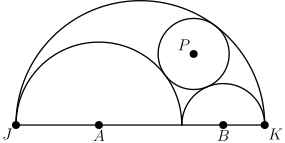
Answer: B
Small Hint:
Let be the center of the large semicircle; then
Big Hint:
Drop a perpendicular from to and set the three expressions for its squared height equal
Solution:
The large semicircle has radius and center the midpoint of Placing at the origin, along the base. Let be the radius of the circle at
By tangency, and Dropping a perpendicular from to the base at horizontal position with height the Pythagorean theorem gives
Equating the first expression with the middle one gives while equating the last expression with the middle one gives Adding yields so
Thus, the correct answer is B.
17.
There are different complex numbers such that For how many of these is a real number?
Answer: D
Small Hint:
Write for
Big Hint:
Then which is real exactly when is even
Solution:
The solutions are the th roots of unity, for
Then which is real exactly when i.e. when is even. There are even values of in the range.
Thus, the correct answer is D.
18.
Let equal the sum of the digits of positive integer For example, For a particular positive integer Which of the following could be the value of
Answer: D
Small Hint:
If ends in exactly nines, adding drops the digit sum by and adds
Big Hint:
So check which choice has this form
Solution:
Adding to increases the digit sum by except that each trailing turns into a losing If ends in exactly nines, then
So the possible values are Among the choices, only fits (for example, ending in four s preceded by enough s).
Thus, the correct answer is D.
19.
A square with side length is inscribed in a right triangle with sides of length and so that one vertex of the square coincides with the right-angle vertex of the triangle. A square with side length is inscribed in another right triangle with sides of length and so that one side of the square lies on the hypotenuse of the triangle. What is
Answer: D
Small Hint:
A square with its corner at the right angle has side
Big Hint:
A square with a side on a base of length and height to that base has side use the hypotenuse as the base
Solution:
For the first square, the two smaller triangles it cuts off are similar to the whole triangle, giving so (Equivalently, a square in the right angle has side )
For the second square, take the hypotenuse of length as base; the altitude to it is A square with a side on a base and height has side so
Therefore
Thus, the correct answer is D.
20.
How many ordered pairs such that is a positive real number and is an integer between and inclusive, satisfy the equation
Answer: E
Small Hint:
Let the equation becomes
Big Hint:
Either or count the values for each of the allowed bases
Solution:
Let Since the equation is so or
If then valid for every one of the bases. If then giving values of for each base, i.e. pairs.
In total there are ordered pairs.
Thus, the correct answer is E.
21.
A set is constructed as follows. To begin, Repeatedly, as long as possible, if is an integer root of some polynomial for some all of whose coefficients are elements of then is put into When no more elements can be added to how many elements does have?
Answer: D
Small Hint:
By the Rational Root Theorem, any integer root of a polynomial with coefficients in divides its constant term
Big Hint:
Starting from reach show nothing else can enter
Solution:
Using the root enters Then enters as a root of and enters from
Now has root and gives then and give At this point
No further integer can appear. Inductively, every nonzero member of divides If a polynomial used in the rule has constant term factor out the largest possible power of any nonzero root is then a root of a polynomial whose constant term is the first nonzero original coefficient. The Rational Root Theorem shows that the root divides this coefficient, which by the inductive hypothesis divides So has elements.
Thus, the correct answer is D.
22.
A square is drawn in the Cartesian coordinate plane with vertices at and A particle starts at Every second it moves with equal probability to one of the eight lattice points (points with integer coordinates) closest to its current position, independently of its previous moves. In other words, the probability is that the particle will move from to each of or The particle will eventually hit the square for the first time, either at one of the corners of the square or at one of the lattice points in the interior of one of the sides of the square. The probability that it will hit at a corner rather than at an interior point of a side is where and are relatively prime positive integers. What is
Answer: E
Small Hint:
By symmetry, track only three interior states: the center, the four edge-midpoint neighbors, and the four diagonal neighbors
Big Hint:
Write hitting-probability equations for each state and solve the linear system for the center’s value
Solution:
By symmetry, group the relevant interior points into three types: the “axis” points and the “diagonal” points Let be the probabilities of eventually hitting a corner starting from a point of type
Reading off the transition probabilities (a point in goes to with prob to with to with and to a side interior with etc.) gives
Solving yields The required probability is so
Thus, the correct answer is E.
23.
For certain real numbers and the polynomial has three distinct roots, and each root of is also a root of the polynomial What is
Answer: C
Small Hint:
Since the three roots of are roots of we have for one extra root
Big Hint:
Match the coefficients to find then
Solution:
Since has three distinct roots all shared by the quartic we can write for some remaining root Expanding,
Matching the coefficient, so Matching the coefficient, so
Then and so
Thus, the correct answer is C.
24.
Quadrilateral is inscribed in circle and has sides and Let and be points on such that and Let be the intersection of line and the line through parallel to Let be the intersection of line and the line through parallel to Let be the point on circle other than that lies on line What is
Answer: A
Small Hint:
The parallels give and
Big Hint:
Combine those ratios with Power of a Point to get find via Law of Cosines
Solution:
Because and we get and giving and Hence so
Power of a Point at gives and combining yields With and so
Since is cyclic, and are supplementary. The Law of Cosines on and gives so Therefore
Thus, the correct answer is A.
25.
The vertices of a centrally symmetric hexagon in the complex plane are given by For each an element is chosen from at random, independently of the other choices. Let be the product of the numbers selected. What is the probability that
Answer: E
Small Hint:
The two elements have magnitude the other four have magnitude
Big Hint:
For you need exactly of the large-magnitude factors and of the small ones, then get the phase right
Solution:
Let (each of magnitude ) and be the other four elements (each of magnitude ). Since forces and exactly factors must come from and from
A product of elements of equals (real), and a product of elements of equals one of Their product is one of each equally likely, so exactly of these configurations give
The chance of landing in the -from-, -from- pattern is Multiplying by gives
Thus, the correct answer is E.