
2016 AMC 12B Solutions
Scroll down to view professionally curated solutions from LIVE by Po-Shen Loh, print PDF solutions, view answer key, or take the full timed exam.
All problems are used with official legal permission of the Mathematical Association of America (MAA).
1.
What is the value of
when
Small Hint:
so when
Big Hint:
The numerator is then divide by
Solution:
With we have The numerator is and dividing by gives
Thus, the correct answer is D.
2.
The harmonic mean of two numbers can be computed as twice their product divided by their sum. The harmonic mean of and is closest to which integer?
Small Hint:
Twice the product over the sum:
Big Hint:
is just a hair under a whole number; round it
Solution:
The harmonic mean is Since is very close to this is just under so the closest integer is
Thus, the correct answer is A.
3.
Let What is the value of
Small Hint:
and the innermost part is
Big Hint:
Simplify outward: then then the outer absolute value, and finally
Solution:
Since The innermost expression is Then and the outer absolute value leaves Finally subtracting gives
Thus, the correct answer is D.
4.
The ratio of the measures of two acute angles is and the complement of one of these two angles is twice as large as the complement of the other. What is the sum of the degree measures of the two angles?
Small Hint:
Let the angles be with
Big Hint:
The complements are and set
Solution:
Let the angles be with The larger complement belongs to the smaller angle, so This gives so and The sum is
Thus, the correct answer is C.
5.
The War of started with a declaration of war on Thursday, June The peace treaty to end the war was signed days later, on December On what day of the week was the treaty signed?
Friday
Saturday
Sunday
Monday
Tuesday
Small Hint:
Days of the week repeat every days, so reduce modulo
Big Hint:
so count days forward from Thursday
Solution:
Because the treaty was signed full weeks plus days after Thursday. Two days beyond Thursday is Saturday.
Thus, the correct answer is B.
6.
All three vertices of lie on the parabola defined by with at the origin and parallel to the -axis. The area of the triangle is What is the length of
Small Hint:
Let a top vertex be by symmetry the other is
Big Hint:
The base is and the height is so
Solution:
Let the vertex in the first quadrant be By symmetry the base is and the height is so Thus and
Thus, the correct answer is C.
7.
Josh writes the numbers He marks out skips the next number marks out and continues skipping and marking out the next number to the end of his list. Then he goes back to the start of his list, marks out the first remaining number skips the next number marks out skips marks out and so on to the end. Josh continues in this manner until only one number remains. What is that number?
Small Hint:
After the first pass only the multiples of remain; after the next, only the multiples of
Big Hint:
Each pass keeps the multiples of the next power of find the highest power of that is at most
Solution:
The first pass removes the odd numbers, leaving the multiples of The second pass removes leaving the multiples of In general, after the th pass only the multiples of remain. The surviving number is the highest power of not exceeding which is
Thus, the correct answer is D.
8.
A thin piece of wood of uniform density in the shape of an equilateral triangle with side length inches weighs ounces. A second piece of the same type of wood, with the same thickness, also in the shape of an equilateral triangle, has side length inches. Which of the following is closest to the weight, in ounces, of the second piece?
Small Hint:
The weight is proportional to the area, which scales with the square of the side length
Big Hint:
Multiply by
Solution:
Weight is proportional to area, and area scales with the square of the side length. The second side is times the first, so its weight is ounces.
Thus, the correct answer is D.
9.
Carl decided to fence in his rectangular garden. He bought fence posts, placed one on each of the four corners, and spaced out the rest evenly along the edges of the garden, leaving exactly yards between neighboring posts. The longer side of his garden, including the corners, has twice as many posts as the shorter side, including the corners. What is the area, in square yards, of Carl’s garden?
Small Hint:
Let the shorter side have posts and the longer side posts; the four corner posts are shared
Big Hint:
Total posts a side with posts spans yards
Solution:
Let the shorter side have posts, so the longer side has Counting all posts and subtracting the four corners counted twice, giving The shorter side has posts, or yards, and the longer side has posts, or yards. The area is
Thus, the correct answer is B.
10.
A quadrilateral has vertices and where and are integers with The area of is What is
Small Hint:
Check the slopes: and have slope while and have slope so is a rectangle
Big Hint:
Its sides are and so the area is
Solution:
The sides and have slope and and have slope so is a rectangle with sides and Its area is so The only perfect squares differing by are and giving and
Thus, the correct answer is A.
11.
How many squares whose sides are parallel to the axes and whose vertices have coordinates that are integers lie entirely within the region bounded by the line the line and the line
Small Hint:
The region sits below note and
Big Hint:
In each vertical strip count the and squares that fit below the line, then add them up
Solution:
A square whose left edge is must fit below the lowest point of over its width, namely For side length the possible left edges contribute squares. For side length the left edges contribute and for side length the left edges contribute A square of side at least cannot fit, so the total is
Thus, the correct answer is D.
12.
All the numbers are written in a array of squares, one number in each square, in such a way that if two numbers are consecutive then they occupy squares that share an edge. The numbers in the four corners add up to What number is in the center?
Small Hint:
Color the grid like a checkerboard; consecutive numbers must lie on opposite colors, so they alternate
Big Hint:
The five same-colored cells (four corners plus center) must hold the five odd numbers, which sum to
Solution:
Color the grid like a checkerboard so the four corners and the center share one color. Since consecutive numbers occupy adjacent (opposite colored) squares, the numbers alternate parity along the chain, so the five same-colored cells contain the five odd numbers which sum to The four corners add to so the center is
Thus, the correct answer is C.
13.
Alice and Bob live miles apart. One day Alice looks due north from her house and sees an airplane. At the same time Bob looks due west from his house and sees the same airplane. The angle of elevation of the airplane is from Alice’s position and from Bob’s position. Which of the following is closest to the airplane’s altitude, in miles?
Small Hint:
Let the plane be above point on the ground at height Triangles and are -- right triangles
Big Hint:
and then
Solution:
Let the airplane be at directly above point on the ground at altitude Triangles and are -- right triangles, so and Since Alice looks north and Bob looks west, so Then giving closest to
Thus, the correct answer is E.
14.
The sum of an infinite geometric series is a positive number and the second term in the series is What is the smallest possible value of
Small Hint:
With ratio and second term the first term is so
Big Hint:
is smallest when is largest; maximize the downward parabola
Solution:
Let be the common ratio. Since the second term is the first term is so Convergence requires and then forces Therefore is smallest when is largest. The parabola peaks at where it equals so the smallest value of is
Thus, the correct answer is E.
15.
All the numbers are assigned to the six faces of a cube, one number to each face. For each of the eight vertices of the cube, a product of three numbers is computed, where the three numbers are the numbers assigned to the three faces that include that vertex. What is the greatest possible value of the sum of these eight products?
Small Hint:
Group the three pairs of opposite faces as
Big Hint:
The sum of the eight vertex products factors as with a fixed total, a product is largest when the factors are equal
Solution:
Pair the opposite faces as Each vertex product uses one face from each pair, so the sum of all eight products factors as The three factors have fixed total and a product with fixed sum is largest when the factors are equal, at each. This balance is achievable with giving
Thus, the correct answer is D.
16.
In how many ways can be written as the sum of an increasing sequence of two or more consecutive positive integers?
Small Hint:
A run of consecutive integers equals times its median, and
Big Hint:
For odd the median is an integer factor; for even the median is a half-integer. Count both while keeping all terms positive
Solution:
A sum of consecutive integers equals the count times the median. For an odd number of terms, the median is an integer divisor of giving runs of (median ), (median ), (median ), and (median ) terms. For an even number of terms the median is a half-integer. The positive possibilities have lengths with respective medians Longer divisor-based runs would force a nonpositive first term. This gives ways.
Thus, the correct answer is E.
17.
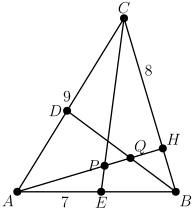
In shown in the figure, and is an altitude. Points and lie on sides and respectively, so that and are angle bisectors, intersecting at and respectively. What is
Small Hint:
Let Then which gives and
Big Hint:
By the angle bisector theorem, and then
Solution:
Let Then and from the two right triangles This gives and By the angle bisector theorem in so Similarly in so Then
Thus, the correct answer is D.
18.
What is the area of the region enclosed by the graph of the equation
Small Hint:
The graph is symmetric about both axes; in the first quadrant the equation is
Big Hint:
Complete the square to in that quadrant the region is a right triangle plus a semicircle
Solution:
By symmetry, consider the first quadrant, where the equation is or This is a circle centered at passing through and since the center is the midpoint of that chord, the enclosed first-quadrant region is the right triangle with legs to and (area ) plus a semicircle of radius (area ). Multiplying by for all quadrants gives
Thus, the correct answer is B.
19.
Tom, Dick, and Harry are playing a game. Starting at the same time, each of them flips a fair coin repeatedly until he gets his first head, at which point he stops. What is the probability that all three flip their coins the same number of times?
Small Hint:
A single player gets his first head on flip with probability
Big Hint:
All three stop on flip with probability sum this geometric series over
Solution:
A player’s first head comes on flip with probability All three stopping on the same flip has probability Summing over
Thus, the correct answer is B.
20.
A set of teams held a round-robin tournament in which every team played every other team exactly once. Every team won games and lost games; there were no ties. How many sets of three teams were there in which beat beat and beat
Small Hint:
Each team plays others, so there are teams and triples in all
Big Hint:
A non-cyclic triple has exactly one team that beats the other two; count those and subtract from the total
Solution:
Since each team won and lost there are teams and triples. A triple is not cyclic exactly when one team beats both others. Choosing that team ( ways) and of the teams it beat gives non-cyclic triples. Thus the cyclic triples number
Thus, the correct answer is A.
21.
Let be a unit square. Let be the midpoint of For let be the intersection of and and let be the foot of the perpendicular from to What is
Small Hint:
Similar triangles give the recursion and leads to
Big Hint:
The area of is the sum telescopes
Solution:
Place and let Intersecting line with (the line ) gives with both coordinates so From this yields The base of is and its height is the -coordinate of which is Then Summing telescopes to
Thus, the correct answer is B.
22.
For a certain positive integer less than the decimal equivalent of is a repeating decimal of period and the decimal equivalent of is a repeating decimal of period In which interval does lie?
Small Hint:
Period means is divisible by period means is divisible by
Big Hint:
must divide but not forcing test each to see whether is divisible by
Solution:
Period requires to be divisible by Period requires to be divisible by while is not divisible by (else the period would be or ). Hence is a multiple of Since also divides and is less than the only possibilities are giving Only divides so
Finally, while and so its period is exactly Also divides but not so the period of is exactly Thus lies in
Thus, the correct answer is B.
23.
What is the volume of the region in three-dimensional space defined by the inequalities and
Small Hint:
The set is a regular octahedron with diagonals of length and volume
Big Hint:
The second inequality is that octahedron translated up by their overlap is a similar octahedron with half the linear size
Solution:
The region is a regular octahedron with vertices at whose volume is The second region is the same octahedron shifted up by Their intersection is bounded by another regular octahedron with diagonals of length half the linear dimensions of the first, so its volume is
Thus, the correct answer is A.
24.
There are exactly ordered quadruples such that and What is the smallest possible value of
Small Hint:
Divide everything by With you need reduced quadruples of gcd and lcm analyzed one prime at a time
Big Hint:
For a prime with maximum exponent the count of exponent quadruples is Use the factorization of to determine how many primes divide and which values of can occur
Solution:
Writing each entry as times a reduced value, we need and For each prime dividing with maximum exponent the number of valid exponent quadruples is The total over all primes must equal Since equals and for and the exponents give one candidate factorization.
Every prime contributes exactly one factor of so exactly three primes divide Their odd factors must divide Checking the divisors gives with odd factors The choice leaves only for the product of the other two odd factors, but each is at least so this is impossible. Therefore the maximum exponents are exactly To minimize assign the largest exponent to the smallest prime: so
Thus, the correct answer is D.
25.
The sequence is defined recursively by and for What is the smallest positive integer such that the product is an integer?
Small Hint:
Write Then and
Big Hint:
The product is an integer exactly when is divisible by solve and use the order of modulo
Solution:
Write The recursion becomes solved by The product is an integer exactly when is divisible by Summing the formula for gives when is odd, and when is even.
The order of modulo is because and For odd divisibility therefore requires to be divisible by first occurring at For even it requires to be divisible by first occurring at Hence the smallest positive is
Thus, the correct answer is A.