
2016 AMC 12A Problems
Scroll down and press Start to try the exam! Or, go to the printable PDF, answer key, or professional solutions curated by LIVE by Po-Shen Loh.
All problems are used with official legal permission of the Mathematical Association of America (MAA).
Or jump straight to a single problem with its solution: 1 · 2 · 3 · 4 · 5 · 6 · 7 · 8 · 9 · 10 · 11 · 12 · 13 · 14 · 15 · 16 · 17 · 18 · 19 · 20 · 21 · 22 · 23 · 24 · 25
Want to learn professionally through interactive video classes?
Timed
1:15:00
1.
2.
For what value of does
Answer: C
Small Hint:
Write every base as a power of
Big Hint:
The left side becomes and the right side
Solution:
Since and the equation becomes so Then giving
Thus, the correct answer is C.
3.
The remainder function can be defined for all real numbers and with by where denotes the greatest integer less than or equal to What is the value of
Answer: B
Small Hint:
Compute first
Big Hint:
Solution:
First, and
Therefore
Thus, the correct answer is B.
4.
The mean, median, and mode of the data values are all equal to What is the value of
Answer: D
Small Hint:
Set the mean equal to
Big Hint:
then confirm the median and mode
Solution:
The mean condition gives so and
In nondecreasing order the data are so the median is and the mode is as required.
Thus, the correct answer is D.
5.
Goldbach’s conjecture states that every even integer greater than can be written as the sum of two prime numbers (for example, ). So far, no one has been able to prove that the conjecture is true, and no one has found a counterexample to show that the conjecture is false. What would a counterexample consist of?
an odd integer greater than that can be written as the sum of two prime numbers
an odd integer greater than that cannot be written as the sum of two prime numbers
an even integer greater than that can be written as the sum of two numbers that are not prime
an even integer greater than that can be written as the sum of two prime numbers
an even integer greater than that cannot be written as the sum of two prime numbers
Answer: E
Small Hint:
A counterexample keeps the hypothesis but breaks the conclusion
Big Hint:
The hypothesis is “even integer greater than ”; the conclusion is “a sum of two primes”
Solution:
A counterexample must satisfy the hypothesis of being an even integer greater than while failing the conclusion that it can be written as the sum of two prime numbers.
Thus, the correct answer is E.
6.
A triangular array of coins has coin in the first row, coins in the second row, coins in the third row, and so on up to coins in the th row. What is the sum of the digits of
Answer: D
Small Hint:
Big Hint:
Solve by noting
Solution:
The total number of coins is so Since we have and the sum of its digits is
Thus, the correct answer is D.
7.
Which of these describes the graph of
two parallel lines
two intersecting lines
three lines that all pass through a common point
three lines that do not all pass through a common point
a line and a parabola
Answer: D
Small Hint:
Move everything to one side and factor out
Big Hint:
is the union of three lines
Solution:
Moving all terms to one side gives which factors as The graph is therefore the union of the lines and
The first two lines intersect at the origin, but the third line is parallel to and does not pass through the origin. So the graph consists of three lines that do not all pass through a common point.
Thus, the correct answer is D.
8.
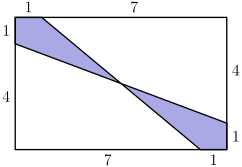
What is the area of the shaded region of the given rectangle?
Answer: D
Small Hint:
Every drawn segment passes through the center of the rectangle
Big Hint:
The main diagonal splits the shaded region into four triangles, each with base
Solution:
The diagonal of the rectangle from the upper-left corner to the lower-right corner divides the shaded region into four triangles, all meeting at the center of the rectangle.
Two of these triangles have a horizontal base of length and altitude and the other two have a vertical base of length and altitude The total area is
Thus, the correct answer is D.
9.
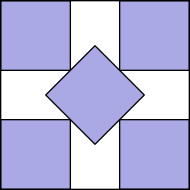
The five small shaded squares inside this unit square are congruent and have disjoint interiors. The midpoint of each side of the middle square coincides with one of the vertices of the other four small squares as shown. The common side length is where and are positive integers. What is
Answer: E
Small Hint:
Draw the diagonal of the unit square, which has length
Big Hint:
That diagonal equals two small-square diagonals plus one small-square side:
Solution:
Let be the common side length. The diagonal of the unit square has length and consists of two small-square diagonals (each ) plus one small-square side length so
Solving, Thus and
Thus, the correct answer is E.
10.
Five friends sat in a movie theater in a row containing seats, numbered to from left to right. (The directions “left” and “right” are from the point of view of the people as they sit in the seats.) During the movie Ada went to the lobby to get some popcorn. When she returned, she found that Bea had moved two seats to the right, Ceci had moved one seat to the left, and Dee and Edie had switched seats, leaving an end seat for Ada. In which seat had Ada been sitting before she got up?
Answer: B
Small Hint:
The total rightward movement must equal the total leftward movement
Big Hint:
Bea moves Ceci moves and Dee and Edie cancel; find Ada’s shift
Solution:
The net displacement of all five friends is zero. Dee and Edie swapped seats, so their movements cancel. Bea moved and Ceci moved a net of so Ada must move to balance.
Ada returns to an end seat; since she moved one seat to the left, that seat must be seat so she had been sitting in seat
Thus, the correct answer is B.
11.
Each of the students in a certain summer camp can either sing, dance, or act. Some students have more than one talent, but no student has all three talents. There are students who cannot sing, students who cannot dance, and students who cannot act. How many students have two of these talents?
Answer: E
Small Hint:
Count how many students can do each activity
Big Hint:
Adding the three counts tallies two-talent students twice; subtract
Solution:
The numbers who can sing, dance, and act are and respectively, for a total of
Since no student has all three talents, each student has one or two talents, so single-talent students are counted once and two-talent students are counted twice. The number counted twice is
Thus, the correct answer is E.
12.
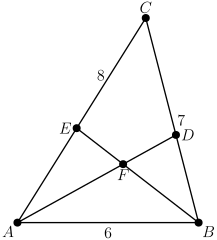
In and Point lies on and bisects Point lies on and bisects The bisectors intersect at What is the ratio
Answer: C
Small Hint:
Apply the Angle Bisector Theorem in to find
Big Hint:
In segment bisects so
Solution:
Applying the Angle Bisector Theorem to gives so
Now lies along the bisector of in so by the Angle Bisector Theorem again,
Thus, the correct answer is C.
13.
Let be a positive multiple of One red ball and green balls are arranged in a line in random order. Let be the probability that at least of the green balls are on the same side of the red ball. Observe that and that approaches as grows large. What is the sum of the digits of the least value of such that
Answer: A
Small Hint:
Write the red ball has equally likely positions
Big Hint:
solve
Solution:
Write Number the positions of the red ball from one end; there are equally likely positions.
Fewer than of the green balls lie on each side exactly when the red ball is in one of the positions which is positions. Hence
Solving gives so and meaning Thus and whose digit sum is
Thus, the correct answer is A.
14.
Each vertex of a cube is to be labeled with an integer from through with each integer being used once, in such a way that the sum of the four numbers on the vertices of a face is the same for each face. Arrangements that can be obtained from each other through rotations of the cube are considered to be the same. How many different arrangements are possible?
Answer: C
Small Hint:
Each vertex lies on faces, so the six face-sums total
Big Hint:
The face-sum is show and must be on adjacent vertices
Solution:
Each vertex belongs to faces, so giving each face-sum
The four-element subsets containing with sum are and Only one omits so at least two of the three distinct faces through contain Two vertices of a cube lie on two common faces exactly when they are adjacent; hence and are adjacent.
Rotate the cube so that is at the lower-left-front vertex and at the lower-right-front vertex. The unique face through that does not contain must use and these can be placed in orders. Each order forces at the three opposite vertices, and the remaining face sums are then Hence there are arrangements.
Thus, the correct answer is C.
15.
Circles with centers and having radii and respectively, lie on the same side of line and are tangent to at and respectively, with between and The circle with center is externally tangent to each of the other two circles. What is the area of
Answer: D
Small Hint:
The horizontal distance between two tangent points is
Big Hint:
Place at heights and use the shoelace formula
Solution:
The centers lie at heights and above line Since circle is externally tangent to circle we have so the horizontal distance is Since circle is tangent to circle we have so
Place and By the shoelace formula, the area is
Thus, the correct answer is D.
16.
The graphs of and are plotted on the same set of axes. How many points in the plane with positive -coordinates lie on two or more of the graphs?
Answer: D
Small Hint:
Let and rewrite all four as
Big Hint:
Find every where two of these four expressions are equal
Solution:
Let Then and Two graphs meet where two of are equal for some valid
Setting gives so or setting gives the same values. Setting gives i.e. where and are both The remaining pairings have no real solution.
The distinct intersection points are and so there are
Thus, the correct answer is D.
17.
Let be a square. Let and be the centers, respectively, of equilateral triangles with bases and each exterior to the square. What is the ratio of the area of square to the area of square
Answer: B
Small Hint:
The center of an equilateral triangle lies of its height from the base
Big Hint:
Compare diagonals of the two squares; the area ratio is the square of the length ratio
Solution:
Let square have side length Each equilateral triangle has height and its center lies of that height, namely from the square’s side.
Square has diagonal Square has diagonal equal to the side of plus twice namely The area ratio is the square of the ratio of diagonals:
Thus, the correct answer is B.
18.
For some positive integer the number has positive integer divisors, including and the number How many positive integer divisors does the number have?
Answer: D
Small Hint:
so has exactly three prime factors
Big Hint:
The exponents plus one multiply to deduce
Solution:
The number is divisible by the three distinct primes If its prime exponents are then where Because there are already at least three factors greater than there are exactly three, so no other prime divides
Each exponent in is so each divisor-count factor is The factors all have that form, so the exponents are in some order. After subtracting the exponent from and dividing by the exponents in are in some order. Thus for two distinct primes chosen from
Consequently has exponents and while introduces a third prime because is not divisible by Hence the number of divisors of is
Thus, the correct answer is D.
19.
Jerry starts at on the real number line. He tosses a fair coin times. When he gets heads, he moves unit in the positive direction; when he gets tails, he moves unit in the negative direction. The probability that he reaches at some time during this process is where and are relatively prime positive integers. What is (For example, he succeeds if his sequence of tosses is HTHHHHHH.)
Answer: B
Small Hint:
Count the toss sequences in which the running total reaches
Big Hint:
With at most tails he always reaches with or tails only some orders work
Solution:
Count the sequences of tosses whose running total reaches With at most tails he certainly reaches contributing sequences.
With exactly tails, he can first reach on toss or toss Reaching it on toss requires four initial heads, after which the remaining head has possible positions. Otherwise, tosses and are heads, one of the first four tosses is a tail, and the last two are tails, again giving possibilities. Thus this case contributes With exactly tails, only HHHHTTTT works, giving He cannot reach with fewer than heads.
So there are favorable sequences out of a probability of Then
Thus, the correct answer is B.
20.
A binary operation has the properties that and that for all nonzero real numbers and (Here the dot represents the usual multiplication operation.) The solution to the equation can be written as where and are relatively prime positive integers. What is
Answer: A
Small Hint:
Use to simplify
Big Hint:
Show so
Solution:
Setting gives Then setting gives so
Therefore so and
Thus, the correct answer is A.
21.
A quadrilateral is inscribed in a circle of radius Three of the sides of this quadrilateral have length What is the length of its fourth side?
Answer: E
Small Hint:
Each side of length subtends a central angle with
Big Hint:
The fourth chord has the same length as one subtending use
Solution:
Let be the central angle subtending a side of length with radius By the law of cosines on the isosceles triangle from the center, so
The three equal sides use three consecutive arcs of angle so the fourth arc has angle Its chord has the same length as a chord with central angle and Its length squared is so the fourth side is
Thus, the correct answer is E.
22.
How many ordered triples of positive integers satisfy and
Answer: A
Small Hint:
Factor:
Big Hint:
Handle each prime separately, using of the exponents
Solution:
Because and the factor divides while neither nor is divisible by Also divides while neither nor is divisible by and must have the factor
Writing and the lcm conditions require and The first pair can be and the second can be Thus there are ordered triples.
Thus, the correct answer is A.
23.
Three numbers in the interval are chosen independently and at random. What is the probability that the chosen numbers are the side lengths of a triangle with positive area?
Answer: C
Small Hint:
The triples fill a unit cube; failure means one number the sum of the other two
Big Hint:
Each region such as is a tetrahedron of volume
Solution:
The ordered triples fill the unit cube of volume They fail to form a triangle exactly when one value is at least the sum of the other two.
The region is a tetrahedron with vertices of volume The analogous regions and also have volume and have disjoint interiors. So the failure probability is and the triangle probability is
Thus, the correct answer is C.
24.
There is a smallest positive real number such that there exists a positive real number such that all the roots of the polynomial are real. In fact, for this value of the value of is unique. What is this value of
Answer: B
Small Hint:
If the roots are then and
Big Hint:
Apply AM-GM to the minimum forces
Solution:
By Vieta’s formulas, the real roots satisfy and so
The positive product means either all three roots are positive or two are negative. In the latter case write the roots as with The positive sum forces and then a contradiction. Hence all three roots are positive.
By the AM-GM inequality, so with equality if and only if At this smallest
Thus, the correct answer is B.
25.
Let be a positive integer. Bernardo and Silvia take turns writing and erasing numbers on a blackboard as follows: Bernardo starts by writing the smallest perfect square with digits. Every time Bernardo writes a number, Silvia erases the last digits of it. Bernardo then writes the next perfect square, Silvia erases the last digits of it, and this process continues until the last two numbers that remain on the board differ by at least Let be the smallest positive integer not written on the board. For example, if then the numbers that Bernardo writes are and and the numbers showing on the board after Silvia erases are and and thus What is the sum of the digits of
Answer: E
Small Hint:
For even the numbers shown are for
Big Hint:
Show then add over
Solution:
Take The smallest perfect square with digits is and after Silvia erases, the numbers shown are for
Put A jump of at least from to requires so write with The case gives a jump of only so the first larger jump has Let and Because is divisible by
Therefore the first jump of at least occurs at the first for which Since this is The last displayed value before the gap is so the smallest missing integer is
Summing over There are no carries, so the digit sum is
Thus, the correct answer is E.