
2015 AMC 12A Solutions
Scroll down to view professionally curated solutions from LIVE by Po-Shen Loh, print PDF solutions, view answer key, or take the full timed exam.
All problems are used with official legal permission of the Mathematical Association of America (MAA).
1.
What is the value of
Small Hint:
Evaluate inside the parentheses first, using
Big Hint:
A exponent means take the reciprocal before multiplying by
Solution:
Inside the parentheses,
Then
Thus, the correct answer is C.
2.
Two of the three sides of a triangle are and Which of the following numbers is not a possible perimeter of the triangle?
Small Hint:
The third side lies strictly between and
Big Hint:
Add to that range to bound the perimeter
Solution:
By the Triangle Inequality, the third side satisfies that is
The perimeter is so it lies strictly between and Among the choices, only falls outside this range.
Thus, the correct answer is E.
3.
Mr. Patrick teaches math to students. He was grading tests and found that when he graded everyone’s test except Payton’s, the average grade for the class was After he graded Payton’s test, the class average became What was Payton’s score on the test?
Small Hint:
The other students together scored
Big Hint:
All scores together total ; subtract
Solution:
The sum of the other scores was The sum of all scores was
Therefore Payton’s score was
Thus, the correct answer is E.
4.
The sum of two positive numbers is times their difference. What is the ratio of the larger number to the smaller number?
Small Hint:
Let the numbers be and write
Big Hint:
Rearrange to relate and , then form
Solution:
Let and be the numbers with Then
Expanding gives so and
Thus, the correct answer is B.
5.
Amelia needs to estimate the quantity where and are large positive integers. She rounds each of the integers so that the calculation will be easier to do mentally. In which of these situations will her answer necessarily be greater than the exact value of
She rounds all three numbers up.
She rounds and up, and she rounds down.
She rounds and up, and she rounds down.
She rounds up, and she rounds and down.
She rounds up, and she rounds and down.
Small Hint:
Increasing or decreasing makes larger
Big Hint:
Decreasing makes larger; find the choice where every change raises the result
Solution:
To make larger, round the numerator up and the denominator down. To make larger, round down.
Only choice does all three: it rounds up while rounding and down, so every change pushes the estimate above the exact value. In the other choices at least one change works the wrong way, so the estimate is not guaranteed to be larger.
Thus, the correct answer is D.
6.
Two years ago Pete was three times as old as his cousin Claire. Two years before that, Pete was four times as old as Claire. In how many years will the ratio of their ages be
Small Hint:
Let be their current ages: and
Big Hint:
Solve for and then find with
Solution:
Let and be Pete’s and Claire’s current ages. Then and
Solving these gives and so Pete is years older than Claire.
The ratio is when Claire is which is years from now.
Thus, the correct answer is B.
7.
Two right circular cylinders have the same volume. The radius of the second cylinder is more than the radius of the first. What is the relationship between the heights of the two cylinders?
The second height is less than the first.
The first height is more than the second.
The second height is less than the first.
The first height is more than the second.
The second height is of the first.
Small Hint:
Equal volumes give with
Big Hint:
Divide by to compare and note
Solution:
Let and be the radii and heights of the first and second cylinders. The volumes are equal, so and
Then Dividing by yields so the first height is more than the second.
Thus, the correct answer is D.
8.
The ratio of the length to the width of a rectangle is If the rectangle has diagonal of length then the area may be expressed as for some constant What is
Small Hint:
Let the sides be and so the diagonal is
Big Hint:
Write the area in terms of
Solution:
Let the sides of the rectangle be and By the Pythagorean Theorem the diagonal is so
The area is so
Thus, the correct answer is C.
9.
A box contains red marbles, green marbles, and yellow marbles. Carol takes marbles from the box at random; then Claudia takes of the remaining marbles at random; and then Cheryl takes the last marbles. What is the probability that Cheryl gets marbles of the same color?
Small Hint:
Because all draws are random, Cheryl’s marbles are just a random pair of the six
Big Hint:
Fix her first marble; her second is equally likely to be any of the other
Solution:
Because the marbles left for Cheryl are determined at random, her two marbles are equally likely to be any pair. Fixing her first marble, the second is equally likely to be any of the remaining marbles.
Exactly one of those matches the first marble in color, so the probability is
Thus, the correct answer is C.
10.
Integers and with satisfy What is
Small Hint:
Add to both sides so the left side factors
Big Hint:
use with
Solution:
Adding to both sides and factoring gives
Because and are distinct positive integers with the only possibility is and Therefore
Thus, the correct answer is E.
11.
On a sheet of paper, Isabella draws a circle of radius a circle of radius and all possible lines simultaneously tangent to both circles. Isabella notices that she has drawn exactly lines. How many different values of are possible?
Small Hint:
The number of common tangents depends on how the two circles are positioned
Big Hint:
Move the circles from one inside the other out to fully separated and count at each stage
Solution:
The number of common tangent lines depends on the relative position of the two circles:
If the smaller circle is inside the larger, there are tangents. If it is internally tangent, there is If the circles intersect at two points, there are If they are externally tangent, there are If they are separated, there are
Thus can be any of which gives possible values.
Thus, the correct answer is D.
12.
The parabolas and intersect the coordinate axes in exactly four points, and these four points are the vertices of a kite of area What is
Small Hint:
The two -intercepts are and the -intercepts are symmetric about the -axis
Big Hint:
The kite’s diagonals are the vertical distance and the horizontal spread of the -intercepts
Solution:
The -intercepts of the two parabolas are and To intersect the -axis, the first parabola opens upward and the second opens downward, so their -intercepts are for some
The kite has one diagonal of length along the -axis and the other of length Its area is so
Thus the -intercepts are For the first parabola, gives for the second, gives Therefore
Thus, the correct answer is B.
13.
A league with teams holds a round-robin tournament, with each team playing every other team exactly once. Games either end with one team victorious or else end in a draw. A team scores points for every game it wins and point for every game it draws. Which of the following is not a true statement about the list of scores?
There must be an even number of odd scores.
There must be an even number of even scores.
There cannot be two scores of
The sum of the scores must be at least
The highest score must be at least
Small Hint:
Every game contributes exactly points in total, so the sum of all scores is fixed
Big Hint:
Consider what happens if every single game ends in a draw
Solution:
Each of the teams plays games, so games are played, and each game adds points to the list. The total of all scores is
If every game is a draw, each team scores so the highest score need not reach thus statement can fail. The other statements always hold: the sum the sum being even forces an even number of odd scores and hence an even number of even scores, and two teams cannot both score because their mutual game gives at least one of them a point.
Thus, the correct answer is E.
14.
What is the value of for which
Small Hint:
Big Hint:
The sum becomes
Solution:
By the change-of-base formula, Therefore
It follows that
Thus, the correct answer is D.
15.
What is the minimum number of digits to the right of the decimal point needed to express the fraction as a decimal?
Small Hint:
The numerator shares no factor of or with the denominator
Big Hint:
Multiply the top and bottom to turn the denominator into a power of
Solution:
The numerator and denominator share no common factors. To write the fraction as a decimal, rewrite it with a power of in the denominator; the smallest that works is
Since the numerator is not divisible by the decimal has exactly places after the point.
Thus, the correct answer is C.
16.
Tetrahedron has and What is the volume of the tetrahedron?
Small Hint:
Triangles and are both -- right triangles sharing the edge
Big Hint:
Drop altitudes from and to their common foot shows is perpendicular to base
Solution:
Triangles and are -- right triangles with area and common hypotenuse Let be the foot of the altitude from to then Likewise the altitude from meets at the same point with
Triangle has sides and so it is an isosceles right triangle with the right angle at Thus and making perpendicular to the plane of
The tetrahedron’s volume is
Thus, the correct answer is C.
17.
Eight people are sitting around a circular table, each holding a fair coin. All eight people flip their coins and those who flip heads stand while those who flip tails remain seated. What is the probability that no two adjacent people will stand?
Small Hint:
There are equally likely outcomes; count those with no two adjacent heads
Big Hint:
Group by the number of people standing more than forces an adjacency
Solution:
There are equally likely outcomes. Count the arrangements of standers (heads) with no two adjacent around the circle of seats, grouped by how many people stand.
The number of ways to choose non-adjacent seats from a circle of is For this gives for and more than standers is impossible without an adjacency.
The total is so the probability is
Thus, the correct answer is A.
18.
The zeros of the function are integers. What is the sum of the possible values of
Small Hint:
If the integer roots are then and
Big Hint:
Eliminate to get i.e.
Solution:
Let the integer zeros be and By Vieta’s formulas and so Rearranging gives
The integer factor pairs of are which yield pairs summing to and
The distinct possible values of are whose sum is
Thus, the correct answer is C.
19.
For some positive integers there is a quadrilateral with positive integer side lengths, perimeter right angles at and and How many different values of are possible?
Small Hint:
Drop a perpendicular from to with right angles at that creates a rectangle
Big Hint:
If and then which forces to be even
Solution:
In every such quadrilateral Let be the foot of the perpendicular from to then and Let and so
By the Pythagorean Theorem so and is even. Writing gives and the perimeter is
Increasing values give the required quadrilaterals with increasing perimeter. For the perimeter is and for it is Therefore there are possible values of
Thus, the correct answer is B.
20.
Isosceles triangles and are not congruent but have the same area and the same perimeter. The sides of have lengths and while those of have lengths and Which of the following numbers is closest to
Small Hint:
has perimeter and area write those same two conditions for
Big Hint:
Eliminate using you reach a cubic with the extraneous root to factor out
Solution:
The altitude of to its base of length is so has area and perimeter
For we need and area Substituting and squaring leads to
Since and are not congruent, so and Because this is between and so the closest integer is
Thus, the correct answer is A.
21.
A circle of radius passes through both foci of, and exactly four points on, the ellipse with equation The set of all possible values of is an interval What is
Small Hint:
The ellipse is with foci at
Big Hint:
A circle through both foci is centered at require its bottom point to lie outside the ellipse
Solution:
The ellipse has semi-axes and so and the foci are
A circle through both foci has its center on the -axis, say with radius Its top point always lies outside the ellipse. For four intersection points, its bottom point must be below which happens exactly when
As ranges over the radius ranges over so
Thus, the correct answer is D.
22.
For each positive integer let be the number of sequences of length consisting solely of the letters and with no more than three s in a row and no more than three s in a row. What is the remainder when is divided by
Small Hint:
A valid sequence ends in a run of or equal letters, giving
Big Hint:
Reduce the recurrence modulo and modulo separately to find its period
Solution:
Note Every valid sequence ends in a run of one, two, or three equal letters; removing that run leaves a valid sequence of length or Thus
Modulo the first terms are The next three terms are which reproduce the initial state, so the recurrence repeats with period Since it follows that
Modulo the terms repeat as because the next three-term state after these four terms is again Thus the period is As we have
Writing the condition gives so
Thus, the correct answer is D.
23.
Let be a square of side length Two points are chosen independently at random on the sides of The probability that the straight-line distance between the points is at least is where and are positive integers and What is
Small Hint:
Condition on whether the two points lie on the same side, opposite sides, or adjacent sides
Big Hint:
The adjacent-sides case produces the term via a quarter-circle of radius
Solution:
The second point is on the same side as the first with probability on the opposite side with probability and on an adjacent side with probability
Opposite sides: the distance is at least always, probability
Same side: for points and the condition has probability
Adjacent sides: for points and the condition is the region outside a quarter-circle of radius with probability
The total probability is Thus
Thus, the correct answer is A.
24.
Rational numbers and are chosen at random among all rational numbers in the interval that can be written as fractions where and are integers with What is the probability that is a real number?
Small Hint:
There are allowed values for each of and is real iff or
Big Hint:
Translate those into or
Solution:
There are possible values for each of and In reduced form, denominators contribute respectively values in for a total of
Writing and the fourth power is real if and only if or
The case means giving pairs; the case means giving another pairs, of which were already counted.
For the remaining condition with neither side zero, the allowed values of are and The corresponding numbers of allowed values of are respectively For example, when the values are and the other rows follow from the same quarter-turn identities. Hence this condition contributes more pairs.
In all there are valid pairs out of so the probability is
Thus, the correct answer is D.
25.
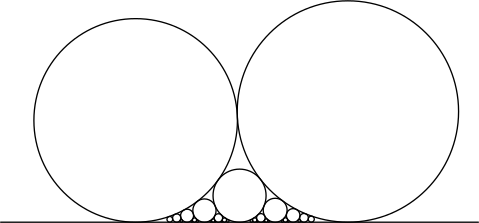
A collection of circles in the upper half-plane, all tangent to the -axis, is constructed in layers as follows. Layer consists of two circles of radii and that are externally tangent. For the circles in are ordered according to their points of tangency with the -axis. For every pair of consecutive circles in this order, a new circle is constructed externally tangent to each of the two circles in the pair. Layer consists of the circles constructed in this way. Let and for every circle denote by its radius. What is
Small Hint:
For a circle nestled between two circles tangent to the same line,
Big Hint:
Let the layer sums are
Solution:
If a circle of radius is tangent to the -axis and nestled in the crevice between two circles of radii and that are also tangent to the axis and to each other, then
Let which is the sum over The single circle of also contributes For each new circle contributes the sum of its two neighbors, and every earlier circle is counted twice except the two circles of this yields a sum of over
Therefore
Since the sum is
Thus, the correct answer is D.