
2014 AMC 12B Problems
Scroll down and press Start to try the exam! Or, go to the printable PDF, answer key, or professional solutions curated by LIVE by Po-Shen Loh.
All problems are used with official legal permission of the Mathematical Association of America (MAA).
Or jump straight to a single problem with its solution: 1 · 2 · 3 · 4 · 5 · 6 · 7 · 8 · 9 · 10 · 11 · 12 · 13 · 14 · 15 · 16 · 17 · 18 · 19 · 20 · 21 · 22 · 23 · 24 · 25
Want to learn professionally through interactive video classes?
Timed
1:15:00
1.
Leah has coins, all of which are pennies and nickels. If she had one more nickel than she has now, then she would have the same number of pennies and nickels. In cents, how much are Leah’s coins worth?
Answer: C
Small Hint:
Let be the number of nickels, so there are pennies
Big Hint:
Adding one nickel gives nickels, which must equal the pennies
Solution:
Let be the number of nickels, so Leah has pennies. One more nickel would give her nickels, and this equals the number of pennies: Solving gives so there are nickels and pennies.
The total value is cents.
Thus, the correct answer is C.
2.
Orvin went to the store with just enough money to buy balloons. When he arrived he discovered that the store had a special sale on balloons: buy balloon at the regular price and get a second at off the regular price. What is the greatest number of balloons Orvin could buy?
Answer: C
Small Hint:
Group the balloons into pairs, one at full price and one at of the price
Big Hint:
Each pair costs of a regular balloon’s price
Solution:
Under the sale, a pair of balloons costs times the regular price of one balloon.
Orvin’s money buys balloons at the regular price, so he can afford pairs, which is balloons.
Thus, the correct answer is C.
3.
Randy drove the first third of his trip on a gravel road, the next miles on pavement, and the remaining one-fifth on a dirt road. In miles, how long was Randy’s trip?
Answer: E
Small Hint:
The paved stretch is the fraction of the trip not on gravel or dirt
Big Hint:
That paved fraction equals miles
Solution:
The fraction of the trip on pavement is
Since this equals miles, the whole trip is miles.
Thus, the correct answer is E.
4.
Susie pays for muffins and bananas. Calvin spends twice as much paying for muffins and bananas. A muffin is how many times as expensive as a banana?
Answer: B
Small Hint:
Let a muffin cost and a banana cost
Big Hint:
Calvin spending twice as much means
Solution:
Let a muffin cost and a banana cost Then
Expanding gives so and
Thus, the correct answer is B.
5.
Doug constructs a square window using equal-size panes of glass, as shown. The ratio of the height to width for each pane is and the borders around and between the panes are inches wide. In inches, what is the side length of the square window?

Answer: A
Small Hint:
Let each pane be wide and tall
Big Hint:
The window’s width equals its height
Solution:
Let each pane have width and height The window is panes wide with vertical borders, so its width is
It is panes tall with horizontal borders, so its height is
Setting width equal to height gives so and the side length is
Thus, the correct answer is A.
6.
Ed and Ann both have lemonade with their lunch. Ed orders the regular size. Ann gets the large lemonade, which is more than the regular. After both consume of their drinks, Ann gives Ed a third of what she has left, and additional ounces. When they finish their lemonades they realize that they both drank the same amount. How many ounces of lemonade did they drink together?
Answer: D
Small Hint:
Let a regular lemonade be ounces, so the large is
Big Hint:
After drinking Ann has left and hands Ed of that plus
Solution:
Let a regular lemonade hold ounces, so Ann’s large holds After each drinks Ann has left, and she gives Ed ounces.
Ed drinks his full ounces plus that gift, and Ann drinks her minus the gift. Setting these equal, which gives so
Then Ed drank ounces and Ann drank ounces, for a total of ounces.
Thus, the correct answer is D.
7.
For how many positive integers is also a positive integer?
Answer: D
Small Hint:
Rewrite
Big Hint:
So must be a positive divisor of and the quotient must be at least
Solution:
Write
For this to be a positive integer, must be a positive divisor of with i.e.
The divisors of that are at most are giving values of (namely ).
Thus, the correct answer is D.
8.
In the addition shown below and are distinct digits. How many different values are possible for
Answer: C
Small Hint:
The leftmost column gives with no carry, so
Big Hint:
The second and fourth columns force and no carries anywhere
Solution:
The leftmost column shows with no carry out, so Examining the tens and thousands columns (each of the form producing the same digit) forces and eliminates all carries.
Every column then reduces to with distinct. Since and are distinct positive digits, can be any value from up to giving possibilities, for example
Thus, the correct answer is C.
9.
Convex quadrilateral has and as shown. What is the area of the quadrilateral?

Answer: B
Small Hint:
Use right triangle to find diagonal
Big Hint:
Check whether satisfy
Solution:
By the Pythagorean Theorem in right triangle
Since the converse of the Pythagorean Theorem shows so is right.
The area of is and the area of is The quadrilateral has area
Thus, the correct answer is B.
10.
Danica drove her new car on a trip for a whole number of hours, averaging miles per hour. At the beginning of the trip, miles was displayed on the odometer, where is a -digit number with and At the end of the trip, the odometer showed miles. What is
Answer: D
Small Hint:
The distance driven is
Big Hint:
It is also a multiple of so it is a multiple of
Solution:
The distance driven is a multiple of Driving a whole number of hours at mph makes it a multiple of too, hence a multiple of
Since the odometer difference is at most a -digit number and the distance must be so
With and the only choice is Then
Thus, the correct answer is D.
11.
A list of positive integers has a mean of a median of and a unique mode of What is the largest possible value of an integer in the list?
Answer: E
Small Hint:
The numbers sum to
Big Hint:
Maximize one number by minimizing the other ten, keeping the th value and the unique mode
Solution:
The list sums to To maximize one entry, minimize the sum of the other ten.
Sorted, the sixth number must be (the median), and must appear more often than any other value. Trying three times, the smallest possible ten numbers are which sum to and keep the unique mode.
The largest entry is then
Thus, the correct answer is E.
12.
A set consists of triangles whose sides have integer lengths less than and no two elements of are congruent or similar. What is the largest number of elements that can have?
Answer: B
Small Hint:
List each triangle by its sides in nonincreasing order using values from
Big Hint:
Drop those failing the triangle inequality, and count and only once since they are similar
Solution:
Write each triangle by its side lengths in nonincreasing order. Only one equilateral triangle is allowed (all are similar), and of the similar pair and only one may appear.
The remaining valid, pairwise non-similar triangles are seven in all. Together with one equilateral and one of the similar pair, has at most elements.
Thus, the correct answer is B.
13.
Real numbers and are chosen with such that no triangle with positive area has side lengths and or and What is the smallest possible value of
Answer: C
Small Hint:
With no triangle means
Big Hint:
No triangle means i.e.
Solution:
Since is the largest of no such triangle exists exactly when Since is the largest of no such triangle exists exactly when that is
Both conditions hold with smallest when and meet, giving or
The root larger than is
Thus, the correct answer is C.
14.
A rectangular box has a total surface area of square inches. The sum of the lengths of all its edges is inches. What is the sum of the lengths in inches of all of its interior diagonals?
Answer: D
Small Hint:
Let the edges be so and
Big Hint:
Use to find each diagonal
Solution:
Let the edges be Then and Therefore
Each of the interior diagonals has length so their total length is
Thus, the correct answer is D.
15.
When the number is an integer. What is the largest power of that is a factor of
Answer: C
Small Hint:
so
Big Hint:
Only and contribute factors of
Solution:
Since the sum gives so
The factors of come from (giving ), (giving ), and (giving ). In total the exponent of is
Thus, the correct answer is C.
16.
Let be a cubic polynomial with and What is
Answer: E
Small Hint:
Write using
Big Hint:
Adding and isolates and
Solution:
Since write
Then and Adding these gives so
The odd-power terms cancel in the sum: Since this equals
Thus, the correct answer is E.
17.
Let be the parabola with equation and let There are real numbers and such that the line through with slope does not intersect if and only if What is
Answer: E
Small Hint:
The line is set it equal to
Big Hint:
No intersection means the discriminant use the sum of the roots
Solution:
The line through is Substituting into gives
There is no intersection exactly when this has no real root, i.e. when the discriminant is negative. That happens between the two roots and of
By Vieta’s formulas,
Thus, the correct answer is E.
18.
The numbers are to be arranged in a circle. An arrangement is bad if it is not true that for every from to one can find a subset of the numbers that appear consecutively on the circle that sum to Arrangements that differ only by a rotation or a reflection are considered the same. How many different bad arrangements are there?
Answer: B
Small Hint:
Sums through are always achievable with a single number
Big Hint:
If a consecutive block sums to its complement sums to so only and can fail
Solution:
Any single number covers sums through If a consecutive block sums to the remaining numbers form a consecutive block summing to so sums through are automatically covered as well. Thus an arrangement is bad only if it fails to produce or
If cannot be formed, rotate and reflect so the order is The pair cannot be or so avoiding the block then forces If cannot be formed, write the order as Now cannot be or so and avoiding forces
These are the only two bad arrangements up to rotation and reflection.
Thus, the correct answer is B.
19.
A sphere is inscribed in a truncated right circular cone as shown. The volume of the truncated cone is twice that of the sphere. What is the ratio of the radius of the bottom base of the truncated cone to the radius of the top base of the truncated cone?

Small Hint:
Take an axial cross-section, normalize the top radius to and call the bottom and sphere radii and
Big Hint:
Use the distance from the sphere center to a slanted side to relate and then compare the frustum and sphere volumes
Solution:
Let the top radius be the bottom radius and the sphere radius The sphere touches both bases, so the frustum height is In an axial cross-section put the sphere center at ; the right slanted side through and has equation Its distance from is so giving
The frustum volume is Setting it equal to twice the sphere volume and using yields that is
The positive root is
Thus, the correct answer is E.
20.
For how many positive integers is
infinitely many
Answer: B
Small Hint:
Both logarithms require
Big Hint:
Combining gives which is
Solution:
The logarithms are defined only when and so
Within this range the inequality becomes which expands to i.e. This holds for every
The integers strictly between and except are and which is values.
Thus, the correct answer is B.
21.
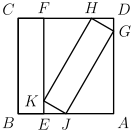
In the figure, is a square of side length The rectangles and are congruent. What is
Answer: C
Small Hint:
Let in right triangle
Big Hint:
Along the top side, simplifies to
Solution:
Let and with In right triangle so
Along side Substituting for gives
Hence so and
Thus, the correct answer is C.
22.
In a small pond there are eleven lily pads in a row labeled through A frog is sitting on pad When the frog is on pad it will jump to pad with probability and to pad with probability Each jump is independent of the previous jumps. If the frog reaches pad it will be eaten by a patiently waiting snake. If the frog reaches pad it will exit the pond, never to return. What is the probability that the frog will escape being eaten by the snake?
Answer: C
Small Hint:
By symmetry the escape probability from pad is
Big Hint:
Let be the escape probability from pad and write each in terms of its neighbors
Solution:
Let be the probability of eventually reaching pad starting from pad By the symmetry of the jump rule at the center,
Each interior pad satisfies which gives
Put The recurrence is equivalent to so Since and Therefore
Thus, the correct answer is C.
23.
The number is prime. Let What is the remainder when is divided by
Answer: C
Small Hint:
Modulo reduce using and so on
Big Hint:
This gives and the alternating sum telescopes
Solution:
Working modulo the identity together with leads to so
Then
The remaining sum is so
Thus, the correct answer is C.
24.
Let be a pentagon inscribed in a circle such that and The sum of the lengths of all diagonals of is equal to where and are relatively prime positive integers. What is
Answer: D
Small Hint:
Equal chords subtend equal arcs, so call this
Big Hint:
Apply Ptolemy’s theorem to and to get equations in
Solution:
Because arcs are equal and arcs are equal, the chords are all equal; let and
Ptolemy’s theorem on and gives Solving the first two for and and substituting into the third yields
So and The five diagonals are summing to
Thus and the correct answer is D.
25.
What is the sum of all positive real solutions to the equation
Answer: D
Small Hint:
Substitute and use
Big Hint:
The equation reduces to forcing and to be integers of the same parity
Solution:
Let Dividing by and using the equation simplifies to
Both cosines must equal or both equal so and are integers of the same parity. Since is even, both must be even, so with a positive odd divisor of giving
Each such gives so the sum of solutions is
Thus, the correct answer is D.