
2013 AMC 12B Solutions
Scroll down to view professionally curated solutions from LIVE by Po-Shen Loh, print PDF solutions, view answer key, or take the full timed exam.
All problems are used with official legal permission of the Mathematical Association of America (MAA).
1.
On a particular January day, the high temperature in Lincoln, Nebraska, was degrees higher than the low temperature, and the average of the high and low temperatures was In degrees, what was the low temperature in Lincoln that day?
Small Hint:
The high and low differ by so each is away from their average
Big Hint:
The low temperature is below the average of
Solution:
The high exceeds the low by so the low is below the average. Since the average is the low temperature is Thus, the correct answer is C.
2.
Mr. Green measures his rectangular garden by walking two of the sides and finds that it is steps by steps. Each of Mr. Green’s steps is feet long. Mr. Green expects a half a pound of potatoes per square foot from his garden. How many pounds of potatoes does Mr. Green expect from his garden?
Small Hint:
Convert steps to feet first: each step is feet
Big Hint:
Multiply the area in square feet by pound per square foot
Solution:
The garden is feet by feet, an area of square feet. At half a pound per square foot, Mr. Green expects pounds. Thus, the correct answer is A.
3.
When counting from to is the st number counted. When counting backwards from to is the th number counted. What is
Small Hint:
Counting backwards, is the st number, is the nd, and so on
Big Hint:
The value is the th number counted
Solution:
Counting down from the value is the th number. So is the th number. Thus, the correct answer is D.
4.
Ray’s car averages miles per gallon of gasoline, and Tom’s car averages miles per gallon of gasoline. Ray and Tom each drive the same number of miles. What is the cars’ combined rate of miles per gallon of gasoline?
Small Hint:
Combined mileage is total miles divided by total gallons, not the average of the two rates
Big Hint:
If each drives miles, the gallons used are and
Solution:
If each drives miles, together they cover miles using gallons. The combined rate is miles per gallon. Thus, the correct answer is B.
5.
The average age of fifth-graders is The average age of of their parents is What is the average age of all of these parents and fifth-graders?
Small Hint:
The overall average is the total of all ages divided by the total number of people
Big Hint:
The total age is spread over people
Solution:
The parents’ ages sum to and the fifth-graders’ to a total of Dividing by people gives Thus, the correct answer is C.
6.
Real numbers and satisfy the equation What is
Small Hint:
Move every term to one side and complete the square in both and
Big Hint:
A sum of two squares equal to forces each square to be
Solution:
Rearranging gives that is Hence and so Thus, the correct answer is B.
7.
Jo and Blair take turns counting from to one more than the last number said by the other person. Jo starts by saying “”, so Blair follows by saying “ ”. Jo then says “ ”, and so on. What is the rd number said?
Small Hint:
The turn that ends at consists of someone saying
Big Hint:
After the turn ending at a total of numbers have been said
Solution:
After the turn that counts up to exactly numbers have been said. For that is The next turn starts so the rd number is the th number of that turn, namely Thus, the correct answer is E.
8.
Line has equation and goes through Line has equation and meets line at point Line has positive slope, goes through point and meets at point The area of is What is the slope of
Small Hint:
Find by solving together with
Big Hint:
The distance from to line is so gives
Solution:
Solving with gives The distance from to the line is so gives Then or the latter makes vertical, so and the slope is Thus, the correct answer is B.
9.
What is the sum of the exponents of the prime factors of the square root of the largest perfect square that divides ?
Small Hint:
Factor
Big Hint:
The largest square divisor keeps only even exponents; halving them gives the square root
Solution:
Since the largest perfect square dividing it is whose square root is The exponents sum to Thus, the correct answer is C.
10.
Alex has red tokens and blue tokens. There is a booth where Alex can give two red tokens and receive in return a silver token and a blue token, and another booth where Alex can give three blue tokens and receive in return a silver token and a red token. Alex continues to exchange tokens until no more exchanges are possible. How many silver tokens will Alex have at the end?
Small Hint:
After exchanges at the first booth and at the second, Alex has red and blue tokens
Big Hint:
Exchanges stop when fewer than red and fewer than blue remain; the silver count is
Solution:
After red-booth and blue-booth exchanges, Alex has red tokens, blue tokens, and silver tokens. At termination the red count is or and the blue count is or Solving the token equations over these six cases leaves only ending at or ending at The latter is unreachable: its final exchange would have to start at either or Hence Alex finishes with silver tokens. Thus, the correct answer is E.
11.
Two bees start at the same spot and fly at the same rate in the following directions. Bee travels foot north, then foot east, then foot upwards, and then continues to repeat this pattern. Bee travels foot south, then foot west, and then continues to repeat this pattern. In what directions are the bees traveling when they are exactly feet away from each other?
east, west
north, south
north, west
up, south
up, west
Small Hint:
Use coordinates with east, north, up as the bees only get farther apart over time
Big Hint:
Compute the distance right before and right after each foot to find where it crosses
Solution:
Take east, north, up as After feet bee is at and bee is at a distance On the next foot bee moves east to and bee moves west to a distance So they pass through feet apart while heads east and heads west. Thus, the correct answer is A.
12.
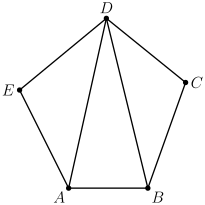
Cities and are connected by roads and How many different routes are there from to that use each road exactly once? (Such a route will necessarily visit some cities more than once.)
Small Hint:
Cities and each touch only two roads, so they behave like detours on the – and – connections
Big Hint:
Count the trails from to on the reduced graph, then multiply by the independent detour choices
Solution:
City (roads ) is a detour on an – trip, and city (roads ) is a detour on a – trip. Replace them to get a graph on with two – connections, two – connections, and one – road. The trails from to using each once are of types: and Each detour (through through ) can be taken on either passage, so each type gives actual routes, for routes. Thus, the correct answer is D.
13.
The internal angles of quadrilateral form an arithmetic progression. Triangles and are similar with and Moreover, the angles in each of these two triangles also form an arithmetic progression. In degrees, what is the largest possible sum of the two largest angles of
Small Hint:
A triangle’s angles form an arithmetic progression exactly when its middle angle is
Big Hint:
Let and the four angles of become which must be an arithmetic progression with one triangle angle equal to
Solution:
The angles of a triangle form an arithmetic progression exactly when the middle one is With and the four angles of are which must itself be an arithmetic progression. In increasing order they are either or giving or One of the triangle angles is Substitution leaves the angle sets and The two largest angles sum to at most Thus, the correct answer is D.
14.
Two non-decreasing sequences of nonnegative integers have different first terms. Each sequence has the property that each term beginning with the third is the sum of the previous two terms, and the seventh term of each sequence is What is the smallest possible value of
Small Hint:
In terms of the first two terms the seventh term equals
Big Hint:
Setting the two seventh terms equal gives coprimality of and forces to be a multiple of
Solution:
A sequence starting has seventh term For the two sequences, so Since we need to be a multiple of and to be a multiple of Taking with nondecreasing terms gives Choosing yields Thus, the correct answer is C.
15.
The number is expressed in the form
where and are positive integers and is as small as possible. What is
Small Hint:
Factor its largest prime is
Big Hint:
Some must reach so but also contains the prime which must be cancelled from the denominator
Solution:
Since the numerator needs a factorial at least to supply the prime so But also has a factor of which does not, so the denominator needs Thus attained by via Then Thus, the correct answer is B.
16.
Let be an equiangular convex pentagon of perimeter The pairwise intersections of the lines that extend the sides of the pentagon determine a five-pointed star polygon. Let be the perimeter of this star. What is the difference between the maximum and the minimum possible values of
Small Hint:
Each interior angle of an equiangular pentagon is so every point of the star is an isosceles triangle with a apex
Big Hint:
Each star point’s two equal sides are the same fixed multiple of the pentagon side it sits on, so the star perimeter is times the pentagon perimeter
Solution:
An equiangular pentagon has all interior angles so each point of the star is an isosceles triangle with base angles and apex By the equal base angles, each point contributes two sides that are the same fixed multiple of the pentagon side it rests on. Summing over the five points, the star perimeter equals independent of the individual side lengths. So is constant, and the difference between its maximum and minimum values is Thus, the correct answer is A.
17.
Let and be real numbers such that
and
What is the difference between the maximum and minimum possible values of
Small Hint:
Write and
Big Hint:
Real with a given sum and sum of squares exist iff
Solution:
From the equations, and Real numbers with a given sum and sum of squares exist iff i.e. This simplifies to so The difference is Thus, the correct answer is D.
18.
Barbara and Jenna play the following game, in which they take turns. A number of coins lie on a table. When it is Barbara’s turn, she must remove or coins, unless only one coin remains, in which case she loses her turn. When it is Jenna’s turn, she must remove or coins. A coin flip determines who goes first. Whoever removes the last coin wins the game. Assume both players use their best strategy. Who will win when the game starts with coins and when the game starts with coins?
Barbara will win with coins, and Jenna will win with coins.
Jenna will win with coins, and whoever goes first will win with coins.
Barbara will win with coins, and whoever goes second will win with coins.
Jenna will win with coins, and Barbara will win with coins.
Whoever goes first will win with coins, and whoever goes second will win with coins.
Small Hint:
Track the number of coins modulo
Big Hint:
Jenna can always restore a multiple of after her move, answering Barbara’s with and her with decide who can maintain the invariant for each starting count
Solution:
Work modulo With coins, Jenna wins either way: going first she takes to leave a multiple of then answers Barbara’s with and with to keep multiples of eventually taking the last coin; going second she keeps the count until Barbara is stuck at coins, must remove and leaves Jenna the last coin. With coins, whoever goes first wins: Jenna first reduces to the case, while Barbara first takes and then keeps multiples of This is choice B. Thus, the correct answer is B.
19.
In triangle and Distinct points and lie on segments and respectively, such that and The length of segment can be written as where and are relatively prime positive integers. What is
Small Hint:
The altitude in the -- triangle gives
Big Hint:
Since points are concyclic; use similar right triangles to find then
Solution:
The altitude from to gives Because triangle giving and Since quadrilateral is cyclic, so making right triangles and similar: so Hence and Thus, the correct answer is B.
20.
For points and are the vertices of a trapezoid. What is
Small Hint:
All four points lie on the parabola the slope of the chord joining parameters and is
Big Hint:
On this range the parallel sides must be and so
Solution:
Each point lies on and the chord through parameters has slope For both and lie between and so and sit between and and the parallel sides are and Equal slopes give Multiplying by and simplifying yields Squaring and using gives whose only root in is Thus, the correct answer is A.
21.
Consider the set of parabolas defined as follows: all parabolas have as focus the point and the directrix lines have the form with and integers such that and No three of these parabolas have a common point. How many points in the plane are on two of these parabolas?
Small Hint:
Two parabolas sharing a focus meet in points unless their directrices are parallel with the focus not between them
Big Hint:
From all pairs, subtract the non-intersecting ones: equal slope and same-sign -intercepts
Solution:
Two parabolas with common focus meet in exactly points, except when their directrices are parallel and lies outside the strip between them, in which case they do not meet. The non-intersecting pairs have directrices of equal slope and -intercepts of the same sign. There are slopes, and for each, same-sign intercept pairs. Since every intersecting pair meets in points and no point lies on three parabolas, the total is Thus, the correct answer is C.
22.
Let and be integers. Suppose that the product of the solutions for of the equation
is the smallest possible integer. What is
Small Hint:
Use to turn the equation into a quadratic in
Big Hint:
The product of the roots satisfies so minimize this integer
Solution:
Writing and the equation becomes a quadratic in whose roots sum to Hence where For each prime dividing let its exponents in be Then An odd is impossible. If then is a multiple of and this prime contributes at least but some other prime must divide If is positive, its contribution to is at least if then and the least contribution is Every other positive even gives more. Thus the minimum uses only with giving and So Thus, the correct answer is A.
23.
Bernardo chooses a three-digit positive integer and writes both its base- and base- representations on a blackboard. Later LeRoy sees the two numbers Bernardo has written. Treating the two numbers as base- integers, he adds them to obtain an integer For example, if Bernardo writes the numbers and and LeRoy obtains the sum For how many choices of are the two rightmost digits of in order, the same as those of
Small Hint:
Since the condition depends only on so let range from to
Big Hint:
Matching last digits forces the base- and base- units digits equal; working modulo pins down the allowed last-two-digit pairs
Solution:
Because the condition on depends only on so consider Let the last two base- digits be and the last two base- digits be Modulo the desired equality and force The Chinese Remainder Theorem applied modulo and then gives Comparing twice this residue modulo with the decimal number reduces to Hence the valid pairs are exactly Each combines with choices of giving values of Thus, the correct answer is E.
24.
Let be a triangle where is the midpoint of and is the angle bisector of with on Let be the intersection of the median and the bisector In addition is equilateral and What is
Small Hint:
Let and the equilateral triangle gives
Big Hint:
Similar triangles yield and then apply the Law of Cosines in
Solution:
Let and Since is equilateral, which gives and From the first, with we get so From the second, The Law of Cosines in with gives Hence Thus, the correct answer is A.
25.
Let be the set of polynomials of the form
where are integers and has distinct roots of the form with and integers. How many polynomials are in
Small Hint:
Real coefficients pair nonreal roots as conjugates, so factors into linear and quadratic pieces, each with constant term dividing
Big Hint:
For each divisor of count the basic factors of magnitude (solutions of plus ), then multiply choices so the constant terms multiply to
Solution:
Since the coefficients are real, nonreal roots occur in conjugate pairs, so factors into distinct linear factors with and quadratics Each factor’s constant term divides For the numbers of conjugate pairs with and are respectively. Adding the two linear choices gives and The factor-magnitude partitions of using values greater than are and Distinct roots require choosing two different factors in the last case. Finally, account for the free presence of and (with forced by the sign of the remaining product), gives Thus, the correct answer is B.