
2013 AMC 12A Solutions
Scroll down to view professionally curated solutions from LIVE by Po-Shen Loh, print PDF solutions, view answer key, or take the full timed exam.
All problems are used with official legal permission of the Mathematical Association of America (MAA).
1.
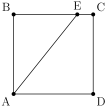
Square has side length Point is on and the area of is What is
Small hint:
Use as the height of
Big hint:
Set equal to the given area
Solution:
We have by the formula for the area of a triangle that This gives us Thus, E is the correct answer.
2.
A softball team played ten games, scoring and runs. They lost by one run in exactly five games. In each of their other games, they scored twice as many runs as their opponent. How many total runs did their opponents score?
Small hint:
The doubled-score games must be the even scoring games
Big hint:
Pair odd scores with one-run losses and even scores with halved opponent scores
Solution:
Note that if they scored twice as many runs as their opponents, then they scored an even number of runs.
This means in the games where they scored and runs, their opponents scored and runs respectively.
This sums to
In the other games, their opponents scored and runs.
This sums to
The total number of runs is then Thus, C is the correct answer.
3.
A flower bouquet contains pink roses, red roses, pink carnations, and red carnations. One third of the pink flowers are roses, three fourths of the red flowers are carnations, and six tenths of the flowers are pink. What percent of the flowers are carnations?
Small hint:
Break the bouquet into pink carnations and red carnations
Big hint:
Use the given fractions of pink and red flowers separately
Solution:
Let the total number of flowers be There are pink flowers and red flowers.
Then there are pink roses, which means there are pink carnations.
There are also red carnations. This means there are carnations. This is of the total flowers.
Thus, E is the correct answer.
4.
5.
Tom, Dorothy, and Sammy went on a vacation and agreed to split the costs evenly. During their trip Tom paid Dorothy paid and Sammy paid In order to share costs equally, Tom gave Sammy dollars, and Dorothy gave Sammy dollars. What is
Small hint:
First find the total trip cost and each person’s fair share
Big hint:
Tom and Dorothy each pay Sammy the amount they are short of a fair share
Solution:
The total cost was , so each person’s share was .
Tom paid less than his share, and Dorothy paid less than her share, so and .
Therefore .
Thus, B is the correct answer.
6.
In a recent basketball game, Shenille attempted only three-point shots and two-point shots. She was successful on of her three-point shots and of her two-point shots. Shenille attempted shots. How many points did she score?
Small hint:
Let and be the numbers of two-point and three-point attempts
Big hint:
Compare the points earned per attempted shot type after applying the success percentages
Solution:
Let be the number of two-point shots and be the number of three-point shots.
Then, Shenille makes two-point shots and three-point shots, for a total score of
We know that
Thus, B is the correct answer.
7.
The sequence has the property that every term beginning with the third is the sum of the previous two. That is, Suppose that and What is
Small hint:
Rearrange the rule to and step downward
Big hint:
From find then work down to
Solution:
Since we get Then and
Thus, the correct answer is C.
8.
Given that and are distinct nonzero real numbers such that what is
Small hint:
Multiply both sides by to clear the fractions
Big hint:
The result factors as
Solution:
Multiplying by gives so
Since it follows that
Thus, the correct answer is D.
9.
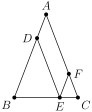
In and Points and are on sides and respectively, such that and are parallel to and respectively. What is the perimeter of parallelogram
Small hint:
Use the parallels to get similar triangles near and
Big hint:
Rewrite opposite sides of the parallelogram as pieces of and
Solution:
Note that and due to the parallel lines.
This tells us that and We have that the perimeter of is
Thus, C is the correct answer.
10.
Let be the set of positive integers for which has the repeating decimal representation with and different digits. What is the sum of the elements of
Small hint:
A two-digit repeating block means
Big hint:
So is the two-digit number check the divisors of
Solution:
If then a two-digit number. The positive divisors of are
Only make equal to which have two different digits. The requested sum is
Thus, the correct answer is D.
11.
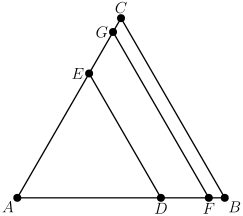
Triangle is equilateral with Points and are on and points and are on such that both and are parallel to Furthermore, triangle and trapezoids and all have the same perimeter. What is
Small hint:
Let and and write each of the three perimeters in terms of and
Big hint:
The three equal perimeters give
Solution:
Let and The parallel cuts make the small regions equilateral or isosceles trapezoids, so the perimeters are
Setting them equal, gives and Solving yields and so
Thus, the correct answer is C.
12.
The angles in a particular triangle are in arithmetic progression, and the side lengths are and The sum of the possible values of equals where and are positive integers. What is
Small hint:
Angles in arithmetic progression summing to force the middle angle to be
Big hint:
Apply the Law of Cosines in each case for which side is opposite the angle
Solution:
If the angles are their sum gives so one angle is
If is opposite the angle, the Law of Cosines gives so
If is opposite the angle, then whose positive solution is If is opposite, then has no real solution.
The sum of the possible values is so
Thus, the correct answer is A.
13.
Let points and Quadrilateral is cut into equal area pieces by a line passing through This line intersects at point where these fractions are in lowest terms. What is
Small hint:
First compute the total area of
Big hint:
The cutting line through makes half the quadrilateral area
Solution:
Let the cutting line meet at . Drop perpendiculars from , , and to the -axis as in the diagram.
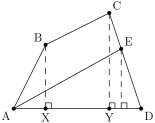
The areas of , trapezoid , and are , , and , respectively, so .
Thus has area . Since , the height of is .
The line has equation , so , giving . Therefore .
Thus, B is the correct answer.
14.
The sequence is an arithmetic progression. What is
Small hint:
Equal differences of logs mean is a geometric sequence
Big hint:
Find the common ratio from
Solution:
Because the logarithms are in arithmetic progression, is a geometric sequence. Its common ratio satisfies so and
Therefore
Thus, the correct answer is B.
15.
Rabbits Peter and Pauline have three offspring—Flopsie, Mopsie, and Cottontail. These five rabbits are to be distributed to four different pet stores so that no store gets both a parent and a child. It is not required that every store gets a rabbit. In how many different ways can this be done?
Small hint:
Split into cases by whether the two parents go to the same store
Big hint:
Same store: parent choices and child assignments; different stores: and
Solution:
If the two parents share a store, there are choices for it, and each child must go to one of the other three stores: ways.
If the parents go to different stores, there are choices, and each child must go to one of the two remaining stores: ways.
The total is
Thus, the correct answer is D.
16.
and are three piles of rocks. The mean weight of the rocks in is pounds, the mean weight of the rocks in is pounds, the mean weight of the rocks in the combined piles and is pounds, and the mean weight of the rocks in the combined piles and is pounds. What is the greatest possible integer value for the mean in pounds of the rocks in the combined piles and
Small hint:
Let be the counts; the mean gives
Big hint:
Write the mean in terms of and using and the mean
Solution:
Let be the numbers of rocks in the piles. From we get so and
Let be the mean of and Using the mean to express we find so
Since is heavier than the mean of and exceeds forcing i.e. The value is attainable by taking then pile has mean and the displayed formula gives Thus the greatest integer mean is
Thus, the correct answer is E.
17.
A group of pirates agree to divide a treasure chest of gold coins among themselves as follows. The pirate to take a share takes of the coins that remain in the chest. The number of coins initially in the chest is the smallest number for which this arrangement will allow each pirate to receive a positive whole number of coins. How many coins does the pirate receive?
Small hint:
Work backward from the number left for the last pirate
Big hint:
The remaining amount is multiplied by when reversing pirate
Solution:
Work backward. If coins remain for the th pirate, then before pirate took a share, the chest had times as many coins as it had afterward.
Therefore the initial number of coins is .
Since , the smallest that makes the initial number an integer is .
This value is attainable. The number of coins present just before pirate takes a share is For , all these amounts are integers. Each pirate’s share is the difference between two consecutive remaining amounts, so every share is an integer as well.
Thus, the th pirate receives coins, and D is the correct answer.
18.
Six spheres of radius are positioned so that their centers are at the vertices of a regular hexagon of side length The six spheres are internally tangent to a larger sphere whose center is the center of the hexagon. An eighth sphere is externally tangent to the six smaller spheres and internally tangent to the larger sphere. What is the radius of this eighth sphere?
Small hint:
The large sphere has radius
Big hint:
Use a right triangle joining the large center, a small-sphere center, and the eighth-sphere center
Solution:
The centers of the six radius- spheres form a regular hexagon of side length , so each is units from the large sphere’s center. Hence the large sphere has radius .

Let the eighth sphere have radius , and let its center be distance from the large sphere’s center. Internal tangency gives , so .
Using the right triangle between the large center, a small-sphere center, and the eighth-sphere center, . Thus , so .
Thus, B is the correct answer.
19.
In and A circle with center and radius intersects at points and Moreover and have integer lengths. What is
Small hint:
Use power of a point from
Big hint:
Factor and use the triangle inequality to choose the valid factor pair
Solution:
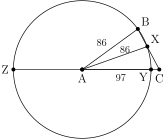
By power of a point from , .
This equals .
Both and are integers, so is an integer factor paired with . Also , so the only possible pair is , .
Thus, D is the correct answer.
20.
Let be the set For define to mean that either or How many ordered triples of elements of have the property that and
Small hint:
Work modulo then means
Big hint:
Fix ( ways); let with then has options
Solution:
Reading the elements modulo the relation holds exactly when
There are choices for Once is fixed, take for some Then must satisfy giving choices.
The total is
Thus, the correct answer is B.
21.
Consider
Which of the following intervals contains
Small hint:
Track where the nested value sits: for small then etc.
Big hint:
For the value satisfies so estimate
Solution:
Let One checks for then for then for and for
Hence so and therefore
Thus, the correct answer is A.
22.
A palindrome is a nonnegative integer number that reads the same forwards and backwards when written in base with no leading zeros. A -digit palindrome is chosen uniformly at random. What is the probability that is also a palindrome?
Small hint:
Show must be a -digit palindrome
Big hint:
The product is a palindrome exactly when and count those
Solution:
Let If had four digits, then so the first and last digits of the six-digit palindrome would both be This forces the first and last digits of the palindromic to be hence and a contradiction. Therefore is a five-digit palindrome
Writing no carries occur exactly when and the resulting digits are If the leading and trailing digits differ; if only the next pair differs. Thus the conditions are also necessary. The number of valid is
There are six-digit palindromes, so the probability is
Thus, the correct answer is E.
23.
is a square of side length Point is on such that The square region bounded by is rotated counterclockwise with center sweeping out a region whose area is where and are positive integers and What is
Small hint:
Track the images the swept region is four circular sectors plus four triangles
Big hint:
and give the sector radii, and is a –– triangle
Solution:
Let be the images of the vertices under the rotation. The swept region decomposes into four circular sectors and four triangles.
Since and the sectors at and have areas and If is the midpoint of then and so is a -- triangle and Hence the two sectors along each have area The two triangles with altitude contribute and the other congruent pair has altitude and contributes Thus the four triangles contribute
The total area is so
Thus, the correct answer is C.
24.
Three distinct segments are chosen at random among the segments whose endpoints are the vertices of a regular -gon. What is the probability that the lengths of these three segments are the three side lengths of a triangle with positive area?
Small hint:
There are possible lengths count how many segments have each length
Big hint:
Use complementary counting: subtract the triples whose longest length is at least the sum of the other two
Solution:
Inscribe the -gon in a unit circle. The segment lengths are for with segments of each length and of length
Comparing sums, the forbidden index triples with and are
The first three triples ending in contribute the two repeated-length triples ending in contribute the three triples of distinct non-diameter lengths contribute and the two remaining diameter triples contribute Dividing their sum by gives failure probability so the answer is
Thus, the correct answer is E.
25.
Let be defined by How many complex numbers are there such that and both the real and the imaginary parts of are integers with absolute value at most
Small hint:
Show is one-to-one on the upper half-plane, so counting equals counting valid
Big hint:
The image is count lattice points with
Solution:
On the upper half-plane if then since the factor so is one-to-one on
For real the boundary values trace the parabola Since lies to its left and is continuous and one-to-one on its image consists precisely of the values satisfying Thus we count with and
Thus, the correct answer is A.