
2012 AMC 12B Problems
Scroll down and press Start to try the exam! Or, go to the printable PDF, answer key, or professional solutions curated by LIVE by Po-Shen Loh.
All problems are used with official legal permission of the Mathematical Association of America (MAA).
Or jump straight to a single problem with its solution: 1 · 2 · 3 · 4 · 5 · 6 · 7 · 8 · 9 · 10 · 11 · 12 · 13 · 14 · 15 · 16 · 17 · 18 · 19 · 20 · 21 · 22 · 23 · 24 · 25
Want to learn professionally through interactive video classes?
Timed
1:15:00
1.
Each third-grade classroom at Pearl Creek Elementary has students and pet rabbits. How many more students than rabbits are there in all of the third-grade classrooms?
Answer: C
Small Hint:
Each classroom has more students than rabbits
Big Hint:
Multiply the per-classroom difference by
Solution:
Each classroom has more students than rabbits.
Across all classrooms there are more students than rabbits.
Thus, the correct answer is C.
2.
A circle of radius is inscribed in a rectangle as shown. The ratio of the length of the rectangle to its width is What is the area of the rectangle?

Small Hint:
The width of the rectangle equals the diameter of the circle
Big Hint:
The length is twice the width
Solution:
The circle is inscribed, so the width of the rectangle equals the diameter,
The length is then so the area is
Thus, the correct answer is E.
3.
For a science project, Sammy observed a chipmunk and a squirrel stashing acorns in holes. The chipmunk hid acorns in each of the holes it dug. The squirrel hid acorns in each of the holes it dug. They each hid the same number of acorns, although the squirrel needed fewer holes. How many acorns did the chipmunk hide?
Answer: D
Small Hint:
Let be the number of holes the chipmunk dug, so the squirrel dug
Big Hint:
The equal totals give
Solution:
Let be the number of holes the chipmunk dug. The chipmunk hid acorns and the squirrel hid acorns.
Since they hid the same number, which gives
The chipmunk hid acorns.
Thus, the correct answer is D.
4.
Suppose that the euro is worth dollars. If Diana has dollars and Étienne has euros, by what percent is the value of Étienne’s money greater than the value of Diana’s money?
Answer: B
Small Hint:
Convert Étienne’s euros to dollars first
Big Hint:
The percent increase is
Solution:
Étienne’s money is worth dollars, while Diana has dollars.
The percent by which Étienne’s value exceeds Diana’s is
Thus, the correct answer is B.
5.
Two integers have a sum of When two more integers are added to the first two integers the sum is Finally when two more integers are added to the sum of the previous four integers the sum is What is the minimum number of even integers among the integers?
Answer: A
Small Hint:
Look at the sum of each new pair: and
Big Hint:
A pair has an odd sum only when exactly one of its two integers is even
Solution:
The three successive pairs have sums and
A pair sums to an even number when its two integers share parity, and to an odd number when exactly one is even. Only the middle pair sums to an odd number, so it must contain at least one even integer.
The other two pairs can be all odd, so as few as even integer is possible, for example
Thus, the correct answer is A.
6.
In order to estimate the value of where and are real numbers with Xiaoli rounded up by a small amount, rounded down by the same amount, and then subtracted her rounded values. Which of the following statements is necessarily correct?
Her estimate is larger than
Her estimate is smaller than
Her estimate equals
Her estimate equals
Her estimate is
Answer: A
Small Hint:
Write the rounded values as and for a small
Big Hint:
Subtract to compare with
Solution:
Let be the small amount. Xiaoli computes
Since her estimate exceeds the true value
Thus, the correct answer is A.
7.
Small lights are hung on a string inches apart in the order red, red, green, green, green, red, red, green, green, green, and so on continuing this pattern of red lights followed by green lights. How many feet separate the rd red light and the st red light?
Note: foot is equal to inches.
Answer: E
Small Hint:
Group the lights into repeating blocks of (two red, three green)
Big Hint:
The rd red light starts block and the st red light starts block
Solution:
The lights repeat in blocks of so consecutive blocks start inches, or feet, apart.
Each block has one odd-numbered red light beginning it. The rd red light begins the nd block and the st red light begins the th block.
The distance between them is feet.
Thus, the correct answer is E.
8.
A dessert chef prepares the dessert for every day of a week starting with Sunday. The dessert each day is either cake, pie, ice cream, or pudding. The same dessert may not be served two days in a row. There must be cake on Friday because of a birthday. How many different dessert menus for the week are possible?
Answer: A
Small Hint:
Fix Friday as cake, then count the other six days
Big Hint:
Each remaining day has choices, anything except the dessert served the following day
Solution:
Friday is fixed as cake. Work outward from Friday.
Each of the other six days (Saturday, then Thursday, Wednesday, Tuesday, Monday, Sunday) can be any dessert except the one served on the neighboring already-chosen day, giving choices each.
The number of menus is
Thus, the correct answer is A.
9.
It takes Clea seconds to walk down an escalator when it is not operating, and only seconds to walk down the escalator when it is operating. How many seconds does it take Clea to ride down the operating escalator when she just stands on it?
Answer: B
Small Hint:
Let the escalator length be fixed and write Clea’s walking rate and the escalator’s rate
Big Hint:
From find in terms of then use
Solution:
Let be Clea’s walking rate and the escalator’s rate, with the length equal to Walking on the moving escalator gives so
Standing takes time with so and seconds.
Thus, the correct answer is B.
10.
What is the area of the polygon whose vertices are the points of intersection of the curves and
Answer: B
Small Hint:
Solve the first equation for and substitute into the second
Big Hint:
The three intersection points form a triangle; use one vertical side as the base
Solution:
From we get Substituting into gives so or
The intersection points are and
The vertical side from to has length and the horizontal distance to is so the area is
Thus, the correct answer is B.
11.
In the equation below, and are consecutive positive integers, and and represent number bases: What is
Answer: C
Small Hint:
Rewrite each numeral in terms of its base, e.g.
Big Hint:
Try both and and solve the resulting quadratic in
Solution:
Writing the numerals out, and
With the equation becomes which simplifies to The positive solution is so
(The case gives which has no integer solution.)
Therefore
Thus, the correct answer is C.
12.
How many sequences of zeros and/or ones of length have all the zeros consecutive, or all the ones consecutive, or both?
Answer: E
Small Hint:
Let be the sequences with all zeros together and those with all ones together, then use
Big Hint:
A sequence with the zeros together is fixed by choosing the first and last zero positions, giving of them
Solution:
Let be the sequences in which all zeros are consecutive and those in which all ones are consecutive.
For there is one all-ones sequence, sequences with exactly one zero, and sequences with two or more zeros (choose the first and last zero position). So and by symmetry
A sequence in is a block of zeros followed by a block of ones, or the reverse; there are of these.
Therefore
Thus, the correct answer is E.
13.
Two parabolas have equations and where and are integers (not necessarily different), each chosen independently by rolling a fair six-sided die. What is the probability that the parabolas have at least one point in common?
Answer: D
Small Hint:
Setting the two right sides equal, the terms cancel, leaving
Big Hint:
There is no common point exactly when and find that probability and subtract from
Solution:
The parabolas meet where i.e. This has no solution exactly when the lines are parallel and distinct: and
The probability that is and the probability that is so the probability of no common point is
The probability of at least one common point is
Thus, the correct answer is D.
14.
Bernardo and Silvia play the following game. An integer between and inclusive, is selected and given to Bernardo. Whenever Bernardo receives a number, he doubles it and passes the result to Silvia. Whenever Silvia receives a number, she adds to it and passes the result to Bernardo. The winner is the last person who produces a number less than Let be the smallest initial number that results in a win for Bernardo. What is the sum of the digits of
Answer: A
Small Hint:
Bernardo wins on a turn when his doubled result reaches forcing Silvia’s next number to be at least
Big Hint:
Work backwards: find the smallest start that first reaches after Bernardo’s move, over one, two, three, or four rounds
Solution:
Bernardo wins after a round when his doubled number but the previous numbers stayed below The smallest with is
Working backwards, the smallest starting values that lead to a win after two, three, and four rounds are the smallest integers with and namely and No start wins after more than four rounds.
So and the sum of its digits is
Thus, the correct answer is A.
15.
Jesse cuts a circular paper disk of radius along two radii to form two sectors, the smaller having a central angle of degrees. He makes two circular cones, using each sector to form the lateral surface of a cone. What is the ratio of the volume of the smaller cone to that of the larger?
Answer: C
Small Hint:
The arc length of each sector becomes the circumference of that cone’s base, giving its base radius
Big Hint:
Each cone has slant height so find each height with the Pythagorean theorem before comparing
Solution:
Each sector forms a cone with slant height The smaller sector’s arc length is so its base radius is and its height is
The larger sector (central angle ) has arc length base radius and height
The ratio of volumes is
Thus, the correct answer is C.
16.
Amy, Beth, and Jo listen to four different songs and discuss which ones they like. No song is liked by all three. Furthermore, for each of the three pairs of the girls, there is at least one song liked by those two girls but disliked by the third. In how many different ways is this possible?
Answer: B
Small Hint:
Each song is liked by one of the pairs by a single girl, or by no one; all three pairs must appear
Big Hint:
Split into the case where all four songs go to pairs and the case where exactly three songs cover the three pairs
Solution:
Each song is liked by exactly one of the three pairs, by a single girl, or by no one. Every pair must be represented.
Case every song is liked by a pair. One pair gets two of the four songs ( ways, and choices for which pair), and the other two pairs get one song each ( ways). This gives
Case three songs go to the three pairs (one each) and the fourth song is liked by a single girl or no one. Assigning the four songs to these four roles gives ways, and the leftover role has options (Amy, Beth, Jo, or no one):
The total is
Thus, the correct answer is B.
17.
Square lies in the first quadrant. Points and lie on lines and respectively. What is the sum of the coordinates of the center of the square
Answer: C
Small Hint:
Let be the angle line makes with the -axis; the square condition relates the projections of the given segments
Big Hint:
From get then intersect the two lines through the midpoints and
Solution:
Let be the acute angle line makes with the -axis. Sides span the segment from to as while span the segment from to as
Since the square has equal sides, so Thus lines have slope and lines have slope
The center lies on the line through with slope and the line through with slope These meet at
The sum of the coordinates is
Thus, the correct answer is C.
18.
Let be a list of the first positive integers such that for each either or or both appear somewhere before in the list. How many such lists are there?
Answer: B
Small Hint:
The numbers greater than or equal to must appear in increasing order, and those less than in decreasing order
Big Hint:
Choosing which positions hold the small numbers determines the list, giving
Solution:
Once is fixed, the numbers must appear left to right in increasing order, and the numbers must appear from right to left in increasing order (so each new small number has its successor already placed).
For each the list is determined by choosing which of the positions after the first hold the numbers below giving lists.
Summing,
Thus, the correct answer is B.
19.
A unit cube has vertices and Vertices and are adjacent to and for vertices and are opposite to each other. A regular octahedron has one vertex in each of the segments and What is the octahedron’s side length?
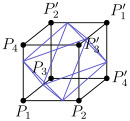
Answer: A
Small Hint:
By symmetry each octahedron vertex is the same distance from (or ) along its edge
Big Hint:
Set the squared distance between two vertices sharing equal to the squared distance across, and solve for
Solution:
Place at the origin with edges along the axes, and let each of the three octahedron vertices near be a distance from by symmetry the three near are also a distance from
Two vertices sharing such as and are a distance apart. A vertex near say and the appropriate vertex near say must be the same distance apart.
Setting the two squared side lengths equal and using the cube’s unit edges yields so the side length is
Thus, the correct answer is A.
20.
A trapezoid has side lengths and The sum of all the possible areas of the trapezoid can be written in the form of where and are rational numbers and and are positive integers not divisible by the square of a prime. What is the greatest integer less than or equal to
Answer: D
Small Hint:
Slide one parallel side over: a trapezoid with parallel sides and legs gives a triangle with sides
Big Hint:
The triangle inequality forces the longer parallel side to be apply Heron’s formula in the cases
Solution:
For a trapezoid with parallel sides and legs translating a leg forms a triangle with sides and The triangle inequality forces the longer parallel side to be
If the triangle has sides with area and the trapezoid has area If the triangle has sides with area giving trapezoid area If the triangle has sides a right triangle, giving trapezoid area
The total is so
The greatest integer at most this value is
Thus, the correct answer is D.
21.
Square is inscribed in equiangular hexagon with on on and on Suppose that and What is the side-length of the square?
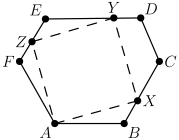
Answer: A
Small Hint:
Drop the square’s vertex onto a line through perpendicular to the parallel sides and
Big Hint:
Let the equiangular angles give congruent corner triangles, so express in terms of and solve for the side
Solution:
Extend and to a line through perpendicular to both, meeting them at and Since we have and With the Pythagorean theorem gives
The equiangular angles make the four corner triangles congruent, and chasing the equal segments along yields so
Since we get giving
Thus, the correct answer is A.
22.
A bug travels from to along the segments in the hexagonal lattice pictured below. The segments marked with an arrow can be traveled only in the direction of the arrow, and the bug never travels the same segment more than once. How many different paths are there?
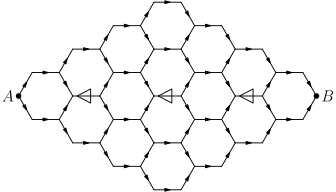
Answer: E
Small Hint:
There are three left-pointing “back” segments; split into cases by which subset of them the path uses
Big Hint:
With no back segment used, the path picks one forward segment per column, giving
Solution:
Label the seven columns of forward (rightward) segments; a path with no back segment simply chooses one forward segment in each column. The numbers of choices are giving paths.
Let be the three left-pointing back segments (in columns ). Analyzing which columns become forced once a back segment is traversed gives paths for each of and for for for each of and and for
Adding,
Thus, the correct answer is E.
23.
Consider all polynomials of a complex variable, where and are integers, and the polynomial has a zero with What is the sum of all values over all the polynomials with these properties?
Answer: B
Small Hint:
Apply the triangle inequality to equality forces the coefficient jumps to concentrate
Big Hint:
First handle the cases where for some otherwise equality in the triangle inequality permits only one nonzero coefficient jump
Solution:
Because applying the triangle inequality to the identity has left side of absolute value The nonnegative coefficient jumps on the right sum to so the triangle inequality is an equality and all its nonzero complex summands point in the same direction.
If two jumps are nonzero, their quotient shows that is a positive real for some Since this means The cases give, respectively, and a polynomial already in the first family. If no such power exists, equality forces exactly one nonzero jump. The constant jump gives any other jump again forces and returns to the cases just listed. Hence the polynomials are exactly for together with and
Their values at are and summing gives
Thus, the correct answer is B.
24.
Define the function on the positive integers by setting and if is the prime factorization of then For every let For how many in the range is the sequence unbounded? Note: a sequence of positive numbers is unbounded if for every integer there is a member of the sequence greater than
Answer: D
Small Hint:
If is a multiple of then is a multiple of so unboundedness is inherited by multiples; find the minimal “essential”
Big Hint:
An essential has every exponent at least and at most two prime factors; analyze powers of first, then the few remaining prime powers and prime pairs below
Solution:
If is a multiple of then is a multiple of so if is unbounded so is Call essential if it is unbounded but no proper divisor is. An essential must have all exponents at least and forces at most two primes.
For two iterations send the exponent pair to Thus the orbit is unbounded exactly when or producing the essential values and For a single other prime, the bound leaves only direct application of leaves only essential. With two primes, leaves the pairs besides Applying to their possible squareful products leaves only
Their multiples up to number and with no overlaps, for a total of
Thus, the correct answer is D.
25.
Let and Let be the set of all right triangles whose vertices are in For every right triangle with vertices and in counter-clockwise order and right angle at let What is
Answer: B
Small Hint:
Pairing a triangle with its reflection swaps with whose product is
Big Hint:
Reflections collapse the whole product down to a handful of triangles through the origin, and only six survive
Solution:
Isosceles right triangles contribute For a scalene right triangle, reflecting across a suitable line pairs it with a triangle so that
Successive reflections (across then then ) reduce the product to the reciprocal of the product over just six triangles of the form with on the top row.
Those six give so the required product is its reciprocal,
Thus, the correct answer is B.