
2012 AMC 12A Problems
Scroll down and press Start to try the exam! Or, go to the printable PDF, answer key, or professional solutions curated by LIVE by Po-Shen Loh.
All problems are used with official legal permission of the Mathematical Association of America (MAA).
Or jump straight to a single problem with its solution: 1 · 2 · 3 · 4 · 5 · 6 · 7 · 8 · 9 · 10 · 11 · 12 · 13 · 14 · 15 · 16 · 17 · 18 · 19 · 20 · 21 · 22 · 23 · 24 · 25
Want to learn professionally through interactive video classes?
Timed
1:15:00
1.
A bug crawls along a number line, starting at It crawls to then turns around and crawls to How many units does the bug crawl altogether?
Answer: E
Small Hint:
Add the two separate crawl distances rather than the net displacement
Big Hint:
The first leg is and the second is
Solution:
The bug crawls units on the first leg and units on the second leg.
The total distance is
Thus, the correct answer is E.
2.
Cagney can frost a cupcake every seconds and Lacey can frost a cupcake every seconds. Working together, how many cupcakes can they frost in minutes?
Answer: D
Small Hint:
Convert minutes to seconds, or count each person’s cupcakes per minute
Big Hint:
In minutes Cagney frosts and Lacey frosts
Solution:
In minutes there are seconds. Cagney frosts cupcakes and Lacey frosts cupcakes.
Together they frost cupcakes.
Thus, the correct answer is D.
3.
A box centimeters high, centimeters wide, and centimeters long can hold grams of clay. A second box with twice the height, three times the width, and the same length as the first box can hold grams of clay. What is
Answer: D
Small Hint:
The capacity is proportional to the volume
Big Hint:
The volume is multiplied by
Solution:
The second box has times the volume of the first, so it holds times as much clay.
Therefore
Thus, the correct answer is D.
4.
In a bag of marbles, of the marbles are blue and the rest are red. If the number of red marbles is doubled and the number of blue marbles stays the same, what fraction of the marbles will be red?
Answer: C
Small Hint:
Start with a convenient total, such as marbles
Big Hint:
Blue and red begin at and ; doubling the red gives blue and red
Solution:
Suppose there are marbles: blue and red. Doubling the red gives red while the blue stays at
The total is now so the fraction that is red is
Thus, the correct answer is C.
5.
A fruit salad consists of blueberries, raspberries, grapes, and cherries. The fruit salad has a total of pieces of fruit. There are twice as many raspberries as blueberries, three times as many grapes as cherries, and four times as many cherries as raspberries. How many cherries are there in the fruit salad?
Answer: D
Small Hint:
Express every count in terms of the number of blueberries
Big Hint:
With blueberries there are raspberries, cherries, and grapes
Solution:
Let be the number of blueberries. Then there are raspberries, cherries, and grapes.
The total is so and there are cherries.
Thus, the correct answer is D.
6.
The sums of three whole numbers taken in pairs are and What is the middle number?
Answer: D
Small Hint:
Adding all three pairwise sums counts each number twice
Big Hint:
The total is half of ; subtract each pair sum to get the third number
Solution:
Let the numbers be Adding the three pairwise sums gives so
Then and The middle number is
Thus, the correct answer is D.
7.
Mary divides a circle into sectors. The central angles of these sectors, measured in degrees, are all integers and they form an arithmetic sequence. What is the degree measure of the smallest possible sector angle?
Answer: C
Small Hint:
The twelve angles sum to
Big Hint:
With first term and common difference so
Solution:
Let be the smallest angle and the common difference. The sum of the angles is so
To make small, take large. Since must be even, is even, and gives so A larger even makes non-positive.
Thus, the correct answer is C.
8.
An iterative average of the numbers and is computed in the following way. Arrange the five numbers in some order. Find the mean of the first two numbers, then find the mean of that with the third number, then the mean of that with the fourth number, and finally the mean of that with the fifth number. What is the difference between the largest and smallest possible values that can be obtained using this procedure?
Answer: C
Small Hint:
Work out the weight each position contributes to the final average
Big Hint:
For the order the result is ; the last entries matter most
Solution:
For the order the iterative average is The later positions carry the most weight.
The largest value uses giving and the smallest uses giving
The difference is
Thus, the correct answer is C.
9.
A year is a leap year if and only if the year number is divisible by (such as ) or is divisible by but not by (such as ). The th anniversary of the birth of novelist Charles Dickens was celebrated on February a Tuesday. On what day of the week was Dickens born?
Friday
Saturday
Sunday
Monday
Tuesday
Answer: A
Small Hint:
Count the total number of days between the two February th dates, working modulo
Big Hint:
In years there are ordinary days plus one extra for each leap year; is not a leap year
Solution:
From February to February there are ordinary days plus one for each leap day.
One quarter of the years contain a leap day, except giving leap days. So the span is days.
Since the birth day was days before a Tuesday, which is a Friday.
Thus, the correct answer is A.
10.
A triangle has area one side of length and the median to that side of length Let be the acute angle formed by that side and the median. What is
Answer: D
Small Hint:
A median splits a triangle into two pieces of equal area
Big Hint:
One half-triangle has sides and with included angle and area
Solution:
The median divides the triangle into two triangles of equal area One of them has the two sides of length (half the base) and (the median) meeting at angle
Its area is so
Thus, the correct answer is D.
11.
Alex, Mel, and Chelsea play a game that has rounds. In each round there is a single winner, and the outcomes of the rounds are independent. For each round the probability that Alex wins is and Mel is twice as likely to win as Chelsea. What is the probability that Alex wins three rounds, Mel wins two rounds, and Chelsea wins one round?
Answer: B
Small Hint:
First find each player’s per-round win probability
Big Hint:
Since and multiply by the number of arrangements
Solution:
Since Alex wins with probability the others share the remaining With Mel twice as likely as Chelsea, and
The number of orderings of the wins is The probability is
Thus, the correct answer is B.
12.
A square region is externally tangent to the circle with equation at the point on the side Vertices and are on the circle with equation What is the side length of this square?
Answer: D
Small Hint:
Use the symmetry across the -axis to write and
Big Hint:
The side length is horizontally and vertically, so ; substitute into
Solution:
By symmetry let with and The square sits on the tangent point so its horizontal width is and its height is
Since these are equal, giving
Substituting into yields The positive root is so the side length is
Thus, the correct answer is D.
13.
Paula the painter and her two helpers each paint at constant, but different, rates. They always start at AM and all three always take the same amount of time to eat lunch. On Monday the three of them painted of a house, quitting at PM. On Tuesday, when Paula wasn’t there, the two helpers painted only of the house and quit at PM. On Wednesday Paula worked by herself and finished the house by working until PM. How long, in minutes, was each day’s lunch break?
Answer: D
Small Hint:
Let the lunch break be minutes and let and be the painting rates (percent per minute)
Big Hint:
Working minutes are and ; set up
Solution:
Let be the lunch length in minutes. The three worked minutes Monday, the helpers minutes Tuesday, and Paula minutes Wednesday.
If Paula paints per minute and the helpers together paint per minute, then
Adding the last two equations and subtracting from the first gives so Solving the system gives and
Thus, the correct answer is D.
14.
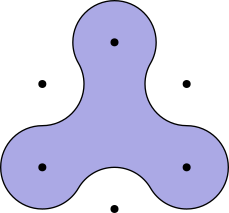
The closed curve in the figure is made up of congruent circular arcs each of length where each of the centers of the corresponding circles is among the vertices of a regular hexagon of side What is the area enclosed by the curve?
Answer: E
Small Hint:
Each arc is a sector of a unit circle, since arc length means radius
Big Hint:
The outward and inward sectors rearrange into one full unit circle added to the hexagon of side
Solution:
Each arc has length on a unit circle, so it is a sector. The nine equal sectors can be reassembled so that the enclosed region equals the regular hexagon of side plus one full circle of radius
A regular hexagon of side splits into equilateral triangles of side so its area is
Adding the unit circle’s area gives
Thus, the correct answer is E.
15.
A square is partitioned into unit squares. Each unit square is painted either white or black with each color being equally likely, chosen independently and at random. The square is then rotated clockwise about its center, and every white square in a position formerly occupied by a black square is painted black. The colors of all other squares are left unchanged. What is the probability that the grid is now entirely black?
Answer: A
Small Hint:
Treat the four corners, the four edges, and the center as three independent groups
Big Hint:
A square ends black unless it is white and the square rotated into its position was also white; the center must start black
Solution:
The four corners form one cycle under the rotation, the four edge squares form another, and the center is fixed. These three groups are independent.
A position remains white exactly when both it and the square rotated into it were originally white. Thus the corners end black exactly when their cyclic string has no adjacent pair of whites. The allowed strings are the all-black string, the strings with one white, and the strings with two opposite whites: of the possibilities. Hence the corner probability is The same argument applies to the four edge squares.
The center is black at the end only if it started black, with probability Multiplying, the whole grid is black with probability
Thus, the correct answer is A.
16.
Circle has its center lying on circle The two circles meet at and Point in the exterior of lies on circle and and What is the radius of circle
Answer: E
Small Hint:
Let be the radius, so ; these equal chords of subtend equal angles at
Big Hint:
Apply the Law of Cosines to triangles and and set the two expressions for equal
Solution:
Let be the radius of so These are equal chords of so they subtend equal angles at
Applying the Law of Cosines to triangles and
Clearing denominators and solving gives so
Thus, the correct answer is E.
17.
Let be a subset of with the property that no pair of distinct elements in has a sum divisible by What is the largest possible size of
Answer: B
Small Hint:
Sort the numbers by their remainder modulo ; there are numbers in each class
Big Hint:
Residues and cannot both appear, nor can and and at most one multiple of is allowed
Solution:
Group by residue modulo each class has numbers. A sum is divisible by when the residues are or
So can use at most one number and only one of the classes and only one of That allows at most numbers.
The set achieves so the maximum is
Thus, the correct answer is B.
18.
Triangle has and Let denote the intersection of the internal angle bisectors of What is
Answer: A
Small Hint:
Drop perpendiculars from to the sides; the tangent segment from has length
Big Hint:
Find the inradius from area and Heron’s formula, then use the right triangle with legs and
Solution:
Let be the foot of the perpendicular from the incenter to The tangent length where so
By Heron’s formula the area is and the inradius satisfies
In right triangle so
Thus, the correct answer is A.
19.
Adam, Benin, Chiang, Deshawn, Esther, and Fiona have internet accounts. Some, but not all, of them are internet friends with each other, and none of them has an internet friend outside this group. Each of them has the same number of internet friends. In how many different ways can this happen?
Answer: B
Small Hint:
Model the friendships as a graph on vertices where everyone has the same degree with
Big Hint:
The cases and are complements of each other, as are and count the two -regular graph types separately
Solution:
Model people as vertices of a graph, with edges for friendships. Everyone has the same degree with The cases and are complementary graphs, so pairs with and with
For the graph is a perfect matching: ways. Thus also gives
For the graph is a union of cycles: either two triangles or one hexagon totaling Thus also gives
The total is
Thus, the correct answer is B.
20.
Consider the polynomial
The coefficient of is equal to What is
Answer: B
Small Hint:
Each factor contributes either its term or its constant ; the chosen exponents must sum to
Big Hint:
There is only one way to write as a sum of distinct powers of two, so exactly one term produces
Solution:
Expanding the product, a term of degree comes from choosing from some factors so that the exponents sum to Since powers of two are distinct, this corresponds to the binary representation
That representation is unique, so exactly one term gives and its coefficient is the product of the constants from the remaining factors: those with
The coefficient is so
Thus, the correct answer is B.
21.
Let and be positive integers with such that and
What is
Answer: E
Small Hint:
Add the two equations to get a clean symmetric expression
Big Hint:
The sum simplifies to and uniquely
Solution:
Adding the two equations gives that is,
The only way to write as a sum of three squares is Since we get with either or
Substituting into the first equation gives so and The other case has no integer solution.
Thus, the correct answer is E.
22.
Distinct planes intersect the interior of a cube Let be the union of the faces of and let The intersection of and consists of the union of all segments joining the midpoints of every pair of edges belonging to the same face of What is the difference between the maximum and the minimum possible values of
Answer: C
Small Hint:
On each face the drawn segments join midpoints of edges; classify a plane’s cross-section as a square, rectangle, triangle, or hexagon
Big Hint:
For the maximum, count all planes of each type; for the minimum, cover all short and long segments with as few planes as possible
Solution:
On every face, the required segments join midpoints of edges. A plane cutting the cube meets the faces in one of four symmetric shapes: a square through midpoints ( such planes), a rectangle per edge ( planes), a triangle per vertex ( planes), or a regular hexagon per pair of opposite vertices ( planes).
Using all of them gives the maximum
The full figure consists of short segments and long segments. A square plane contains a rectangle a triangle and a hexagon short and long segments, respectively. Give each short segment weight and each long segment weight Every plane then covers weight at most whereas the required segments have total weight Thus at least planes are needed. The hexagon planes cover all short segments, and the square planes cover all long segments, so is attainable.
The difference is
Thus, the correct answer is C.
23.
Let be the square one of whose diagonals has endpoints and A point is chosen uniformly at random over all pairs of real numbers and such that and Let be a translated copy of centered at What is the probability that the square region determined by contains exactly two points with integer coordinates in its interior?
Answer: C
Small Hint:
The square has diagonals of length and area by periodicity, reduce to one unit cell of the lattice
Big Hint:
contains a lattice point exactly when lies in the copy of centered there; containing two requires in the overlap of copies centered at adjacent lattice points
Solution:
The diagonal from to has length so is a square of area The translate contains a lattice point exactly when lies inside the copy of centered at that point.
Containing exactly two interior lattice points requires to lie in the overlap of two copies centered at adjacent lattice points. By periodicity the answer is the total such overlap area within one unit cell.
Consider copies centered at and Their overlap is a rectangle. A quarter-turn of the listed half-diagonal gives the relevant vertices and Following the two pairs of parallel sides through their intersections gives side lengths and so the overlap area is Diagonally centered copies do not overlap, and horizontal and vertical adjacencies contribute equally. Accounting for the cell boundaries gives probability
Thus, the correct answer is C.
24.
Let be the sequence of real numbers defined by and and more generally
Rearranging the numbers in the sequence in decreasing order produces a new sequence What is the sum of all the integers such that
Answer: C
Small Hint:
Each base is between and so raising to a power reverses order; compare consecutive terms
Big Hint:
The values interleave: a term is fixed when its rank equals its index
Solution:
Because each base lies strictly between and the function is decreasing, while is increasing for Comparing terms shows the sequence orders as
So in the decreasing arrangement, the even-indexed terms come first, then the odd-indexed terms in reverse. A term satisfies exactly when its position equals its index, which for the descending odd tail requires
Solving gives so the unique fixed index, and the sum is
Thus, the correct answer is C.
25.
Let where denotes the fractional part of The number is the smallest positive integer such that the equation has at least real solutions What is
Note: the fractional part of is a real number such that and is an integer.
Answer: C
Small Hint:
is a periodic triangular wave with so all solutions lie in
Big Hint:
On each unit interval the graph of oscillates a growing number of times; the total number of intersections with is
Solution:
Since every solution lies in The function is a triangular wave of period Put For each integer the function decreases from to on while it increases from to on The first interval is exceptional, but it contributes no intersection with
Counting the oscillations, on the intervals and the curve meets the line a total of and times. Summing over gives real solutions.
The smallest with is since and
Thus, the correct answer is C.