
2010 AMC 12A Solutions
Scroll down to view professionally curated solutions from LIVE by Po-Shen Loh, print PDF solutions, view answer key, or take the full timed exam.
All problems are used with official legal permission of the Mathematical Association of America (MAA).
1.
What is
Small Hint:
Distribute the negative signs and look for terms that cancel
Big Hint:
After the and terms cancel, only the two s remain
Solution:
Distributing the negative signs gives
Thus, C is the correct answer.
2.
A ferry boat shuttles tourists to an island every hour starting at am until its last trip, which starts at pm. One day the boat captain notes that on the am trip there were tourists on the ferry boat, and that on each successive trip, the number of tourists was fewer than on the previous trip. How many tourists did the ferry take to the island that day?
Small Hint:
Count how many trips run from am through pm
Big Hint:
The trip counts are add them
Solution:
The ferry makes trips: at and
The numbers of tourists are so the total is
Thus, A is the correct answer.
3.
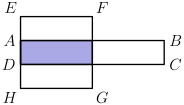
Rectangle pictured below, shares of its area with square Square shares of its area with rectangle What is
Small Hint:
Let be the side length of the square; the shaded overlap has width and height
Big Hint:
Half the rectangle’s area equals the overlap, giving one fifth of the square’s area gives
Solution:
Let be the side length of square The shaded overlap has width and height so its area is
Because the overlap is of the rectangle, so Because it is of the square, so
Therefore
Thus, E is the correct answer.
4.
If then which of the following must be positive?
Small Hint:
Test each choice with a negative value such as
Big Hint:
Rewrite as dividing into a negative number flips the sign
Solution:
Choice (D) is When so
Testing shows the other choices need not be positive: and
Thus, D is the correct answer.
5.
Halfway through a -shot archery tournament, Chelsea leads by points. For each shot a bullseye scores points, with other possible scores being and points. Chelsea always scores at least points on each shot. If Chelsea’s next shots are bullseyes she will be guaranteed victory. What is the minimum value for
Small Hint:
Chelsea’s opponent can score at most points on each of the remaining shots
Big Hint:
With bullseyes and at least points on the other shots, require
Solution:
The opponent can score at most on the last shots. Since Chelsea leads by she must score more than points on her remaining shots to guarantee victory.
Her bullseyes give points, and her other shots give at least points, so This simplifies to i.e.
Therefore Chelsea needs at least bullseyes.
Thus, C is the correct answer.
6.
A palindrome, such as is a number that remains the same when its digits are reversed. The numbers and are three-digit and four-digit palindromes, respectively. What is the sum of the digits of
Small Hint:
Bound the four-digit palindrome between and
Big Hint:
Find the only palindrome in that interval, then subtract
Solution:
Note that is at most This means that has a maximum of
Similarly, we have that the minimum value of is
The only palindrome in this range is so this is what equals.
Thus whose digit sum is
Thus, E is the correct answer.
7.
Logan is constructing a scaled model of his town. The city’s water tower stands meters high, and the top portion is a sphere that holds liters of water. Logan’s miniature water tower holds liters. How tall, in meters, should Logan make his tower?
Small Hint:
Volume scale is the cube of length scale
Big Hint:
Compare liters to liters, then take a cube root
Solution:
The model-to-original volume ratio is Lengths scale by the cube root, so the model-to-original height ratio is Therefore the model should be meters tall.
Thus, C is the correct answer.
8.
Triangle has Let and be on and respectively, such that Let be the intersection of segments and and suppose that is equilateral. What is
Small Hint:
Let
Big Hint:
Use to find then angle-chase
Solution:
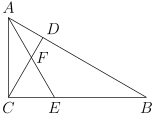
Let Because is equilateral, Rays and are opposite, so
In we get Since lies on this is Hence
Put so The Law of Cosines gives Thus the side lengths are in the ratio with the hypotenuse, so
Thus, C is the correct answer.
9.
A solid cube has side length inches. A -inch by -inch square hole is cut into the center of each face. The edges of each cut are parallel to the edges of the cube, and each hole goes all the way through the cube. What is the volume, in cubic inches, of the remaining solid?
Small Hint:
Use inclusion-exclusion for the three rectangular holes
Big Hint:
The three holes overlap in the central cube
Solution:
Note that all the cut out solids intersect in the middle of the cube.
This region of intersection is a cube with side length Then the volume of the cutout region is
We have to subtract out the center region twice since it is included in all regions.
The remaining volume is then
Thus, A is the correct answer.
10.
The first four terms of an arithmetic sequence are and What is the th term of this sequence?
Small Hint:
The common difference equals
Big Hint:
Also and solve for and
Solution:
Consecutive terms differ by a common difference From the last two terms,
From the first two terms, and from the second and third, Solving this system gives and
The th term is
Thus, A is the correct answer.
11.
12.
In a magical swamp there are two species of talking amphibians: toads, whose statements are always true, and frogs, whose statements are always false. Four amphibians, Brian, Chris, LeRoy, and Mike live together in this swamp, and they make the following statements.
Brian: “Mike and I are different species.”
Chris: “LeRoy is a frog.”
LeRoy: “Chris is a frog.”
Mike: “Of the four of us, at least two are toads.”
How many of these four amphibians are frogs?
Small Hint:
Chris and LeRoy cannot have the same species
Big Hint:
If Brian were a toad, Mike’s statement would create a contradiction
Solution:
Chris and LeRoy are of opposite species: if Chris is a toad, his statement makes LeRoy a frog; if Chris is a frog, his false statement makes LeRoy a toad. Thus exactly one of them is a toad.
If Brian is a toad, his true statement makes Mike a frog. If Brian is a frog, his false statement says that he and Mike are the same species, again making Mike a frog. Therefore Mike is always a frog.
Mike’s statement is therefore false, so there are fewer than two toads. Chris and LeRoy already supply exactly one toad, forcing Brian to be a frog. Hence there is one toad and frogs.
Thus, D is the correct answer.
13.
For how many integer values of do the graphs of and not intersect?
Small Hint:
For is a circle of radius and is a hyperbola
Big Hint:
The hyperbola’s points closest to the origin are at distance compare with the radius
Solution:
For the graph of is the single point and is the two axes, which meet at the origin, so the graphs intersect.
For the circle has radius and the hyperbola has its two vertices nearest the origin at distance The graphs meet exactly when that is
So they fail to intersect only when namely and giving values.
Thus, C is the correct answer.
14.
Nondegenerate has integer side lengths, is an angle bisector, and What is the smallest possible value of the perimeter?
Small Hint:
Use the Angle Bisector Theorem
Big Hint:
and
Solution:
Using the Angle Bisector Theorem, we have that
For and to be integers, we must have that is a multiple of
To minimize the perimeter, we can set and This, however, makes the triangle degenerate.
must then be and Since the perimeter is
Thus, B is the correct answer.
15.
A coin is altered so that the probability that it lands on heads is less than and when the coin is flipped four times, the probability of an equal number of heads and tails is What is the probability that the coin lands on heads?
Small Hint:
The chance of two heads and two tails is
Big Hint:
This reduces to solve the quadratic and take the root with
Solution:
Let be the probability of heads. The chance of two heads and two tails in four flips is
Thus so
This gives so Since we take
Thus, D is the correct answer.
16.
Bernardo randomly picks distinct numbers from the set and arranges them in descending order to form a -digit number. Silvia randomly picks distinct numbers from the set and also arranges them in descending order to form a -digit number. What is the probability that Bernardo’s number is larger than Silvia’s number?
Small Hint:
Separate cases according to whether Bernardo picks
Big Hint:
Without a the two numbers are symmetric except when the chosen sets match
Solution:
There are two cases: Bernardo picks a or he doesn’t.
Case Bernardo picks a
Since a number is fixed, there are ways to choose the other two numbers.
There are a total of ways to pick all three numbers. The probability is then
Note that if Bernardo picks a he automatically has a greater number than Silvia.
This means that Bernardo always wins in this case.
Case Bernardo doesn’t pick a
There is a chance of this happening. Since both people are choosing from the same numbers, they have an equal chance of winning.
We still need to find the probability that the numbers are the same. There is a chance that Silvia chooses the same numbers as Bernardo. The probability that Bernardo gets a higher number is then
The total probability of Bernardo getting a higher number is then
Thus, B is the correct answer.
17.
Equiangular hexagon has side lengths and The area of is of the area of the hexagon. What is the sum of all possible values of
Small Hint:
Split the hexagon into and three corner triangles
Big Hint:
Express both areas using and
Solution:
Note that is equilateral. Using the Law of Cosines in we get
The area of is then
The three corner triangles and each have area
Thus the hexagon has area
The condition gives so
By Vieta’s formulas, the sum of the possible values of is
Thus, E is the correct answer.
18.
A -step path is to go from to with each step increasing either the -coordinate or the -coordinate by How many such paths stay outside or on the boundary of the square at each step?
Small Hint:
Each step increases by so the path meets the line at exactly one lattice point
Big Hint:
To avoid the square’s interior, that point is or count paths through each
Solution:
Every step increases by which runs from to so each path passes through exactly one lattice point with
To stay out of the open square, that point must have so it is one of
By symmetry consider the three points and double. The number of paths from to is and the number continuing on to is also
Therefore the total is
Thus, D is the correct answer.
19.
Each of boxes in a line contains a single red marble, and for the box in the th position also contains white marbles. Isabella begins at the first box and successively draws a single marble at random from each box, in order. She stops when she first draws a red marble. Let be the probability that Isabella stops after drawing exactly marbles. What is the smallest value of for which
Small Hint:
The first draws must be white, then the th draw red
Big Hint:
The white probabilities telescope:
Solution:
Since there are marbles in the th box, there is a chance Isabella draws a white marble from it.
The probability of drawing a red marble is then To stop after drawing the th marble, the first marbles must have been white.
This happens with a probability of
Note that all the numerators cancel with the adjacent denominator, which means that this expression reduces to
We have to find the smallest such that
Since but the smallest such is
Thus, A is the correct answer.
20.
Arithmetic sequences and have integer terms with and for some What is the largest possible value of
Small Hint:
Write and so divides both and
Big Hint:
Check each factor pair of with then must divide
Solution:
Since and for integers the value divides both and hence divides
The factor pairs of with are and
For every pair except the numbers and are relatively prime, forcing For so can equal giving
The sequences and realize this, so the largest value is
Thus, C is the correct answer.
21.
The graph of lies above the line except at three values of where the graph and the line intersect. What is the largest of those values?
Small Hint:
The graph minus the line is nonnegative with three double roots, so it equals
Big Hint:
Match the coefficients of to determine the cubic, then factor it
Solution:
Let be the graph minus the line. It is nonnegative and vanishes at three points, each a double root, so
Matching coefficients gives then then
Thus the cubic is with roots and The largest is
Thus, A is the correct answer.
22.
What is the minimum value of
Small Hint:
is piecewise linear with corners at the minimum is where its slope turns from negative to positive
Big Hint:
On the slope is find where it vanishes
Solution:
The function is piecewise linear with breakpoints at On the interval its slope is where
This slope is zero when i.e. so the minimum occurs at the right endpoint
There, terms with contribute and terms with contribute so
Thus, A is the correct answer.
23.
The number obtained from the last two nonzero digits of is equal to What is
Small Hint:
Remove the factors making trailing zeroes, then work modulo
Big Hint:
Use congruences modulo and modulo to pin down the last two digits
Solution:
The number of trailing zeroes in is Let
There are still more than two factors of left after removing so
Let be the product of factors of not divisible by and let be the product of the factors divisible by Each block is and there are blocks, so
After removing the factors of from the remaining factors can be grouped as
Therefore Since and the inverse of modulo is we get
The number congruent to and is so the last two nonzero digits form
Thus, A is the correct answer.
24.
Let The intersection of the domain of with the interval is a union of disjoint open intervals. What is
Small Hint:
The domain is where is symmetric about
Big Hint:
Count the zeros in and note the sign fails to flip at and
Solution:
Let the domain of is where Since and is even, so it suffices to study and double.
In the zeros of are the fractions with and For there are of them, totaling
These zeros split into subintervals on which has constant sign. Near every factor is positive, so there, and the sign flips at each zero except and where an even number of factors vanish.
Tracking the signs, exactly of the subintervals have By symmetry there are more in so
Thus, B is the correct answer.
25.
Two quadrilaterals are considered the same if one can be obtained from the other by a rotation and a translation. How many different convex cyclic quadrilaterals are there with integer sides and perimeter equal to
Small Hint:
A convex cyclic quadrilateral with given side lengths in a given cyclic order is unique; each side is at most
Big Hint:
Count ordered quadruples summing to then quotient by cyclic rotation using Burnside’s lemma
Solution:
A convex cyclic quadrilateral is determined up to rotation and translation by its cyclic sequence of side lengths, and it exists exactly when the largest side is less than the sum of the others. With perimeter this means each side is at most
First count ordered quadruples of positive integers with and each entry at most Without the upper bound there are removing those with some entry at least subtracts leaving
Rotations of the quadrilateral correspond to cyclic permutations of By Burnside’s lemma the number of distinct quadrilaterals is where counts quadruples fixed by rotating positions.
A one- or three-step rotation fixes only so A two-step rotation fixes with and giving
Hence the count is
Thus, C is the correct answer.