
2009 AMC 12B Solutions
Scroll down to view professionally curated solutions from LIVE by Po-Shen Loh, print PDF solutions, view answer key, or take the full timed exam.
All problems are used with official legal permission of the Mathematical Association of America (MAA).
1.
Each morning of her five-day workweek, Jane bought either a -cent muffin or a -cent bagel. Her total cost for the week was a whole number of dollars. How many bagels did she buy?
Small Hint:
She buys items total, so muffins and bagels together number
Big Hint:
The total cents must be a multiple of reduce the cost modulo
Solution:
With bagels she buys muffins, costing cents. For a whole number of dollars this must be a multiple of Thus or Since only works, giving cents
Thus, the correct answer is B.
2.
Paula the painter had just enough paint for identically sized rooms. Unfortunately, on the way to work, three cans of paint fell off her truck, so she had only enough paint for rooms. How many cans of paint did she use for the rooms?
Small Hint:
The lost cans account for the rooms she can no longer paint
Big Hint:
The ratio of cans to rooms is
Solution:
Losing cans cost her rooms, so cans paint rooms and each room needs of a can.
For rooms she used cans.
Thus, the correct answer is C.
3.
Twenty percent less than is one-third more than what number?
Small Hint:
Twenty percent less than is
Big Hint:
One-third more than a number is
Solution:
Twenty percent less than is
One-third more than is so gives
Thus, the correct answer is D.
4.
A rectangular yard contains two flower beds in the shape of congruent isosceles right triangles. The remainder of the yard has a trapezoidal shape, as shown. The parallel sides of the trapezoid have lengths and meters. What fraction of the yard is occupied by the flower beds?

Small Hint:
The two triangle legs equal half the difference of the parallel sides
Big Hint:
Each isosceles right triangle has legs
Solution:
The parallel sides differ by so each triangle has legs and area The two beds total
The rectangle measures by so its area is and the fraction occupied is
Thus, the correct answer is C.
5.
Kiana has two older twin brothers. The product of their three ages is What is the sum of their three ages?
Small Hint:
so every age is a power of
Big Hint:
If each twin is years old, then times Kiana’s age is and Kiana is younger
Solution:
Since each age is a power of The twins share an age so Kiana’s age is
Taking gives Kiana who is younger than the twins. (Smaller twins would make Kiana older, which is not allowed.) The sum is
Thus, the correct answer is D.
6.
By inserting parentheses, it is possible to give the expression several values. How many different values can be obtained?
Small Hint:
The result depends on when the addition is performed relative to the two multiplications
Big Hint:
Enumerate the distinct groupings; several parenthesizations collapse to the same value
Solution:
The genuinely different groupings give
and
These are all distinct, so values can be obtained.
Thus, the correct answer is C.
7.
In a certain year the price of gasoline rose by during January, fell by during February, rose by during March, and fell by during April. The price of gasoline at the end of April was the same as it had been at the beginning of January. To the nearest integer, what is
Small Hint:
Multiply the successive factors and
Big Hint:
After three months the price is times the start, so April must undo that factor
Solution:
After January through March the price is times the original.
To return to the original, April must multiply by a decrease of To the nearest integer,
Thus, the correct answer is B.
8.
When a bucket is two-thirds full of water, the bucket and water weigh kilograms. When the bucket is one-half full of water the total weight is kilograms. In terms of and what is the total weight in kilograms when the bucket is full of water?
Small Hint:
Let the empty bucket weigh and a full load of water weigh so and
Big Hint:
Subtract the two equations to find then compute
Solution:
Let be the bucket’s weight and the weight of a full bucket of water. Then and
Subtracting gives so and The full weight is
Thus, the correct answer is E.
9.
Triangle has vertices and where is on the line What is the area of
Small Hint:
Line is which is parallel to
Big Hint:
Since slides along a line parallel to the area is fixed; pick a convenient
Solution:
Line has equation which is parallel to so the area is independent of where lies on that line.
Take Then the base lies on the -axis with height giving area
Thus, the correct answer is A.
10.
A particular -hour digital clock displays the hour and minute of a day. Unfortunately, whenever it is supposed to display a it mistakenly displays a For example, when it is pm the clock incorrectly shows pm. What fraction of the day will the clock show the correct time?
Small Hint:
The hour is shown correctly unless it contains a namely hours
Big Hint:
A minute is correct only when neither of its digits is a ; count the bad minutes out of
Solution:
The hours containing a are so of the hours display correctly, a fraction
A minute is wrong if either digit is : the tens digit gives ( minutes), and the ones digit adds ( more), in all. So of minutes are correct.
The fraction of the day is
Thus, the correct answer is A.
11.
On Monday, Millie puts a quart of seeds, of which are millet, into a bird feeder. On each successive day she adds another quart of the same mix of seeds without removing any seeds that are left. Each day the birds eat only of the millet in the feeder, but they eat all of the other seeds. On which day, just after Millie has placed the seeds, will the birds find that more than half the seeds in the feeder are millet?
Tuesday
Wednesday
Thursday
Friday
Saturday
Small Hint:
Each morning of the previous millet remains and quart of new millet is added, while the other seeds always total quart
Big Hint:
After days the millet is quart; require this to exceed
Solution:
Each day the birds leave of the millet and Millie adds quart of new millet, so after days the millet is quart.
The non-millet seeds always total quart, so millet exceeds half when that is,
Since and this first happens on day which is Friday.
Thus, the correct answer is D.
12.
The fifth and eighth terms of a geometric sequence of real numbers are and respectively. What is the first term?
Small Hint:
The ratio of the eighth term to the fifth term is
Big Hint:
so ; then divide by
Solution:
The eighth term divided by the fifth term is so
The fifth term is so
Thus, the correct answer is E.
13.
Triangle has and and the altitude to has length What is the sum of the two possible values of
Small Hint:
The foot of the altitude splits ; use the Pythagorean theorem in the two right triangles
Big Hint:
The foot distances are and ; is their sum or difference
Solution:
Let be the foot of the altitude from Then and
If lies between and then ; if the triangle is obtuse, The sum is
Thus, the correct answer is D.
14.
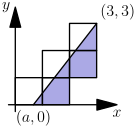
Five unit squares are arranged in the coordinate plane as shown, with the lower left corner at the origin. The slanted line, extending from to divides the entire region into two regions of equal area. What is
Small Hint:
The total area is so each region must be
Big Hint:
The region on the lower-right side of the line is a triangle of base and height minus one unit square
Solution:
The five squares have total area so each region must have area
The line from to together with the axes bounds a triangle of base and height ; the region on the lower-right side of the line is this triangle with one unit square removed. Setting gives so
Thus, the correct answer is C.
15.
Assume Below are five equations for Which equation has the largest solution
Small Hint:
Solving each gives ; a smaller base makes larger
Big Hint:
Compare the values for and find the smallest
Solution:
Each equation gives which is largest when the positive quantity is smallest.
For we have and because Also so Thus is the smallest of the five quantities, and equation (B) has the largest solution.
Thus, the correct answer is B.
16.
Trapezoid has and The ratio is What is
Small Hint:
Draw the line through parallel to meeting at ; then
Big Hint:
Show bisects then apply the angle bisector theorem in
Solution:
Draw the line through parallel to meeting at so is a parallelogram with Then and since segment bisects
By the angle bisector theorem in so
Thus, the correct answer is B.
17.
Each face of a cube is given a single narrow stripe painted from the center of one edge to the center of its opposite edge. The choice of the edge pairing is made at random and independently for each face. What is the probability that there is a continuous stripe encircling the cube?
Small Hint:
Each face’s stripe has orientations, giving equally likely configurations
Big Hint:
An encircling stripe runs around one of pairs of opposite faces; count the configurations forming a loop
Solution:
Each of the faces has equally likely stripe orientations, for configurations.
An encircling stripe runs around one of the pairs of opposite faces. Fixing such a band, the four faces it passes through must be aligned, with probability while the two remaining faces are free. The possible bands are disjoint events, so the probability is
Thus, the correct answer is B.
18.
Rachel and Robert run on a circular track. Rachel runs counterclockwise and completes a lap every seconds, and Robert runs clockwise and completes a lap every seconds. Both start from the start line at the same time. At some random time between minutes and minutes after they begin to run, a photographer standing inside the track takes a picture that shows one-fourth of the track, centered on the starting line. What is the probability that both Rachel and Robert are in the picture?
Small Hint:
The picture spans lap on each side of the start; find when each runner is within that arc during the th minute
Big Hint:
Rachel is in view for s and Robert for s; take the overlap over s
Solution:
The picture covers the arc within lap of the start on each side. At s Rachel has run laps, s short of the line; a quarter lap takes her s, so she is in view between s and s of the th minute.
At s Robert is s from the line; a quarter lap takes s, so he is in view between and s. Both appear between and s, a window of s out of giving probability
Thus, the correct answer is C.
19.
For each positive integer let What is the sum of all values of that are prime numbers?
Small Hint:
Rewrite as a difference of squares:
Big Hint:
Factor it; for the product to be prime, the smaller factor must equal
Solution:
Write
For to be prime the smaller factor must be : solving gives so or
Then and are both prime, summing to
Thus, the correct answer is E.
20.
A convex polyhedron has vertices and edges. The polyhedron is cut by planes in such a way that plane cuts only those edges that meet at vertex In addition, no two planes intersect inside or on The cuts produce pyramids and a new polyhedron How many edges does have?
Small Hint:
Each original edge is cut once near each of its two endpoints, creating new vertices
Big Hint:
Count the new edges (one per edge-endpoint) plus the surviving middle portion of each original edge
Solution:
Each of the edges is cut once near each endpoint, so has vertices.
The cut at vertex creates a small polygon whose number of edges equals the degree of ; summed over all vertices this is the total number of edge-endpoints. The middle portion of each original edge also survives, adding edges. So has edges.
Thus, the correct answer is C.
21.
Ten women sit in seats in a line. All of the get up and then reseat themselves using all seats, each sitting in the seat she was in before or a seat next to the one she occupied before. In how many ways can the women be reseated?
Small Hint:
Let count the valid reseatings of women; consider the rightmost woman’s choice
Big Hint:
If she stays she leaves ways; if she moves left a swap is forced, leaving — so
Solution:
Let be the number of valid reseatings of women. The rightmost woman either keeps her seat, leaving ways for the rest, or swaps with her left neighbor — the only other way to fill the end seat — leaving ways.
Thus with and giving the Fibonacci values So
Thus, the correct answer is A.
22.
Parallelogram has area Vertex is at and all other vertices are in the first quadrant. Vertices and are lattice points on the lines and for some integer respectively. How many such parallelograms are there?
Small Hint:
With and the area of the parallelogram is
Big Hint:
You need ; count ordered factorizations into three positive integers
Solution:
Let and with positive integers and The area is
Each parallelogram corresponds to an ordered triple of positive integers with product The six ’s distribute among the three factors in ways, and likewise the six ’s in ways, giving
Thus, the correct answer is C.
23.
A region in the complex plane is defined by
A complex number is chosen uniformly at random from What is the probability that is also in
Small Hint:
Multiplying gives real part and imaginary part ; both must lie in
Big Hint:
These conditions are and ; find the area of satisfying them
Solution:
Expanding, Both parts lie in iff and
Within the square (area ) these fail only in four corner triangles. Near the line cuts off a right triangle with legs area
The four corners remove leaving The probability is
Thus, the correct answer is D.
24.
For how many values of in is
Note: The functions and denote inverse trigonometric functions.
Small Hint:
On and the left side lies in so any solution needs
Big Hint:
Since is one-to-one on the equation reduces to on
Solution:
On Since takes values in any solution requires where the equation becomes
The equation holds exactly when for some integer
The first family gives contributing and The second gives contributing and Hence there are solutions in
Thus, the correct answer is B.
25.
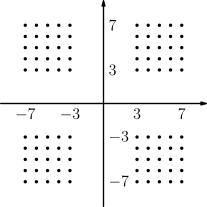
The set is defined by the points with integer coordinates, and How many squares of side at least have their four vertices in
Small Hint:
splits into four blocks, one per quadrant; a side- square takes exactly one vertex from each block
Big Hint:
Slide the four blocks together onto a single grid each valid square maps to a point of or a square in
Solution:
consists of four blocks one in each quadrant. Any square of side uses exactly one vertex in each block, since two points in one block are less than apart while points in different blocks are at least apart.
Sliding each block inward by superimposes them on one grid (points with ). Each such square maps to either a single point of or a square in So the count equals the number of points of plus times the number of squares with vertices in
The grid has axis-parallel squares. For a tilted square, let one side move units horizontally and units vertically, where and For each ordered pair there are placements. The totals for are respectively, giving tilted squares and squares altogether. Therefore the required count is
Thus, the correct answer is E.