
2009 AMC 12A Problems
Scroll down and press Start to try the exam! Or, go to the printable PDF, answer key, or professional solutions curated by LIVE by Po-Shen Loh.
All problems are used with official legal permission of the Mathematical Association of America (MAA).
Or jump straight to a single problem with its solution: 1 · 2 · 3 · 4 · 5 · 6 · 7 · 8 · 9 · 10 · 11 · 12 · 13 · 14 · 15 · 16 · 17 · 18 · 19 · 20 · 21 · 22 · 23 · 24 · 25
Want to learn professionally through interactive video classes?
Timed
1:15:00
1.
Kim’s flight took off from Newark at am and landed in Miami at pm. Both cities are in the same time zone. If her flight took hours and minutes, with what is
Answer: A
Small Hint:
Count the minutes from am up to am, then continue from there
Big Hint:
The flight lasts hours and minutes
Solution:
From am to am is minutes, from am to pm is hours, and from pm to pm is minutes.
So the flight lasted hours and minutes. Thus and
Thus, the correct answer is A.
2.
Which of the following is equal to
Answer: C
Small Hint:
Work outward from the innermost fraction
Big Hint:
First simplify then take its reciprocal
Solution:
Starting inside, so Then and
Thus, the correct answer is C.
3.
What number is one third of the way from to
Answer: B
Small Hint:
The distance from to is
Big Hint:
Add one third of that distance to
Solution:
The gap is One third of the way adds
So the number is
Thus, the correct answer is B.
4.
Four coins are picked out of a piggy bank that contains a collection of pennies, nickels, dimes, and quarters. Which of the following could not be the total value of the four coins, in cents?
Small Hint:
A selection that includes at least one penny cannot total a multiple of
Big Hint:
Without a penny, all four coins are worth at least cents each
Solution:
If the four coins include a penny, the total is not a multiple of so it cannot equal any of the five listed multiples of If there is no penny, every coin is worth at least cents, so the total is at least cents. Either way, is impossible.
The other amounts are attainable: and
Thus, the correct answer is A.
5.
One dimension of a cube is increased by another is decreased by and the third is left unchanged. The volume of the new rectangular solid is less than that of the cube. What was the volume of the cube?
Answer: D
Small Hint:
Let the cube have side length and write the new volume as a product
Big Hint:
The new solid has volume
Solution:
Let the cube have side length The new solid has dimensions and so its volume is
Setting this equal to gives so
The cube’s volume is
Thus, the correct answer is D.
6.
Suppose that and Which of the following is equal to for every pair of integers
Answer: E
Small Hint:
Write
Big Hint:
Then
Solution:
Since
Thus, the correct answer is E.
7.
The first three terms of an arithmetic sequence are and respectively. The th term of the sequence is What is
Answer: B
Small Hint:
Consecutive differences are equal:
Big Hint:
Solve for then find the first term and common difference
Solution:
Equal consecutive differences give that is so
The first three terms are with common difference
The th term satisfies so and
Thus, the correct answer is B.
8.
Four congruent rectangles are placed as shown. The area of the outer square is times that of the inner square. What is the ratio of the length of the longer side of each rectangle to the length of its shorter side?

Answer: A
Small Hint:
Let each rectangle have shorter side and longer side
Big Hint:
The outer square has side the inner square has side and their side ratio is
Solution:
Let the rectangles have shorter side and longer side The outer square has side and the inner square has side
Since the outer area is times the inner area, the side ratio is so
This gives so the ratio of longer to shorter side is
Thus, the correct answer is A.
9.
Suppose that and What is
Answer: D
Small Hint:
Big Hint:
Write and use the given formula for
Solution:
Note that
Using with gives
Thus, the correct answer is D.
10.
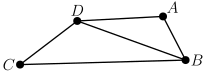
In quadrilateral and is an integer. What is
Answer: C
Small Hint:
Apply the triangle inequality to and
Big Hint:
From and from
Solution:
In the triangle inequality gives so and
In so
The only integer with is
Thus, the correct answer is C.
11.
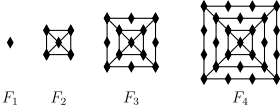
The figures and shown are the first in a sequence of figures. For is constructed from by surrounding it with a square and placing one more diamond on each side of the new square than had on each side of its outside square. For example, figure has diamonds. How many diamonds are there in figure
Answer: E
Small Hint:
The outside square of has diamonds
Big Hint:
Summing over all rings, has diamonds
Solution:
The outside square of has more diamonds than that of and the outside square of has so the outside square of has diamonds.
Adding all the rings,
For this is
Thus, the correct answer is E.
12.
How many positive integers less than are times the sum of their digits?
Answer: B
Small Hint:
If equals times its digit sum, then is a multiple of and is small
Big Hint:
The digit sum of a number below is at most so
Solution:
If then since the digit sum of a number below is at most we have
For a two-digit number gives forcing and so A one-digit number would need impossible for A three-digit number gives whose left side is at least while the right side is at most so there is no solution.
Hence exactly one number, works.
Thus, the correct answer is B.
13.
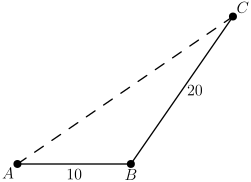
A ship sails miles in a straight line from to turns through an angle between and and then sails another miles to Let be measured in miles. Which of the following intervals contains
Answer: D
Small Hint:
By the Law of Cosines,
Big Hint:
The turn is between and so is between and
Solution:
By the Law of Cosines,
The ship turns through an angle between and so the interior angle lies between and
Since and
So lies in
Thus, the correct answer is D.
14.
A triangle has vertices and and the line divides the triangle into two triangles of equal area. What is the sum of all possible values of
Answer: B
Small Hint:
The line passes through the vertex so to bisect the area it must hit the midpoint of the opposite side
Big Hint:
Set the midpoint of the segment from to on the line
Solution:
The line passes through the vertex so it bisects the triangle’s area exactly when it passes through the midpoint of the opposite side, joining and That midpoint is
Requiring it to satisfy gives so that is
The possible values are and whose sum is
Thus, the correct answer is B.
15.
For what value of is Note: here
Answer: D
Small Hint:
Group the terms in blocks of four consecutive powers of
Big Hint:
Each block with a multiple of equals
Solution:
For a multiple of
Summing the first terms (that is blocks) gives
Adding the next term yields So
Thus, the correct answer is D.
16.
A circle with center is tangent to the positive - and -axes and externally tangent to the circle centered at with radius What is the sum of all possible radii of the circle with center
Answer: D
Small Hint:
A circle tangent to both positive axes with radius has center
Big Hint:
External tangency gives distance between and form a quadratic in and use Vieta
Solution:
A circle tangent to both positive axes with radius has center External tangency to the circle at of radius means the distance between centers is :
Expanding gives Both roots are positive, and by Vieta’s formulas their sum is
Thus, the correct answer is D.
17.
Let and be two different infinite geometric series of positive numbers with the same first term. The sum of the first series is and the sum of the second series is What is
Answer: C
Small Hint:
The sum of an infinite geometric series with first term and ratio is
Big Hint:
Each ratio satisfies that is use Vieta on the two roots
Solution:
For a series with first term and ratio the sum is so
Both and satisfy this same quadratic, and since the two series are different, so they are its two distinct roots. By Vieta’s formulas,
Thus, the correct answer is C.
18.
For let where there are zeros between the and the Let be the number of factors of in the prime factorization of What is the maximum value of
Answer: B
Small Hint:
Write
Big Hint:
Factor out the smaller power of the largest count comes at where supplies one extra factor of
Solution:
Note that
For the first term has fewer than factors of so For the first term is divisible by but the term is not, so
For Since and contributes exactly one more factor of we get
So the maximum value is
Thus, the correct answer is B.
19.
Andrea inscribed a circle inside a regular pentagon, circumscribed a circle around the pentagon, and calculated the area of the region between the two circles. Bethany did the same with a regular heptagon ( sides). The areas of the two regions were and respectively. Each polygon had a side length of Which of the following is true?
Answer: C
Small Hint:
For a regular polygon with side let and be the inradius and circumradius, and look at the center, a side’s midpoint, and its endpoint
Big Hint:
That right triangle has legs and and hypotenuse so regardless of the number of sides
Solution:
For a regular polygon with side length let be the center, the midpoint of a side, and an endpoint of that side. Then has a right angle at with (inradius), and (circumradius).
So and the area between the circles is for any number of sides. Hence
Thus, the correct answer is C.
20.
Convex quadrilateral has and Diagonals and intersect at and and have equal areas. What is
Answer: E
Small Hint:
Equal areas of and imply and have equal areas
Big Hint:
That forces making with ratio
Solution:
Adding to each of and shows and have equal areas. They share base so and are equidistant from line meaning
Then with ratio so
Writing and we get so and
Thus, the correct answer is E.
21.
Let where and are complex numbers. Suppose that What is the number of nonreal zeros of
Answer: C
Small Hint:
Notice that
Big Hint:
So the zeros satisfy or count the nonreal fourth roots
Solution:
Since a value is a zero exactly when equals one of the roots of namely or
The equation has four distinct nonreal roots. Each of and has two real roots and two nonreal roots.
So the nonreal zeros number
Thus, the correct answer is C.
22.
A regular octahedron has side length A plane parallel to two of its opposite faces cuts the octahedron into two congruent solids. The polygon formed by the intersection of the plane and the octahedron has area where and are positive integers, and are relatively prime, and is not divisible by the square of any prime. What is
Answer: E
Small Hint:
The cutting plane passes through the midpoints of the six edges that do not belong to the two parallel faces
Big Hint:
Those midpoints form a regular hexagon with side find its area
Solution:
Let the two parallel faces be triangles. The plane passes through the midpoints of the six edges not on those faces, forming an equilateral hexagon of side which by symmetry is also equiangular and hence regular.
A regular hexagon is six equilateral triangles, so its area is
Thus and
Thus, the correct answer is E.
23.
Functions and are quadratic, and the graph of contains the vertex of the graph of The four -intercepts on the two graphs have -coordinates and in increasing order, and The value of is where and are positive integers, and is not divisible by the square of any prime. What is
Small Hint:
The map is a rotation about that sends the graph of to the graph of
Big Hint:
So the roots pair as with find and use the vertex condition
Solution:
Because the graphs of and are reflections of each other through the point so the four intercepts pair up with
With we get and
Take as the roots of whose vertex has -coordinate so The condition that the vertex of lies on the graph of gives which gives Since must be less than we need so
Then so Hence
Thus, the correct answer is D.
24.
The tower function of twos is defined recursively as follows: and for Let and What is the largest integer such that is defined?
Small Hint:
Repeatedly applying peels one level off a tower:
Big Hint:
Track how many logs can survive before the value drops below
Solution:
Since each application of strips one off the top of a tower of twos.
Write and let be the result of applying to exactly times. The first two results are
For the lower bound, Repeatedly taking logarithms gives for In particular, so and Thus is defined.
For the upper bound, so Repeating the last comparison gives for Hence Together with the lower bound, this yields so Therefore is undefined, and the largest possible is
Thus, the correct answer is E.
25.
The first two terms of a sequence are and For What is
Answer: A
Small Hint:
The recursion matches the tangent addition formula
Big Hint:
Since and write and track
Solution:
The recursion is exactly the tangent addition formula, and
Writing with and the sequence is which is periodic with period
Since so and
Thus, the correct answer is A.