
2008 AMC 12B Problems
25 problems · 75 minutes
Scroll down and press Start to try the exam! Or, go to the printable PDF, answer key, or professional solutions curated by LIVE by Po-Shen Loh.
Or jump straight to a single problem with its solution: 1 · 2 · 3 · 4 · 5 · 6 · 7 · 8 · 9 · 10 · 11 · 12 · 13 · 14 · 15 · 16 · 17 · 18 · 19 · 20 · 21 · 22 · 23 · 24 · 25
All problems are used with official legal permission of the Mathematical Association of America (MAA).
Want to learn professionally through interactive video classes?
Learn LIVETimed
1:15:00
1.
A basketball player made baskets during a game. Each basket was worth either or points. How many different numbers could represent the total points scored by the player?
Answer: E
Small hint:
If baskets are worth points, the total is
Big hint:
As runs from to , the total increases by each time
Solution:
If of the baskets are worth points and the rest worth the total is
As ranges over the total takes every integer value from to giving possibilities.
Thus, the correct answer is E.
2.
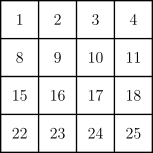
A block of calendar dates is shown. The order of the numbers in the second row is to be reversed. Then the order of the numbers in the fourth row is to be reversed. Finally, the numbers on each diagonal are to be added. What will be the positive difference between the two diagonal sums?
Answer: B
Small hint:
After reversing rows and write out the new grid
Big hint:
The main diagonal reads and the other reads
Solution:
After reversing the second row to and the fourth row to the two diagonals are and
Their sums are and so the positive difference is
Thus, the correct answer is B.
3.
A semipro baseball league has teams with players each. League rules state that a player must be paid at least and that the total of all players’ salaries for each team cannot exceed What is the maximum possible salary, in dollars, for a single player?
Answer: C
Small hint:
To maximize one salary, pay everyone else as little as allowed
Big hint:
The other players each earn
Solution:
One player’s salary is largest when the other players each earn the minimum
That leaves for the single player.
Thus, the correct answer is C.
4.
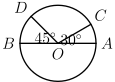
On circle points and are on the same side of diameter and What is the ratio of the area of the smaller sector to the area of the circle?
Small hint:
and together make the straight angle
Big hint:
A sector’s fraction of the circle is its central angle divided by
Solution:
Since and fill the straight angle over diameter
The sector’s share of the circle is
Thus, the correct answer is D.
5.
A class collects to buy flowers for a classmate who is in the hospital. Roses cost each, and carnations cost each. No other flowers are to be used. How many different bouquets could be purchased for exactly
Answer: C
Small hint:
Let be the number of roses; then
Big hint:
Since is even and is even, must be even, and
Solution:
If roses and carnations are bought, then Because and are even, must be even, so is even.
Also so The even values each give a valid which is bouquets.
Thus, the correct answer is C.
6.
Postman Pete has a pedometer to count his steps. The pedometer records up to steps, then flips over to on the next step. Pete plans to determine his mileage for a year. On January Pete sets the pedometer to During the year, the pedometer flips from to forty-four times. On December the pedometer reads Pete takes steps per mile. Which of the following is closest to the number of miles Pete walked during the year?
Answer: A
Small hint:
Each flip represents steps
Big hint:
Total steps are then divide by
Solution:
Each flip counts steps, so Pete took steps.
Dividing by gives about miles, which is closest to
Thus, the correct answer is A.
7.
For real numbers and define What is
Answer: A
Small hint:
Compare and
Big hint:
Once you know the two inputs agree, apply the definition of
Solution:
Since the two inputs are identical.
Therefore
Thus, the correct answer is A.
8.
Points and lie on The length of is times the length of and the length of is times the length of The length of is what fraction of the length of
Answer: C
Small hint:
From and find as a fraction of
Big hint:
Similarly and
Solution:
Since and we get so
Since and we get so
Then
Thus, the correct answer is C.
9.
Points and are on a circle of radius and Point is the midpoint of the minor arc What is the length of the line segment
Answer: A
Small hint:
The line from the center through perpendicularly bisects chord
Big hint:
Find the center-to-chord distance, subtract from to reach then use the right triangle with leg
Solution:
Let be the center and the midpoint of Then with so
Since is the midpoint of the minor arc, are collinear and
Then
Thus, the correct answer is A.
10.
Bricklayer Brenda would take hours to build a chimney alone, and bricklayer Brandon would take hours to build it alone. When they work together, they talk a lot, and their combined output is decreased by bricks per hour. Working together, they build the chimney in hours. How many bricks are in the chimney?
Answer: B
Small hint:
Let be the number of bricks; their solo rates are and
Big hint:
Together they lay bricks per hour for hours to total
Solution:
Let be the number of bricks. Brenda lays per hour and Brandon so together they lay per hour.
Over hours this equals Solving, which gives
Thus, the correct answer is B.
11.
A cone-shaped mountain has its base on the ocean floor and has a height of feet. The top of the volume of the mountain is above water. What is the depth of the ocean at the base of the mountain, in feet?
Answer: A
Small hint:
The above-water part is a smaller cone similar to the whole mountain
Big hint:
The volume ratio is the cube of the height ratio; the depth is the total height minus the above-water cone’s height
Solution:
The part above the water is a cone similar to the whole mountain, with volume of the total. Since volume scales as the cube of length, the above-water cone’s height is of the full height.
So the above-water height is feet.
The ocean depth at the base is the submerged height, feet.
Thus, the correct answer is A.
12.
For each positive integer the mean of the first terms of a sequence is What is the th term of the sequence?
Answer: B
Small hint:
The sum of the first terms is
Big hint:
The th term is
Solution:
Since the mean of the first terms is their sum is
The th term is so the th term is
Thus, the correct answer is B.
13.
Vertex of equilateral is in the interior of unit square Let be the region consisting of all points inside and outside whose distance from is between and What is the area of
Answer: B
Small hint:
Take as a side of the square; “distance from between and ” is a vertical strip of width and area
Big hint:
From that strip’s area subtract the part of the strip that lies inside
Solution:
Place so lies along the -axis and distance from is the -coordinate. The region lies in the strip which within the square has area
Equilateral has and area Its part with is a right triangle with a angle at legs and and area By symmetry, so is its part with The area of the triangle inside the strip is
Therefore
Thus, the correct answer is B.
14.
A circle has a radius of and a circumference of What is
Answer: C
Small hint:
Circumference equals times the radius
Big hint:
Use and then form
Solution:
The circumference is times the radius, so
Rewriting, hence
Therefore
Thus, the correct answer is C.
15.
On each side of a unit square, an equilateral triangle of side length is constructed. On each new side of each equilateral triangle, another equilateral triangle of side length is constructed. The interiors of the square and the triangles have no points in common. Let be the region formed by the union of the square and all the triangles, and let be the smallest convex polygon that contains What is the area of the region that is inside but outside
Answer: C
Small hint:
The gap between and is four small triangles, one at each corner of the square
Big hint:
Each gap triangle has two sides of length meeting at angle use
Solution:
The convex hull differs from only near the four corners of the square, where a small triangular gap forms. Each gap triangle has two sides of length (outer edges of adjacent triangles).
The angle between those two sides is so each gap has area
The total area is
Thus, the correct answer is C.
16.
A rectangular floor measures feet by feet, where and are positive integers with An artist paints a rectangle on the floor with the sides of the rectangle parallel to the sides of the floor. The unpainted part of the floor forms a border of width foot around the painted rectangle and occupies half the area of the entire floor. How many possibilities are there for the ordered pair
Answer: B
Small hint:
The painted rectangle measures by and its area is half of
Big hint:
From rearrange to
Solution:
The painted rectangle is and it is half the floor, so
Expanding gives and adding yields
With the factorizations give and So there are possibilities.
Thus, the correct answer is B.
17.
Let and be three distinct points on the graph of such that line is parallel to the -axis and is a right triangle with area What is the sum of the digits of the -coordinate of
Answer: C
Small hint:
Write and since have distinct -coordinates, the right angle is at
Big hint:
Perpendicular legs and force the height above get from the area, then
Solution:
Since is horizontal, take and and let The right angle cannot be at or (that would need ), so it is at
Put Taking the dot product of and gives The points are distinct, so hence This value is the height of the triangle above
The area is so and the -coordinate of is
Its digit sum is
Thus, the correct answer is C.
18.
A pyramid has a square base and vertex The area of square is and the areas of and are and respectively. What is the volume of the pyramid?
Answer: E
Small hint:
The base has side the given triangle areas give slant distances and to sides and
Big hint:
Triangle has sides and stands perpendicular to the base; its altitude to is the pyramid’s height
Solution:
The square has side Let and be the feet of the perpendiculars from to and Then and
Triangle lies in a plane perpendicular to the base, so its altitude to is the pyramid’s height. By Heron’s formula with its area is so the altitude to is
The volume is
Thus, the correct answer is E.
19.
A function is defined by for all complex numbers where and are complex numbers and Suppose that and are both real. What is the smallest possible value of
Answer: B
Small hint:
Write and requiring and to be real gives two linear conditions
Big hint:
They force and so minimize over
Solution:
Let and Then and
Both being real forces and i.e. and
Hence which is smallest when giving
Thus, the correct answer is B.
20.
Michael walks at the rate of feet per second on a long straight path. Trash pails are located every feet along the path. A garbage truck travels at feet per second in the same direction as Michael and stops for seconds at each pail. As Michael passes a pail, he notices the truck ahead of him just leaving the next pail. How many times will Michael and the truck meet?
Answer: B
Small hint:
Number the pails so Michael starts at pail and the truck at pail track arrival times
Big hint:
Michael reaches pail at seconds; the truck leaves pail at seconds
Solution:
Number the pails so Michael is at pail and the truck at pail Michael reaches pail at seconds. The truck leaves pail at seconds and arrives there at seconds.
Michael and the truck are together at pail when which simplifies to
At pail they meet as the truck departs, at pails and Michael passes it, and at pail they meet as the truck arrives. Between pails and the truck must overtake Michael once more, so in total they meet times.
Thus, the correct answer is B.
21.
Two circles of radius are to be constructed as follows. The center of circle is chosen uniformly and at random from the line segment joining to The center of circle is chosen uniformly and at random, and independently of the first choice, from the line segment joining to What is the probability that circles and intersect?
Answer: E
Small hint:
With centers and the circles intersect iff i.e.
Big hint:
In the square of area find the area with by removing the two corner triangles where
Solution:
Let the centers be and with The circles (radius each) intersect iff the distance between centers is at most
The pairs fill the square of area The failing region is two right triangles, each with legs of total area
So the favorable area is and the probability is
Thus, the correct answer is E.
22.
A parking lot has spaces in a row. Twelve cars arrive, each of which requires one parking space, and their drivers choose their spaces at random from among the available spaces. Auntie Em then arrives in her SUV, which requires adjacent spaces. What is the probability that she is able to park?
Answer: E
Small hint:
The empty spaces are equally likely to be any of the she fails exactly when no two empties are adjacent
Big hint:
The number of ways to choose empty spaces among with no two adjacent is subtract that probability from
Solution:
After the cars park, spaces are empty, equally likely to be any of the for equally likely sets.
Auntie Em fails exactly when no two empty spaces are adjacent. The number of ways to place non-adjacent empties among is
So the probability she can park is
Thus, the correct answer is E.
23.
The sum of the base- logarithms of the divisors of is What is
Answer: A
Small hint:
The sum of the logs of the divisors equals the log of the product of all divisors
Big hint:
has divisors, and the product of the divisors of is this gives
Solution:
The sum of the base- logs of the divisors is the log of their product. A number with divisors has divisor product
Here has divisors, so the product is and its log is
Thus giving
Thus, the correct answer is A.
24.
Let Distinct points lie on the -axis, and distinct points lie on the graph of For every positive integer is an equilateral triangle. What is the least for which the length
Answer: C
Small hint:
If the apex sits at height above the midpoint; lying on gives
Big hint:
Subtracting consecutive relations yields so and
Solution:
Let and be the base of the th equilateral triangle. Its apex lies above the midpoint at height and being on gives i.e.
Writing the same relation for the previous triangle and subtracting gives and with we get Summing,
We need i.e. Since and the least such is
Thus, the correct answer is C.
25.
Let be a trapezoid with and Bisectors of and meet at and bisectors of and meet at What is the area of hexagon
Answer: B
Small hint:
so their bisectors meet at right angles, and the midpoint of is equidistant from
Big hint:
This puts on the midline with get the height from ( sides )
Solution:
Because so the bisectors of and meet at right angles, Then the midpoint of is the circumcenter of right triangle giving Thus where the last equality uses the angle bisector at Therefore The same argument gives for the midpoint of Hence are collinear on the midline.
The midline has length while and Hence
Drawing with on gives and In so and the trapezoid’s height is
The segment sits at half the height, so the hexagon splits into two trapezoids and
Thus, the correct answer is B.