2008 AMC 12A Solutions

Scroll down to view professionally curated solutions from LIVE by Po-Shen Loh, print PDF solutions, view answer key, or take the full timed exam.

All problems are used with official legal permission of the Mathematical Association of America (MAA).

1.

A bakery owner turns on his doughnut machine at 8:308{:}30 am. At 11:1011{:}10 am the machine has completed one third of the day’s job. At what time will the doughnut machine complete the job?
1:501{:}50 pm
3:003{:}00 pm
3:303{:}30 pm
4:304{:}30 pm
5:505{:}50 pm
Concepts:date and timeratio and proportion
Small hint:
Find how long one third of the job takes, in minutes
Big hint:
The whole job takes three times as long, measured from the 8:308{:}30 am start
Solution:
From 8:308{:}30 am to 11:1011{:}10 am is 22 hours and 4040 minutes, or 160160 minutes, to finish one third of the job.
The entire job therefore takes 3⋅160=4803 \cdot 160 = 480 minutes, or 88 hours.
Eight hours after 8:308{:}30 am is 4:304{:}30 pm.
Thus, the correct answer is D.

2.

What is the reciprocal of 12+23?\dfrac{1}{2} + \dfrac{2}{3}?
67\dfrac{6}{7}
76\dfrac{7}{6}
53\dfrac{5}{3}
33
72\dfrac{7}{2}
Concepts:fraction
Difficulty rating: 910
Small hint:
Add the two fractions using a common denominator
Big hint:
The reciprocal swaps the numerator and denominator
Solution:
Using a common denominator, 12+23=36+46=76. \dfrac{1}{2} + \dfrac{2}{3} = \dfrac{3}{6} + \dfrac{4}{6} = \dfrac{7}{6}.
The reciprocal of 76\dfrac{7}{6} is 67.\dfrac{6}{7}.
Thus, A is the correct answer.

3.

Suppose that 23\dfrac{2}{3} of 1010 bananas are worth as much as 88 oranges. How many oranges are worth as much as 12\dfrac{1}{2} of 55 bananas?
22
52\dfrac{5}{2}
33
72\dfrac{7}{2}
44
Difficulty rating: 1070
Small hint:
Find the worth of a single banana in oranges
Big hint:
23\dfrac{2}{3} of 1010 is 203\dfrac{20}{3} bananas, and these equal 88 oranges
Solution:
Since 23\dfrac{2}{3} of 1010 bananas is 203\dfrac{20}{3} bananas worth 88 oranges, one banana is worth 8÷203=658 \div \dfrac{20}{3} = \dfrac{6}{5} oranges.
Now 12\dfrac{1}{2} of 55 bananas is 52\dfrac{5}{2} bananas, worth 52⋅65=3\dfrac{5}{2} \cdot \dfrac{6}{5} = 3 oranges.
Thus, the correct answer is C.

4.

Which of the following is equal to the product
84⋅128⋅1612⋯4n+44n⋯20082004? \begin{aligned} &\dfrac{8}{4} \cdot \dfrac{12}{8} \cdot \dfrac{16}{12} \cdots \dfrac{4n+4}{4n} \\ &\quad \cdots \dfrac{2008}{2004}? \end{aligned}
251251
502502
10041004
20082008
40164016
Difficulty rating: 1120
Small hint:
Write out the first few factors and look for cancellation
Big hint:
Each numerator cancels the next denominator, leaving 20084\dfrac{2008}{4}
Solution:
Every denominator except the first cancels with the numerator of the previous fraction, so the whole product telescopes to 20084=502.\dfrac{2008}{4} = 502.
Thus, the correct answer is B.

5.

Suppose that
2x3−x6 \dfrac{2x}{3} - \dfrac{x}{6}
is an integer. Which of the following statements must be true about x?x?
It is negative.
It is even, but not necessarily a multiple of 3.3.
It is a multiple of 3,3, but not necessarily even.
It is a multiple of 6,6, but not necessarily a multiple of 12.12.
It is a multiple of 12.12.
Difficulty rating: 1140
Small hint:
Combine 2x3−x6\dfrac{2x}{3} - \dfrac{x}{6} over a common denominator
Big hint:
The expression simplifies to x2;\dfrac{x}{2}; decide what that being an integer forces about xx
Solution:
Combining over a common denominator, 2x3−x6=4x−x6=x2.\dfrac{2x}{3} - \dfrac{x}{6} = \dfrac{4x - x}{6} = \dfrac{x}{2}.
For x2\dfrac{x}{2} to be an integer, xx must be even.
The example x=4x = 4 shows that xx need not be a multiple of 33 and rules out the other statements.
Thus, the correct answer is B.

6.

Heather compares the price of a new computer at two different stores. Store A offers 15%15\% off the sticker price followed by a $90\$90 rebate, and store B offers 25%25\% off the same sticker price with no rebate. Heather saves $15\$15 by buying the computer at store A instead of store B. What is the sticker price of the computer, in dollars?
750750
900900
10001000
10501050
15001500
Difficulty rating: 1230
Small hint:
Let xx be the sticker price and write each store’s final price
Big hint:
Store A costs 0.85x−900.85x - 90 and store B costs 0.75x,0.75x, with A cheaper by $15\$15
Solution:
Let xx be the sticker price. Heather pays 0.85x−900.85x - 90 at store A and 0.75x0.75x at store B.
Since store A is $15\$15 cheaper, 0.85x−90=0.75x−15, 0.85x - 90 = 0.75x - 15, which gives 0.1x=75,0.1x = 75, so x=750.x = 750.
Thus, the correct answer is A.

7.

While Steve and LeRoy are fishing 11 mile from shore, their boat springs a leak, and water comes in at a constant rate of 1010 gallons per minute. The boat will sink if it takes in more than 3030 gallons of water. Steve starts rowing toward the shore at a constant rate of 44 miles per hour while LeRoy bails water out of the boat. What is the slowest rate, in gallons per minute, at which LeRoy can bail if they are to reach the shore without sinking?
22
44
66
88
1010
Difficulty rating: 1300
Small hint:
Find how many minutes Steve needs to row one mile
Big hint:
In that time 150150 gallons enter, but the boat can hold only 3030
Solution:
At 44 miles per hour, Steve rows 11 mile in 1515 minutes. During that time 15⋅10=15015 \cdot 10 = 150 gallons enter.
To stay under 3030 gallons, LeRoy must bail 150−30=120150 - 30 = 120 gallons in 1515 minutes, or 12015=8\dfrac{120}{15} = 8 gallons per minute.
Thus, the correct answer is D.

8.

What is the volume of a cube whose surface area is twice that of a cube with volume 1?1?
2\sqrt{2}
22
222\sqrt{2}
44
88
Difficulty rating: 1380
Small hint:
A cube with volume 11 has surface area 66
Big hint:
If the larger cube has side s,s, then 6s2=126s^2 = 12
Solution:
The cube with volume 11 has side 11 and surface area 6.6. The larger cube has surface area 12,12, so if its side is s,s, then 6s2=12,6s^2 = 12, giving s=2.s = \sqrt{2}.
Its volume is (2)3=22. (\sqrt{2})^3 = 2\sqrt{2}.
Thus, C is the correct answer.

9.

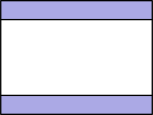
Older television screens have an aspect ratio of 4:3.4:3. That is, the ratio of the width to the height is 4:3.4:3. The aspect ratio of many movies is not 4:3,4:3, so they are sometimes shown on a television screen by “letterboxing” — darkening strips of equal height at the top and bottom of the screen, as shown. Suppose a movie has an aspect ratio of 2:12:1 and is shown on an older television screen with a 2727-inch diagonal. What is the height, in inches, of each darkened strip?
22
2.252.25
2.52.5
2.72.7
33
Difficulty rating: 1410
Small hint:
The screen’s sides satisfy h:w:27=3:4:5h : w : 27 = 3 : 4 : 5
Big hint:
The lit region has aspect ratio 2:1,2:1, so its height is half the screen width
Solution:
Since the screen is 4:34:3 with a 2727-inch diagonal, h:w:27=3:4:5,h : w : 27 = 3 : 4 : 5, giving height h=35⋅27=16.2h = \dfrac{3}{5}\cdot 27 = 16.2 and width w=45⋅27=21.6.w = \dfrac{4}{5}\cdot 27 = 21.6.
The lit 2:12:1 region has the full width 21.621.6 and height 21.62=10.8.\dfrac{21.6}{2} = 10.8.
The two strips share the remaining height, so each has height 16.2−10.82=2.7.\dfrac{16.2 - 10.8}{2} = 2.7.
Thus, the correct answer is D.

10.

Doug can paint a room in 55 hours. Dave can paint the same room in 77 hours. Doug and Dave paint the room together and take a one-hour break for lunch. Let tt be the total time, in hours, required for them to complete the job working together, including lunch. Which of the following equations is satisfied by t?t?
(15+17)(t+1)=1\left(\dfrac{1}{5} + \dfrac{1}{7}\right)(t + 1) = 1
(15+17)t+1=1\left(\dfrac{1}{5} + \dfrac{1}{7}\right)t + 1 = 1
(15+17)t=1\left(\dfrac{1}{5} + \dfrac{1}{7}\right)t = 1
(15+17)(t−1)=1\left(\dfrac{1}{5} + \dfrac{1}{7}\right)(t - 1) = 1
(5+7)t=1(5 + 7)t = 1
Difficulty rating: 1330
Small hint:
Together they paint 15+17\dfrac{1}{5} + \dfrac{1}{7} of the room each working hour
Big hint:
They actually work for t−1t - 1 hours because of the one-hour lunch break
Solution:
Working together, Doug and Dave paint 15+17\dfrac{1}{5} + \dfrac{1}{7} of the room per hour.
Because they break for one hour, they work for only t−1t - 1 hours, and this must complete the whole room:
(15+17)(t−1)=1. \left(\dfrac{1}{5} + \dfrac{1}{7}\right)(t - 1) = 1.
Thus, the correct answer is D.

11.

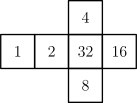
Three cubes are each formed from the pattern shown. They are then stacked on a table one on top of another so that the 1313 visible numbers have the greatest possible sum. What is that sum?
154154
159159
164164
167167
189189
Difficulty rating: 1560
Small hint:
On each cube the opposite faces are 11 & 32,32, 22 & 16,16, and 44 & 88
Big hint:
The two lower cubes each hide a pair of opposite faces; the top cube hides only its bottom face
Solution:
The six faces of each cube sum to 1+2+4+8+16+32=63.1 + 2 + 4 + 8 + 16 + 32 = 63. From the pattern, the pairs of opposite faces are 11 & 32,32, 22 & 16,16, and 44 & 8.8.
Each of the two lower cubes hides a pair of opposite faces (top and bottom); hiding the pair 4+8=124 + 8 = 12 is best. The top cube hides only its bottom face, so hide the 1.1.
The greatest sum is 3⋅63−2⋅12−1=189−24−1=164. \begin{aligned} &3 \cdot 63 - 2 \cdot 12 - 1 \\ &= 189 - 24 - 1 \\ &= 164. \end{aligned}
Thus, C is the correct answer.

12.

A function ff has domain [0,2][0, 2] and range [0,1].[0, 1]. (The notation [a,b][a, b] denotes {x:a≤x≤b}.\{x : a \le x \le b\}.) What are the domain and range, respectively, of the function gg defined by g(x)=1−f(x+1)?g(x) = 1 - f(x + 1)?
[−1,1],[-1, 1], [−1,0][-1, 0]
[−1,1],[-1, 1], [0,1][0, 1]
[0,2],[0, 2], [−1,0][-1, 0]
[1,3],[1, 3], [−1,0][-1, 0]
[1,3],[1, 3], [0,1][0, 1]
Concepts:function
Difficulty rating: 1620
Small hint:
f(x+1)f(x + 1) is defined when 0≤x+1≤20 \le x + 1 \le 2
Big hint:
Subtracting f(x+1)∈[0,1]f(x + 1) \in [0, 1] from 11 reverses the interval but keeps it [0,1][0, 1]
Solution:
The value f(x+1)f(x + 1) is defined when 0≤x+1≤2,0 \le x + 1 \le 2, that is, −1≤x≤1,-1 \le x \le 1, so the domain of gg is [−1,1].[-1, 1].
As f(x+1)f(x + 1) ranges over [0,1],[0, 1], the value 1−f(x+1)1 - f(x + 1) ranges over [0,1][0, 1] as well, so the range of gg is [0,1].[0, 1].
Thus, B is the correct answer.

13.

Points AA and BB lie on a circle centered at O,O, and ∠AOB=60∘.\angle AOB = 60^\circ. A second circle is internally tangent to the first and tangent to both OAOA and OB.OB. What is the ratio of the area of the smaller circle to that of the larger circle?
116\dfrac{1}{16}
19\dfrac{1}{9}
18\dfrac{1}{8}
16\dfrac{1}{6}
14\dfrac{1}{4}
Difficulty rating: 1600
Small hint:
The small circle’s center lies on the bisector of ∠AOB\angle AOB
Big hint:
The center is 2r2r from OO by a 3030-6060-9090 triangle, and also R−rR - r from OO
Solution:
Let the radii be rr and R.R. The small circle’s center EE lies on the bisector of ∠AOB,\angle AOB, so OEOE makes a 30∘30^\circ angle with OA.OA.
The perpendicular from EE to OAOA has length r,r, and in the resulting 3030-6060-9090 triangle OE=2r.OE = 2r.
Since OE=R−r,OE = R - r, we get 2r=R−r,2r = R - r, so R=3rR = 3r and the area ratio is (13)2=19.\left(\dfrac{1}{3}\right)^2 = \dfrac{1}{9}.
Thus, the correct answer is B.

14.

What is the area of the region defined by the inequality ∣3x−18∣+∣2y+7∣≤3?|3x - 18| + |2y + 7| \le 3?
33
72\dfrac{7}{2}
44
92\dfrac{9}{2}
55
Difficulty rating: 1660
Small hint:
The region is a rhombus centered where 3x−18=03x - 18 = 0 and 2y+7=02y + 7 = 0
Big hint:
Its horizontal diagonal spans x∈[5,7]x \in [5, 7] and its vertical diagonal spans y∈[−5,−2]y \in [-5, -2]
Solution:
The region is a rhombus centered at (6,−72).\left(6, -\tfrac{7}{2}\right). Setting 2y+7=02y + 7 = 0 gives ∣3x−18∣≤3,|3x - 18| \le 3, so x∈[5,7],x \in [5, 7], a horizontal diagonal of length 2.2.
Setting 3x−18=03x - 18 = 0 gives ∣2y+7∣≤3,|2y + 7| \le 3, so y∈[−5,−2],y \in [-5, -2], a vertical diagonal of length 3.3.
The area of the rhombus is half the product of its diagonals, 12⋅2⋅3=3. \dfrac{1}{2} \cdot 2 \cdot 3 = 3.
Thus, A is the correct answer.

15.

Let k=20082+22008.k = 2008^2 + 2^{2008}. What is the units digit of k2+2k?k^2 + 2^k?
00
22
44
66
88
Difficulty rating: 1820
Small hint:
Find the units digit of kk first
Big hint:
220082^{2008} ends in 66 and 200822008^2 ends in 4;4; then determine k mod 4k \bmod 4 to handle 2k2^k
Solution:
The units digit of 2n2^n cycles 2,4,8,6,2, 4, 8, 6, so 220082^{2008} ends in 6.6. Also 200822008^2 ends in 4.4.
Thus kk ends in 0,0, so k2k^2 ends in 0.0.
Both 200822008^2 and 220082^{2008} are multiples of 4,4, so k≡0(mod4),k \equiv 0 \pmod 4, which makes 2k2^k end in 6.6.
The units digit of k2+2kk^2 + 2^k is 0+6=6.0 + 6 = 6.
Thus, the correct answer is D.

16.

The numbers log⁡(a3b7),\log(a^3 b^7), log⁡(a5b12),\log(a^5 b^{12}), and log⁡(a8b15)\log(a^8 b^{15}) are the first three terms of an arithmetic sequence, and the 1212th term of the sequence is log⁡(bn).\log(b^n). What is n?n?
4040
5656
7676
112112
143143
Difficulty rating: 1800
Small hint:
Write each term as plog⁡a+qlog⁡bp \log a + q \log b and set the consecutive differences equal
Big hint:
Equal differences force log⁡a=2log⁡b,\log a = 2 \log b, reducing every term to a multiple of log⁡b\log b
Solution:
The three terms are 3log⁡a+7log⁡b,3\log a + 7\log b, 5log⁡a+12log⁡b,5\log a + 12\log b, and 8log⁡a+15log⁡b.8\log a + 15\log b. Setting the two consecutive differences equal, 2log⁡a+5log⁡b=3log⁡a+3log⁡b, \begin{aligned} &2\log a + 5\log b \\ &= 3\log a + 3\log b, \end{aligned} so log⁡a=2log⁡b.\log a = 2\log b.
The first term is then (3⋅2+7)log⁡b=13log⁡b,(3 \cdot 2 + 7)\log b = 13\log b, and the common difference is (2⋅2+5)log⁡b=9log⁡b.(2 \cdot 2 + 5)\log b = 9\log b.
The 1212th term is (13+11⋅9)log⁡b=112log⁡b=log⁡(b112), \begin{aligned} (13 + 11 \cdot 9)\log b &= 112\log b \\ &= \log(b^{112}), \end{aligned} so n=112.n = 112.
Thus, D is the correct answer.

17.

Let a1,a_1, a2,a_2, …\ldots be a sequence of integers determined by the rule an=an−12a_n = \frac{a_{n-1}}{2} if an−1a_{n-1} is even and an=3an−1+1a_n = 3a_{n-1} + 1 if an−1a_{n-1} is odd. For how many positive integers a1≤2008a_1 \le 2008 is it true that a1a_1 is less than each of a2,a_2, a3,a_3, and a4?a_4?
250250
251251
501501
502502
10041004
Difficulty rating: 1870
Small hint:
If a1a_1 is even then a2<a1,a_2 \lt a_1, so a1a_1 must be odd
Big hint:
Split the odd case according to whether a1≡1a_1 \equiv 1 or a1≡3(mod4)a_1 \equiv 3 \pmod 4
Solution:
If a1a_1 is even, then a2=a12<a1,a_2 = \frac{a_1}{2} \lt a_1, so the condition fails.
If a1≡1(mod4),a_1 \equiv 1 \pmod 4, then a2=3a1+1a_2 = 3a_1 + 1 is a multiple of 4,4, so a3=3a1+12a_3 = \frac{3a_1 + 1}{2} and a4=3a1+14≤a1,a_4 = \frac{3a_1 + 1}{4} \le a_1, and again the condition fails.
If a1≡3(mod4),a_1 \equiv 3 \pmod 4, then a2a_2 is even but not a multiple of 4,4, so a3=3a1+12>a1,a_3 = \frac{3a_1 + 1}{2} \gt a_1, and a3a_3 is odd, giving a4=3a3+1>a3>a1.a_4 = 3a_3 + 1 \gt a_3 \gt a_1. The condition holds.
Exactly 20084=502\tfrac{2008}{4} = 502 values of a1≤2008a_1 \le 2008 satisfy a1≡3(mod4).a_1 \equiv 3 \pmod 4.
Thus, D is the correct answer.

18.

Triangle ABC,ABC, with sides of length 5,5, 6,6, and 7,7, has one vertex on the positive xx-axis, one on the positive yy-axis, and one on the positive zz-axis. Let OO be the origin. What is the volume of tetrahedron OABC?OABC?
85\sqrt{85}
90\sqrt{90}
95\sqrt{95}
1010
105\sqrt{105}
Difficulty rating: 1910
Small hint:
Let the vertices be (a,0,0),(a, 0, 0), (0,b,0),(0, b, 0), (0,0,c)(0, 0, c) and write the three side-length equations
Big hint:
Adding the three equations gives a2+b2+c2,a^2 + b^2 + c^2, and the volume is 16abc\tfrac{1}{6}abc
Solution:
Let A=(a,0,0),A = (a, 0, 0), B=(0,b,0),B = (0, b, 0), C=(0,0,c).C = (0, 0, c). Assigning the sides, a2+b2=25,b2+c2=36,a2+c2=49. \begin{aligned} a^2 + b^2 &= 25, \\ b^2 + c^2 &= 36, \\ a^2 + c^2 &= 49. \end{aligned}
Adding gives a2+b2+c2=55,a^2 + b^2 + c^2 = 55, so a2=19,a^2 = 19, b2=6,b^2 = 6, and c2=30.c^2 = 30.
The volume is 16abc=1619⋅6⋅30=163420=95. \begin{aligned} \dfrac{1}{6}abc &= \dfrac{1}{6}\sqrt{19 \cdot 6 \cdot 30} \\ &= \dfrac{1}{6}\sqrt{3420} \\ &= \sqrt{95}. \end{aligned}
Thus, C is the correct answer.

19.

In the expansion of (1+x+x2+⋯+x27)⋅(1+x+x2+⋯+x14)2, \begin{aligned} &\left(1 + x + x^2 + \cdots + x^{27}\right) \\ &\quad {}\cdot \left(1 + x + x^2 + \cdots + x^{14}\right)^2, \end{aligned} what is the coefficient of x28?x^{28}?
195195
196196
224224
378378
405405
Difficulty rating: 1930
Small hint:
A term has the form xa+b+cx^{a+b+c} with 0≤a≤270 \le a \le 27 and 0≤b,c≤140 \le b, c \le 14
Big hint:
For each of the 15215^2 pairs (b,c),(b, c), there is a unique valid a,a, except when b=c=0b = c = 0
Solution:
Each term is xa+b+cx^{a + b + c} with 0≤a≤270 \le a \le 27 and 0≤b,c≤14.0 \le b, c \le 14. To get x28x^{28} we need a=28−b−c.a = 28 - b - c.
There are (14+1)2=225(14 + 1)^2 = 225 choices for (b,c).(b, c). For every choice except (b,c)=(0,0),(b, c) = (0, 0), the required a=28−b−ca = 28 - b - c lies in [0,27],[0, 27], giving a valid term.
The coefficient of x28x^{28} is therefore 225−1=224.225 - 1 = 224.
Thus, C is the correct answer.

20.

Triangle ABCABC has AC=3,AC = 3, BC=4,BC = 4, and AB=5.AB = 5. Point DD is on AB,AB, and CDCD bisects the right angle. The inscribed circles of △ADC\triangle ADC and △BCD\triangle BCD have radii rar_a and rb,r_b, respectively. What is rarb?\frac{r_a}{r_b}?
128(10−2)\dfrac{1}{28}(10 - \sqrt{2})
356(10−2)\dfrac{3}{56}(10 - \sqrt{2})
114(10−2)\dfrac{1}{14}(10 - \sqrt{2})
556(10−2)\dfrac{5}{56}(10 - \sqrt{2})
328(10−2)\dfrac{3}{28}(10 - \sqrt{2})
Difficulty rating: 2100
Small hint:
By the Angle Bisector Theorem, AD:DB=CA:CB=3:4AD:DB = CA:CB = 3:4
Big hint:
For each small triangle r=areas;r = \frac{\text{area}}{s}; the two triangles share the base CDCD
Solution:
By the Angle Bisector Theorem, AD:DB=CA:CB=3:4,AD:DB = CA:CB = 3:4, so AD=157AD = \tfrac{15}{7} and BD=207.BD = \tfrac{20}{7}. The areas of △ADC\triangle ADC and △BCD\triangle BCD share base CD,CD, so they are in ratio 3:4,3:4, namely 187\tfrac{18}{7} and 247.\tfrac{24}{7}.
Splitting △ABC\triangle ABC along CD,CD, which meets each leg at 45∘,45^\circ, gives 3⋅CD22+4⋅CD22=6, \dfrac{3 \cdot CD}{2\sqrt{2}} + \dfrac{4 \cdot CD}{2\sqrt{2}} = 6, so CD=1227.CD = \tfrac{12\sqrt{2}}{7}.
The two semiperimeters are sa=67(3+2),sb=67(4+2). \begin{aligned} s_a &= \dfrac{6}{7}(3 + \sqrt{2}), \\ s_b &= \dfrac{6}{7}(4 + \sqrt{2}). \end{aligned} Using r=areas,r = \frac{\text{area}}{s}, rarb=[ADC][BCD]⋅sbsa=34⋅4+23+2, \begin{aligned} \dfrac{r_a}{r_b} &= \dfrac{[ADC]}{[BCD]} \cdot \dfrac{s_b}{s_a} \\ &= \dfrac{3}{4} \cdot \dfrac{4 + \sqrt{2}}{3 + \sqrt{2}}, \end{aligned}
Rationalizing, 4+23+2=10−27,\dfrac{4 + \sqrt{2}}{3 + \sqrt{2}} = \dfrac{10 - \sqrt{2}}{7}, so rarb=34⋅10−27=328(10−2). \begin{aligned} \dfrac{r_a}{r_b} &= \dfrac{3}{4} \cdot \dfrac{10 - \sqrt{2}}{7} \\ &= \dfrac{3}{28}(10 - \sqrt{2}). \end{aligned}
Thus, E is the correct answer.

21.

A permutation (a1,a2,a3,a4,a5)(a_1, a_2, a_3, a_4, a_5) of (1,2,3,4,5)(1, 2, 3, 4, 5) is heavy-tailed if a1+a2<a4+a5.a_1 + a_2 \lt a_4 + a_5. What is the number of heavy-tailed permutations?
3636
4040
4444
4848
5252
Difficulty rating: 2050
Small hint:
By symmetry, a1+a2<a4+a5a_1 + a_2 \lt a_4 + a_5 and a1+a2>a4+a5a_1 + a_2 \gt a_4 + a_5 occur equally often
Big hint:
Count the balanced permutations a1+a2=a4+a5;a_1 + a_2 = a_4 + a_5; here a3∈{1,3,5}a_3 \in \{1, 3, 5\}
Solution:
Call a permutation balanced if a1+a2=a4+a5.a_1 + a_2 = a_4 + a_5. Reversing the entries swaps the two strict cases, so heavy-tailed and heavy-headed permutations are equally numerous.
The total 1+2+3+4+5=151 + 2 + 3 + 4 + 5 = 15 is odd, so in a balanced permutation a3a_3 must be odd, one of 1,3,5.1, 3, 5. For each choice, the remaining four numbers split uniquely into two equal-sum pairs.
Any of the four can be a1a_1 (fixing a2a_2), and either remaining number can be a4a_4 (fixing a5a_5), giving 3⋅4⋅2=243 \cdot 4 \cdot 2 = 24 balanced permutations.
The other 120−24=96120 - 24 = 96 permutations split evenly, so there are 962=48\tfrac{96}{2} = 48 heavy-tailed permutations.
Thus, D is the correct answer.

22.

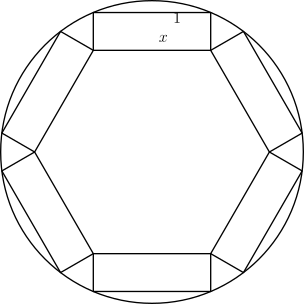
A round table has radius 4.4. Six rectangular place mats are placed on the table. Each place mat has width 11 and length xx as shown. They are positioned so that each mat has two corners on the edge of the table, these two corners being end points of the same side of length x.x. Further, the mats are positioned so that the inner corners each touch an inner corner of an adjacent mat. What is x?x?
25−32\sqrt{5} - \sqrt{3}
33
37−32\dfrac{3\sqrt{7} - \sqrt{3}}{2}
232\sqrt{3}
5+232\dfrac{5 + 2\sqrt{3}}{2}
Difficulty rating: 2140
Small hint:
Take one mat with outer corners P,Q,P, Q, and let RR be the point of the circle opposite P,P, so △PQR\triangle PQR is right-angled with hypotenuse 88
Big hint:
The inner corners meet in 120∘120^\circ isosceles triangles, giving QR=3 x+2QR = \sqrt{3}\,x + 2
Solution:
Pick a mat with outer corners PP and Q,Q, and let RR be the point on the circle diametrically opposite P.P. Then △PQR\triangle PQR is right-angled at QQ with hypotenuse PR=8.PR = 8.
The inner corners of adjacent mats meet in isosceles triangles with vertex angle 120∘120^\circ and sides x,x, whose base is 3 x.\sqrt{3}\,x. Together with the two mat widths, QR=3 x+2.QR = \sqrt{3}\,x + 2.
By the Pythagorean theorem, (3 x+2)2+x2=64, \left(\sqrt{3}\,x + 2\right)^2 + x^2 = 64, which simplifies to x2+3 x−15=0.x^2 + \sqrt{3}\,x - 15 = 0.
Taking the positive root, x=37−32. x = \dfrac{3\sqrt{7} - \sqrt{3}}{2}.
Thus, the correct answer is C.

23.

The solutions of the equation z4+4z3i−6z2−4zi−i=0z^4 + 4z^3 i - 6z^2 - 4zi - i = 0 are the vertices of a convex polygon in the complex plane. What is the area of the polygon?
2582^{\frac{5}{8}}
2342^{\frac{3}{4}}
22
2542^{\frac{5}{4}}
2322^{\frac{3}{2}}
Difficulty rating: 2240
Small hint:
Add 1+i1 + i to both sides to recognize a perfect fourth power
Big hint:
The four values of z+iz + i lie equally spaced on a circle of radius 218,2^{\frac{1}{8}}, forming a square
Solution:
Adding 1+i1 + i to both sides, the left side becomes z4+4z3i−6z2−4zi+1=(z+i)4, \begin{aligned} &z^4 + 4z^3 i - 6z^2 - 4zi + 1 \\ &= (z + i)^4, \end{aligned} so (z+i)4=1+i.(z + i)^4 = 1 + i.
The four solutions for w=z+iw = z + i are equally spaced on a circle of radius ∣1+i∣14=(212)14=218,|1 + i|^{\frac{1}{4}} = (2^{\frac{1}{2}})^{\frac{1}{4}} = 2^{\frac{1}{8}}, and they form a square. Subtracting ii merely translates it.
A square inscribed in a circle of radius 2182^{\frac{1}{8}} has diagonal 2⋅218=298,2 \cdot 2^{\frac{1}{8}} = 2^{\frac{9}{8}}, so its side is 2982=258.\tfrac{2^{\frac{9}{8}}}{\sqrt{2}} = 2^{\frac{5}{8}}.
The area is (258)2=254. \left(2^{\frac{5}{8}}\right)^2 = 2^{\frac{5}{4}}.
Thus, D is the correct answer.

24.

Triangle ABCABC has ∠C=60∘\angle C = 60^\circ and BC=4.BC = 4. Point DD is the midpoint of BC.BC. What is the largest possible value of tan⁡(∠BAD)?\tan(\angle BAD)?
36\dfrac{\sqrt{3}}{6}
33\dfrac{\sqrt{3}}{3}
322\dfrac{\sqrt{3}}{2\sqrt{2}}
342−3\dfrac{\sqrt{3}}{4\sqrt{2} - 3}
11
Difficulty rating: 2380
Small hint:
Place C=(0,0),C = (0, 0), B=(2,23),B = (2, 2\sqrt{3}), and A=(x,0)A = (x, 0) with x>0x \gt 0
Big hint:
Using slopes gives tan⁡(∠BAD)=3 xx2−3x+8;\tan(\angle BAD) = \dfrac{\sqrt{3}\,x}{x^2 - 3x + 8}; divide through by xx and use AM-GM
Solution:
Place C=(0,0),C = (0, 0), B=(2,23)B = (2, 2\sqrt{3}) so that ∠C=60∘\angle C = 60^\circ and BC=4,BC = 4, and let A=(x,0)A = (x, 0) with x>0.x \gt 0. Then D=(1,3)D = (1, \sqrt{3}) is the midpoint of BC.BC.
The vectors AB→=(2−x,23)\overrightarrow{AB} = (2-x, 2\sqrt{3}) and AD→=(1−x,3)\overrightarrow{AD} = (1-x, \sqrt{3}) have cross-product magnitude 3 x\sqrt{3}\,x and dot product x2−3x+8,x^2 - 3x + 8, which is always positive. Hence tan⁡(∠BAD)=3 xx2−3x+8. \tan(\angle BAD) = \dfrac{\sqrt{3}\,x}{x^2 - 3x + 8}.
Dividing the numerator and denominator by x,x, tan⁡(∠BAD)=3x+8x−3. \tan(\angle BAD) = \dfrac{\sqrt{3}}{x + \frac{8}{x} - 3}. By AM-GM, x+8x≥28=42,x + \frac{8}{x} \ge 2\sqrt{8} = 4\sqrt{2}, with equality at x=22.x = 2\sqrt{2}. Since 42−3>0,4\sqrt{2} - 3 \gt 0, the denominator is positive and smallest there, so the largest value is tan⁡(∠BAD)=342−3. \tan(\angle BAD) = \dfrac{\sqrt{3}}{4\sqrt{2} - 3}.
Thus, D is the correct answer.

25.

A sequence (a1,b1),(a_1, b_1), (a2,b2),(a_2, b_2), (a3,b3),(a_3, b_3), …\ldots of points in the coordinate plane satisfies (an+1,bn+1)=(3 an−bn,  3 bn+an)(n=1,2,3,…) \begin{aligned} &(a_{n+1}, b_{n+1}) \\ &= \left(\sqrt{3}\,a_n - b_n,\; \sqrt{3}\,b_n + a_n\right) \\ &\quad (n = 1, 2, 3, \ldots) \end{aligned} Suppose that (a100,b100)=(2,4).(a_{100}, b_{100}) = (2, 4). What is a1+b1?a_1 + b_1?
−1297-\dfrac{1}{2^{97}}
−1299-\dfrac{1}{2^{99}}
00
1298\dfrac{1}{2^{98}}
1296\dfrac{1}{2^{96}}
Difficulty rating: 2440
Small hint:
Write zn=an+bni;z_n = a_n + b_n i; the recurrence becomes zn+1=zn(3+i)z_{n+1} = z_n(\sqrt{3} + i)
Big hint:
Since 3+i=2(cos⁡30∘+isin⁡30∘),\sqrt{3} + i = 2(\cos 30^\circ + i\sin 30^\circ), apply De Moivre’s theorem to (3+i)99(\sqrt{3} + i)^{99}
Solution:
Let zn=an+bni.z_n = a_n + b_n i. Then zn+1=(3 an−bn)+(3 bn+an)i=(an+bni)(3+i), \begin{aligned} z_{n+1} &= (\sqrt{3}\,a_n - b_n) \\ &\quad {}+ (\sqrt{3}\,b_n + a_n)i \\ &= (a_n + b_n i)(\sqrt{3} + i), \end{aligned} so zn+1=zn(3+i)z_{n+1} = z_n(\sqrt{3} + i) and z100=z1(3+i)99.z_{100} = z_1(\sqrt{3} + i)^{99}.
Since 3+i=2(cos⁡30∘+isin⁡30∘),\sqrt{3} + i = 2(\cos 30^\circ + i\sin 30^\circ), De Moivre’s theorem gives (3+i)99(\sqrt{3} + i)^{99} =299(cos⁡2970∘+isin⁡2970∘).= 2^{99}(\cos 2970^\circ + i\sin 2970^\circ). As 2970∘2970^\circ is coterminal with 90∘,90^\circ, this equals 299i.2^{99} i.
Thus 2+4i=z1⋅299i,2 + 4i = z_1 \cdot 2^{99} i, so z1=2+4i299i=4−2i299. z_1 = \dfrac{2 + 4i}{2^{99} i} = \dfrac{4 - 2i}{2^{99}}.
Then a1=4299a_1 = \tfrac{4}{2^{99}} and b1=−2299,b_1 = -\tfrac{2}{2^{99}}, so a1+b1=2299=1298. a_1 + b_1 = \dfrac{2}{2^{99}} = \dfrac{1}{2^{98}}.
Thus, D is the correct answer.
LIVE by Po-Shen Loh
Programs

LIVE Classes

Self-Paced Classes

Stars

Scholarship

About Us

Who Is Po-Shen Loh?

Email Contact

Newsletter

Jobs

Become a Star

For a more Thought Full world.

© 2026 Expii, Inc.Terms of UsePrivacy PolicyCOPPA Privacy Policy