
2006 AMC 12A Solutions
Scroll down to view professionally curated solutions from LIVE by Po-Shen Loh, print PDF solutions, view answer key, or take the full timed exam.
All problems are used with official legal permission of the Mathematical Association of America (MAA).
1.
Sandwiches at Joe’s Fast Food cost each and sodas cost each. How many dollars will it cost to purchase sandwiches and sodas?
Small Hint:
Multiply each price by its quantity
Big Hint:
The total is
Solution:
Five sandwiches cost dollars and eight sodas cost dollars. Together they cost dollars.
Thus, the correct answer is A.
2.
Define What is
Small Hint:
Evaluate the inner first
Big Hint:
then apply once more
Solution:
By the definition, Then
Thus, the correct answer is C.
3.
The ratio of Mary’s age to Alice’s age is Alice is years old. How old is Mary?
Small Hint:
Mary’s age is of Alice’s age
Big Hint:
Compute
Solution:
Mary’s age is of Alice’s, so Mary is years old.
Thus, the correct answer is B.
4.
A digital watch displays hours and minutes with AM and PM. What is the largest possible sum of the digits in the display?
Small Hint:
Maximize the minutes digits and the hour digits separately
Big Hint:
The two minutes digits sum to at most the best hour is the single digit
Solution:
The two minutes digits sum to at most at minutes past the hour. For the hour, a single digit gives digit sum which beats any two-digit hour give at most
The largest total is occurring at
Thus, the correct answer is E.
5.
Doug and Dave shared a pizza with equally-sized slices. Doug wanted a plain pizza, but Dave wanted anchovies on half of the pizza. The cost of a plain pizza was and there was an additional cost of for putting anchovies on one half. Dave ate all the slices of anchovy pizza and one plain slice. Doug ate the remainder. Each then paid for what he had eaten. How many more dollars did Dave pay than Doug?
Small Hint:
The plain pizza is for slices, so each plain slice costs
Big Hint:
Spread the anchovy surcharge over the anchovy slices, then total each person’s cost
Solution:
Each plain slice costs The anchovy charge is spread over the anchovy slices, adding each, so an anchovy slice costs
Dave ate anchovy slices and plain slice: Doug ate the remaining plain slices: Dave paid more.
Thus, the correct answer is D.
6.
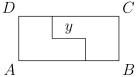
The rectangle is cut into two congruent hexagons, as shown, in such a way that the two hexagons can be repositioned without overlap to form a square. What is
Small Hint:
The two hexagons reassemble into a square of area
Big Hint:
The staircase splits the width into three equal horizontal pieces that sum to
Solution:
The two hexagons form a square of area so the square has side
The staircase cut splits the width into three equal horizontal pieces of length which together span the full width: so (The two vertical steps each rise building the extra height of the square.)
Thus, the correct answer is A.
7.
Mary is older than Sally, and Sally is younger than Danielle. The sum of their ages is years. How old will Mary be on her next birthday?
Small Hint:
Let Danielle’s age be then express Sally’s and Mary’s ages in terms of
Big Hint:
Sally and Mary the ages sum to
Solution:
Let Danielle be years old. Then Sally is and Mary is
The sum gives So Mary is years old, and on her next birthday she will be
Thus, the correct answer is B.
8.
How many sets of two or more consecutive positive integers have a sum of
Small Hint:
A run of consecutive integers sums to times its middle value
Big Hint:
Test beyond the smallest possible sum already exceeds
Solution:
The sum of consecutive integers equals times their median. For a sum of gives gives and gives
A run of four consecutive integers sums to an even number, and more than five terms already exceed So there are sets.
Thus, the correct answer is C.
9.
Oscar buys pencils and erasers for A pencil costs more than an eraser, and both items cost a whole number of cents. What is the total cost, in cents, of one pencil and one eraser?
Small Hint:
Group as sets of one pencil and one eraser, plus extra pencils
Big Hint:
If is the cost of one pencil plus one eraser, then so is a multiple of
Solution:
Let be a pencil’s cost and the cost of one pencil plus one eraser, in cents. Then so is a multiple of less than Hence with respectively.
Since a pencil costs more than an eraser, which holds only for (pencil eraser ). So one pencil and one eraser cost cents.
Thus, the correct answer is A.
10.
For how many real values of is an integer?
Small Hint:
Set for a nonnegative integer
Big Hint:
Need and each valid gives a distinct
Solution:
Let be an integer. Then and so
Each such gives hence a distinct value That is values.
Thus, the correct answer is E.
11.
Which of the following describes the graph of the equation
the empty set
one point
two lines
a circle
the entire plane
Small Hint:
Expand and simplify
Big Hint:
The equation reduces to
Solution:
Expanding, so i.e.
This is the union of the two coordinate axes, a pair of lines.
Thus, the correct answer is C.
12.
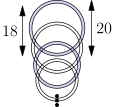
A number of linked rings, each cm thick, are hanging on a peg. The top ring has an outside diameter of cm. The outside diameter of each of the other rings is cm less than that of the ring above it. The bottom ring has an outside diameter of cm. What is the distance, in cm, from the top of the top ring to the bottom of the bottom ring?
Small Hint:
The top ring spans cm; each lower ring adds its outside diameter minus for the overlap
Big Hint:
Total
Solution:
The top ring spans cm. Each ring below overlaps the ring above by cm (twice the -cm thickness), so it adds its outside diameter minus
The lower rings have outside diameters contributing Thus the total distance is
Thus, the correct answer is B.
13.
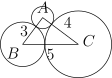
The vertices of a –– right triangle are the centers of three mutually externally tangent circles, as shown. What is the sum of the areas of these circles?
Small Hint:
The radii at two adjacent vertices sum to the side length between them
Big Hint:
Solve
Solution:
If are the radii at the vertices, then Adding all three gives so
The sum of the areas is
Thus, the correct answer is E.
14.
Two farmers agree that pigs are worth and that goats are worth When one farmer owes the other money, he pays the debt in pigs or goats, with “change” received in the form of goats or pigs as necessary. (For example, a debt could be paid with two pigs, with one goat received in change.) What is the amount of the smallest positive debt that can be resolved in this way?
Small Hint:
A resolvable debt has the form for integers
Big Hint:
Every such value is a multiple of
Solution:
A debt is resolvable if and only if for integers Thus is a multiple of so no smaller positive debt works.
A debt of is achievable since i.e. give goats and receive pigs in change.
Thus, the correct answer is C.
15.
Suppose and What is the smallest possible positive value of
Small Hint:
means is an odd multiple of
Big Hint:
means minimize
Solution:
Since we have Since we have
On the unit circle, the smallest positive angular separation between an odd multiple of and an angle congruent to is It is attained by taking and which gives
Thus, the correct answer is A.
16.
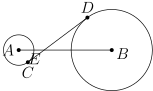
Circles with centers and have radii and respectively. A common internal tangent intersects the circles at and respectively. Lines and intersect at and What is
Small Hint:
Radii and are perpendicular to the tangent, so
Big Hint:
and
Solution:
The radii satisfy and By the Pythagorean theorem,
Since we get so Then
Thus, the correct answer is B.
17.
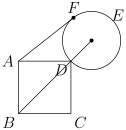
Square has side length a circle centered at has radius and and are both rational. The circle passes through and lies on Point lies on the circle, on the same side of as Segment is tangent to the circle, and What is
Small Hint:
The tangent length satisfies
Big Hint:
Place at the origin; then and match rational and irrational parts
Solution:
Set so that lies on ray
Since is tangent to the circle, Computing and simplifying gives
Because and are rational, the rational and irrational parts match: and Thus and
Thus, the correct answer is B.
18.
The function has the property that for each real number in its domain, is also in its domain and What is the largest set of real numbers that can be in the domain of
Small Hint:
Substitute in place of to get a second equation
Big Hint:
Comparing the two equations forces
Solution:
Replacing by gives Together with this requires so
Both values are consistent, with and So the largest possible domain is
Thus, the correct answer is E.
19.
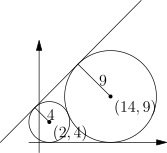
Circles with centers and have radii and respectively. The equation of a common external tangent to the circles can be written in the form with What is
Small Hint:
Each circle is tangent to the -axis, so the -axis is one common external tangent
Big Hint:
The two external tangents meet on the line through the centers, whose slope is the other tangent has slope
Solution:
Each circle’s radius equals its center’s -coordinate, so both are tangent to the -axis, which is a common external tangent. The two external tangents meet at the -intercept of the line through the centers.
That line has slope and passes through meeting the -axis at
The other tangent makes angle with the -axis, so its slope is Then
Thus, the correct answer is E.
20.
A bug starts at one vertex of a cube and moves along the edges of the cube according to the following rule. At each vertex the bug will choose to travel along one of the three edges emanating from that vertex. Each edge has equal probability of being chosen, and all choices are independent. What is the probability that after seven moves the bug will have visited every vertex exactly once?
Small Hint:
There are equally likely -move walks; count those visiting all vertices
Big Hint:
There are choices for the first move and for the second, after which the path is nearly forced
Solution:
From the start there are equally likely -move walks. For a walk visiting all vertices, there are choices for the first move and for the second, since it cannot return to the starting vertex.
Label cube vertices by three-bit strings. By symmetry, after fixing those first two moves we may take the first three vertices to be A branch check gives exactly these three completions: Thus there are such walks.
The probability is
Thus, the correct answer is C.
21.
Let
and
What is the ratio of the area of to the area of
Small Hint:
For rewrite the condition as
Big Hint:
Complete the square to get disks, then compare their squared radii
Solution:
For the condition becomes i.e.
These are disks with squared radii for and for
The logarithms require For each disk, the squared distance from its center to the line is which is more than the squared radius. Hence both disks lie entirely in so no points were added when the inequalities were rewritten. The area ratio is
Thus, the correct answer is E.
22.
A circle of radius is concentric with and outside a regular hexagon of side length The probability that three entire sides of the hexagon are visible from a randomly chosen point on the circle is What is
Small Hint:
The complementary arcs, from which only two whole sides are visible, total half the circle; by symmetry each measures
Big Hint:
The distance from the center to a side (the apothem) is and
Solution:
Place the hexagon at the center of the circle. Corresponding to each vertex is an arc from which only the two sides meeting there are entirely visible. These six congruent arcs make up the complementary probability so each arc measures
Take the arc centered on the ray from the center through a vertex and let be its upper endpoint. Then and at a third side is just becoming visible, so lies on that side’s supporting line. Its distance from is the apothem
Hence giving
Thus, the correct answer is D.
23.
Given a finite sequence of real numbers, let be the sequence of real numbers. Define and, for each integer define Suppose and let If then what is
Small Hint:
Applying repeatedly introduces binomial coefficients; has a single term
Big Hint:
That term is
Solution:
Each application of averages adjacent terms, so after steps the single remaining term is
Setting this equal to gives so Since we get
Thus, the correct answer is B.
24.
The expression
is simplified by expanding it and combining like terms. How many terms are in the simplified expression?
Small Hint:
A monomial survives only when is even; the odd- terms cancel
Big Hint:
For each even from to count the possible values of
Solution:
A term survives only when is even, since terms with odd cancel between the two expansions.
For each even with the exponent ranges over values and is then determined. Summing over even the sum of the first odd positive integers, which is
Thus, the correct answer is D.
25.
How many non-empty subsets of have the following two properties?
No two consecutive integers belong to
If contains elements, then contains no number less than
Small Hint:
A -element valid set is a -subset of with no two consecutive
Big Hint:
Such sets biject with -subsets of a -element set, counted by
Solution:
By property a valid -element set is a -subset of with no two consecutive elements.
Collapsing the gaps between chosen elements, these correspond bijectively to -subsets of a -element set, counted by This is nonzero only for so the total is
Thus, the correct answer is E.