
2004 AMC 12A Solutions
Scroll down to view professionally curated solutions from LIVE by Po-Shen Loh, print PDF solutions, view answer key, or take the full timed exam.
All problems are used with official legal permission of the Mathematical Association of America (MAA).
1.
Alicia earns per hour, of which is deducted to pay local taxes. How many cents per hour of Alicia’s wages are used to pay local taxes?
Small Hint:
Convert into cents before taking the percentage
Big Hint:
cents, and of that is the tax
Solution:
Since is cents, the tax is cents per hour.
Thus, the correct answer is E.
2.
On the AMC each correct answer is worth points, each incorrect answer is worth points, and each problem left unanswered is worth points. If Charlyn leaves of the problems unanswered, how many of the remaining problems must she answer correctly in order to score at least
Small Hint:
The blanks already contribute points
Big Hint:
Find the smallest number of correct answers whose points each cover the remaining points
Solution:
The unanswered problems are worth points, so Charlyn needs at least more points from correct answers.
Each correct answer is worth points, and the smallest multiple of that is at least is So she needs at least correct answers.
Thus, the correct answer is C.
3.
For how many ordered pairs of positive integers is
Small Hint:
Solve for in terms of
Big Hint:
must be positive, which bounds how large the positive integer can be
Solution:
Writing the value of is a positive integer precisely when is a positive integer with
This gives valid ordered pairs.
Thus, the correct answer is B.
4.
Bertha has daughters and no sons. Some of her daughters have daughters, and the rest have none. Bertha has a total of daughters and granddaughters, and no great-granddaughters. How many of Bertha’s daughters and granddaughters have no daughters?
Small Hint:
First count the granddaughters, then determine how many daughters have children
Big Hint:
Every woman with daughters has exactly of them
Solution:
Bertha has granddaughters, none of whom have daughters.
These granddaughters are the children of of Bertha’s daughters, so exactly women have daughters.
Therefore the number of women with no daughters is
Thus, the correct answer is E.
5.
The graph of a line is shown. Which of the following is true?

Small Hint:
Read the sign and size of the slope and the -intercept separately
Big Hint:
Both and have absolute value less than but opposite signs
Solution:
The -intercept of the line is between and so
The slope is negative and shallow, between and so
The product is therefore negative with absolute value less than giving
Thus, the correct answer is B.
6.
Let and Which of the following is largest?
Small Hint:
Factor each difference to write it as a multiple of a power of
Big Hint:
while every other choice is a multiple of the smaller
Solution:
Compute each difference by factoring:
and
Since exceeds each of the others, none of which reaches the difference is the largest.
Thus, the correct answer is A.
7.
A game is played with tokens according to the following rule. In each round, the player with the most tokens gives one token to each of the other players and also places one token into a discard pile. The game ends when some player runs out of tokens. Players and start with and tokens, respectively. How many rounds will there be in the game?
Small Hint:
Track the token counts over one full cycle of three rounds
Big Hint:
Every three rounds each player loses exactly one token, so find when the leader hits
Solution:
After three rounds the players and have and tokens, respectively. Every subsequent three rounds reduces each player’s supply by one token.
After rounds they have and tokens. In the th round player who has the most, gives away all three of their tokens and runs out, ending the game.
Thus, the correct answer is B.
8.
In the figure, and are right angles, and and intersect at What is the difference between the areas of and

Small Hint:
Add the shared triangle to each of the two triangles
Big Hint:
The difference equals
Solution:
Let and be the areas of and respectively.
Then has area and has area
The requested difference is
Thus, the correct answer is B.
9.
A company sells peanut butter in cylindrical jars. Marketing research suggests that using wider jars will increase sales. If the diameter of the jars is increased by without altering the volume, by what percent must the height be decreased?
Small Hint:
The base area scales with the square of the diameter
Big Hint:
Multiplying the diameter by multiplies the base area by
Solution:
Multiplying the diameter by multiplies the base area by
To keep the volume fixed, the height must be multiplied by That is a decrease of or
Thus, the correct answer is C.
10.
The sum of consecutive integers is What is their median?
Small Hint:
For consecutive integers the median equals the mean
Big Hint:
The median is the sum divided by the number of terms,
Solution:
The sum of a set of consecutive integers equals the number of terms times their mean, and for consecutive integers the mean equals the median.
So the median is
Thus, the correct answer is C.
11.
The average value of all the pennies, nickels, dimes, and quarters in Paula’s purse is cents. If she had one more quarter, the average value would be cents. How many dimes does she have in her purse?
Small Hint:
Let be the current number of coins and write the total value two ways after adding a quarter
Big Hint:
Solve for then figure out which coins total cents
Solution:
If Paula has coins, their total value is cents. Adding a quarter gives coins worth cents, which must also equal cents.
So giving
Four coins totalling cents must be three quarters and one nickel, so the number of dimes is
Thus, the correct answer is A.
12.
Let and Points and are on the line and and intersect at What is the length of
Small Hint:
Find the equations of lines and then intersect each with
Big Hint:
and both lie on so each has equal coordinates
Solution:
Line passes through with slope so its equation is Setting gives
Line passes through with slope so Setting gives
Then
Thus, the correct answer is B.
13.
Let be the set of points in the coordinate plane, where each of and may be or How many distinct lines pass through at least two members of
Small Hint:
Start from the pairs of points, each of which determines a line
Big Hint:
Some lines pass through three collinear points and get counted times
Solution:
There are pairs of points, and each pair determines a line.
However, there are three horizontal, three vertical, and two diagonal lines that each pass through three collinear points of Each such line is counted times, an overcount of per line.
With such lines, the number of distinct lines is
Thus, the correct answer is B.
14.
A sequence of three real numbers forms an arithmetic progression with a first term of If is added to the second term and is added to the third term, the three resulting numbers form a geometric progression. What is the smallest possible value for the third term of the geometric progression?
Small Hint:
Write the arithmetic terms as
Big Hint:
In a geometric progression the middle term squared equals the product of the outer terms
Solution:
The arithmetic progression is After the additions, the geometric progression is
The geometric condition gives which simplifies to so or
The corresponding third terms are and so the smallest possible value is
Thus, the correct answer is A.
15.
Brenda and Sally run in opposite directions on a circular track, starting at diametrically opposite points. They first meet after Brenda has run meters. They next meet after Sally has run meters past their first meeting point. Each girl runs at a constant speed. What is the length of the track in meters?
Small Hint:
By the first meeting the two together have covered half the track
Big Hint:
Between the first and second meetings they together cover a full track, so Brenda runs twice her first leg
Solution:
Starting at opposite ends, when they first meet they have together run half the track. Between the first and second meetings, they together run a full track length.
Since Brenda runs at a constant speed and covered meters before the first meeting, she covers meters between the two meetings.
Adding Sally’s meters over that same interval gives a track length of meters.
Thus, the correct answer is C.
16.
The set of all real numbers for which is defined is What is the value of
Small Hint:
Work from the outside in: each logarithm requires its argument to be positive
Big Hint:
is defined only when i.e. the next argument exceeds
Solution:
The expression is defined if and only if that is,
This holds if and only if which is equivalent to
Therefore
Thus, the correct answer is B.
17.
Let be a function with the following properties:
(i) and
(ii) for any positive integer
What is the value of
Small Hint:
Apply the rule repeatedly with to unwind
Big Hint:
The exponent accumulates as
Solution:
Applying with we get
Unwinding from the exponents accumulate:
Therefore
Thus, the correct answer is D.
18.
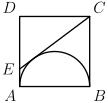
Square has side length A semicircle with diameter is constructed inside the square, and the tangent to the semicircle from intersects side at What is the length of
Small Hint:
Two tangent segments from a common external point to a circle are equal
Big Hint:
With the tangent lengths give then apply the Pythagorean theorem to
Solution:
Let be the point where touches the semicircle. Since and are both tangents from we have Similarly, with the tangents from give
Thus In right triangle where and
Expanding gives so and
Thus, the correct answer is D.
19.
Circles and are externally tangent to each other and internally tangent to circle Circles and are congruent. Circle has radius and passes through the center of What is the radius of circle

Small Hint:
Since passes through the center of and is internally tangent, circle has radius
Big Hint:
Place the center of at the origin; use right triangles formed by the centers and the axis of symmetry
Solution:
Circle has radius and passes through the center of while being internally tangent to so has radius
Place the center of at the origin, with centered at By symmetry, has center and radius with its mirror image across the horizontal axis, so the two congruent circles touch on that axis and
Internal tangency to gives and external tangency to gives
Subtracting and using yields and The radius of circle is
Thus, the correct answer is D.
20.
Select numbers and between and independently and at random, and let be their sum. Let and be the results when and respectively, are rounded to the nearest integer. What is the probability that
Small Hint:
Model as a random point in the unit square and split by whether each of is below
Big Hint:
The condition fails only when but or but
Solution:
Represent the choices as a point in the unit square. Each of and rounds to if below and to otherwise, while rounds based on and
The equation fails in exactly two regions. If it fails when this is a right triangle of area If it fails when this is another right triangle of area When exactly one of is at least the equation always holds.
Thus the failure probability is so the requested probability is
Thus, the correct answer is E.
21.
If what is the value of
Small Hint:
The series is geometric with ratio
Big Hint:
Sum to get then use
Solution:
The series is geometric with first term and ratio so its sum is
Thus and
Thus, the correct answer is D.
22.
Three mutually tangent spheres of radius rest on a horizontal plane. A sphere of radius rests on them. What is the distance from the plane to the top of the larger sphere?
Small Hint:
The three small centers form an equilateral triangle of side at height
Big Hint:
The big center lies above the triangle’s centroid; use the distance between centers to find its height
Solution:
Let the centers of the three unit spheres be forming an equilateral triangle of side at height above the plane, and let be the center of the large sphere directly above the centroid of
The distance from a vertex to the centroid is and so
Since is unit above the plane and the top of the large sphere is units above the total height is
Thus, the correct answer is B.
23.
A polynomial has real coefficients with and distinct complex zeros with and real, and Which of the following quantities can be a nonzero number?
Small Hint:
Since is a root, nonreal roots come in conjugate pairs
Big Hint:
which is not forced to be zero; check each other option must vanish
Solution:
Since is a root,
The nonreal zeros occur in conjugate pairs, so and the hypothesis then forces The coefficient equals times the sum of the roots so
Because the degree is even, at least one of is real, making one so Thus (A) through (D) all must be
On the other hand, and a valid polynomial such as has So only can be nonzero.
Thus, the correct answer is E.
24.
A plane contains points and with Let be the union of all disks of radius in the plane that cover What is the area of
Small Hint:
A radius- disk covers exactly when its center lies within of both and
Big Hint:
Find that lens-shaped region of centers, then is all points within of
Solution:
A radius- disk covers segment exactly when its center is within of both and That region is the lens where the two unit circles centered at and overlap.
Each unit circle passes through the other’s center, so the lens is bounded by two arcs. Two sectors of area overlap in two equilateral triangles of total area giving area
The set consists of all points within of Beyond itself, this adds two sectors of radius (each area ) and two annuli of outer radius and inner radius (each area ).
Therefore the area of is
Thus, the correct answer is C.
25.
For each integer let denote the base- number The product can be expressed as where and are positive integers and is as small as possible. What is the value of
Small Hint:
A repeating base- fraction equals
Big Hint:
Note which makes the product telescope
Solution:
Since we get
Writing and the product telescopes to
This simplifies to If then rewriting this fraction with denominator would require to divide which it does not. Hence the smallest possible is and
Thus, the correct answer is E.