
2003 AMC 12B Problems
Scroll down and press Start to try the exam! Or, go to the printable PDF, answer key, or professional solutions curated by LIVE by Po-Shen Loh.
All problems are used with official legal permission of the Mathematical Association of America (MAA).
Or jump straight to a single problem with its solution: 1 · 2 · 3 · 4 · 5 · 6 · 7 · 8 · 9 · 10 · 11 · 12 · 13 · 14 · 15 · 16 · 17 · 18 · 19 · 20 · 21 · 22 · 23 · 24 · 25
Want to learn professionally through interactive video classes?
Timed
1:15:00
1.
Which of the following is the same as
Small Hint:
Factor a common constant out of the numerator and the denominator
Big Hint:
The two parenthesized sums are identical
Solution:
Factor from the numerator and from the denominator:
The equal parenthesized sums cancel, leaving
Thus, the correct answer is C.
2.
Al gets the disease algebritis and must take one green pill and one pink pill each day for two weeks. A green pill costs more than a pink pill, and Al’s pills cost a total of for the two weeks. How much does one green pill cost?
Answer: D
Small Hint:
Two weeks is days, so find the cost of one day’s pair of pills first
Big Hint:
If a green pill costs then the pink pill costs and is one day’s cost
Solution:
Over days the daily cost of the two pills is
Let be the cost of a green pill. The pink pill costs so giving
Thus, the correct answer is D.
3.
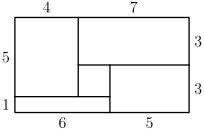
Rose fills each of the rectangular regions of her rectangular flower bed with a different type of flower. The lengths, in feet, of the rectangular regions in her flower bed are as shown in the figure. She plants one flower per square foot in each region. Asters cost each, begonias each, cannas each, dahlias each, and Easter lilies each. What is the least possible cost, in dollars, for her garden?
Answer: A
Small Hint:
Find the area of each of the five regions from the figure
Big Hint:
To minimize the total, put the most expensive flower in the smallest region and so on
Solution:
The five regions have areas and square feet.
To minimize the cost, plant the most expensive flowers in the smallest regions. The least possible cost is
Thus, the correct answer is A.
4.
Moe uses a mower to cut his rectangular -foot by -foot lawn. The swath he cuts is inches wide, but he overlaps each cut by inches to make sure that no grass is missed. He walks at the rate of feet per hour while pushing the mower. Which of the following is closest to the number of hours it will take Moe to mow his lawn?
Answer: C
Small Hint:
Each pass effectively cuts a strip only inches wide because of the overlap
Big Hint:
A -inch strip is feet wide, so each foot walked mows square feet
Solution:
Because of the overlap, each pass adds a strip inches feet wide. So each foot Moe walks mows square feet, that is, square feet per hour.
The lawn has area square feet, so the time is hours.
Thus, the correct answer is C.
5.
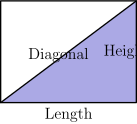
Many television screens are rectangles that are measured by the length of their diagonals. The ratio of the horizontal length to the height in a standard television screen is The horizontal length of a -inch television screen is closest, in inches, to which of the following?
Answer: D
Small Hint:
With sides in ratio the height, length, and diagonal are in ratio
Big Hint:
The diagonal is so the horizontal length is of
Solution:
A rectangle with side ratio has height, length, and diagonal in ratio With diagonal the horizontal length is which is closest to
Thus, the correct answer is D.
6.
The second and fourth terms of a geometric sequence are and Which of the following is a possible first term?
Answer: B
Small Hint:
If the first term is and the ratio is then and
Big Hint:
Dividing the two equations gives so
Solution:
Let the first term be and the common ratio Then and so and
The first term is The choice appears among the options.
Thus, the correct answer is B.
7.
Penniless Pete’s piggy bank has no pennies in it, but it has coins, all nickels, dimes, and quarters, whose total value is It does not necessarily contain coins of all three types. What is the difference between the largest and smallest number of dimes that could be in the bank?
Answer: D
Small Hint:
With nickels, dimes, quarters: and
Big Hint:
Eliminate to get then bound so that are integers
Solution:
Let be the numbers of nickels, dimes, quarters. Then and (dividing the value equation by ).
Subtracting gives so
The largest is at giving (with ). The smallest occurs at giving (with ). The difference is
Thus, the correct answer is D.
8.
Let denote the sum of the digits of the positive integer For example, and For how many two-digit values of is
Small Hint:
Let For a two-digit is between and
Big Hint:
forces or count two-digit with each digit sum
Solution:
Let Since we have Then requires or
The two-digit numbers with digit sum are ( values), and those with digit sum are ( values), for in all.
Thus, the correct answer is E.
9.
Let be a linear function for which What is
Answer: D
Small Hint:
A linear function has a constant rate of change (slope)
Big Hint:
The slope is and the answer is that slope times
Solution:
The slope of is
Therefore
Thus, the correct answer is D.
10.
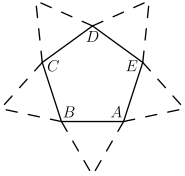
Several figures can be made by attaching two equilateral triangles to the regular pentagon in two of the five positions shown. How many non-congruent figures can be constructed in this way?
Small Hint:
By symmetry, assume one triangle is attached to a fixed side, then place the second
Big Hint:
Only the two sides adjacent versus non-adjacent to the fixed side give different shapes, up to reflection
Solution:
Assume one triangle is attached to side The second triangle can be attached to a side that is one step away or two steps away from
Attaching it to or gives two figures; attaching it to or gives figures that are mirror images of these across the pentagon’s axis of symmetry.
So there are only non-congruent figures.
Thus, the correct answer is B.
11.
Cassandra sets her watch to the correct time at noon. At the actual time of PM, she notices that her watch reads and seconds. Assuming that her watch loses time at a constant rate, what will be the actual time when her watch first reads PM?
PM and seconds
PM
PM
PM
PM
Answer: C
Small Hint:
In real minutes the watch records only minutes
Big Hint:
If the watch shows minutes past noon, the real time is
Solution:
In real minutes the watch advances only minutes seconds minutes. So when the watch shows minutes past noon, the real elapsed time is minutes.
The watch reads PM after recorded minutes, so the real elapsed time is minutes hours minutes past noon. The actual time is PM.
Thus, the correct answer is C.
12.
What is the largest integer that is a divisor of for all positive even integers
Answer: D
Small Hint:
For even the factors are five consecutive odd numbers
Big Hint:
Among any five consecutive odd numbers, one is a multiple of and one is a multiple of
Solution:
For even the five factors are consecutive odd numbers. Among any five consecutive odd numbers, at least one is divisible by and exactly one by so the product is always divisible by
No larger divisor always works: the products for and are and whose greatest common divisor is
Thus, the correct answer is D.
13.
An ice cream cone consists of a sphere of vanilla ice cream and a right circular cone that has the same diameter as the sphere. If the ice cream melts, it will exactly fill the cone. Assume that the melted ice cream occupies of the volume of the frozen ice cream. What is the ratio of the cone’s height to its radius?
Small Hint:
The sphere and cone share the same radius sphere volume is
Big Hint:
Set of the sphere’s volume equal to the cone’s volume
Solution:
Let be the common radius and the cone’s height. The melted ice cream fills the cone, so
This simplifies to so a ratio of
Thus, the correct answer is B.
14.
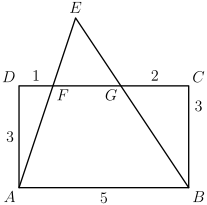
In rectangle and Points and are on so that and Lines and intersect at Find the area of
Answer: D
Small Hint:
and is similar to
Big Hint:
Let the distance from to line be the distance to is with ratio
Solution:
Since and triangles and are similar with ratio
Let the distance from to line be Then the distance from to is and giving
The height of is so its area is
Thus, the correct answer is D.
15.
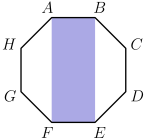
A regular octagon has an area of one square unit. What is the area of the rectangle
Answer: D
Small Hint:
Let be the center of the octagon, which is the midpoint of diagonal
Big Hint:
is one of the eight triangles from the center, so it has area
Solution:
Let be the center of the octagon. Joining to the vertices splits the octagon into congruent triangles, so has area
Since is the midpoint of triangles and have equal areas, so has area
The rectangle is split by diagonal into two congruent triangles, so is half of it. Hence has area
Thus, the correct answer is D.
16.
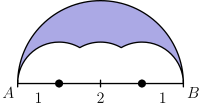
Three semicircles of radius are constructed on diameter of a semicircle of radius The centers of the small semicircles divide into four line segments of equal length, as shown. What is the area of the shaded region that lies within the large semicircle but outside the smaller semicircles?
Answer: E
Small Hint:
The large semicircle has area
Big Hint:
Use inclusion-exclusion: subtract the two overlaps from the total area of the three small semicircles
Solution:
The large semicircle has area
The three small semicircles have total area before their overlaps are accounted for. The centers of each adjacent pair are unit apart, so their intersection is bounded by two sectors and an equilateral triangle. Each of the two overlaps therefore has area
The shaded area is
Thus, the correct answer is E.
17.
If and what is
Answer: D
Small Hint:
Let and the equations become linear in and
Big Hint:
Solve and then compute
Solution:
Let and Then and
Solving gives and so
Thus, the correct answer is D.
18.
Let and be positive integers such that The minimum possible value of has a prime factorization What is
Answer: B
Small Hint:
The minimum uses only the primes and so write
Big Hint:
Match exponents of and need and
Solution:
For the minimum neither nor has prime factors other than and Write so Writing we need
Matching exponents: gives the least and gives the least So and
Thus, the correct answer is B.
19.
Let be the set of permutations of the sequence for which the first term is not A permutation is chosen randomly from The probability that the second term is in lowest terms, is What is
Answer: E
Small Hint:
Count directly: choices for the first term, then for the rest
Big Hint:
Count permutations in whose second term is the first term is or
Solution:
The set contains permutations, since the first term has choices and the remaining four terms can be arranged in ways.
For the second term to be the first term must be or (not not ), giving choices, and the remaining three terms can be arranged in ways:
The probability is so
Thus, the correct answer is E.
20.
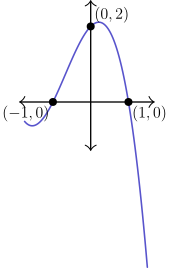
Part of the graph of is shown. What is
Answer: B
Small Hint:
Read off and from the graph
Big Hint:
Adding eliminates and leaving
Solution:
The graph passes through and So
Adding so
Thus, the correct answer is B.
21.
An object moves cm in a straight line from to turns at an angle measured in radians and chosen at random from the interval and moves cm in a straight line to What is the probability that
Answer: D
Small Hint:
Let be the interior angle at apply the Law of Cosines to
Big Hint:
so is equivalent to
Solution:
Let be the interior angle of at By the Law of Cosines,
Then means i.e. i.e.
As is uniform on so is The probability is
Thus, the correct answer is D.
22.
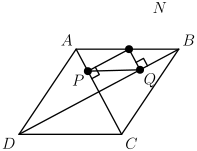
Let be a rhombus with and Let be a point on and let and be the feet of the perpendiculars from to and respectively. Which of the following is closest to the minimum possible value of
Answer: C
Small Hint:
Let be the center; the diagonals meet at right angles, so is a rectangle and
Big Hint:
is smallest when is the foot of the altitude from in right triangle with legs and
Solution:
Let be the intersection of the diagonals. Then is right-angled at with legs and Quadrilateral has right angles at and so it is a rectangle and
The minimum of is the altitude from to in Since equating the two area expressions gives
This is closest to
Thus, the correct answer is C.
23.
The number of -intercepts on the graph of in the interval is closest to
Answer: A
Small Hint:
when for a nonzero integer i.e.
Big Hint:
Count integers with
Solution:
The intercepts occur where that is for a nonzero integer
The condition becomes
The number of such integers is closest to
Thus, the correct answer is A.
24.
Positive integers and are chosen so that and the system of equations and has exactly one solution. What is the minimum value of
Answer: C
Small Hint:
The graph of is piecewise linear with slopes
Big Hint:
The line has slope a single intersection forces it to touch the corner at where
Solution:
The function is piecewise linear with slopes and corners at The line has slope
A line of slope meets this graph exactly once only if it passes through the leftmost corner where the graph’s slope jumps from to Substituting, so
Since we need so This bound is attained: take and Therefore the minimum is
Thus, the correct answer is C.
25.
Three points are chosen randomly and independently on a circle. What is the probability that all three pairwise distances between the points are less than the radius of the circle?
Answer: D
Small Hint:
A chord is shorter than the radius exactly when its arc measures less than
Big Hint:
All three pairwise chords are short precisely when the three points lie within some arc
Solution:
A chord has length less than the radius exactly when the arc it subtends is less than since a chord of a arc equals the radius.
All three pairwise chords are shorter than the radius precisely when the three points all lie within some arc of
For any successful configuration, exactly one of the three points is the counterclockwise endpoint of such a containing arc (apart from probability-zero boundary cases). Choose that endpoint in ways; each of the other two points independently has probability of lying in the next Hence the probability is
Thus, the correct answer is D.