
2002 AMC 12A Problems
Scroll down and press Start to try the exam! Or, go to the printable PDF, answer key, or professional solutions curated by LIVE by Po-Shen Loh.
All problems are used with official legal permission of the Mathematical Association of America (MAA).
Or jump straight to a single problem with its solution: 1 · 2 · 3 · 4 · 5 · 6 · 7 · 8 · 9 · 10 · 11 · 12 · 13 · 14 · 15 · 16 · 17 · 18 · 19 · 20 · 21 · 22 · 23 · 24 · 25
Want to learn professionally through interactive video classes?
Timed
1:15:00
1.
Compute the sum of all the roots of
Answer: A
Small Hint:
Both terms share the factor
Big Hint:
The equation becomes
Solution:
Factoring out gives
The roots are and whose sum is
Thus, the correct answer is A.
2.
Cindy was asked by her teacher to subtract from a certain number and then divide the result by Instead, she subtracted and then divided the result by giving an answer of What would her answer have been had she worked the problem correctly?
Answer: A
Small Hint:
Her computation was
Big Hint:
Solve for then evaluate
Solution:
Let be the number. Cindy computed so and
The correct computation gives
Thus, the correct answer is A.
3.
According to the standard convention for exponentiation, If the order in which the exponentiations are performed is changed, how many other values are possible?
Answer: B
Small Hint:
There are five ways to parenthesize a tower of four ’s
Big Hint:
Every parenthesization evaluates to either or
Solution:
The five parenthesizations of give
So the only values are and Besides the standard value there is exactly other.
Thus, the correct answer is B.
4.
Find the degree measure of an angle whose complement is of its supplement.
Answer: B
Small Hint:
The complement is and the supplement is
Big Hint:
Solve
Solution:
Let the angle be Then so
This gives so
Thus, the correct answer is B.
5.
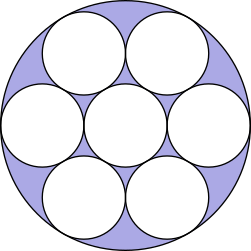
Each of the small circles in the figure has radius one. The innermost circle is tangent to the six circles that surround it, and each of those circles is tangent to the large circle and to its small-circle neighbors. Find the area of the shaded region.
Answer: C
Small Hint:
Each surrounding circle has its center units from the center, so the large circle has radius
Big Hint:
Subtract the areas of the seven unit circles from the area of the large circle
Solution:
Each of the six outer unit circles is tangent to the central unit circle, so its center is units from the center. Adding one more radius, the large circle has radius and area
The seven unit circles have total area so the shaded region has area
Thus, the correct answer is C.
6.
For how many positive integers does there exist at least one positive integer such that
infinitely many
Answer: E
Small Hint:
Consider what happens when
Big Hint:
For the inequality reduces to
Solution:
Taking the inequality becomes which holds for every positive integer
So every positive integer works, and there are infinitely many.
Thus, the correct answer is E.
7.
If an arc of on circle has the same length as an arc of on circle then the ratio of the area of circle to the area of circle is
Answer: A
Small Hint:
Equal arc lengths:
Big Hint:
Find the area ratio is its square
Solution:
Equal arc lengths give so
The ratio of areas is
Thus, the correct answer is A.
8.
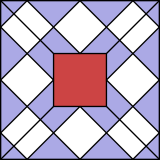
Betsy designed a flag using blue triangles, small white squares, and a red center square, as shown. Let be the total area of the blue triangles, the total area of the white squares, and the area of the red square. Which of the following is correct?
Answer: A
Small Hint:
Cover the whole flag with congruent triangles
Big Hint:
Count how many of those triangles lie in the blue region and in the white region
Solution:
Drawing the diagonals shown, the entire flag is tiled by congruent triangles. Counting, there are triangles in the blue region, in the white region, and in the red square.
Since the blue and white regions contain the same number of triangles,
Thus, the correct answer is A.
9.
Jamal wants to store computer files on floppy disks, each of which has a capacity of megabytes (mb). Three of his files require mb of memory each, more require mb each, and the remaining require mb each. No file can be split between floppy disks. What is the minimal number of floppy disks that will hold all the files?
Answer: B
Small Hint:
The total memory needed is mb
Big Hint:
A disk holding a file has room for only one file, wasting mb; add up this waste
Solution:
The files need mb, so at least disks by volume alone.
A disk containing a -mb file has room for only one more -mb file, leaving at least mb unused. Across the three -mb files this wastes at least mb, over half a disk, forcing at least disks.
Thirteen suffice: six disks each hold two -mb files, three disks each hold one -mb file plus one -mb file, and four disks each hold three -mb files.
Thus, the correct answer is B.
10.
Sarah pours four ounces of coffee into an eight-ounce cup and four ounces of cream into a second cup of the same size. She then transfers half the coffee from the first cup to the second and, after stirring thoroughly, transfers half the liquid in the second cup back to the first. What fraction of the liquid in the first cup is now cream?
Small Hint:
After the first transfer, cup holds oz coffee and oz cream
Big Hint:
Transferring back half of cup moves its coffee and cream in equal proportion; find the cream in cup
Solution:
After transferring half the coffee, cup has oz coffee and cup has oz coffee and oz cream, a total of oz.
Transferring half of cup back moves oz coffee and oz cream. Cup then holds oz coffee and oz cream.
The fraction that is cream is
Thus, the correct answer is D.
11.
Mr. Earl E. Bird leaves his house for work at exactly A.M. every morning. When he averages miles per hour, he arrives at his workplace three minutes late. When he averages miles per hour, he arrives three minutes early. At what average speed, in miles per hour, should Mr. Bird drive to arrive at his workplace precisely on time?
Answer: B
Small Hint:
Let be the on-time travel time in hours; three minutes is hours
Big Hint:
Set solve for then find the distance
Solution:
Let be the time in hours to arrive on time. Since three minutes is hours,
This gives so The distance is miles, and the required speed is miles per hour.
Thus, the correct answer is B.
12.
Both roots of the quadratic equation are prime numbers. The number of possible values of is
more than four
Answer: B
Small Hint:
If the roots are primes and then
Big Hint:
An odd sum forces one of the primes to be
Solution:
If the roots are primes and then by Vieta’s formulas and
Since is odd, one prime must be even, namely and the other is Both are prime, so is the only possible value.
Thus, the correct answer is B.
13.
Two different positive numbers and each differ from their reciprocals by What is
Answer: C
Small Hint:
A number with satisfies or
Big Hint:
The two positive solutions are reciprocals of each other; add them using the quadratic formula
Solution:
A positive number differs from its reciprocal by when or i.e. or
The positive roots are and which are reciprocals of each other. Their sum is
Thus, the correct answer is C.
14.
For all positive integers let Let Which of the following relations is true?
Answer: D
Small Hint:
Big Hint:
Combine into and evaluate the product inside
Solution:
Using and adding logs,
Since this is
Thus, the correct answer is D.
15.
The mean, median, unique mode, and range of a collection of eight integers are all equal to The largest integer that can be an element of this collection is
Answer: D
Small Hint:
The eight integers sum to and the mode must repeat
Big Hint:
Test the largest value the smallest would then be and check the remaining sum
Solution:
The collection has mean, median, unique mode, and range all equal to so is attainable.
Suppose the largest were The range forces the smallest to be Because is the mode, it occurs in the sorted list; together with median this forces the two middle values to be Then so the remaining four values sum to averaging At least one would be below contradicting the minimum. So is impossible.
Thus, the correct answer is D.
16.
Tina randomly selects two distinct numbers from the set and Sergio randomly selects a number from the set The probability that Sergio’s number is larger than the sum of the two numbers chosen by Tina is
Answer: A
Small Hint:
Tina has equally likely pairs
Big Hint:
For a pair with sum Sergio exceeds it with probability
Solution:
Tina’s ten pairs have sums For a sum Sergio’s number exceeds it with probability
The corresponding values of are totaling The overall probability is
Thus, the correct answer is A.
17.
Several sets of prime numbers, such as use each of the nine nonzero digits exactly once. What is the smallest possible sum such a set of primes could have?
Answer: B
Small Hint:
The digits cannot end a prime past one digit, so each must be a tens digit
Big Hint:
Those three contribute at least and the remaining six digits at least their own sum as units digits; then check a valid set exists
Solution:
The even digits cannot be the units digit of a multi-digit prime, so each must appear in a tens place or higher, contributing at least The other six digits contribute at least so the sum is at least
This bound is achieved, for example by whose sum is
Thus, the correct answer is B.
18.
Let and be circles defined by and respectively. What is the length of the shortest line segment that is tangent to at and to at
Answer: C
Small Hint:
The shortest such segment is the internal tangent; it crosses between the centers
Big Hint:
The crossing point divides in the ratio of the radii use similar right triangles
Solution:
The centers are and with radii and so The shortest tangent is the internal one, meeting at a point that splits it in the ratio giving
The right triangles and are similar with ratio Then and so
Thus, the correct answer is C.
19.
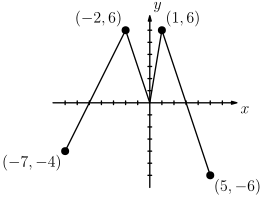
The graph of the function is shown below. How many solutions does the equation have?
Answer: D
Small Hint:
means must be an input where equals
Big Hint:
From the graph at and count solutions of and
Solution:
The graph reaches at and so requires or
The horizontal line meets the graph twice, and meets it four times, giving solutions.
Thus, the correct answer is D.
20.
Suppose that and are digits, not both nine and not both zero, and the repeating decimal is expressed as a fraction in lowest terms. How many different denominators are possible?
Answer: C
Small Hint:
where is the two-digit value
Big Hint:
In lowest terms the denominator is a divisor of exclude since are not both
Solution:
Since the reduced denominator divides The divisors are
The denominator would require i.e. which is excluded. Each is achievable: numerators and reduce to denominators and respectively. Thus there are possible denominators.
Thus, the correct answer is C.
21.
Consider the sequence of numbers For the th term of the sequence is the units digit of the sum of the two previous terms. Let denote the sum of the first terms of this sequence. The smallest value of for which is
Answer: B
Small Hint:
Write out terms until the pattern repeats
Big Hint:
The first terms sum to and then repeat; find how many full blocks stay under
Solution:
Continuing the sequence gives which repeats with period Each block of terms sums to
The largest with is giving Adding the next terms contributes pushing the total past So
Thus, the correct answer is B.
22.
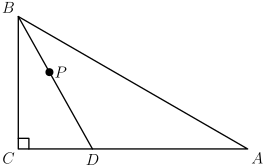
Triangle is a right triangle with as its right angle, and Let be randomly chosen inside and extend to meet at What is the probability that
Answer: C
Small Hint:
is -- with and
Big Hint:
Choose on with so then iff lies inside
Solution:
Since and the -- triangle has and
Place on with then As moves along exceeds exactly when i.e. when lies beyond which happens iff is inside
The probability is
Thus, the correct answer is C.
23.
In triangle side and the perpendicular bisector of meet in point and bisects If and what is the area of triangle
Answer: D
Small Hint:
is on the perpendicular bisector of so
Big Hint:
The angle bisector gives apply the Law of Cosines with read from
Solution:
Since lies on the perpendicular bisector of The angle bisector gives so write and
Let In isosceles the foot of the perpendicular is the midpoint of so
Applying the Law of Cosines in which simplifies to so and
Now has sides By Heron’s formula with the area is
Thus, the correct answer is D.
24.
Find the number of ordered pairs of real numbers such that
Answer: E
Small Hint:
Write so the equation is take magnitudes
Big Hint:
forces or when
Solution:
Let The equation is Taking magnitudes, so giving or
If then one solution. If then so i.e. which has distinct roots.
Altogether there are ordered pairs.
Thus, the correct answer is E.
25.
The nonzero coefficients of a polynomial with real coefficients are all replaced by their mean to form a polynomial Which of the following could be a graph of and over the interval
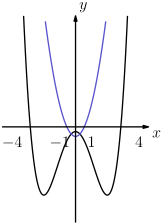
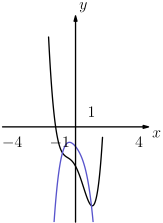
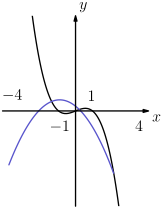
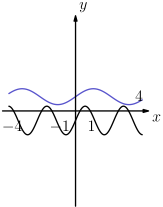
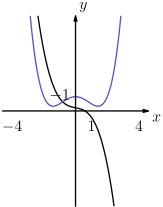
Answer: B
Small Hint:
The sum of the coefficients of equals the sum of the coefficients of
Big Hint:
Evaluating at gives so the two graphs must intersect at
Solution:
Replacing the nonzero coefficients by their mean keeps the total of the coefficients unchanged, so and have the same coefficient sum. Since and each equal that sum,
Therefore the graphs of and must cross at The only choice showing an intersection at is graph B. (There, and )
Thus, the correct answer is B.