
2001 AMC 12 Solutions
Scroll down to view professionally curated solutions from LIVE by Po-Shen Loh, print PDF solutions, view answer key, or take the full timed exam.
All problems are used with official legal permission of the Mathematical Association of America (MAA).
1.
The sum of two numbers is Suppose is added to each number and then each of the resulting numbers is doubled. What is the sum of the final two numbers?
Small Hint:
Adding to each of the two numbers increases their sum by
Big Hint:
Doubling each number doubles the sum
Solution:
Adding to each number raises the sum from to Doubling each number doubles the sum, giving
Thus, the correct answer is E.
2.
Let and denote the product and the sum, respectively, of the digits of the integer For example, and Suppose is a two-digit number such that What is the units digit of
Small Hint:
Write where is the tens digit and is the units digit
Big Hint:
The equation simplifies to
Solution:
Write Then and so This reduces to Since we can divide by to get
The units digit of is
Thus, the correct answer is E.
3.
The state income tax where Kristin lives is levied at the rate of of the first of annual income plus of any amount above Kristin noticed that the state income tax she paid amounted to of her annual income. What was her annual income?
Small Hint:
Let her income be dollars with and write the tax two different ways
Big Hint:
Set ; the terms cancel
Solution:
Let her income be dollars. Writing the tax with both descriptions and multiplying by
Expanding, every term containing cancels, leaving so and
Thus, the correct answer is B.
4.
The mean of three numbers is more than the least of the numbers and less than the greatest. The median of the three numbers is What is their sum?
Small Hint:
Let be the mean; the least number is and the greatest is
Big Hint:
The median is the middle number so
Solution:
Let be the mean. The least number is the greatest is and the middle number is the median Their sum is so
This gives so the sum of the three numbers is
Thus, the correct answer is D.
5.
What is the product of all positive odd integers less than
Small Hint:
The product of all odd numbers equals divided by the product of all even numbers up to
Big Hint:
The even numbers are
Solution:
The product of every integer from to is so the product of the odd ones is divided by the product of the even ones.
The even numbers factor as
Therefore the product of the odd integers is
Thus, the correct answer is D.
6.
A telephone number has the form where each letter represents a different digit. The digits in each part of the number are in decreasing order; that is, and Furthermore, and are consecutive even digits; and are consecutive odd digits; and Find
Small Hint:
Four consecutive decreasing odd digits must be or
Big Hint:
The leftover odd digit sits in and with two even digits summing to it must be
Solution:
The four consecutive decreasing odd digits are either or leaving one odd digit ( or ) for
Since and the other two digits of are even, the odd digit must be (a would force the two even digits to sum to ). So the two even digits sum to
The three consecutive decreasing even digits are or leaving the even pairs or for Only sums to so and
Thus, the correct answer is E.
7.
A charity sells benefit tickets for a total of Some tickets sell for full price (a whole dollar amount), and the rest sell for half price. How much money is raised by the full-price tickets?
Small Hint:
With full-price tickets at price the total is
Big Hint:
This becomes and lies between and
Solution:
Let tickets sell at full price dollars. Then so
Since we need a factor of with The only such factor is giving and
The full-price tickets raise dollars.
Thus, the correct answer is A.
8.
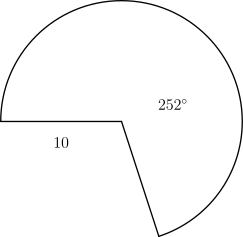
Which of the cones below can be formed from a sector of a circle of radius by aligning the two straight sides?


Small Hint:
The radius of the sector becomes the slant height of the cone, so the slant height is
Big Hint:
The arc length of the sector becomes the base circumference:
Solution:
When the sector is rolled into a cone, its radius becomes the slant height, and its arc becomes the base circle.
The arc length is so the base circumference is and the base radius is
The cone therefore has base radius and slant height which is choice C.
Thus, the correct answer is C.
9.
Let be a function satisfying for all positive real numbers and If what is the value of
Small Hint:
Write as times a convenient factor
Big Hint:
Solution:
Choose and so that Then
Thus, the correct answer is C.
10.
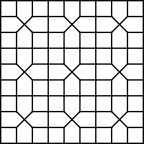
The plane is tiled by congruent squares and congruent pentagons as indicated. The percent of the plane that is enclosed by the pentagons is closest to
Small Hint:
The pattern repeats in blocks of unit squares
Big Hint:
In each block, the four squares that stay square make up of the area
Solution:
The pattern repeats over a block of nine unit squares. Four of these nine squares are not covered by pentagons; the rest of the area belongs to the pentagons.
So the pentagons enclose which is closest to
Thus, the correct answer is D.
11.
A box contains exactly five chips, three red and two white. Chips are randomly removed one at a time without replacement until all the red chips are drawn or all the white chips are drawn. What is the probability that the last chip drawn is white?
Small Hint:
Imagine drawing all five chips and recording the full order
Big Hint:
The drawing ends on the second white exactly when the very last chip in the full order is red
Solution:
Imagine continuing until all five chips are removed. The process actually stops on a white chip exactly when the whites run out before the reds, i.e. when the last chip in the full ordering is red.
The last of the five chips is equally likely to be any chip, so it is red with probability
Thus, the correct answer is D.
12.
How many positive integers not exceeding are multiples of or but not
Small Hint:
First count multiples of or using
Big Hint:
Then subtract those also divisible by i.e. the multiples of or
Solution:
Multiples of or up to number using and
Among these, the ones divisible by are multiples of or : using and
The count is
Thus, the correct answer is B.
13.
The parabola with equation and vertex is reflected about the line This results in the parabola with equation Which of the following equals
Small Hint:
Note that is the first parabola evaluated at and is the second at
Big Hint:
Reflecting about sends the value at each to
Solution:
The value is the first parabola at and is the reflected parabola at
Reflecting the curve about replaces each height by So at the two heights sum to
Thus, the correct answer is E.
14.
Given the nine-sided regular polygon how many distinct equilateral triangles in the plane of the polygon have at least two vertices in the set
Small Hint:
Each pair of vertices is a side of exactly two equilateral triangles
Big Hint:
This counts triangles, but the three all-vertex triangles get counted three times each
Solution:
Each of the pairs of vertices is a side of exactly two equilateral triangles, giving triangles counted with multiplicity.
The triangles and have all three vertices in the set, so each is counted three times instead of once, an overcount of apiece.
The number of distinct triangles is
Thus, the correct answer is D.
15.
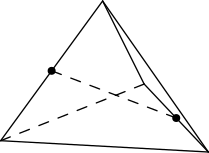
An insect lives on the surface of a regular tetrahedron with edges of length It wishes to travel on the surface of the tetrahedron from the midpoint of one edge to the midpoint of the opposite edge. What is the length of the shortest such trip? (Note: Two edges of a tetrahedron are opposite if they have no common endpoint.)
Small Hint:
Unfold the two faces the path crosses into a single flat figure
Big Hint:
The two faces form a rhombus of side and the midpoints become midpoints of opposite sides
Solution:
A shortest path leaves the starting edge through one of its two incident faces and reaches the opposite edge through one of its two incident faces. Any such pair of faces shares an edge. Unfolding that pair gives a rhombus of side made of two equilateral triangles.
The two opposite-edge midpoints become the midpoints of opposite sides of this rhombus, which are exactly unit apart along a straight segment. Folding back preserves the length, so the shortest trip is
Thus, the correct answer is B.
16.
A spider has one sock and one shoe for each of its eight legs. In how many different orders can the spider put on its socks and shoes, assuming that, on each leg, the sock must be put on before the shoe?
Small Hint:
There are items, so orderings with no restriction
Big Hint:
On each leg the sock precedes the shoe in exactly half of all orderings, and the eight legs are independent
Solution:
Think of the items ( socks and shoes) arranged in some order: there are arrangements.
For each leg, the sock comes before the shoe in exactly half of all arrangements. Imposing this on all eight legs independently divides by giving
Thus, the correct answer is D.
17.
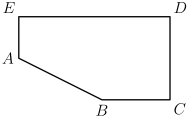
A point is selected at random from the interior of the pentagon with vertices and What is the probability that is obtuse?
Small Hint:
is obtuse exactly when lies inside the circle having as diameter
Big Hint:
That semicircle lies entirely inside the pentagon, so compare its area to the pentagon’s area
Solution:
when is on the circle with diameter centered at with radius The angle is obtuse when is inside this circle.
The relevant half-disk lies wholly within the pentagon, with area
The pentagon is the rectangle with corners minus triangle so its area is
The probability is
Thus, the correct answer is C.
18.
A circle centered at with a radius of and a circle centered at with a radius of are externally tangent. A third circle is tangent to the first two and to one of their common external tangents as shown. The radius of the third circle is
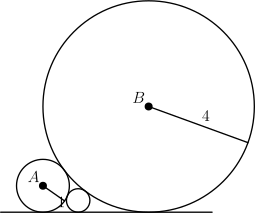
Small Hint:
For two circles of radii and both tangent to a line and to each other, their contact points on the line are apart
Big Hint:
The contact point of the small circle splits the segment:
Solution:
When two mutually tangent circles of radii and both rest on a line, the distance between their points of tangency is
The big circles’ contact points are apart. Placing the small circle of radius between them, its two tangent distances add up:
Then so and
Thus, the correct answer is D.
19.
The polynomial has the property that the mean of its zeros, the product of its zeros, and the sum of its coefficients are all equal. If the -intercept of the graph of is what is
Small Hint:
By Vieta, the sum of the zeros is and the product is the sum of coefficients is
Big Hint:
The -intercept gives so the common value is the product of the zeros
Solution:
The -intercept is By Vieta’s formulas the product of the zeros is the mean of the zeros is and the sum of the coefficients is
All three are equal to From we get
Then becomes so
Thus, the correct answer is A.
20.
Points and lie in the first quadrant and are the vertices of quadrilateral The quadrilateral formed by joining the midpoints of and is a square. What is the sum of the coordinates of point
Small Hint:
Let and be the midpoints of and find and first
Big Hint:
The next midpoint satisfies rotated (same length, perpendicular)
Solution:
The midpoints are of and of
For the midpoint quadrilateral to be a square, consecutive sides are perpendicular and equal. With the side to the midpoint of must be so
Since is the midpoint of and we get The sum of its coordinates is
Thus, the correct answer is C.
21.
Four positive integers and have a product of and satisfy
What is
Small Hint:
Add to each equation so the left side factors: and so on
Big Hint:
has a factor of but does not, so is a multiple of
Solution:
Adding to each equation factors the left sides:
Since has a factor of while is not divisible by the factor must carry the Among divisors of only makes divide
Then and giving (Indeed )
So
Thus, the correct answer is D.
22.
In rectangle points and lie on so that and is the midpoint of Also, intersects at and at The area of rectangle is Find the area of triangle
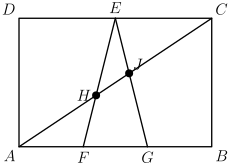
Small Hint:
Triangle has base and the full height, so its area is of the rectangle
Big Hint:
Use to get and from similar triangles
Solution:
Triangle has base and height equal to the rectangle’s height, so its area is
Because triangles and are similar with ratio so Likewise
Then giving
Thus, the correct answer is C.
23.
A polynomial of degree four with leading coefficient and integer coefficients has two real zeros, both of which are integers. Which of the following can also be a zero of the polynomial?
Small Hint:
Factor out the two integer roots: the remaining factor is with integers
Big Hint:
The complex zeros are match the real part and check that is an integer
Solution:
Writing with integer roots matching coefficients forces and to be integers.
The other two zeros are A real part of requires making the imaginary part
Choice A needs i.e. an integer, so it works. The other choices force a non-integer (for example choice E needs and choice D needs with ).
Thus, the correct answer is A.
24.
In triangle Point is on so that and Find
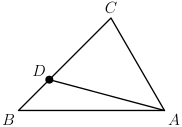
Small Hint:
The exterior angle gives
Big Hint:
Drop a perpendicular from to line at then is -- with
Solution:
Let be the foot of the perpendicular from to line The exterior angle of gives so is a -- triangle with
Then is isosceles with and since too, is isosceles with
Also so is isosceles with Hence making right triangle isosceles with
Therefore
Thus, the correct answer is D.
25.
Consider sequences of positive real numbers of the form in which every term after the first is less than the product of its two immediate neighbors. For how many different values of does the term appear somewhere in the sequence?
more than
Small Hint:
The condition rearranges to letting you march forward
Big Hint:
Doing this repeatedly shows the sequence is periodic with period so can only be one of five terms
Solution:
If are consecutive terms then so Applying this repeatedly, the first five terms are after which and recur, so the sequence is periodic with period
Here is the second term. Setting each of the other four displayed terms equal to gives, respectively, These four values are positive and distinct. The second term itself is and periodicity shows there are no other positions to consider.
So there are values of
Thus, the correct answer is D.