
2000 AMC 12 Problems
Scroll down and press Start to try the exam! Or, go to the printable PDF, answer key, or professional solutions curated by LIVE by Po-Shen Loh.
All problems are used with official legal permission of the Mathematical Association of America (MAA).
Or jump straight to a single problem with its solution: 1 · 2 · 3 · 4 · 5 · 6 · 7 · 8 · 9 · 10 · 11 · 12 · 13 · 14 · 15 · 16 · 17 · 18 · 19 · 20 · 21 · 22 · 23 · 24 · 25
Want to learn professionally through interactive video classes?
Timed
1:15:00
1.
In the year the United States will host the International Mathematical Olympiad. Let and be distinct positive integers such that the product What is the largest possible value of the sum
Answer: E
Small Hint:
Factor into primes
Big Hint:
To maximize the sum, make one factor as large as possible and the others small
Solution:
Factoring gives
To maximize the sum of three distinct positive integers with this product, take and
The largest sum is
Thus, the correct answer is E.
2.
What is
Answer: A
Small Hint:
Write the leading factor as
Big Hint:
Multiplying powers of the same base adds the exponents
Solution:
Writing we get
All of the other options are larger than this.
Thus, the correct answer is A.
3.
Each day, Jenny ate of the jellybeans that were in her jar at the beginning of that day. At the end of the second day, remained. How many jellybeans were in the jar originally?
Answer: B
Small Hint:
Eating leaves at the end of each day
Big Hint:
After two days, of the original amount remains
Solution:
Since is eaten each day, remains at the end of each day. If is the original number, then
Solving gives so
Thus, the correct answer is B.
4.
The Fibonacci sequence starts with two s, and each term afterwards is the sum of its two predecessors. Which one of the ten digits is the last to appear in the units position of a number in the Fibonacci sequence?
Answer: C
Small Hint:
Track only the units digit of each term
Big Hint:
List the units digits until all ten digits have appeared, and note which shows up last
Solution:
The sequence of units digits begins
Scanning this list, the digit is the last of the ten digits to appear.
Thus, the correct answer is C.
5.
If where then what is
Answer: C
Small Hint:
Since the quantity is negative, so
Big Hint:
Solve for then compute
Solution:
Since we have so
Then
Thus, the correct answer is C.
6.
Two different prime numbers between and are chosen. When their sum is subtracted from their product, which of the following numbers could be obtained?
Small Hint:
The primes are and ; note that
Big Hint:
Both primes are odd, so then test the remaining candidates
Solution:
The primes between and are and
For two such primes, is a product of two even numbers minus hence it is This leaves and The latter would require but no two distinct numbers in have product
Indeed,
Thus, the correct answer is C.
7.
How many positive integers have the property that is a positive integer?
Answer: E
Small Hint:
If then
Big Hint:
For to be an integer, must be a positive divisor of
Solution:
If then so must be a positive divisor of
The possibilities give that is, and
There are such values of
Thus, the correct answer is E.
8.
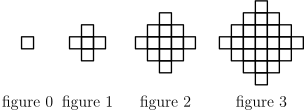
Figures and consist of and nonoverlapping unit squares, respectively. If the pattern were continued, how many nonoverlapping unit squares would there be in figure
Answer: C
Small Hint:
Each figure is a diamond whose rows are the odd numbers up and back down
Big Hint:
Figure has unit squares
Solution:
Figure is a diamond whose row lengths increase through the odd numbers and back down, giving a total of unit squares. This matches for
Therefore figure has unit squares.
Thus, the correct answer is C.
9.
Mrs. Walter gave an exam in a mathematics class of five students. She entered the scores in random order into a spreadsheet, which recalculated the class average after each score was entered. Mrs. Walter noticed that after each score was entered, the average was always an integer. The scores (listed in ascending order) were and What was the last score Mrs. Walter entered?
Answer: C
Small Hint:
The sum of the first scores entered must be divisible by
Big Hint:
Use divisibility by then by ; the residues of the scores modulo are
Solution:
The total is which is divisible by The sum of the first three scores must be divisible by
Modulo the scores are The only triple summing to a multiple of is so these are the first three (with third, since the first two, and must have equal parity).
Since the fourth score must be which is That leaves as the last score entered.
Thus, the correct answer is C.
10.
The point is reflected in the -plane, then its image is rotated by about the -axis to produce and finally, is translated by units in the positive direction to produce What are the coordinates of
Answer: E
Small Hint:
Reflecting in the -plane negates the -coordinate
Big Hint:
A turn about the -axis negates both the - and -coordinates
Solution:
Reflecting in the -plane gives
Rotating about the -axis negates and giving
Translating units in the positive direction gives
Thus, the correct answer is E.
11.
Two non-zero real numbers, and satisfy Find a possible value of
Answer: E
Small Hint:
Combine over a common denominator:
Big Hint:
Replace with in the numerator and expand
Solution:
Combining over a common denominator,
Replacing with in the numerator,
Therefore the expression equals
Thus, the correct answer is E.
12.
Let and be nonnegative integers such that What is the maximum value of
Answer: E
Small Hint:
Big Hint:
The three factors sum to so their product is largest when they are equal
Solution:
Observe that
Since this equals The three factors sum to so their product is maximized when each equals giving
The maximum value is
Thus, the correct answer is E.
13.
One morning each member of Angela’s family drank an -ounce mixture of coffee with milk. The amounts of coffee and milk varied from cup to cup, but were never zero. Angela drank a quarter of the total amount of milk and a sixth of the total amount of coffee. How many people are in the family?
Answer: C
Small Hint:
Suppose Angela’s own cup contains units of coffee and units of milk with
Big Hint:
Then the family total is coffee and milk, so the number of people is
Solution:
Measure amounts in -ounce cups, so Angela’s cup holds coffee and milk with
Since Angela drank a sixth of the coffee, the total coffee is ; since she drank a quarter of the milk, the total milk is The number of people equals the total number of cups,
This is an integer only when is an integer, and since this forces giving people.
Thus, the correct answer is C.
14.
When the mean, median, and mode of the list
are arranged in increasing order, they form a non-constant arithmetic progression. What is the sum of all possible real values of
Answer: E
Small Hint:
The mode is and the mean is
Big Hint:
Split into cases by where falls relative to the other numbers, and require a non-constant progression
Solution:
The six fixed numbers sum to so the mean is and the mode is If then is both median and mode, forcing a constant progression, so
Case : the median is Requiring to form an arithmetic progression yields as the only value in this range.
Case : the median is and the progression forces the mean to be so giving
The sum of all possible values is
Thus, the correct answer is E.
15.
Let be a function for which Find the sum of all values of for which
Answer: B
Small Hint:
To evaluate set so
Big Hint:
This gives a quadratic in ; use the sum-of-roots formula
Solution:
Setting gives so
This rearranges to
By the sum-of-roots formula, the sum of the values of is
Thus, the correct answer is B.
16.
A checkerboard of rows and columns has a number written in each square, beginning in the upper left corner, so that the first row is numbered the second row and so on down the board. If the board is renumbered so that the left column, top to bottom, is the second column and so on across the board, some squares have the same numbers in both numbering systems. Find the sum of the numbers in these squares (under either system).
Answer: D
Small Hint:
The square in row column is numbered originally and after
Big Hint:
Setting the two expressions equal gives ; find all valid
Solution:
The square is numbered originally and after renumbering. Setting these equal gives
The solutions with and are and
These squares hold the numbers and whose sum is
Thus, the correct answer is D.
17.
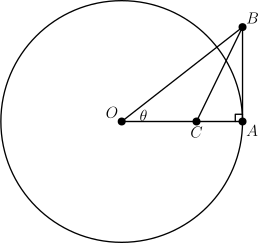
A circle centered at has radius and contains the point Segment is tangent to the circle at and If point lies on and bisects then what is
Answer: D
Small Hint:
Since and we have and
Big Hint:
The bisector gives and
Solution:
Because and is tangent at angle is right, so
Since bisects the angle bisector theorem gives Using
Multiplying numerator and denominator by gives
Thus, the correct answer is D.
18.
In year the th day of the year is a Tuesday. In year the th day is also a Tuesday. On what day of the week did the th day of year occur?
Thursday
Friday
Saturday
Sunday
Monday
Answer: A
Small Hint:
Two dates fall on the same weekday exactly when the number of days between them is a multiple of
Big Hint:
Use the two given Tuesdays to decide which of is a leap year
Solution:
From day of year to day of year the number of days is if is not a leap year. But which would land on a Monday, not a Tuesday.
So year is a leap year, and the gap is days, giving a Tuesday as stated. It follows that year is not a leap year.
The th day of year precedes the Tuesday on day of year by days. Since that day is weekdays before Tuesday, namely Thursday.
Thus, the correct answer is A.
19.
In triangle and Let denote the midpoint of and let denote the intersection of with the bisector of angle Which of the following is closest to the area of triangle
Answer: C
Small Hint:
By Heron’s formula the area of is so the altitude from to is
Big Hint:
is at distance from ; the bisector foot satisfies
Solution:
By Heron’s formula, the area of is so the altitude from to is
The midpoint is from The bisector from meets at with so
Both and lie on so has base and altitude giving area
Thus, the correct answer is C.
20.
If and are positive numbers satisfying and then what is
Answer: B
Small Hint:
Add the three equations, and separately multiply all three together
Big Hint:
Expanding the product produces plus the sum you already computed
Solution:
Adding the three equations gives
Multiplying them gives
Expanding the product, The middle group is the sum so
Hence so
Thus, the correct answer is B.
21.
Through a point on the hypotenuse of a right triangle, lines are drawn parallel to the legs of the triangle so that the triangle is divided into a square and two smaller right triangles. The area of one of the two small right triangles is times the area of the square. What is the ratio of the area of the other small right triangle to the area of the square?
Answer: D
Small Hint:
Let the square have side ; one small triangle has a leg along the square, so its area is
Big Hint:
The two small triangles are similar, so the other triangle’s matching leg is
Solution:
Let the square have side The small triangle sharing one side of the square has a perpendicular leg so its area is giving
The two small triangles are similar, so the other triangle’s leg along the square is and its area is
Thus, the correct answer is D.
22.
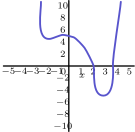
The graph below shows a portion of the curve defined by the quartic polynomial Which of the following is the smallest?
The product of the zeros of
The product of the non-real zeros of
The sum of the coefficients of
The sum of the real zeros of
Answer: C
Small Hint:
The graph shows exactly two real zeros, both positive, so has two non-real (conjugate) zeros
Big Hint:
The product of all zeros equals the -intercept; divide it by the product of the real zeros
Solution:
The graph crosses the -axis exactly twice, both times at positive values, so has two real zeros and two non-real (complex conjugate) zeros.
Reading off the graph: the sum of the coefficients is the sum of the real zeros is greater than and the product of all zeros is the -intercept, which is less than
Let be the product of the real zeros, so The product of the non-real zeros is which is less than
This is smaller than every other listed quantity.
Thus, the correct answer is C.
23.
Professor Gamble buys a lottery ticket, which requires that he pick six different integers from through inclusive. He chooses his numbers so that the sum of the base-ten logarithms of his six numbers is an integer. It so happens that the integers on the winning ticket have the same property -- the sum of the base-ten logarithms is an integer. What is the probability that Professor Gamble holds the winning ticket?
Answer: B
Small Hint:
The sum of logarithms is an integer exactly when the product of the six numbers is a power of
Big Hint:
Only numbers of the form can appear; balance the total factors of and
Solution:
The sum of the logarithms is an integer exactly when the product of the six numbers is Since each chosen number must be of the form so it comes from
For each, record the excess of factors of over factors of : The product is a power of only if the six chosen values have equal totals of s and s, i.e. their excesses sum to
The only negative excesses are for and for A six-number ticket with total excess must contain both: omitting either leaves too few zero and small positive excesses to reach six numbers. The other four numbers must therefore have total excess There are two numbers of excess (), two of excess (), and two of excess (); any number of excess at least would leave too few zeros to complete a four-number selection. Thus we must take both excess- numbers, one excess- number, and one excess- number. This gives exactly four valid tickets: and
Professor Gamble holds one of these four, and only one matches the winning ticket, so the probability is
Thus, the correct answer is B.
24.
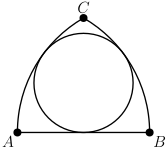
If circular arcs and have centers at and respectively, then there exists a circle tangent to both arc and arc and to If the length of arc is then what is the circumference of the circle?
Answer: D
Small Hint:
Both arcs have radius and is at distance from both and so is equilateral
Big Hint:
Use Power of a Point at with to find the small circle’s radius
Solution:
Each arc has radius and is at distance from both and so is equilateral. Thus arc subtends of a circle of radius whose full circumference is
Let the small circle have radius and touch at its midpoint where By Power of a Point, so giving hence
The circumferences are in the ratio of the radii, so the small circle’s circumference is
Thus, the correct answer is D.
25.
Eight congruent equilateral triangles, each of a different color, are used to construct a regular octahedron. How many distinguishable ways are there to construct the octahedron? (Two colored octahedrons are distinguishable if neither can be rotated to look just like the other.)
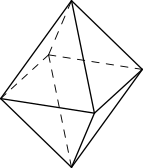
Answer: E
Small Hint:
There are ways to place the eight distinct colors before accounting for rotations
Big Hint:
The rotation group of the octahedron has elements, and distinct colors give each arrangement a trivial stabilizer
Solution:
There are ways to assign the eight distinct colors to the eight faces. Two assignments give the same octahedron exactly when one is a rotation of the other.
The rotation group of a regular octahedron has elements. Because all eight colors are different, no nontrivial rotation fixes a coloring, so each distinguishable octahedron corresponds to exactly assignments.
Therefore the number of distinguishable octahedrons is
Thus, the correct answer is E.