
1998 AMC 12 Solutions
Scroll down to view professionally curated solutions from LIVE by Po-Shen Loh, print PDF solutions, view answer key, or take the full timed exam.
All problems are used with official legal permission of the Mathematical Association of America (MAA).
1.
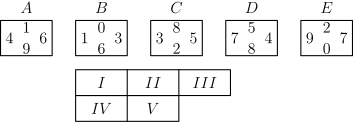
Each of the sides of five congruent rectangles is labeled with an integer, as shown. These five rectangles are placed, without rotating or reflecting, in positions through so that the labels on coincident sides are equal. Which of the rectangles is in position
Small Hint:
The rectangle in position must match another rectangle on both vertical sides
Big Hint:
After finding position , match its left label to the right label of position
Solution:
Position needs both its left and right labels to occur as right and left labels, respectively, on two other rectangles. Only with side labels and permits both matches: has right label and has left label Hence position contains so the correct answer is E.
2.
Letters and represent four different digits selected from If is an integer that is as large as possible, what is the value of
Small Hint:
Make the denominator as small as possible using distinct digits
Big Hint:
The two smallest digits and the two largest digits are disjoint pairs
Solution:
The least positive denominator is and the greatest numerator using two other digits is Their ratio is the integer which is plainly maximal. Thus and E is correct.
3.
If and are digits for which then
Small Hint:
The units column must borrow from the tens column
Big Hint:
Continue the borrowing through the tens and hundreds columns
Solution:
The units column gives so In the tens column, must borrow, and giving The hundreds column then gives Therefore so D is correct.
4.
Define to mean where What is the value of
Small Hint:
Evaluate each of the three inner brackets first
Big Hint:
All three inner brackets have the same value
Solution:
Each inner value is and Thus the outer expression is The correct answer is E.
5.
6.
If is written as a product of two positive integers whose difference is as small as possible, then the difference is
Small Hint:
Factor and look for divisors near its square root
Big Hint:
The closest factor pair is formed from and the remaining factor
Solution:
Since its factor pair nearest is Their difference is so C is correct.
7.
If then
Small Hint:
Start with the innermost cube root and convert it to an exponent
Big Hint:
At each outer level, add to the exponent and divide by
Solution:
The innermost radical is The next is The outermost is Thus D is correct.
8.
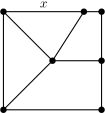
A square with sides of length is divided into two congruent trapezoids and a pentagon, which have equal areas, by joining the center of the square with points on three of the sides, as shown. Find the length of the longer parallel side of each trapezoid.
Small Hint:
Each of the three regions has area
Big Hint:
A trapezoid has height and parallel sides and
Solution:
Each trapezoid has area Its height is and its parallel sides have lengths and Therefore which gives Thus D is correct.
9.
A speaker talked for sixty minutes to a full auditorium. Twenty percent of the audience heard the entire talk and ten percent slept through the entire talk. Half of the remainder heard one third of the talk and the other half heard two thirds of the talk. What was the average number of minutes of the talk heard by members of the audience?
Small Hint:
The two halves of the remainder are each of the audience
Big Hint:
Weight the heard times and by their audience fractions
Solution:
The average is minutes. Thus D is correct.
10.
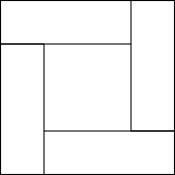
A large square is divided into a small square surrounded by four congruent rectangles as shown. The perimeter of each of the congruent rectangles is What is the area of the large square?
Small Hint:
Let the sides of one rectangle be and
Big Hint:
The side length of the large square is
Solution:
If a rectangle has sides then so The large square has side hence area The correct answer is A.
11.
Let be a rectangle. How many circles in the plane of have a diameter both of whose endpoints are vertices of
Small Hint:
There are six unordered pairs of rectangle vertices
Big Hint:
The two diagonals determine the same circle
Solution:
The four sides determine four distinct diameter circles. The two diagonals are equal and share a midpoint, so they determine the same fifth circle. Hence there are and D is correct.
12.
How many different prime numbers are factors of if
Small Hint:
Undo the logarithms one at a time, starting with base
Big Hint:
The final expression for is a power of
Solution:
Successively exponentiating gives Thus is the only prime factor of so the correct answer is A.
13.
Walter rolls four standard six-sided dice and finds that the product of the numbers on the upper faces is Which of the following could not be the sum of the upper four faces?
Small Hint:
Factor using four factors from through
Big Hint:
Separate the cases with zero, one, or two faces showing
Solution:
Valid rolls include with sum with sum with sum and with sum If two s occur, the other two faces have product and sum at most giving total at most the cases with fewer s also cannot total while retaining product Thus is impossible, and E is correct.
14.
A parabola has vertex at and has two -intercepts, one positive and one negative. If this parabola is the graph of which of and must be positive?
only
only
only
and only
none
Small Hint:
The vertex lies below two intercepts, so determine the opening direction
Big Hint:
Use the signs of the roots’ product and of
Solution:
The parabola opens upward, so Its roots have opposite signs, so and hence Also so Therefore only must be positive, and A is correct.
15.
A regular hexagon and an equilateral triangle have equal areas. What is the ratio of the length of a side of the triangle to the length of a side of the hexagon?
Small Hint:
Partition the regular hexagon into six equilateral triangles
Big Hint:
Equilateral-triangle area is proportional to the square of its side
Solution:
A regular hexagon of side is six equilateral triangles of side An equal-area equilateral triangle of side therefore satisfies so The correct answer is C.
16.
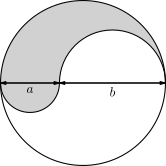
The figure shown is the union of a circle and two semicircles of diameters and all of whose centers are collinear. The ratio of the area of the shaded region to that of the unshaded region is
Small Hint:
Express each region using the large semicircle and one small semicircle
Big Hint:
Both resulting areas factor a common multiple of
Solution:
The shaded area is Similarly, the unshaded area is Their ratio is so B is correct.
17.
Let be a function with the two properties:
(a) for any two real numbers and and
(b)
What is the value of
Small Hint:
Set in the functional equation
Big Hint:
The two properties determine directly for every real
Solution:
Taking gives Hence so E is correct.
18.
A right circular cone of volume a right circular cylinder of volume and a sphere of volume all have the same radius, and the common height of the cone and the cylinder is equal to the diameter of the sphere. Then
Small Hint:
Let the common radius be , so the cone and cylinder height is
Big Hint:
Write all three volumes as multiples of
Solution:
The volumes are and Therefore so A is correct.
19.
How many triangles have area and vertices at and for some angle
Small Hint:
The fixed base has length , and the third vertex has height
Big Hint:
Count the distinct points on the circle satisfying the resulting sine equation
Solution:
The area is Thus There are four corresponding points on the circle, and each gives a distinct triangle. Hence the answer is making C correct.
20.
Three cards, each with a positive integer written on it, are lying face-down on a table. Casey, Stacy, and Tracy are told that
(a) the numbers are all different,
(b) they sum to and
(c) they are in increasing order, left to right.
First, Casey looks at the number on the leftmost card and says, “I don’t have enough information to determine the other two numbers.” Then Tracy looks at the number on the rightmost card and says, “I don’t have enough information to determine the other two numbers.” Finally, Stacy looks at the number on the middle card and says, “I don’t have enough information to determine the other two numbers.” Assume that each person knows that the other two reason perfectly and hears their comments. What number is on the middle card?
There is not enough information to determine the number.
Small Hint:
List all increasing positive triples with sum
Big Hint:
Eliminate triples in the order of the three statements, using what each speaker has learned
Solution:
The eight triples are Casey’s statement excludes With that known, Tracy’s statement excludes rightmost values and The remaining triples are and A middle value or would now identify the triple, so Stacy’s statement forces the middle value Thus C is correct.
21.
In an -meter race, Sunny is exactly meters ahead of Windy when Sunny finishes the race. The next time they race, Sunny sportingly starts meters behind Windy, who is at the starting line. Both runners run at the same constant speed as they did in the first race. How many meters ahead is Sunny when Sunny finishes the second race?
Small Hint:
Express Windy’s speed as a fraction of Sunny’s speed using the first race
Big Hint:
In the second race Sunny travels meters before finishing
Solution:
If Sunny’s speed is Windy’s is Sunny needs time in the second race, during which Windy runs Sunny finishes at position so the lead is Thus C is correct.
22.
What is the value of the expression
Small Hint:
Use the reciprocal identity
Big Hint:
Combine the resulting logarithms of
Solution:
Each term equals Therefore the sum is Thus C is correct.
23.
The graphs of and intersect when satisfies and for no other values of Find
Small Hint:
Complete the square to find both circle centers and radii
Big Hint:
Two circles intersect exactly when the center distance lies between the difference and sum of their radii
Solution:
The circles are Their centers are units apart. With second radius intersection requires or Thus and The correct answer is D.
24.
Call a -digit telephone number - memorable if the prefix sequence is exactly the same as either of the sequences or (possibly both). Assuming that each can be any of the ten decimal digits the number of different memorable telephone numbers is
Small Hint:
Count numbers satisfying each of the two matching conditions separately
Big Hint:
If both matches hold, all seven digits are forced by one repeated digit
Solution:
Each matching condition gives numbers: choose the three prefix digits and the one unconstrained remaining digit. If both hold, then forcing all digits equal, so there are overlaps. Inclusion-exclusion gives so C is correct.
25.
A piece of graph paper is folded once so that is matched with and is matched with Find
Small Hint:
The crease is the perpendicular bisector of the segment joining and
Big Hint:
Find the line , then reflect across it
Solution:
The crease passes through with slope so it is The perpendicular through has slope and meets the crease at This intersection is the midpoint of and giving Hence so B is correct.
26.
In quadrilateral it is given that angles and are right angles, and Then
Small Hint:
The two right angles make cyclic with as a diameter
Big Hint:
Find in triangle , then use the extended law of sines
Solution:
Because the quadrilateral is cyclic, and is its diameter. In triangle By the extended law of sines, Thus B is correct.
27.
A cube is composed of twenty-seven cubes. The big cube is “tunneled” as follows: First, the six cubes which make up the center of each face as well as the center cube are removed as shown. Second, each of the twenty remaining cubes is diminished in the same way. That is, the center facial unit cubes as well as each center cube are removed. The surface area of the final figure is

Small Hint:
After the first stage, classify the twenty remaining large subcubes as corner or edge cubes
Big Hint:
For each second-stage tunnel, subtract exposed center squares and add the newly exposed tunnel walls
Solution:
After the first stage, corner subcubes contribute exposed units each, and edge subcubes contribute each. Tunneling a corner subcube removes exposed unit squares and adds tunnel-wall squares; tunneling an edge subcube removes and also adds Hence the final area is Thus E is correct.
28.
In triangle angle is a right angle and Point is located on so that angle is twice angle If then where and are relatively prime positive integers. Find
Small Hint:
Let , so and
Big Hint:
Set and express and using and
Solution:
Let Since the identity for gives Taking Thus and Therefore so B is correct.
29.
A point in the plane is called a lattice point if both and are integers. The area of the largest square that contains exactly three lattice points in its interior is closest to
Small Hint:
Three collinear interior lattice points force a fourth, so use a smallest noncollinear lattice triangle
Big Hint:
At a maximal square, opposite sides are pinned by nearby lattice points; compare their separation
Solution:
It suffices to enclose the three noncollinear lattice points In a maximal placement, two opposite sides are pinned by neighboring lattice points; the greatest possible separation is the distance between parallel lines through and Hence the area is at most This is attained by the square bounded by Its area is and exactly the three stated lattice points lie inside. Thus D is correct.
30.
For each positive integer let Let denote the smallest positive integer for which the rightmost nonzero digit of is odd. The rightmost nonzero digit of is
Small Hint:
Write and compare its powers of and
Big Hint:
An odd rightmost nonzero digit first becomes possible when the ten-term block contains
Solution:
The five even terms in any ten consecutive integers contribute at least Thus the rightmost nonzero digit can be odd only when the block contains at least eight factors of first possible when it contains For the block has and so the digit remains even. For both valuations are Cancelling and multiplying the remaining odd unit digits gives Hence the first odd rightmost nonzero digit is and E is correct.