
1996 AMC 12 Problems
Scroll down and press Start to try the exam! Or, go to the printable PDF, answer key, or professional solutions curated by LIVE by Po-Shen Loh.
All problems are used with official legal permission of the Mathematical Association of America (MAA).
Or jump straight to a single problem with its solution: 1 · 2 · 3 · 4 · 5 · 6 · 7 · 8 · 9 · 10 · 11 · 12 · 13 · 14 · 15 · 16 · 17 · 18 · 19 · 20 · 21 · 22 · 23 · 24 · 25 · 26 · 27 · 28 · 29 · 30
Want to learn professionally through interactive video classes?
Timed
1:15:00
1.
The addition below is incorrect. What is the largest digit that can be changed to make the addition correct?
Answer: D
Small Hint:
Compare the displayed sum with the actual sum of the three addends
Big Hint:
The correction must lower the total by one unit in a particular place
Solution:
The three addends total which is too large. Changing the tens digit in to lowers the sum by and gives No larger listed digit can make that change, so the correct answer is D.
2.
Each day Walter gets for doing his chores or for doing them exceptionally well. After days of doing his chores daily, Walter has received a total of On how many days did Walter do them exceptionally well?
Answer: A
Small Hint:
Begin with the amount Walter would earn at the ordinary rate on all ten days
Big Hint:
Each exceptionally good day adds the same amount to that baseline
Solution:
Ten ordinary days would pay dollars. Each exceptional day adds dollars, and the actual total is dollars higher. Thus there were exceptional days, so the correct answer is A.
3.
Answer: E
Small Hint:
Evaluate the inner factorial before the outer factorial
Big Hint:
Cancel the denominator from the product in the numerator
Solution:
Since the expression is Thus the correct answer is E.
4.
Six numbers from a list of nine integers are and The largest possible value of the median of all nine numbers in this list is
Answer: D
Small Hint:
The median is the fifth number after all nine are sorted
Big Hint:
To maximize the median, take each of the three unspecified numbers as large as needed
Solution:
The six specified values in order are Even if all three unspecified integers exceed the fifth entry of the full sorted list is This is attainable, so the correct answer is D.
5.
Given that which of the following is the largest?
Answer: E
Small Hint:
A positive fraction grows when its numerator increases or its denominator decreases
Big Hint:
Compare every numerator and denominator with and , respectively
Solution:
Among the displayed numerators, is largest; among the denominators, is smallest. Therefore exceeds every other positive fraction listed, so the correct answer is E.
6.
If then
Answer: E
Small Hint:
Evaluate the four function values separately, paying attention to zero exponents
Big Hint:
The terms at and vanish before any problematic power is needed
Solution:
Direct substitution gives Their sum is so the correct answer is E.
7.
A father takes his twins and a younger child out to dinner on the twins’ birthday. The restaurant charges for the father and for each year of a child’s age, where age is defined as the age at the most recent birthday. If the bill is which of the following could be the age of the youngest child?
Answer: B
Small Hint:
Subtract the father’s charge and divide the remainder by the price per year
Big Hint:
If the twins are years old and the younger child is , impose both and
Solution:
The children account for dollars, so their ages total If each twin is and the younger child is then with Of the choices, gives which works. Thus the correct answer is B.
8.
If and then
Answer: D
Small Hint:
Divide the second equation by the first to eliminate
Big Hint:
Rewrite as a single power of
Solution:
Dividing the equations gives Hence so the correct answer is D.
9.
Triangle and square are in perpendicular planes. Given that and what is
Answer: B
Small Hint:
First identify the right angle in the -- triangle
Big Hint:
A line in one plane perpendicular to the planes’ intersection is perpendicular to the other plane
Solution:
Since triangle is right at In square and Because the two planes are perpendicular along is perpendicular to the plane of and hence to Thus The correct answer is B.
10.
How many line segments have both their endpoints located at the vertices of a given cube?
Answer: D
Small Hint:
A segment is determined by choosing two distinct cube vertices
Big Hint:
Count unordered pairs among the cube’s eight vertices
Solution:
Every unordered pair of the cube’s vertices determines one segment, including edges and diagonals. There are so the correct answer is D.
11.
Given a circle of radius there are many line segments of length that are tangent to the circle at their midpoints. Find the area of the region consisting of all such line segments.
Answer: D
Small Hint:
Each tangent segment extends one unit in each direction from its midpoint
Big Hint:
Use a right triangle from the circle’s center to locate the inner and outer radii of the swept region
Solution:
Each segment is centered at a tangency point units from the circle’s center and extends unit along the tangent in both directions. As the tangency point rotates, the segments fill the annulus with inner radius and outer radius Its area is so the correct answer is D.
12.
A function from the integers to the integers is defined as follows: Suppose is odd and What is the sum of the digits of
Answer: B
Small Hint:
Because is odd, the first iterate is , which is even
Big Hint:
Work backward from , checking the parity required by each inverse branch
Solution:
Since is odd, is even, so If this value were odd, adding could not produce because that would require the value Therefore it is even and is halved to so Hence whose digits sum to The correct answer is B.
13.
Sunny runs at a steady rate, and Moonbeam runs times as fast, where is a number greater than If Moonbeam gives Sunny a head start of meters, how many meters must Moonbeam run to overtake Sunny?
Answer: D
Small Hint:
Let Sunny’s speed be and Moonbeam’s speed be
Big Hint:
If Moonbeam runs meters, express Sunny’s distance during the same time in terms of
Solution:
Suppose Moonbeam runs meters. The elapsed time is so Sunny runs meters after the start. At the catch, Solving gives so the correct answer is D.
14.
Let denote the sum of the even digits of For example, Find
Answer: C
Small Hint:
Include leading zeros and consider the integers from through
Big Hint:
In each digit position, every digit occurs equally often
Solution:
From through each digit occurs times in each of the two positions. The positive even digits sum to so the total contribution is The number contributes no even positive digit, so the correct answer is C.
15.
Two opposite sides of a rectangle are each divided into congruent segments, and the endpoints of one segment are joined to the center to form triangle The other sides are each divided into congruent segments, and the endpoints of one of these segments are joined to the center to form triangle [See figure for ] What is the ratio of the area of triangle to the area of triangle
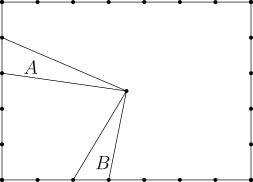
Answer: B
Small Hint:
Write the rectangle’s side lengths as and
Big Hint:
Each triangle has a base that is one divided segment and an altitude equal to half the opposite side length
Solution:
Triangle has base and altitude so its area is Triangle has base and altitude so its area is Their ratio is and the correct answer is B.
16.
A fair standard six-sided dice is tossed three times. Given that the sum of the first two tosses equals the third, what is the probability that at least one is tossed?
Answer: D
Small Hint:
Under the stated condition, count ordered pairs for the first two tosses whose sum is at most
Big Hint:
For the favorable count, separate a third-toss from pairs having a among the first two tosses
Solution:
For third tosses the numbers of ordered first-two-toss pairs are for equally likely conditional outcomes. A third toss of contributes A in the first position gives outcomes and a in the second gives with counted twice. Thus there are favorable outcomes, and the correct answer is D.
17.
In rectangle angle is trisected by and where is on is on and Which of the following is closest to the area of the rectangle
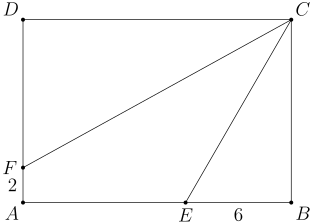
Answer: E
Small Hint:
Each of the three angles at is
Big Hint:
Use the two right triangles adjacent to sides and to determine the rectangle’s height and width
Solution:
Let the rectangle have width and height In right triangle so In the triangle using the horizontal run is and the vertical drop is so Hence The area is closest to Thus the correct answer is E.
18.
A circle of radius has center at A circle of radius has center at A line is tangent to the two circles at points in the first quadrant. Which of the following is closest to the -intercept of the line?
Answer: D
Small Hint:
Write the tangent as and use point-to-line distance for each center
Big Hint:
Subtract the two distance equations to determine the slope before solving for the intercept
Solution:
Write the upper common tangent as and let The two center-to-line distances give Thus so and From the second equation, Therefore the correct answer is D.
19.
The midpoints of the sides of a regular hexagon are joined to form a smaller hexagon. What fraction of the area of is enclosed by the smaller hexagon?
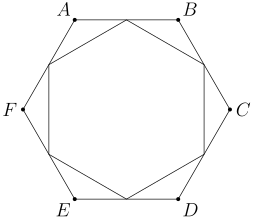
Answer: D
Small Hint:
Compare the distance between adjacent side midpoints with the original side length
Big Hint:
The smaller and larger hexagons are similar, so square their side-length ratio
Solution:
Two adjacent midpoints and their shared vertex form a triangle with two sides and included angle Its opposite side has squared length Thus the smaller hexagon has scale factor and its area ratio is The correct answer is D.
20.
In the -plane, what is the length of the shortest path from to that does not go inside the circle
Answer: C
Small Hint:
The circle’s center is the midpoint of the two endpoints
Big Hint:
The shortest permitted path consists of two tangent segments and the shorter arc between their tangency points
Solution:
Each endpoint is units from the circle’s center, so each tangent segment has length In the right triangle at a tangency point, the angle at the center is Since the endpoint rays are opposite, the intervening minor arc subtends so its length is The total is and the correct answer is C.
21.
Triangles and are isosceles with and intersects at If then is
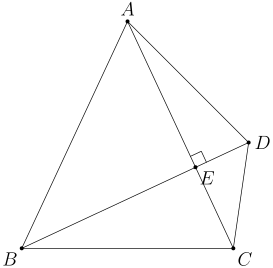
not uniquely determined
Answer: D
Small Hint:
Let and express using isosceles triangle
Big Hint:
Use to find the vertex angle at of isosceles triangle
Solution:
Let Since Because the angle between and is In isosceles triangle so its two base angles are Their sum is so the correct answer is D.
22.
Four distinct points, and are to be selected from points evenly spaced around a circle. All quadruples are equally likely to be chosen. What is the probability that the chord intersects the chord
Answer: B
Small Hint:
Fix any four selected points and examine the three ways to pair them into two chords
Big Hint:
Exactly one pairing joins alternating points around the circle
Solution:
For any fixed four points, there are three ways to partition their labels into two unordered chord pairs. Exactly one pairing joins alternating points around the circle and therefore crosses. The named pair is equally likely to be any of these three pairings, so the probability is The correct answer is B.
23.
The sum of the lengths of the twelve edges of a rectangular box is and the distance from one corner of the box to the farthest corner is The total surface area of the box is
Answer: B
Small Hint:
If the side lengths are , translate the edge sum and space diagonal into equations
Big Hint:
Expand to obtain directly
Solution:
The edge sum gives so The space diagonal gives Therefore the surface area is Thus the correct answer is B.
24.
The sequence consists of ’s separated by blocks of ’s with ’s in the th block. The sum of the first terms of this sequence is
Answer: B
Small Hint:
Count the total number of terms through the end of the th block
Big Hint:
Find the last complete block before term , then account for the partial next block
Solution:
Through block there are ones and twos, hence terms. For this is Their sum is The next terms are one and nine ’s, with sum The requested sum is so the correct answer is B.
25.
Given that what is the largest possible value that can have?
Answer: B
Small Hint:
Complete the square to identify the circle’s center and radius
Big Hint:
The maximum of is its value at the center plus the radius times
Solution:
Completing the square gives At the center, Moving units in the direction of the vector increases the expression by The maximum is so the correct answer is B.
26.
An urn contains marbles of four colors: red, white, blue, and green. When four marbles are drawn without replacement, the following events are equally likely:
(a) the selection of four red marbles;
(b) the selection of one white and three red marbles;
(c) the selection of one white, one blue, and two red marbles; and
(d) the selection of one marble of each color.
What is the smallest number of marbles satisfying the given condition?
more than
Answer: B
Small Hint:
Let the four color counts be and equate the combination counts for the four events
Big Hint:
Successive ratios determine in terms of ; then find the smallest making all three integers
Solution:
Equal probabilities have the same common denominator, so their favorable selection counts satisfy Successive ratios give and The least making all three positive integers is Then for marbles. Thus the correct answer is B.
27.
Consider two solid spherical balls, one centered at with radius and the other centered at with radius How many points with only integer coordinates (lattice points) are there in the intersection of the balls?
Answer: D
Small Hint:
First intersect the possible integer ranges for the -coordinate in the two balls
Big Hint:
At the only possible height, reduce both sphere inequalities to a bound on
Solution:
The first ball permits integer heights through while the second permits through so an intersection lattice point must have At that height the two bounds are Thus can be or These give and ordered integer pairs, respectively, for points. The correct answer is D.
28.
On a rectangular parallelepiped, vertices and are adjacent to vertex The perpendicular distance from to the plane containing and is closest to
Answer: C
Small Hint:
Place at the origin with the three adjacent edges along coordinate axes
Big Hint:
Write the intercept form of the plane through
Solution:
Put and take the adjacent vertices as Their plane is Its distance from the origin is closest to Thus the correct answer is C.
29.
If is a positive integer such that has positive divisors and has positive divisors, then how many positive divisors does have?
Answer: C
Small Hint:
Write , where is relatively prime to , and let be the number of divisors of
Big Hint:
Use the two divisor-count equations to restrict to a divisor of both and
Solution:
Write with and let Then Hence is or Checking the factor pairs of gives no solution when Checking those of when gives the unique solution Therefore so the correct answer is C.
30.
A hexagon inscribed in a circle has three consecutive sides each of length and three consecutive sides each of length The chord of the circle that divides the hexagon into two trapezoids, one with three sides each of length and the other with three sides each of length has length equal to where and are relatively prime positive integers. Find
Answer: E
Small Hint:
Let and be the half-central angles subtended by sides and
Big Hint:
Use and the chord ratio to find , then apply
Solution:
Let the circle have radius and let be the half-central angles for the sides Then and Thus so and The dividing chord spans the three consecutive sides of length so Therefore so The correct answer is E.