
1993 AMC 12 Problems
Scroll down and press Start to try the exam! Or, go to the printable PDF, answer key, or professional solutions curated by LIVE by Po-Shen Loh.
All problems are used with official legal permission of the Mathematical Association of America (MAA).
Or jump straight to a single problem with its solution: 1 · 2 · 3 · 4 · 5 · 6 · 7 · 8 · 9 · 10 · 11 · 12 · 13 · 14 · 15 · 16 · 17 · 18 · 19 · 20 · 21 · 22 · 23 · 24 · 25 · 26 · 27 · 28 · 29 · 30
Want to learn professionally through interactive video classes?
Timed
1:15:00
1.
For integers and define to mean Then equals
Answer: D
Small Hint:
Substitute the three entries in their stated order
Big Hint:
Remember that and
Solution:
By the definition, Thus the correct answer is D.
2.
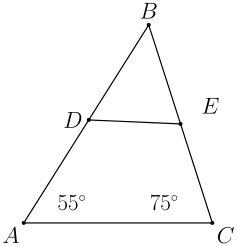
In is on side and is on side If then
Answer: D
Small Hint:
First determine
Big Hint:
Triangle is isosceles with vertex at
Solution:
We have equal to Because and lie on and respectively, Since the two base angles of are Thus the correct answer is D.
3.
Answer: E
Small Hint:
Write as
Big Hint:
Combine the numerator and denominator inside one fifteenth power
Solution:
Using a common exponent, Thus the correct answer is E.
4.
Define the operation “” by for all real numbers and For how many real numbers does
more than
Answer: E
Small Hint:
Substitute into the operation
Big Hint:
Check whether the terms containing cancel
Solution:
For every real Hence every real number works, so there are more than such numbers. Thus the correct answer is E.
5.
Last year a bicycle cost and a cycling helmet cost This year the cost of the bicycle increased by and the cost of the helmet increased by The percent increase in the combined cost of the bicycle and the helmet is
Answer: A
Small Hint:
Find the dollar increase for each item
Big Hint:
Compare the total increase with last year’s combined cost
Solution:
The bicycle increases by and the helmet by for a total increase of Last year’s combined cost was so the percent increase is Thus the correct answer is A.
6.
Answer: B
Small Hint:
Rewrite every power with base
Big Hint:
Factor the smaller power from the numerator and denominator
Solution:
Writing all terms as powers of Its positive square root is Thus the correct answer is B.
7.
The symbol stands for an integer whose base-ten representation is a sequence of ones. For example, etc. When is divided by the quotient is an integer whose base-ten representation is a sequence containing only ones and zeros. The number of zeros in is
Answer: E
Small Hint:
Use
Big Hint:
The quotient has six ones, each four places apart
Solution:
Grouping the digits into six blocks of four gives Thus has six ones, with three zeros between each consecutive pair. It therefore has zeros. Thus the correct answer is E.
8.
Let and be circles of radius that are in the same plane and tangent to each other. How many circles of radius are in this plane and tangent to both and
Answer: D
Small Hint:
A radius- circle can be internally or externally tangent to each unit circle
Big Hint:
For its center, consider distance pairs and
Solution:
Let the centers of the tangent unit circles be units apart. The new center must be units from a unit-circle center for external tangency and units away for internal tangency. The distance pair gives two centers, as does Each mixed pair and gives one center because the corresponding center-circles are internally tangent. Hence there are circles. Thus the correct answer is D.
9.
Country has of the world’s population and owns of the world’s wealth. Country has of the world’s population and of its wealth. Assume that the citizens of share the wealth of equally, and assume that those of share the wealth of equally. Find the ratio of the wealth of a citizen of to the wealth of a citizen of
Answer: D
Small Hint:
Per-capita wealth is total wealth divided by population
Big Hint:
Form the ratio
Solution:
Country ’s per-capita share is proportional to while country ’s is proportional to Their ratio is Thus the correct answer is D.
10.
Let be the number that results when both the base and the exponent of are tripled, where If equals the product of and where then
Answer: C
Small Hint:
Tripling both parts changes to
Big Hint:
Rewrite the equality so both sides are th powers
Solution:
We have Also Positivity allows us to equate the bases, so and Thus the correct answer is C.
11.
If then how many digits are in the base-ten representation for
Answer: A
Small Hint:
Undo the logarithms one at a time from the outside
Big Hint:
The successive values are and before solving for
Solution:
Undoing the logarithms gives This number has decimal digits. Thus the correct answer is A.
12.
If for all then
Answer: E
Small Hint:
To obtain replace the given input variable by
Big Hint:
Simplify
Solution:
Replacing the given by yields Therefore Thus the correct answer is E.
13.
A square of perimeter is inscribed in a square of perimeter What is the greatest distance between a vertex of the inner square and a vertex of the outer square?
Answer: D
Small Hint:
A vertex of the inner square divides an outer side into lengths and
Big Hint:
Use and
Solution:
The outer and inner side lengths are and At any inner vertex, the two pieces of the outer side have lengths and with Hence so From an inner vertex on one side, the farther opposite outer vertex has horizontal displacement and vertical displacement The greatest distance is therefore Thus the correct answer is D.
14.
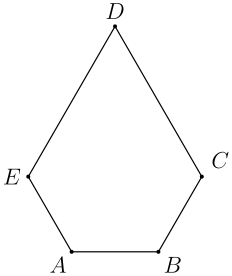
The convex pentagon has and What is the area of
Answer: B
Small Hint:
Draw to split the pentagon into a trapezoid and a triangle
Big Hint:
The angle conditions give so is equilateral
Solution:
Place and The angles and side lengths give Thus is a trapezoid of height and bases and so its area is Also making equilateral with area The total area is Thus the correct answer is B.
15.
For how many values of will an -sided regular polygon have interior angles with integral degree measures?
Answer: D
Small Hint:
An interior angle is
Big Hint:
Count divisors of and exclude values below
Solution:
The interior angle is which is integral exactly when is divisible by Since it has positive divisors. Excluding and leaves allowable values. Thus the correct answer is D.
16.
Consider the non-decreasing sequence of positive integers in which the th positive integer appears times. The remainder when the rd term is divided by is
Answer: D
Small Hint:
The final occurrence of is in position
Big Hint:
Compare with the triangular numbers for and
Solution:
The last occurs in position while the last occurs in position Thus the rd term is whose remainder modulo is Thus the correct answer is D.
17.
Amy painted a dart board over a square clock face using the “hour positions” as boundaries. [See figure.] If is the area of one of the eight triangular regions such as that between o’clock and o’clock, and is the area of one of the four corner quadrilaterals such as that between o’clock and o’clock, then

Answer: A
Small Hint:
Scale the square so its sides are and
Big Hint:
The o’clock ray meets the top side at
Solution:
Let the square be and its center be the origin. The o’clock ray meets the top side at so The corner quadrilateral has vertices Its area is Hence Thus the correct answer is A.
18.
Al and Barb start their new jobs on the same day. Al’s schedule is work-days followed by rest-day. Barb’s schedule is work-days followed by rest-days. On how many of their first days do both have rest-days on the same day?
Answer: E
Small Hint:
The combined schedule repeats every days
Big Hint:
Within one -day cycle, compare Al’s rest days with Barb’s
Solution:
The combined pattern repeats every days. Al rests on days while Barb rests on days Their common rest days are and two per cycle. There are cycles, giving common rest days. Thus the correct answer is E.
19.
How many ordered pairs of positive integers are solutions to
more than
Answer: D
Small Hint:
Clear denominators and complete a product involving and
Big Hint:
The equation is equivalent to
Solution:
Clearing denominators and rearranging gives Both factors must be positive. The four ordered positive factor pairs of give Thus the correct answer is D.
20.
Consider the equation where is a complex variable and Which of the following statements is true?
For all positive real numbers both roots are pure imaginary.
For all negative real numbers both roots are pure imaginary.
For all pure imaginary numbers both roots are real and rational.
For all pure imaginary numbers both roots are real and irrational.
For all complex numbers neither root is real.
Answer: B
Small Hint:
Apply the quadratic formula and simplify the discriminant
Big Hint:
For negative real determine the type of
Solution:
The roots are If is negative and real, then is negative real, so its square roots are pure imaginary. Both resulting values of are therefore pure imaginary. The other universal claims fail, for example by taking or as appropriate. Thus the correct answer is B.
21.
Let be a finite arithmetic sequence with
and
If then
Answer: B
Small Hint:
Use the middle terms to find and
Big Hint:
The difference between and determines the common difference
Solution:
Because symmetric terms of an arithmetic sequence average to the middle term, Thus and so the common difference is Since we have Thus the correct answer is B.
22.
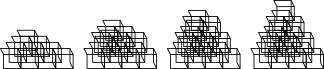
Twenty cubical blocks are arranged as shown. First, are arranged in a triangular pattern; then a layer of arranged in a triangular pattern, is centered on the then a layer of arranged in a triangular pattern, is centered on the and finally one block is centered on top of the third layer. The blocks in the bottom layer are numbered through in some order. Each block in layers and is assigned the number which is the sum of the numbers assigned to the three blocks on which it rests. Find the smallest possible number which could be assigned to the top block.
Answer: C
Small Hint:
Determine how many times each bottom block contributes to the top
Big Hint:
The center, six edge positions, and three corner positions have coefficients and
Solution:
Expanding the sums layer by layer, the top value is where is the center bottom block, the are the six non-corner boundary blocks, and the are the three corner blocks. To minimize this weighted sum, assign to the coefficient- position, to the coefficient- positions, and to the coefficient- positions. The minimum is Thus the correct answer is C.
23.
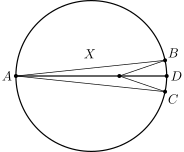
Points and are on a circle of diameter and is on diameter If and then
Answer: B
Small Hint:
Because the diameter through bisects
Big Hint:
Find using right triangle then apply the Law of Sines in
Solution:
Since the line bisects and symmetry also gives Because is a diameter, so Also The Law of Sines in gives Thus the correct answer is B.
24.
A box contains shiny pennies and dull pennies. One by one, pennies are drawn at random from the box and not replaced. If the probability is that it will take more than four draws until the third shiny penny appears and is in lowest terms, then
Answer: E
Small Hint:
View the three shiny pennies as occupying three of seven draw positions
Big Hint:
Subtract the cases in which all three shiny pennies occur among the first four positions
Solution:
The shiny pennies occupy a uniformly chosen -element subset of the draw positions. There are possibilities. The third shiny penny appears by draw exactly when all three shiny positions lie among the first four, which occurs in cases. The requested probability is Therefore Thus the correct answer is E.
25.
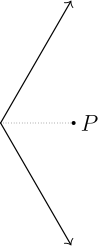
Let be the set of points on the rays forming the sides of a angle, and let be a fixed point inside the angle on the angle bisector. Consider all distinct equilateral triangles with and in (Points and may be on the same ray, and switching the names of and does not create a distinct triangle.) There are
exactly such triangles.
exactly such triangles.
exactly such triangles.
exactly such triangles.
more than such triangles.
Answer: E
Small Hint:
Call the angle’s vertex and choose on one ray so that is equilateral
Big Hint:
Vary a point continuously on and construct a matching point on the other ray
Solution:
Let be the vertex. Choose on one ray so that because bisects the angle, is equilateral. For any on choose on the other ray with Then by SAS. Consequently and so is equilateral. Continuously many choices of give distinct triangles, hence certainly more than Thus the correct answer is E.
26.
Find the largest positive value attained by the function a real number.
Answer: C
Small Hint:
Factor both radicands using the common factor
Big Hint:
On the domain rationalize
Solution:
Both radicals are real exactly when Factoring and rationalizing, On this interval the numerator decreases while the denominator increases, so the maximum occurs at Its value is Thus the correct answer is C.
27.
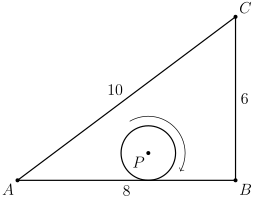
The sides of have lengths and A circle with center and radius rolls around the inside of always remaining tangent to at least one side of the triangle. When first returns to its original position, through what distance has traveled?
Answer: B
Small Hint:
The center traces a smaller triangle whose sides are parallel to the original sides
Big Hint:
The original -- triangle has inradius while the center’s path has inradius
Solution:
The center remains one unit from the side it touches, so its path is the triangle formed by the three inward parallel lines at distance This triangle is similar to The original right triangle has area and semiperimeter hence inradius The path triangle has inradius so its linear scale is Its perimeter, and therefore the distance traveled, is Thus the correct answer is B.
28.
How many triangles with positive area are there whose vertices are points in the -plane whose coordinates are integers satisfying and
Answer: D
Small Hint:
Start with all triples and subtract collinear ones
Big Hint:
Three collinear grid points can occur only horizontally, vertically, or on a slope- diagonal
Solution:
There are triples of grid points. The four rows and four columns contribute collinear triples. For slope the diagonal lengths capable of containing three points are contributing slope contributes another No other slope fits three lattice points inside a -by- point array. Thus the number of positive-area triangles is Thus the correct answer is D.
29.
Which of the following sets could NOT be the lengths of the external diagonals of a right rectangular prism [a “box”]? (An external diagonal is a diagonal of one of the rectangular faces of the box.)
Answer: B
Small Hint:
If are the face diagonals, express the edge squares in terms of
Big Hint:
A necessary and sufficient positivity condition is
Solution:
If the edge lengths are then the three face-diagonal squares are For sorted diagonals so necessarily the analogous formulas show this is also sufficient. Only fails, since Thus the correct answer is B.
30.
Given let for all integers For how many is it true that
infinitely many
Answer: D
Small Hint:
Each step takes the fractional part of twice the preceding value
Big Hint:
Thus is the fractional part of
Solution:
The recurrence is so The equality requires hence is an integer. The values for all satisfy the recurrence and lie in There are values. Thus the correct answer is D.