
1992 AMC 12 Solutions
Scroll down to view professionally curated solutions from LIVE by Po-Shen Loh, print PDF solutions, view answer key, or take the full timed exam.
All problems are used with official legal permission of the Mathematical Association of America (MAA).
1.
If then
Small Hint:
Compare with
Big Hint:
Account separately for the change inside the parentheses and the change in the outside coefficient
Solution:
We have so
Thus the correct answer is B.
2.
An urn is filled with coins and beads, all of which are either silver or gold. Twenty percent of the objects in the urn are beads. Forty percent of the coins in the urn are silver. What percent of the objects in the urn are gold coins?
Small Hint:
First find the percent of all objects that are coins
Big Hint:
Of those coins, use the complement of the silver percentage
Solution:
Coins make up of the objects, and of the coins are gold. Thus gold coins make up of all the objects.
Thus the correct answer is B.
3.
If and the points and lie on a line with slope then
Small Hint:
Write the slope between the two given points
Big Hint:
Set and use the positivity condition
Solution:
The slope condition gives Therefore so Since we obtain
Thus the correct answer is C.
4.
If and are positive integers and and are odd, then is
odd for all choices of
even for all choices of
odd if is even; even if is odd
odd if is odd; even if is even
odd if is not a multiple of ; even if is a multiple of
5.
Small Hint:
Factor the repeated summand
Big Hint:
There are exactly six identical terms
Solution:
Factoring gives
Thus the correct answer is B.
6.
If then
Small Hint:
Collect the powers of and the powers of separately
Big Hint:
Rewrite using a single ratio
Solution:
Combining like bases,
Thus the correct answer is D.
7.
The ratio of to is of to is and of to is What is the ratio of to
Small Hint:
Express both and as multiples of
Big Hint:
Use
Solution:
Multiplying the given ratios, Thus
Thus the correct answer is B.
8.
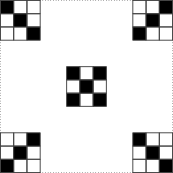
A square floor is tiled with congruent square tiles. The tiles on the two diagonals of the floor are black. The rest of the tiles are white. If there are black tiles, then the total number of tiles is
Small Hint:
If the floor has tiles on a side, count the tiles on both diagonals
Big Hint:
Because the total number of black tiles is odd, the two diagonals share one center tile
Solution:
For an odd each diagonal contains tiles and the two diagonals share only the center tile. Hence so The floor therefore contains tiles.
Thus the correct answer is E.
9.
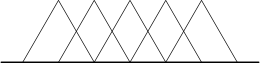
Five equilateral triangles, each with side are arranged so they are all on the same side of a line containing one side of each. Along this line, the midpoint of the base of one triangle is a vertex of the next. The area of the region of the plane that is covered by the union of the five triangular regions is
Small Hint:
Add the areas of the five large triangles, then subtract their overlaps
Big Hint:
Each adjacent overlap is an equilateral triangle with half the original side length
Solution:
Each large triangle has area Each of the four overlaps is an equilateral triangle of side hence area There are no triple overlaps, so the union has area
Thus the correct answer is E.
10.
The number of positive integers for which the equation has an integer solution for is
Small Hint:
Solve the equation for in terms of
Big Hint:
The expression is integral exactly when is a positive divisor of
Solution:
Solving gives Thus is an integer precisely when is a positive divisor of The possibilities are and for a total of
Thus the correct answer is D.
11.
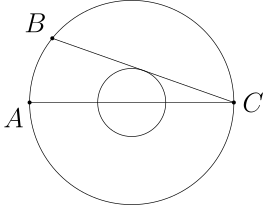
The ratio of the radii of two concentric circles is If is a diameter of the larger circle, is a chord of the larger circle that is tangent to the smaller circle, and then the radius of the larger circle is
Small Hint:
Draw the radius to the point where touches the smaller circle
Big Hint:
Use the similar right triangles formed by the tangent radius and the diameter
Solution:
Let be the common center and the tangency point on Since and triangles and are similar. If the larger radius is then and Thus Hence and
Thus the correct answer is B.
12.
Let be the image when the line is reflected across the -axis. The value of is
Small Hint:
Reflection across the -axis replaces each -coordinate by its negative
Big Hint:
Replace by in the original equation, then solve for
Solution:
A point is on the reflected line exactly when is on the original line. Hence or Therefore
Thus the correct answer is C.
13.
How many pairs of positive integers with satisfy the equation
Small Hint:
Multiply the numerator and denominator by
Big Hint:
After simplifying, write as a multiple of and apply the bound on
Solution:
Multiplying the numerator and denominator by gives Thus The condition becomes so may be any integer from through There are pairs.
Thus the correct answer is C.
14.
Which of the following equations have the same graph?
and only
and only
and only
and
None. All the equations have different graphs
Small Hint:
Pay special attention to what happens when
Big Hint:
Equation II omits one point, while equation III includes an entire extra vertical line
Solution:
Equation I is the whole line Equation II simplifies to that line only when so it omits In equation III, every point with satisfies for other it gives Thus III is the line together with the entire vertical line The three graphs are different.
Thus the correct answer is E.
15.
Let For define a sequence of complex numbers by In the complex plane, how far from the origin is
Small Hint:
Compute the first few terms rather than trying to expand
Big Hint:
Look for a cycle beginning with
Solution:
The first terms are Hence the sequence alternates between at odd indices and at even indices from onward. Therefore whose distance from the origin is
Thus the correct answer is B.
16.
If for three positive numbers and all different, then
Small Hint:
Let and express using the middle ratio
Big Hint:
Substitute into the first ratio
Solution:
Let From we get Then Thus or Hence or and positivity gives
Thus the correct answer is E.
17.
The two-digit integers from to are written consecutively to form the large integer If is the highest power of that is a factor of then
more than
Small Hint:
Use the digit-sum tests for divisibility by and
Big Hint:
Modulo the digit sum of the concatenation equals
Solution:
Modulo a number is congruent to its digit sum, so Thus is divisible by but not by so the highest power of dividing it is
Thus the correct answer is B.
18.
The increasing sequence of positive integers has the property that, for every If then is
Small Hint:
Write and in terms of and
Big Hint:
From use congruences and
Solution:
Let and Repeated use of the recurrence gives Modulo the first equation shows that is a multiple of The positive possibilities are or The conditions leave only and Hence
Thus the correct answer is D.
19.
For each vertex of a solid cube, consider the tetrahedron determined by the vertex and the midpoints of the three edges that meet at that vertex. The portion of the cube that remains when these eight tetrahedra are cut away is called a cuboctahedron. The ratio of the volume of the cuboctahedron to the volume of the original cube is closest to which of these?
Small Hint:
Choose a convenient side length for the cube and compute one removed corner tetrahedron
Big Hint:
Each removed tetrahedron has three mutually perpendicular edges equal to half the cube’s side
Solution:
Take the cube’s side length to be Its volume is Each corner tetrahedron has three perpendicular edges of length so its volume is The eight removed tetrahedra have total volume leaving The ratio is which is closest to
Thus the correct answer is D.
20.
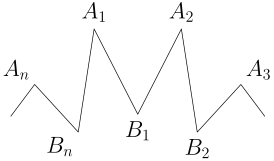
Part of an “-pointed regular star” is shown. It is a simple closed polygon in which all edges are congruent, angles are congruent, and angles are congruent. If the acute angle at is less than the acute angle at then
Small Hint:
Let the acute angles at the - and -vertices be and
Big Hint:
At each inward -vertex, the polygon’s interior angle is
Solution:
Let the acute angles at the tips and notches be and respectively, so The -gon has interior angles and reflex interior angles Therefore Substituting gives so
Thus the correct answer is D.
21.
For a finite sequence of numbers, the Cesàro sum of is defined to be where If the Cesàro sum of the -term sequence is what is the Cesàro sum of the -term sequence
Small Hint:
Convert the first Cesàro sum into the value of
Big Hint:
Each new partial sum is plus an old partial sum, with one initial partial sum equal to
Solution:
The given condition says For the new sequence, the partial sums are Their sum is Dividing by gives the new Cesàro sum
Thus the correct answer is A.
22.
Ten points are selected on the positive -axis, and five points are selected on the positive -axis, The fifty segments connecting the ten selected points on to the five selected points on are drawn. What is the maximum possible number of points of intersection of these fifty segments that could lie in the interior of the first quadrant?
Small Hint:
An interior crossing is determined by choosing two points from each axis
Big Hint:
For each selected pair on each axis, exactly one pair of the four connecting segments crosses
Solution:
Choose two of the points on the -axis and two of the points on the -axis. Among the four connecting segments, the two with reversed endpoint order cross exactly once. The points can be chosen so no three segments meet at one interior point, so the maximum is
Thus the correct answer is B.
23.
What is the size of the largest subset of such that no pair of distinct elements of has a sum divisible by
Small Hint:
Group the integers by their residues modulo
Big Hint:
Pair residue classes with with and with ; treat residue separately
Solution:
The residue classes contain numbers, respectively. We may take numbers from at most one class in each complementary pair and at most one multiple of Thus Taking every number whose residue modulo is or together with one multiple of attains
Thus the correct answer is E.
24.
Let be a parallelogram of area with and Locate and on segments and respectively, with Let the line through parallel to intersect at The area of the quadrilateral is
Small Hint:
Use and as an affine coordinate basis
Big Hint:
In that basis, and ; use the parallel condition to locate
Solution:
Use and as basis vectors. Then A line from parallel to meets at The shoelace formula gives the coordinate area of as Affine coordinates scale all areas by the area of so
Thus the correct answer is C.
25.
In triangle and If perpendiculars constructed to at and to at meet at then
Small Hint:
Place and
Big Hint:
Use the angle to locate then parametrize the line through perpendicular to
Solution:
Set and Then The perpendicular to at is A vector perpendicular to is so the other perpendicular is Its -coordinate is when Since
Thus the correct answer is E.
26.
Semicircle has center and radius Point is on and Extend and to and respectively, so that circular arcs and have and as their respective centers. Circular arc has center The area of the shaded “smile,” is
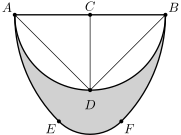
Small Hint:
Use to identify two isosceles right triangles and determine the relevant radii
Big Hint:
Express the smile as one sector plus two sectors, then subtract triangle and semicircle
Solution:
Triangles and are isosceles right triangles, so and The smile is the sector plus the congruent sectors and minus triangle and the original semicircle. Its area is
Thus the correct answer is B.
27.
A circle of radius has chords of length and of length When and are extended through and respectively, they intersect at which is outside the circle. If and then
Small Hint:
Apply the secant-secant theorem to find and
Big Hint:
Once and identify a -- triangle
Solution:
Power of gives Here and so Thus and Since and triangle is right at with Therefore is a diameter, and Hence
Thus the correct answer is D.
28.
Let The product of the real parts of the roots of is
Small Hint:
Apply the quadratic formula and write
Big Hint:
Solve and to determine the real parts of the two roots
Solution:
The quadratic formula gives Since the roots are Their real parts have product
Thus the correct answer is B.
29.
An “unfair” coin has a probability of turning up heads. If this coin is tossed times, what is the probability that the total number of heads is even?
Small Hint:
Track the difference between the probabilities of an even and an odd number of heads
Big Hint:
One toss multiplies that difference by
Solution:
Let and be the probabilities of an even and odd number of heads after tosses. Then while Since we have Solving the sum and difference equations gives
Thus the correct answer is D.
30.
Let be an isosceles trapezoid with bases and Suppose and a circle with center on is tangent to segments and If is the smallest possible value of then
Small Hint:
By symmetry, place the trapezoid with its bases centered on the same vertical axis and put the circle’s center at the midpoint of
Big Hint:
Write the distance from the center to a leg and require the tangency point to lie on the leg segment; the minimum occurs at an endpoint case
Solution:
Place and Symmetry forces the circle’s center to be The horizontal offset along each leg is so The perpendicular from to a leg first has its foot on the segment when the foot reaches the upper endpoint; this boundary condition is Thus Therefore
Thus the correct answer is B.