
1986 AMC 12 Solutions
Scroll down to view professionally curated solutions from LIVE by Po-Shen Loh, print PDF solutions, view answer key, or take the full timed exam.
All problems are used with official legal permission of the Mathematical Association of America (MAA).
1.
Small Hint:
Remove the innermost parentheses before subtracting the second bracket
Big Hint:
Track the minus sign in front of each bracket carefully
Solution:
Expanding the two bracketed expressions gives
Thus the correct answer is B.
2.
If the line in the -plane has half the slope and twice the -intercept of the line then an equation for is
Small Hint:
Read the slope and intercept from
Big Hint:
Apply the two requested changes to the coefficient and constant separately
Solution:
The original line has slope and -intercept Therefore has slope and -intercept so its equation is
Thus the correct answer is A.
3.
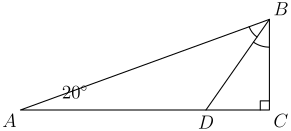
In the figure, has a right angle at and If is the bisector of then
Small Hint:
First find from the angle sum of
Big Hint:
Use the bisector and then the angle sum of right triangle
Solution:
Since and we have The bisector gives Therefore, in right triangle
Thus the correct answer is D.
4.
Let be the statement
“If the sum of the digits of the whole number is divisible by then is divisible by ”
A value of which shows to be false is
none of these
Small Hint:
A counterexample must satisfy the hypothesis but not the conclusion
Big Hint:
Divisibility by requires both divisibility by and by
Solution:
The digit sum of is which is divisible by However, is odd, so it is not divisible by Thus makes the implication false.
Therefore the correct answer is B.
5.
Simplify
Small Hint:
Rewrite as a power of and as an improper fraction
Big Hint:
Simplify both radicals before squaring their difference
Solution:
We have and Hence the expression is
Thus the correct answer is A.
6.
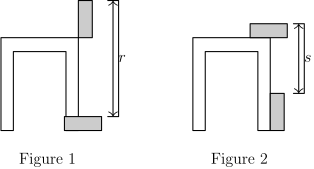
Using a table of a certain height, two identical blocks of wood are placed as shown in Figure Length is found to be inches. After rearranging the blocks as in Figure length is found to be inches. How high is the table?
inches
inches
inches
inches
inches
Small Hint:
Let be the table height and let the block dimensions be and
Big Hint:
Write one vertical-distance equation for each figure and add them
Solution:
Let be the table height and let be the long and short block dimensions. Figure gives while Figure gives Adding cancels the block dimensions: so inches.
Thus the correct answer is C.
7.
The sum of the greatest integer less than or equal to and the least integer greater than or equal to is The solution set for is
Small Hint:
Treat integer and noninteger values of separately
Big Hint:
For noninteger the ceiling is one more than the floor
Solution:
If is an integer, then which cannot equal If is not an integer, then This equals exactly when so
Thus the correct answer is E.
8.
The population of the United States in was The area of the country is square miles. There are square feet in one square mile. Which number below best approximates the average number of square feet per person?
Small Hint:
Divide total square feet by population
Big Hint:
Round the given values to two significant digits before multiplying
Solution:
The average is approximately square feet per person. Of the choices, this is closest to
Thus the correct answer is E.
9.
The product equals
Small Hint:
Factor as a difference of squares
Big Hint:
Separate the product into factors and
Solution:
For each Therefore the product telescopes:
Thus the correct answer is C.
10.
The permutations of AHSME are arranged in dictionary order, as if each were an ordinary five-letter word. The last letter of the th word in this list is
Small Hint:
Group the words into blocks of according to their first letter
Big Hint:
Within the -block, group by the second letter and then list only the needed small block
Solution:
Each first letter occupies a block of words. Positions through begin with so the th word is the th word in that block. The first begin with the next with and the th through th begin with The first two of those are and Thus the th word ends in E.
Therefore the correct answer is E.
11.
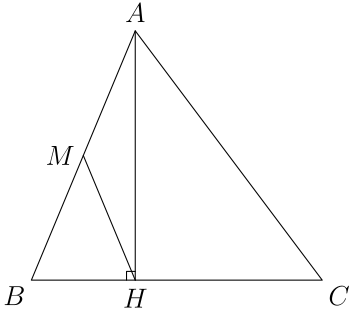
In and Also, is the midpoint of side and is the foot of the altitude from to The length of is
Small Hint:
Focus on right triangle
Big Hint:
Recall the distance from the midpoint of a right triangle’s hypotenuse to each vertex
Solution:
Triangle is right at and is the midpoint of its hypotenuse The midpoint of a right triangle’s hypotenuse is equidistant from all three vertices, so
Thus the correct answer is B.
12.
John scores on this year’s AHSME. Had the old scoring system still been in effect, he would score only for the same answers. How many questions does he leave unanswered? (In the new scoring system that year, one received points for each correct answer, points for each wrong answer, and points for each problem left unanswered. In the previous scoring system, one started with points, received more for each correct answer, lost point for each wrong answer, and neither gained nor lost points for unanswered questions. There are questions in the AHSME.)
not uniquely determined
Small Hint:
Let be the numbers correct, wrong and unanswered
Big Hint:
Use to rewrite the old score before comparing it with the new score
Solution:
Let be the numbers correct, wrong and unanswered. The old score and total number of questions give Eliminating yields The new score is Subtracting these equations gives
Thus the correct answer is B.
13.
A parabola has vertex If is on the parabola, then equals
Small Hint:
Write the parabola in vertex form
Big Hint:
Use the given point to find then expand to read and
Solution:
Write the equation as Substituting gives so Expanding, Thus and
Therefore the correct answer is E.
14.
Suppose hops, skips and jumps are specific units of length. If hops equals skips, jumps equals hops, and jumps equals meters, then one meter equals how many skips?
Small Hint:
Turn each equality into a conversion factor for one unit
Big Hint:
Convert meters to jumps, jumps to hops, and hops to skips in that order
Solution:
From the three relations, Multiplying the conversion factors gives skips.
Thus the correct answer is D.
15.
A student attempted to compute the average, of and by computing the average of and and then computing the average of the result and Whenever the student’s final result is
correct
always less than
always greater than
sometimes less than and sometimes equal to
sometimes greater than and sometimes equal to
Small Hint:
Write both the true average and the student’s result as algebraic expressions
Big Hint:
Subtract the true average and use the order to determine the sign
Solution:
The student’s result is while the true average is Their difference is Since and the numerator is positive. The student’s result is therefore always greater than
Thus the correct answer is C.
16.
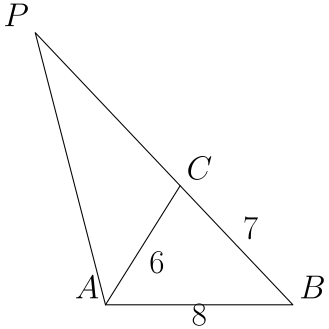
In and side is extended, as shown in the figure, to a point so that is similar to The length of is
Small Hint:
Use the vertex order in to match corresponding sides
Big Hint:
Set and use both and the repeated similarity ratio
Solution:
The stated order of similarity gives Let Then and Since which gives
Thus the correct answer is C.
17.
A drawer in a darkened room contains red socks, green socks, blue socks and black socks. A youngster selects socks one at a time from the drawer but is unable to see the color of the socks drawn. What is the smallest number of socks that must be selected to guarantee that the selection contains at least pairs? (A pair of socks is two socks of the same color. No sock may be counted in more than one pair.)
Small Hint:
For each color, at most one selected sock can remain unpaired
Big Hint:
Use the parity of the total to sharpen the four-unpaired bound, then construct a near-miss
Solution:
With selected socks, the number of colors having an odd count must itself be odd, so it is at most Thus at most socks are unpaired, leaving at least socks in pairs. But socks do not suffice: color counts produce only pairs. Therefore the minimum is
Thus the correct answer is B.
18.
A plane intersects a right circular cylinder of radius forming an ellipse. If the major axis of the ellipse is longer than the minor axis, the length of the major axis is
Small Hint:
The minor axis of such an elliptical section is a diameter of the cylinder
Big Hint:
Increase that diameter by to obtain the major axis
Solution:
The minor axis of an elliptical plane section of a right circular cylinder is a diameter of the cylinder. Its length is therefore The major axis is longer, so its length is
Thus the correct answer is E.
19.
A park is in the shape of a regular hexagon km on a side. Starting at a corner, Alice walks along the perimeter of the park for a distance of km. How many kilometers is she from her starting point?
Small Hint:
The walk consists of two complete sides and half of the next side
Big Hint:
Resolve the three directed segments into horizontal and vertical components
Solution:
Choose the first side in the horizontal direction. The three directed portions of the walk have vectors Their sum is Its squared length is The distance is therefore km.
Thus the correct answer is A.
20.
Suppose and are inversely proportional and positive. If increases by then decreases by
Small Hint:
An increase by multiplies by
Big Hint:
Inverse proportionality divides by that factor; compare the new value with the old one
Solution:
The new value of is Hence the new value of is The fractional decrease is Expressed as a percentage, this is
Thus the correct answer is E.
21.
In the configuration below, is measured in radians, is the center of the circle, and are line segments, and is tangent to the circle at
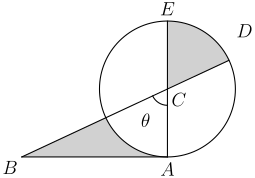
A necessary and sufficient condition for the equality of the two shaded areas, given is
Small Hint:
Let the circle’s radius be and compare a sector with triangle
Big Hint:
Equality of the two shaded pieces means the whole triangle has twice the sector’s area
Solution:
Let The upper shaded sector has area The lower shaded region is triangle with an equal sector removed. Thus the two shaded regions are equal exactly when This is equivalent to Since is tangent at triangle is right at and Therefore the condition is
Thus the correct answer is B.
22.
Six distinct integers are picked at random from What is the probability that, among those selected, the second smallest is
none of these
Small Hint:
Count all six-element subsets of the ten integers
Big Hint:
For second-smallest choose one element below and four above
Solution:
There are possible sets. If the second-smallest element is then is selected, one element is chosen from and four are chosen from This gives favorable sets. The probability is
Thus the correct answer is C.
23.
Let How many positive integers are factors of
Small Hint:
Recognize the coefficients
Big Hint:
After using the binomial theorem, factor the resulting base into primes
Solution:
By the binomial theorem, A divisor independently chooses an exponent from through for each of the three primes. Thus has positive divisors.
Therefore the correct answer is E.
24.
Let where and are integers. If is a factor of both
and
what is
Small Hint:
A common factor divides every integer linear combination of the two polynomials
Big Hint:
Subtract the second polynomial from three times the first
Solution:
The common factor divides Because is monic with integer coefficients, Gauss’s lemma implies that it divides The two polynomials are monic and have the same degree, so Hence
Thus the correct answer is D.
25.
If is the greatest integer less than or equal to then
none of these
Small Hint:
Group the integers according to the interval
Big Hint:
There are integers in the th group; handle separately
Solution:
For exactly integers satisfy and each contributes The final integer contributes Hence The finite geometric-sum identity gives so the requested sum is
Thus the correct answer is B.
26.
It is desired to construct a right triangle in the coordinate plane so that its legs are parallel to the and axes and so that the medians to the midpoints of the legs lie on the lines and The number of different constants for which such a triangle exists is
more than
Small Hint:
Place an axis-aligned right triangle at convenient coordinates and compute the slopes of the two medians to its legs
Big Hint:
The two slopes differ by a factor of remember that either given line could be the steeper one
Solution:
Place the right-angle vertex at and the other vertices at and The medians to the legs have slopes and whose ratio is Therefore, if one median has slope the other can have slope or Both occur: choose a triangle with the required pair of slopes and translate its centroid to the intersection of the two specified lines. Thus there are two possible values of
Therefore the correct answer is C.
27.
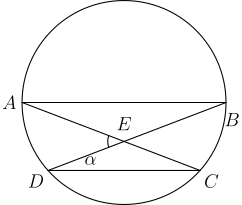
In the adjoining figure, is a diameter of the circle, is a chord parallel to and intersects at with The ratio of the area of to that of is
Small Hint:
Express each triangle’s area using the two sides meeting at
Big Hint:
Use the intersecting-chords theorem, then draw and use the right triangle created by diameter
Solution:
The triangles use the same angle at so Intersecting chords give so this ratio becomes Draw Since is a diameter, and are collinear. Thus triangle is right at and The required ratio is
Thus the correct answer is C.
28.
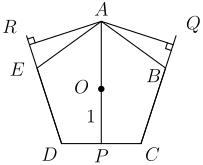
is a regular pentagon. and are the perpendiculars dropped from onto extended and extended, respectively. Let be the center of the pentagon. If then equals
Small Hint:
Let be the side length and compute the pentagon’s area from its five central triangles
Big Hint:
Also split the pentagon into triangles and with altitudes
Solution:
Let the side length be Since the apothem the five central triangles give pentagon area The same pentagon is the union of triangles and whose respective altitudes to side-length bases are Hence so Also Therefore
Thus the correct answer is C.
29.
Two of the altitudes of the scalene triangle have length and If the length of the third altitude is also an integer, what is the biggest it can be?
none of these
Small Hint:
For a fixed triangle area, each side is inversely proportional to its corresponding altitude
Big Hint:
Apply the triangle inequalities to side lengths proportional to
Solution:
Let the third altitude be Since each side equals twice the common area divided by its altitude, the side lengths are proportional to The two nontrivial triangle inequalities give Thus The largest integral possibility is and its three altitudes are distinct as required for a scalene triangle.
Therefore the correct answer is B.
30.
The number of real solutions of the simultaneous equations is
Small Hint:
The equations force all four variables to have the same sign
Big Hint:
For positive study relative to and to
Solution:
Each expression has the same sign as so all four variables have the same sign. Suppose first that they are positive. By AM-GM, every variable is at least For If any variable exceeded the equations would give the impossible strict cycle Hence the only positive solution is Negating all four variables preserves the system, giving exactly one negative solution, with all variables equal to Thus there are two real solutions.
Therefore the correct answer is B.