
1985 AMC 12 Solutions
Scroll down to view professionally curated solutions from LIVE by Po-Shen Loh, print PDF solutions, view answer key, or take the full timed exam.
All problems are used with official legal permission of the Mathematical Association of America (MAA).
1.
If then
Small Hint:
First solve the given equation for
Big Hint:
Substitute into
Solution:
The given equation gives so Therefore
Thus the correct answer is A.
2.
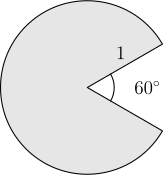
In an arcade game, the “monster” is the shaded sector of a circle of radius cm, as shown in the figure. The missing piece (the mouth) has central angle What is the perimeter of the monster in cm?
Small Hint:
The remaining circular arc has central angle
Big Hint:
Add the length of that arc to the two exposed radii
Solution:
The curved part is of a unit circle, so its length is The two straight sides of the mouth are radii of total length Hence the perimeter is
Thus the correct answer is E.
3.
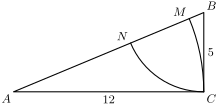
In right with legs and arcs of circles are drawn, one with center and radius the other with center and radius They intersect the hypotenuse in and Then has length
Small Hint:
First find the hypotenuse of the --right triangle
Big Hint:
Measure the positions of both arc intersections from
Solution:
The hypotenuse has length Since point is units from Also so Therefore
Thus the correct answer is D.
4.
A large bag of coins contains pennies, dimes and quarters. There are twice as many dimes as pennies and three times as many quarters as dimes. An amount of money which could be in the bag is
Small Hint:
Let the number of pennies be
Big Hint:
Express the total value in cents as a multiple of
Solution:
If there are pennies, there are dimes and quarters. Their total value is cents. Of the listed dollar amounts, cents is possible.
Thus the correct answer is C.
5.
Which terms must be removed from the sum if the sum of the remaining terms is to equal
and
and
and
and
and
Small Hint:
Compute how much larger the full sum is than
Big Hint:
Use a common denominator of to compare the candidate pairs
Solution:
The full sum is The removed terms must therefore total Since those are the required terms.
Thus the correct answer is E.
6.
One student in a class of boys and girls is to be chosen to represent the class. Each student is equally likely to be chosen and the probability that a boy is chosen is of the probability that a girl is chosen. The ratio of the number of boys to the total number of boys and girls is
Small Hint:
Equal likelihood makes the selection probabilities proportional to the class counts
Big Hint:
A boys-to-girls ratio of uses five equal parts in all
Solution:
Because every student is equally likely to be selected, the number of boys is of the number of girls. Thus the boys-to-girls ratio is and boys make up of the class.
Thus the correct answer is B.
7.
In some computer languages (such as APL), when there are no parentheses in an algebraic expression, the operations are grouped from right to left. Thus, in such languages means the same as in ordinary algebraic notation. If is evaluated in such a language, the result in ordinary algebraic notation would be
Small Hint:
Begin with the rightmost operation,
Big Hint:
Next subtract that result from and only then divide
Solution:
Grouping from the right first gives Subtracting this result from gives Finally, dividing by that quantity gives
Thus the correct answer is E.
8.
Let be real numbers with and nonzero. The solution to is less than the solution to if and only if
Small Hint:
Write each equation’s solution without cross-multiplying
Big Hint:
Multiplying an inequality by reverses its direction
Solution:
The two solutions are and Thus the given comparison is Multiplying both sides by reverses the inequality and gives equivalently No multiplication by the unknown-sign quantity is valid.
Thus the correct answer is E.
9.
The odd positive integers, are arranged in five columns continuing with the pattern shown. Counting from the left, the column in which appears is the
first
second
third
fourth
fifth
Small Hint:
Look at the entries that begin each left-to-right row
Big Hint:
Relate to a nearby multiple of
Solution:
The last number in each right-to-left row is and the next row begins with in the second column. Since it begins such a row and lies in the second column.
Thus the correct answer is B.
10.
An arbitrary circle can intersect the graph of in
at most points
at most points
at most points
at most points
more than points
Small Hint:
Consider a circle tangent to the -axis at the origin
Big Hint:
A very large radius keeps the lower arc close to the axis across many sine waves
Solution:
Take a circle tangent to the -axis at the origin with its center high above the axis. As its radius grows, its lower arc stays positive but arbitrarily close to the -axis over an arbitrarily long interval. On each positive arch of the sine curve is at the endpoints and rises well above this circular arc in between, producing two crossings. Choosing a sufficiently large radius therefore produces more than intersections.
Thus the correct answer is E.
11.
How many distinguishable rearrangements of the letters in CONTEST have both the vowels first? (For instance, OETCNST is one such arrangement, but OTETSNC is not.)
Small Hint:
Order the two vowels in the first two positions
Big Hint:
Permute the remaining five letters while accounting for the repeated
Solution:
The vowels can be ordered first in ways. The remaining letters can be arranged in distinguishable ways because the two ’s agree. The total is
Thus the correct answer is B.
12.
Let and be distinct prime numbers, where is not considered a prime. Which of the following is the smallest positive perfect cube having as a divisor?
Small Hint:
Every prime exponent in a perfect cube is a multiple of
Big Hint:
Raise the exponents and to the least larger multiples of
Solution:
A perfect cube has prime exponents divisible by The least multiples of that are at least and are and respectively. Thus the smallest possible cube is Therefore the correct answer is D.
13.
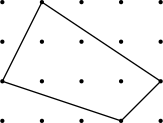
Pegs are put in a board unit apart both horizontally and vertically. A rubber band is stretched over pegs as shown in the figure, forming a quadrilateral. Its area in square units is
Small Hint:
Assign integer coordinates to the four corner pegs
Big Hint:
Use the shoelace formula on and
Solution:
With the lower-left peg as the quadrilateral’s vertices in order are and The shoelace formula gives Therefore the correct answer is E.
14.
Exactly three of the interior angles of a convex polygon are obtuse. What is the maximum number of sides of such a polygon?
Small Hint:
Bound the three obtuse angles by and every other angle by
Big Hint:
Compare that upper bound with the interior-angle sum
Solution:
For an -gon, the three obtuse angles have total less than while the other angles have total at most Hence which simplifies to Six sides are attainable, for example with interior angles and Thus the maximum is
Therefore the correct answer is C.
15.
If and are positive numbers such that and then the value of is
Small Hint:
Substitute into
Big Hint:
Because take the -th root and simplify
Solution:
Substitution gives Taking the positive -th root yields so Therefore
Thus the correct answer is E.
16.
If and then the value of is
none of these
Small Hint:
Use in the tangent addition formula
Big Hint:
Express in terms of
Solution:
Because so Therefore Thus the correct answer is B.
17.
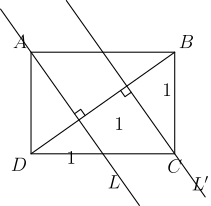
Diagonal of rectangle is divided into three segments of length by parallel lines and that pass through and and are perpendicular to The area of rounded to one decimal place, is
Small Hint:
Let the rectangle’s side lengths be then its diagonal has length
Big Hint:
Project the vertical and horizontal sides onto the diagonal to obtain and
Solution:
Let and Since we have The projection of onto has length and the first marked segment has length so Similarly, the projection of reaches the second division point, so and Hence the area is which rounds to
Therefore the correct answer is B.
18.
Six bags of marbles contain and marbles, respectively. One bag contains chipped marbles only. The other bags contain no chipped marbles. Jane takes three of the bags and George takes two of the others. Only the bag of chipped marbles remains. If Jane gets twice as many marbles as George, how many chipped marbles are there?
Small Hint:
Add all six bag sizes, then remove the chipped bag
Big Hint:
Jane’s and George’s totals are in the ratio so their combined total is divisible by
Solution:
The six bags total If the chipped bag contains marbles, then the other bags total three times George’s amount, so is divisible by Of the choices, only has this property. It is attainable: George can take while Jane takes
Thus the correct answer is D.
19.
Consider the graphs of and where is a positive constant and and are real variables. In how many points do the two graphs intersect?
exactly
exactly
at least but the number varies for different positive values of
for at least one positive value of
none of these
Small Hint:
Use to eliminate
Big Hint:
Show that the resulting quadratic has two distinct positive -roots
Solution:
Substituting into the second equation gives Its discriminant is Its roots have positive product and positive sum so both roots are positive and distinct. For each root the equation gives two distinct values of Thus there are exactly four intersection points.
Therefore the correct answer is A.
20.
A wooden cube with edge length units (where is an integer ) is painted black all over. By slices parallel to its faces, the cube is cut into smaller cubes each of unit edge length. If the number of smaller cubes with just one face painted black is equal to the number of smaller cubes completely free of paint, what is
none of these
Small Hint:
Count the unpainted cubes in the interior cube of side length
Big Hint:
On each face, exactly cubes avoid the edges
Solution:
There are completely unpainted cubes. Each of the six faces contributes cubes with exactly one painted face, so equality gives Since division by gives hence
Therefore the correct answer is D.
21.
How many integers satisfy the equation
none of these
Small Hint:
An integer power can equal when the base is when the base is with even exponent, or when a nonzero base has exponent
Big Hint:
Solve those three cases separately and check every candidate
Solution:
If the base is then giving and If the base is then only makes the exponent even. If the exponent is then and its base is so it also works. Thus the four solutions are and
Therefore the correct answer is C.
22.
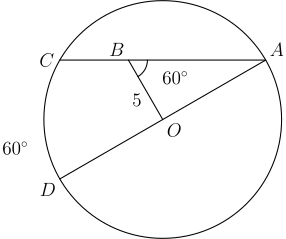
In a circle with center is a diameter, is a chord, and Then the length of is
none of the above
Small Hint:
The arc makes
Big Hint:
Use the resulting -- triangles to compare and
Solution:
Arc gives Since are collinear and are collinear, With triangle is a -- triangle. Because we get and
Also because is a diameter. In the -- triangle the hypotenuse is so Therefore
Thus the correct answer is D.
23.
If where then which of the following is not correct?
Small Hint:
Recognize and as the two nonreal cube roots of unity
Big Hint:
Their powers depend only on the exponent modulo
Solution:
The numbers are the two nonreal cube roots of unity, so This equals when is not divisible by but equals when is divisible by Of the listed exponents, only is divisible by so its displayed equation is the one that is not correct.
Therefore the correct answer is C.
24.
A non-zero digit is chosen in such a way that the probability of choosing digit is The probability that the digit is chosen is exactly the probability that the digit chosen is in the set
Small Hint:
Twice the probability of digit is
Big Hint:
Sum the probabilities over a consecutive set by telescoping its logarithms
Solution:
The probability of is so twice that probability is For the digits through the sum telescopes: Therefore that set has exactly twice the probability of digit
Thus the correct answer is C.
25.
The volume of a certain rectangular solid is its total surface area is and its three dimensions are in geometric progression. The sum of the lengths in cm of all the edges of this solid is
Small Hint:
Write the three dimensions as
Big Hint:
Use the volume to find then use the surface area to find
Solution:
Write the dimensions as since their product is Half the surface area is the sum of the three pairwise products, so giving The sum of the dimensions is Since each dimension occurs on four edges, the sum of all edge lengths is
Thus the correct answer is B.
26.
Find the least positive integer for which is a non-zero reducible fraction.
none of these
Small Hint:
Any common divisor of and also divides a suitable linear combination
Big Hint:
Compute
Solution:
Euclid’s algorithm gives Since is prime, the nonzero fraction is reducible exactly when is a nonzero multiple of The least positive possibility is which is not among the four numerical choices.
Thus the correct answer is E.
27.
Consider a sequence defined by and in general for What is the smallest value of for which is an integer?
Small Hint:
Let and track the exponent of
Big Hint:
Show that and examine the first four terms
Solution:
Let Repeated application of the recurrence gives so It remains to rule out the first three terms. The sequence is strictly increasing. Also so Finally Since we have while gives Thus are not integers, and the first integral term is
Therefore the correct answer is C.
28.
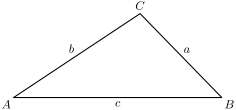
In we have and What is
not uniquely determined
Small Hint:
Use the sine law to write
Big Hint:
After finding use and
Solution:
By the sine law and the triple-angle identity, Hence Since and therefore Also so another application of the sine law gives Thus the correct answer is B.
29.
In their base representations, the integer consists of a sequence of eights and the integer consists of a sequence of fives. What is the sum of the digits of the base representation of the integer
Small Hint:
Write a string of identical digits using
Big Hint:
After removing the terminal zero, express the product as a string of fours minus a string of eights
Solution:
Let and Then and ends in Removing that zero does not change the digit sum and leaves Thus is a string of fours minus a string of eights. The subtraction produces fours, then then fives, then Its digit sum is Therefore the correct answer is C.
30.
Let be the greatest integer less than or equal to Then the number of real solutions to is
Small Hint:
Set and solve the equation for
Big Hint:
Enforce to determine which integer values of work
Solution:
Let A solution must be positive and satisfy The lower inequality is equivalent to so The upper inequality is equivalent to Among this holds exactly for Each interval contributes one root, so there are four real solutions.
Therefore the correct answer is E.