
1983 AMC 12 Solutions
Scroll down to view professionally curated solutions from LIVE by Po-Shen Loh, print PDF solutions, view answer key, or take the full timed exam.
All problems are used with official legal permission of the Mathematical Association of America (MAA).
1.
If and then equals
Small Hint:
Use to express in terms of
Big Hint:
After substitution, discard the solution that makes
Solution:
The second equation gives Substituting into the first gives so The condition rules out leaving and
Therefore, the correct answer is E.
2.
Point is outside circle on the plane. At most how many points on are cm from
Small Hint:
Points at a fixed distance from form another circle
Big Hint:
Count the common points of the two circles; the maximum occurs when they cross
Solution:
The points cm from form a circle centered at Two distinct circles intersect in at most two points, and two intersections are possible.
Therefore, the correct answer is B.
3.
Three primes, and satisfy and Then equals
Small Hint:
Every prime except one is odd
Big Hint:
If both addends were odd, their sum would be an even number greater than
Solution:
If both and were odd, then would be even and greater than so it would not be prime. Thus one addend is the only even prime, Since that addend is
Therefore, the correct answer is A.
4.
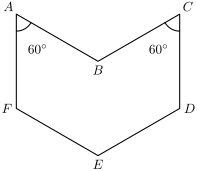
In the adjoining plane figure, sides and are parallel, as are sides and and sides and Each side has length Also, The area of the figure is
Small Hint:
Place and vertically and use the angles to assign coordinates
Big Hint:
The six vertices can be written using horizontal changes of
Solution:
The parallel directions and angles place the vertices, up to rigid motion, at Applying the shoelace formula to these six vertices gives area
Therefore, the correct answer is D.
5.
Triangle has a right angle at If then is
Small Hint:
Angles and are complementary
Big Hint:
Use and
Solution:
Since Because we have and
Therefore, the correct answer is D.
6.
When and are multiplied, the product is a polynomial of degree
Small Hint:
Track the largest exponent produced by choosing one term from each factor
Big Hint:
The leading term comes from
Solution:
The greatest exponent comes from Every other term has smaller exponent, and the smallest possible exponent is so the product is indeed a polynomial. Its degree is
Therefore, the correct answer is C.
7.
Alice sells an item at less than the list price and receives of her selling price as her commission. Bob sells the same item at less than the list price and receives of his selling price as his commission. If they both get the same commission, then the list price is
Small Hint:
Let be the list price and write each commission in terms of
Big Hint:
Set equal to
Solution:
If the list price is equality of commissions gives Multiplying by and solving gives so
Therefore, the correct answer is B.
8.
Let Then for is
Small Hint:
Substitute directly into the formula
Big Hint:
Multiply numerator and denominator of by
Solution:
We have The restriction makes all displayed quantities defined.
Therefore, the correct answer is A.
9.
In a certain population the ratio of the number of women to the number of men is to If the average (arithmetic mean) age of the women is and the average age of the men is then the average age of the population is
Small Hint:
Use groups of women and men
Big Hint:
Divide by the total number of people
Solution:
Using women and men, the total of all ages is Dividing by people gives
Therefore, the correct answer is D.
10.
Segment is both a diameter of a circle of radius and a side of an equilateral triangle The circle also intersects and at points and respectively. The length of is
Small Hint:
Because is a diameter, is a right angle
Big Hint:
Triangle is a -- triangle with hypotenuse
Solution:
Since is on the circle with diameter Also because is equilateral. Thus is a -- triangle with hypotenuse so
Therefore, the correct answer is D.
11.
Simplify
Small Hint:
Recognize the sine addition identity
Big Hint:
Apply the sine addition formula with and
Solution:
Taking and the sine addition identity gives
Therefore, the correct answer is B.
12.
13.
If and and none of these quantities is then equals
Small Hint:
Multiply two of and then divide by the third
Big Hint:
Use and
Solution:
From the three products, Putting their sum over denominator gives
Therefore, the correct answer is E.
14.
The units digit of is
Small Hint:
Reduce to when considering units digits
Big Hint:
Combine the two powers of and use the length- units-digit cycles
Solution:
Modulo because powers of repeat every Also Thus the product has units digit
Therefore, the correct answer is E.
15.
Three balls marked and are placed in an urn. One ball is drawn, its number is recorded, and then the ball is returned to the urn. This process is repeated and then repeated once more, and each ball is equally likely to be drawn on each occasion. If the sum of the numbers recorded is what is the probability that the ball numbered was drawn all three times?
Small Hint:
List the ordered triples from whose sum is
Big Hint:
The possibilities are the permutations of together with
Solution:
The ordered triples with sum are the six permutations of and the triple They are equally likely, and exactly one of the seven has three ’s. The conditional probability is therefore
Therefore, the correct answer is C.
16.
Let where the digits are obtained by writing the integers through in order. The rd digit to the right of the decimal point is
Small Hint:
First count the digits contributed by the one- and two-digit integers
Big Hint:
After digits, locate the remaining position within the three-digit integers
Solution:
The one-digit integers contribute digits and the two-digit integers contribute for total. Thus the desired digit is the th digit among the three-digit integers. Since it is the last digit of the th three-digit integer, namely That digit is
Therefore, the correct answer is D.
17.
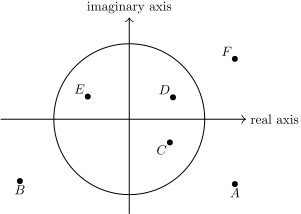
The diagram to the right shows several numbers in the complex plane. The circle is the unit circle centered at the origin. One of these numbers is the reciprocal of Which one?
Small Hint:
For its reciprocal has modulus
Big Hint:
The reciprocal reflects the argument across the real axis and moves inside the unit circle
Solution:
If then Because is outside the unit circle in quadrant I, its reciprocal is inside the unit circle in quadrant IV, with the reflected argument. Only point has those properties.
Therefore, the correct answer is C.
18.
Let be a polynomial function such that, for all real For all real is
none of these
Small Hint:
Rewrite the right side as a polynomial in
Big Hint:
Setting gives
Solution:
With Hence Substituting gives
Therefore, the correct answer is B.
19.
Point is on side of triangle If and then the length of is
Small Hint:
The angle bisector theorem gives
Big Hint:
Set and then apply the law of cosines to the two triangles
Solution:
By the angle bisector theorem, write and Let The law of cosines in triangles and whose angles at are both gives Subtracting four times the first equation from the second yields Since
Therefore, the correct answer is A.
20.
If and are the roots of and and are the roots of then is necessarily
Small Hint:
The roots of the second quadratic are reciprocals of the roots of the first
Big Hint:
Use Vieta’s formulas to express their sum and product in terms of
Solution:
Let the first roots be and Then and The second roots are and so Therefore
Therefore, the correct answer is C.
21.
Find the smallest positive number from the numbers below
Small Hint:
Compare the squares to determine which listed differences are positive
Big Hint:
Rationalize each positive difference using
Solution:
Since choice A is positive; since choice C is negative; and since choice D is positive while E is negative. The two positive values satisfy The second denominator is larger, so choice D is the smaller positive number.
Therefore, the correct answer is D.
22.
Consider the two functions where the variable and the constants and are real numbers. Each such pair of constants and may be considered as a point in an -plane. Let be the set of such points for which the graphs of and do not intersect (in the -plane). The area of is
infinite
Small Hint:
Set and require the resulting quadratic to have no real roots
Big Hint:
Simplify the negative-discriminant condition in terms of and
Solution:
Intersections correspond to roots of There are no real roots exactly when its discriminant is negative: Thus is the interior of the unit circle in the -plane, with area
Therefore, the correct answer is B.
23.
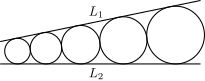
In the adjoining figure the five circles are tangent to one another consecutively and to the lines and If the radius of the largest circle is and that of the smallest one is then the radius of the middle circle is
Small Hint:
Every pair of consecutive tangent circles has the same shape after scaling
Big Hint:
The radii form a geometric sequence, so the middle radius squared is the product of the extremes
Solution:
The centers lie on the angle bisector of and Similarity of the configuration for any two consecutive circles shows that consecutive radii have a constant ratio. Thus the five radii form a geometric sequence. If the middle radius is symmetry of a five-term geometric sequence gives so
Therefore, the correct answer is A.
24.
How many non-congruent right triangles are there such that the perimeter in cm and area in are numerically equal?
none
infinitely many
Small Hint:
Start with any shape of right triangle and scale all its side lengths by
Big Hint:
Under scaling, perimeter is multiplied by while area is multiplied by
Solution:
Start with any right triangle having perimeter and area Scaling every side by produces perimeter and area which are equal. Infinitely many nonsimilar right-triangle shapes exist, and the resulting triangles are therefore noncongruent.
Therefore, the correct answer is E.
25.
If and then is
Small Hint:
Express and as base- logarithms
Big Hint:
Use and
Solution:
Since and Therefore the exponent is and
Therefore, the correct answer is B.
26.
The probability that event occurs is the probability that event occurs is Let be the probability that both and occur. The smallest interval necessarily containing is the interval
Small Hint:
Apply inclusion-exclusion to events and
Big Hint:
Bound between and
Solution:
Inclusion-exclusion gives Since it follows that Both endpoints can occur, so this is the smallest necessary interval.
Therefore, the correct answer is D.
27.
A large sphere is on a horizontal field on a sunny day. At a certain time the shadow of the sphere reaches out a distance of m from the point where the sphere touches the ground. At the same instant a meter stick (held vertically with one end on the ground) casts a shadow of length m. What is the radius of the sphere in meters? (Assume the sun’s rays are parallel and the meter stick is a line segment.)
Small Hint:
In a vertical cross-section, the limiting sun ray is tangent to a circle
Big Hint:
The meter stick shows that the ray rises unit for every horizontal units
Solution:
Take the sphere’s ground-contact point as and its center as The limiting sun ray passes through the shadow endpoint and has slope so its equation is Tangency means the distance from to this line equals Hence
Therefore, the correct answer is E.
28.
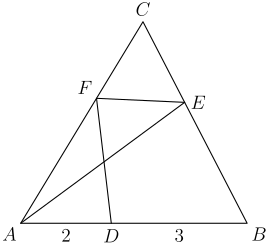
Triangle in the figure has area Points and all distinct from and are on sides and respectively, and If triangle and quadrilateral have equal areas, then that area is
not uniquely determined
Small Hint:
Draw and cancel the common triangle from the equal areas
Big Hint:
Equal areas of and imply ; then compare triangles and
Solution:
Draw From equality implies Their common base then gives so triangles and are similar. Hence Triangles and share the altitude from to so
Therefore, the correct answer is C.
29.
A point lies in the same plane as a given square of side Let the vertices of the square, taken counterclockwise, be and Also, let the distances from to and respectively, be and What is the greatest distance that can be from if
Small Hint:
Place and
Big Hint:
Substitute into the distance equation and complete the square
Solution:
Place and with Then which simplifies to Thus lies on a circle centered units from with radius Its greatest distance from is
Therefore, the correct answer is C.
30.
Distinct points and are on a semicircle with diameter and center The point is on and If then equals
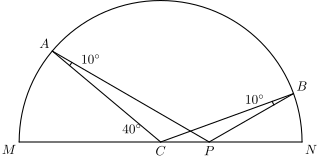
Small Hint:
The arc gives
Big Hint:
Compare triangles and using and the law of sines
Solution:
Since the central angle so Hence Applying the law of sines in triangles and and using gives Because and are distinct, Therefore so
Therefore, the correct answer is C.