
1982 AMC 12 Problems
Scroll down and press Start to try the exam! Or, go to the printable PDF, answer key, or professional solutions curated by LIVE by Po-Shen Loh.
All problems are used with official legal permission of the Mathematical Association of America (MAA).
Or jump straight to a single problem with its solution: 1 · 2 · 3 · 4 · 5 · 6 · 7 · 8 · 9 · 10 · 11 · 12 · 13 · 14 · 15 · 16 · 17 · 18 · 19 · 20 · 21 · 22 · 23 · 24 · 25 · 26 · 27 · 28 · 29 · 30
Want to learn professionally through interactive video classes?
Timed
1:15:00
1.
When the polynomial is divided by the polynomial the remainder is
Answer: E
Small Hint:
Work modulo
Big Hint:
Replace by in
Solution:
Modulo we have so This linear polynomial is the remainder.
Therefore, the correct answer is E.
2.
If a number eight times as large as is increased by two, then one fourth of the result equals
Answer: A
Small Hint:
Translate the first two operations before dividing
Big Hint:
Simplify term by term
Solution:
Eight times increased by two, is One fourth is
Therefore, the correct answer is A.
3.
Evaluate at
Answer: C
Small Hint:
Evaluate the inner first
Big Hint:
The same value becomes both the base and exponent
Solution:
At Hence
Therefore, the correct answer is C.
4.
The perimeter of a semicircular region, measured in centimeters, is numerically equal to its area, measured in square centimeters. The radius of the semicircle, measured in centimeters, is
Answer: E
Small Hint:
Include the diameter in the perimeter of the region
Big Hint:
Set equal to
Solution:
For equality of perimeter and area gives Dividing by and solving yields
Therefore, the correct answer is E.
5.
Two positive numbers and are in the ratio where If then the smaller of and is
Answer: C
Small Hint:
Write the numbers as and
Big Hint:
Use their sum to determine the common scale factor
Solution:
Write and Since is smaller. From so
Therefore, the correct answer is C.
6.
The sum of all but one of the interior angles of a convex polygon equals The remaining angle is
Answer: D
Small Hint:
A polygon’s total interior angle sum is a multiple of
Big Hint:
The missing convex angle must place the total strictly between and
Solution:
The total must be and the missing angle lies between and The only multiple of between and is leaving
Therefore, the correct answer is D.
7.
If the operation is defined by then which one of the following is false?
for all real and
equals for all real and
equals for all real
for all real
for all real and
Answer: B
Small Hint:
First simplify the operation to
Big Hint:
Test the proposed distributive law with and
Solution:
Since the operation is commutative, has identity and becomes ordinary multiplication after adding Thus it is associative, and direct expansion also verifies C. Statement B fails when and its left side is but its right side is Hence B is false.
Therefore, the correct answer is B.
8.
By definition and where are positive integers and If form an arithmetic progression with then equals
Answer: B
Small Hint:
The middle term of an arithmetic progression is the average of its neighbors
Big Hint:
Substitute the factorial formulas into
Solution:
The progression condition is Substitution and cancellation give or Since
Therefore, the correct answer is B.
9.
A vertical line divides the triangle with vertices and in the -plane into two regions of equal area. The equation of the line is
Answer: B
Small Hint:
For the triangle lies between and
Big Hint:
Set the accumulated area to one half of the triangle’s total area
Solution:
The triangle has area The portion with has area For a cut the area to its left is therefore Setting this equal to gives whose relevant solution is
Therefore, the correct answer is B.
10.
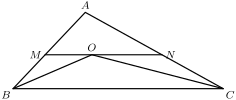
In the adjoining diagram, bisects bisects and is parallel to If and then the perimeter of is
Answer: A
Small Hint:
Because is the incenter, its distance from is the inradius
Big Hint:
Compare the altitude of with the altitude of
Solution:
The sides have semiperimeter and area so the inradius is Taking as base, the altitude is Thus the similarity scale from to is Its perimeter is
Therefore, the correct answer is A.
11.
How many integers with four different digits are there between and such that the absolute value of the difference between the first digit and the last digit is
Answer: C
Small Hint:
First count the allowed ordered pairs of first and last digits
Big Hint:
Once those digits are fixed, choose two distinct middle digits from the remaining eight
Solution:
For leading digits the number of possible last digits differing by is plus or In addition, leading digit may end in giving endpoint pairs. The middle digits can then be chosen in ordered ways. Thus the count is
Therefore, the correct answer is C.
12.
Let where and are constants. If then equals
not uniquely determined
Answer: A
Small Hint:
Separate the constant term from the odd-powered terms
Big Hint:
If compare and
Solution:
Let which is odd. Since Therefore and
Therefore, the correct answer is A.
13.
14.
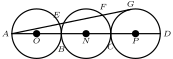
In the adjoining figure, points and lie on line segment and and are diameters of circles and respectively. Circles and all have radius and the line is tangent to circle at If intersects circle at points and then chord has length
none of these
Answer: C
Small Hint:
Use right triangle to find the distance from to line
Big Hint:
A chord at distance from a circle’s center has length
Solution:
Here and The distance from to scales with so it is Therefore the chord in the radius- circle has length
Therefore, the correct answer is C.
15.
Let denote the greatest integer not exceeding Let and satisfy the simultaneous equations If is not an integer, then is
an integer
between and
between and
between and
Answer: D
Small Hint:
For nonintegral relate to
Big Hint:
Let and equate the two formulas for
Solution:
For nonintegral let then Thus so and Since we have
Therefore, the correct answer is D.
16.
In the adjoining figure, a wooden cube has edges of length meters. Square holes of side one meter, centered in each face, are cut through to the opposite face. The edges of the holes are parallel to the edges of the cube. The entire surface area including the inside, in square meters, is

Answer: B
Small Hint:
Start with the outer faces after removing their central squares
Big Hint:
For each of the three tunnels, count the four interior walls not removed by the crossing tunnels
Solution:
The six outer faces contribute Each of the three length- square tunnels has four inner walls, but the central unit segment of every wall is removed by a perpendicular tunnel, leaving area per wall. Thus the inside contributes The total is
Therefore, the correct answer is B.
17.
How many real numbers satisfy the equation
Answer: C
Small Hint:
Substitute noting that
Big Hint:
The equation becomes a quadratic in
Solution:
Let Then whose roots are and Both are positive and each corresponds to one real so there are solutions.
Therefore, the correct answer is C.
18.
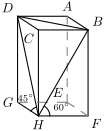
In the adjoining figure of a rectangular solid, and Find the cosine of
Answer: D
Small Hint:
Assign coordinates at along the three mutually perpendicular edges
Big Hint:
Translate the two given angles into relationships among the three edge lengths, then use a dot product
Solution:
Let and Then and The condition gives while the condition gives Hence
Therefore, the correct answer is D.
19.
Let for The sum of the largest and smallest values of is
none of these
Answer: B
Small Hint:
Break the interval at the zeros and
Big Hint:
Simplify on each resulting interval
Solution:
On on and on Thus the minimum is and the maximum is whose sum is
Therefore, the correct answer is B.
20.
The number of pairs of positive integers which satisfy the equation is
not finite
none of these
Answer: D
Small Hint:
Rearrange as
Big Hint:
Choose to be a perfect square
Solution:
For every positive integer take and Then so This supplies infinitely many positive-integer pairs.
Therefore, the correct answer is D.
21.
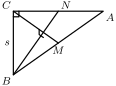
In the adjoining figure, the triangle is a right triangle with Median is perpendicular to median and side The length of is
Answer: E
Small Hint:
Place and
Big Hint:
Use a dot product for the directions of the two medians
Solution:
Set and Then and Perpendicularity gives hence Therefore
Therefore, the correct answer is E.
22.
In a narrow alley of width a ladder of length is placed with its foot at a point between the walls. Resting against one wall at a distance above the ground, the ladder makes a angle with the ground. Resting against the other wall at a distance above the ground, the ladder makes a angle with the ground. The width is equal to

Answer: E
Small Hint:
Express the two horizontal portions of the alley using cosines
Big Hint:
Compare with
Solution:
The horizontal distances from to the walls are and so The sum-to-product identity gives Since
Therefore, the correct answer is E.
23.
The lengths of the sides of a triangle are consecutive integers, and the largest angle is twice the smallest angle. The cosine of the smallest angle is
none of these
Answer: A
Small Hint:
Let the smallest and largest angles be and
Big Hint:
Use the law of sines to compare the shortest and longest consecutive sides
Solution:
Let the consecutive sides be opposite angles By the law of sines, The law of cosines at the smallest angle also gives Equating these expressions yields so Hence the sides are and
Therefore, the correct answer is A.
24.
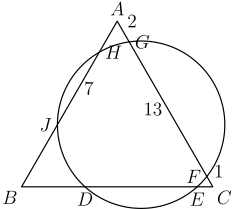
In the adjoining figure, the circle meets the sides of an equilateral triangle at six points. If and then equals
Answer: A
Small Hint:
All three sides of the triangle have length
Big Hint:
Apply power of a point from and to relate the two base segments and
Solution:
First, power of gives The latter product is so and Let From the secants at and Also Subtracting the power equations and using the sum gives Hence and Substitution into gives so
Therefore, the correct answer is A.
25.
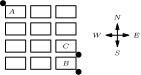
The adjoining figure is a map of part of a city: the small rectangles are blocks and the spaces in between are streets. Each morning a student walks from intersection to intersection always walking along streets shown, always going east or south. For variety, at each intersection where he has a choice, he chooses with probability (independent of all other choices) whether to go east or south. Find the probability that, on any given morning, he walks through intersection
Answer: D
Small Hint:
Reaching means making the third eastward move before the fourth southward move
Big Hint:
Condition on the number of south moves made before the third east move
Solution:
If south moves occur before the third east move, the final step to is east and the preceding steps contain two east moves. Thus
Therefore, the correct answer is D.
26.
If the base representation of a perfect square is where then is
not uniquely determined
Answer: B
Small Hint:
Only the last two base- digits matter modulo
Big Hint:
List the quadratic residues modulo that lie between and
Solution:
The last two octal digits represent Squares modulo in the range include only Thus so
Therefore, the correct answer is B.
27.
Suppose is a solution of the polynomial equation where and are real constants and Which one of the following must also be a solution?
none of these
Answer: C
Small Hint:
Conjugate the entire equation
Big Hint:
Compare the conjugated equation at with the original polynomial evaluated at
Solution:
Conjugating the equation changes each to and to Because the odd-powered terms also change sign when the input is negated, this conjugated equation is precisely the original polynomial evaluated at Thus must be a root.
Therefore, the correct answer is C.
28.
A set of consecutive positive integers beginning with is written on a blackboard. One number is erased. The average (arithmetic mean) of the remaining numbers is What number was erased?
can not be determined
Answer: B
Small Hint:
If the last written number is the remaining count is
Big Hint:
Use the bounds on the erased value to narrow the possible values of
Solution:
The new average is below the original average but differs from it by less than forcing or Since the remaining sum must be integral, is divisible by so The erased number is
Therefore, the correct answer is B.
29.
Let and be three positive real numbers whose sum is If no one of these numbers is more than twice any other, then the minimum possible value of the product is
none of these
Answer: A
Small Hint:
Order the variables ; then the active constraint is
Big Hint:
A minimum occurs on the boundary where
Solution:
Order At a minimum the spread is maximal, so and The ordering requires Thus Its only interior critical point is a maximum, so compare endpoints: the values are and respectively. The minimum is
Therefore, the correct answer is A.
30.
Find the units digit in the decimal expansion of
none of these
Answer: D
Small Hint:
Pair with its conjugate
Big Hint:
The integers satisfy a short recurrence, while
Solution:
Let and so The integers satisfy hence for every Therefore is a multiple of minus a positive number less than Its integer part therefore ends in
Therefore, the correct answer is D.