
1981 AMC 12 Solutions
Scroll down to view professionally curated solutions from LIVE by Po-Shen Loh, print PDF solutions, view answer key, or take the full timed exam.
All problems are used with official legal permission of the Mathematical Association of America (MAA).
1.
If then equals
Small Hint:
The equation already gives the value of
Big Hint:
Square the known value once more
Solution:
From we get Therefore
Therefore, the correct answer is E.
2.
Point is on side of square If has length one and has length two, then the area of the square is

Small Hint:
Triangle is a right triangle
Big Hint:
The unknown leg is also the side length of the square
Solution:
Let the square’s side length be In right triangle Hence which is exactly the area of the square.
Therefore, the correct answer is C.
3.
For equals
Small Hint:
Use as a common denominator
Big Hint:
Add the resulting numerators and
Solution:
Using the common denominator gives
Therefore, the correct answer is D.
4.
If three times the larger of two numbers is four times the smaller and the difference between the numbers is then the larger of the two numbers is
Small Hint:
Let and denote the larger and smaller numbers
Big Hint:
Use together with
Solution:
The relation gives Thus so
Therefore, the correct answer is C.
5.
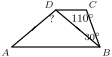
In trapezoid sides and are parallel, and diagonal and side have equal length. If and then
Small Hint:
Use the parallel bases to find the full interior angle at
Big Hint:
Then use in triangle
Solution:
Since consecutive interior angles give Hence Because triangle has Therefore
Therefore, the correct answer is C.
6.
If then equals
Small Hint:
Notice that each denominator is one less than its numerator
Big Hint:
Set and compare with
Solution:
Let The equation becomes Cross-multiplication gives so
Therefore, the correct answer is A.
7.
How many of the first one hundred positive integers are divisible by all of the numbers
Small Hint:
Find the least common multiple of and
Big Hint:
Count the multiples of that least common multiple through
Solution:
The least common multiple is Among the positive integers through only is a multiple of Thus the count is
Therefore, the correct answer is B.
8.
For all positive numbers the product equals
Small Hint:
Rewrite each sum of reciprocals over a common denominator
Big Hint:
The two reciprocal sums introduce factors and
Solution:
We have and All symmetric sum factors cancel, leaving
Therefore, the correct answer is A.
9.
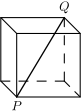
In the adjoining figure, is a diagonal of the cube. If has length then the surface area of the cube is
Small Hint:
Relate the cube’s space diagonal to its side length
Big Hint:
Substitute the side length into the formula for six square faces
Solution:
If the side length is then the space diagonal is so The surface area is
Therefore, the correct answer is A.
10.
The lines and are symmetric to each other with respect to the line If the equation of line is with and then the equation of is
Small Hint:
Reflection across interchanges the two coordinates
Big Hint:
Swap and in the original equation, then solve for
Solution:
Interchanging and in gives Solving,
Therefore, the correct answer is E.
11.
The three sides of a right triangle have integral lengths which form an arithmetic progression. One of the sides could have length
Small Hint:
Represent the three equally spaced sides as
Big Hint:
Every such integral right triangle is a multiple of a -- triangle
Solution:
If the sides are the Pythagorean equation gives hence and for some positive integer Thus the sides are Of the choices, can occur.
Therefore, the correct answer is C.
12.
If and are positive numbers and then the number obtained by increasing by and decreasing the result by exceeds if and only if
Small Hint:
Write the two successive percentage changes as multiplication factors
Big Hint:
Use when dividing by
Solution:
The final amount is It exceeds exactly when Expanding gives Since this is
Therefore, the correct answer is E.
13.
Suppose that at the end of any year, a unit of money has lost of the value it had at the beginning of that year. Find the smallest integer such that after years the unit of money will have lost at least of its value. (To the nearest thousandth is )
Small Hint:
After years, the fraction of value remaining is
Big Hint:
Use
Solution:
At least lost means Now Thus so The least integer is
Therefore, the correct answer is E.
14.
In a geometric sequence of real numbers, the sum of the first two terms is and the sum of the first six terms is The sum of the first four terms is
Small Hint:
Factor the first-six-term sum into the first-two-term sum times
Big Hint:
Set and solve
Solution:
If the first term is and ratio is then Since we have With so The first four terms sum to
Therefore, the correct answer is A.
15.
If and then is
not uniquely determined
Small Hint:
Take logarithms to base of the two equal positive powers
Big Hint:
Let and
Solution:
Let and Taking base- logarithms gives Since Therefore so
Therefore, the correct answer is B.
16.
The base three representation of is The first digit (on the left) of the base nine representation of is
Small Hint:
Since group the base-three digits in pairs from the right
Big Hint:
Convert the leftmost pair into a base-nine digit
Solution:
The representation has an even number of base-three digits, so its leftmost base-nine digit comes from That pair has value so the first base-nine digit is
Therefore, the correct answer is E.
17.
The function is not defined for but, for all nonzero real numbers The equation is satisfied by
exactly one real number
exactly two real numbers
no real numbers
infinitely many, but not all, nonzero real numbers
all nonzero real numbers
Small Hint:
Apply the given relation again after replacing by
Big Hint:
Solve the two equations for , then compare its values at and
Solution:
Replacing by gives Solving the two linear equations yields Hence so equality requires Thus or Both and work, giving exactly two real numbers.
Therefore, the correct answer is B.
18.
The number of real solutions to the equation is
Small Hint:
Use odd symmetry and first count the positive solutions
Big Hint:
Only positive sine humps below can meet the line, with special care for the first hump
Solution:
The equation is odd-symmetric and has the solution On there is one further positive solution. For each the positive sine hump on rises above and then falls below it, giving two solutions. There are no positive solutions beyond , because the next positive hump begins above while Thus there are positive solutions, the same number negative, and zero itself:
Therefore, the correct answer is C.
19.
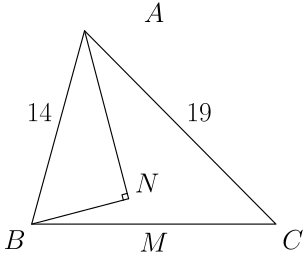
In is the midpoint of side bisects and is the measure of If sides and have lengths and respectively, then length equals
Small Hint:
Extend through to meet
Big Hint:
Use congruence across the angle bisector, then apply the midpoint theorem
Solution:
Extend to meet at The right triangles and are congruent because is common and bisects the angle at Hence is bisected by and Since In triangle points and are the midpoints of and so
Therefore, the correct answer is B.
20.
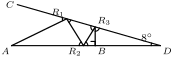
A ray of light originates from point and travels in a plane, being reflected times between lines and before striking a point (which may be on or ) perpendicularly and retracing its path to (At each point of reflection the light makes two equal angles as indicated in the adjoining figure. The figure shows the light path for ) If what is the largest value can have?
There is no largest value.
Small Hint:
Track the acute angle between the ray and each successive reflecting line
Big Hint:
Each reflection advances that angle by the wedge angle
Solution:
Let be the initial acute angle between the ray and Successive exterior-angle relations increase the corresponding acute angle by at each reflection. At the final perpendicular strike, Thus so The greatest integer possible is attained when
Therefore, the correct answer is B.
21.
In a triangle with sides of lengths and The measure of the angle opposite the side of length is
Small Hint:
Expand the left side as a difference of squares
Big Hint:
Compare the resulting expression for with the law of cosines
Solution:
The condition gives so If is opposite the law of cosines says Therefore so and
Therefore, the correct answer is D.
22.
How many lines in a three-dimensional rectangular coordinate system pass through four distinct points of the form where and are positive integers not exceeding four?
Small Hint:
Four collinear lattice points in this -by--by- grid must advance by coordinate steps or
Big Hint:
Count axis-parallel lines, face-diagonal lines, and space diagonals separately
Solution:
There are axis-parallel lines. For face-diagonal directions, choose the pair of varying coordinates in ways, choose one of diagonal slopes, and fix the remaining coordinate in ways, giving Finally, the cube has space diagonals. Thus the total is
Therefore, the correct answer is D.
23.
Equilateral is inscribed in a circle. A second circle is tangent internally to the circumcircle at and tangent to sides and at points and If side has length then segment has length
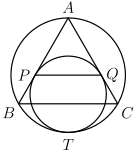
Small Hint:
Use symmetry to place both circle centers and on the altitude from
Big Hint:
Relate the smaller circle’s radius to the circumradius using the half-angle at
Solution:
The circumradius of the equilateral triangle is If the smaller radius is its center lies on the altitude and is from because its distance to either side is and the half-angle is Internal tangency at the bottom gives so The tangency points on the two sides are separated by
Therefore, the correct answer is C.
24.
If is a constant such that and then for each positive integer equals
Small Hint:
Rewrite the condition as a quadratic equation in
Big Hint:
Its two roots are
Solution:
The equation is whose roots are and Thus and By De Moivre’s theorem,
Therefore, the correct answer is D.
25.
In triangle in the adjoining figure, and trisect The lengths of and are and respectively. The length of the shortest side of is
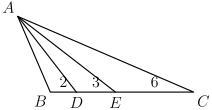
not uniquely determined by the given information
Small Hint:
Let the three equal angles be , and apply the angle-bisector theorem to a suitable subtriangle
Big Hint:
Equate law-of-cosines expressions for in the three adjacent triangles
Solution:
Let and Since bisects and bisects the angle-bisector theorem gives so and Applying the law of cosines to triangles and and equating their common values gives Hence and The sides are and so the shortest is
Therefore, the correct answer is A.
26.
Alice, Bob, and Carol repeatedly take turns tossing a die. Alice begins; Bob always follows Alice; Carol always follows Bob; and Alice always follows Carol. Find the probability that Carol will be the first one to toss a six. (The probability of obtaining a six on any toss is independent of the outcome of any other toss.)
Small Hint:
For Carol to win in a given round, Alice and Bob must fail before Carol succeeds
Big Hint:
If all three fail, the process restarts with the same probabilities
Solution:
Carol wins in the first round with probability A complete round with no six has probability Therefore the desired geometric series is
Therefore, the correct answer is D.
27.
In the adjoining figure triangle is inscribed in a circle. Point lies on with and point lies on with Side and side each have length equal to the length of chord and Chord intersects sides and at and respectively. The ratio of the area of to the area of is
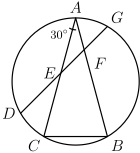
Small Hint:
Use equal chords to identify the relevant equal arcs and isosceles triangles
Big Hint:
Normalize and find from a -- triangle
Solution:
Scale so The equal-chord arc relations show that triangle is -- and Put Then so Equal chords also give Hence
Therefore, the correct answer is C.
28.
Consider the set of all equations where are real constants and for Let be the largest positive real number which satisfies at least one of these equations. Then
Small Hint:
For positive the coefficients that push a root farthest right take their lower bounds
Big Hint:
Bracket the largest root of at two consecutive choice endpoints
Solution:
Write an allowed polynomial as For where Thus no positive root can exceed the largest root of Taking gives so itself is attained. Since we have
Therefore, the correct answer is D.
29.
If then the sum of the real solutions of is equal to
Small Hint:
The principal square root forces
Big Hint:
After one squaring, factor a difference involving
Solution:
Since squaring once gives Let Then and so Since we have or Therefore and The only nonnegative root is and it satisfies the original equation. It is therefore also the sum of all real solutions.
Therefore, the correct answer is E.
30.
If are the solutions of the equation then an equation whose solutions are is
none of these
Small Hint:
Use the missing cubic term to find
Big Hint:
Each listed expression becomes the negative reciprocal of one original root
Solution:
Vieta’s formulas give Thus, for example, and similarly the new roots are Put in Multiplying by gives or
Therefore, the correct answer is D.