
1980 AMC 12 Solutions
Scroll down to view professionally curated solutions from LIVE by Po-Shen Loh, print PDF solutions, view answer key, or take the full timed exam.
All problems are used with official legal permission of the Mathematical Association of America (MAA).
1.
The largest whole number such that seven times the number is less than is
Small Hint:
Translate “seven times the number is less than ” into an inequality
Big Hint:
Locate between two consecutive whole numbers
Solution:
The number must be less than The largest whole number below this value is
Therefore, the correct answer is C.
2.
The degree of as a polynomial in is
Small Hint:
Find the highest power contributed by each parenthesized factor
Big Hint:
Degrees add when nonzero polynomials are multiplied
Solution:
The first factor has degree and the second has degree Their product therefore has degree
Therefore, the correct answer is D.
3.
If the ratio of to is what is the ratio of to
Small Hint:
Write the stated ratio as an equation of two fractions
Big Hint:
Cross-multiply and collect the -terms and -terms separately
Solution:
The condition gives Thus so and
Therefore, the correct answer is E.
4.
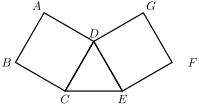
In the adjoining figure, is an equilateral triangle and and are squares. The measure of is
Small Hint:
Identify the three known angles at
Big Hint:
Use the full angle around point
Solution:
At the two square angles are each and the equilateral-triangle angle is Hence
Therefore, the correct answer is C.
5.
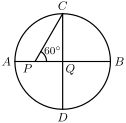
If and are perpendicular diameters of circle in and then the length of divided by the length of is
Small Hint:
Use the perpendicular diameters to identify a right angle in
Big Hint:
Relate the short and long legs of the resulting -- triangle
Solution:
Triangle is right at and has so it is a -- triangle. Since
Therefore, the correct answer is B.
6.
A positive number satisfies the inequality if and only if
Small Hint:
Use the fact that both sides are positive
Big Hint:
Divide by before squaring or isolating
Solution:
Because division by preserves the inequality: Thus which is equivalent to
Therefore, the correct answer is A.
7.
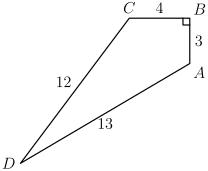
Sides and of convex polygon have lengths and respectively; and is a right angle. The area of the quadrilateral is
Small Hint:
Draw diagonal and find its length from
Big Hint:
Recognize a second right triangle using the side lengths and
Solution:
Triangle is a -- right triangle, so and its area is Since triangle is right at and has area The quadrilateral’s area is
Therefore, the correct answer is B.
8.
How many pairs of nonzero real numbers satisfy the equation
none
one pair for each
two pairs for each
Small Hint:
Clear the denominators, noting that and must be nonzero
Big Hint:
Treat the resulting homogeneous quadratic as an equation in the ratio
Solution:
Clearing denominators gives or Since let Then whose discriminant is Thus there are no real pairs.
Therefore, the correct answer is A.
9.
A man walks miles due west, turns to his left and walks miles in the new direction. If he finishes at a point miles from his starting point, then is
not uniquely determined by the given information
Small Hint:
Resolve the second walk into horizontal and vertical components
Big Hint:
The distance equation is quadratic in ; check whether both positive roots are valid
Solution:
Take east as the positive horizontal direction. After the turn, the -mile displacement has components Therefore Hence giving or The value is not unique.
Therefore, the correct answer is E.
10.
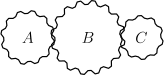
The number of teeth in three meshed circular gears are respectively. (The teeth on all gears are the same size and regularly spaced as in the figure.) The angular speeds, in revolutions per minute, of are in the proportion
Small Hint:
Meshed teeth have the same tangential speed at their points of contact
Big Hint:
Angular speed is inversely proportional to circumference and hence to the number of teeth
Solution:
The gears’ circumferences are proportional to and while their tangential speeds have equal magnitude. Their angular speeds are therefore proportional to Multiplying all three terms by gives
Therefore, the correct answer is D.
11.
If the sum of the first terms and the sum of the first terms of a given arithmetic progression are and respectively, then the sum of the first terms is
Small Hint:
Write
Big Hint:
Use the two known partial sums to find the expression
Solution:
The two given sums yield Subtracting gives so and Therefore
Therefore, the correct answer is D.
12.
The equations of and are and respectively. Suppose makes twice as large an angle with the horizontal (measured counterclockwise from the positive -axis) as does and that has times the slope of If is not horizontal, then is
not uniquely determined by the given information
Small Hint:
Let the angle of inclination of be
Big Hint:
Substitute into
Solution:
Let Then and also Hence The nonhorizontal condition gives so or Thus
Therefore, the correct answer is C.
13.
A bug (of negligible size) starts at the origin on the coordinate plane. First it moves unit right to Then it makes a turn counterclockwise and travels a unit to If it continues in this fashion, each time making a turn counterclockwise and traveling half as far as in the previous move, to which of the following points will it come closest?
Small Hint:
Represent a counterclockwise turn by multiplication by
Big Hint:
The displacement vectors form an infinite geometric series with ratio
Solution:
As complex numbers, the successive displacement vectors are Their sum is Thus the bug approaches
Therefore, the correct answer is B.
14.
If is a constant and the function defined by satisfies for all real numbers except then is
not uniquely determined by the given information
Small Hint:
Compute as a single rational expression
Big Hint:
For the result to equal identically, compare the coefficient of in the denominator
Solution:
Direct composition gives For this to equal identically, the denominator must be the constant Thus and both of which give
Therefore, the correct answer is A.
15.
A store prices an item in dollars and cents so that when sales tax is added no rounding is necessary because the result is exactly dollars, where is a positive integer. The smallest value of is
Small Hint:
Let the untaxed price be an integer number of cents
Big Hint:
Reduce the equation to a divisibility condition on
Solution:
Let the price be cents. Then so Since and are relatively prime, must divide The smallest positive possibility is
Therefore, the correct answer is B.
16.
Four of the eight vertices of a cube are vertices of a regular tetrahedron. Find the ratio of the surface area of the cube to the surface area of the tetrahedron.

Small Hint:
If the cube edge is each tetrahedron edge is a face diagonal
Big Hint:
Compare with four equilateral triangles of side
Solution:
Let the cube edge be Each tetrahedron edge is a cube face diagonal, so it has length The tetrahedron’s surface area is The cube’s surface area is so the ratio is
Therefore, the correct answer is B.
17.
Given that for how many integers is an integer?
none
Small Hint:
Expand and isolate its imaginary part
Big Hint:
An integer has imaginary part zero, so solve the resulting cubic factorization
Solution:
Expansion gives The imaginary part vanishes exactly when or For each of these three integers the real part is an integer, so there are values.
Therefore, the correct answer is D.
18.
If and then equals
none of these
Small Hint:
Convert into an exponential equation
Big Hint:
Use and the positivity of
Solution:
We have so Therefore
Therefore, the correct answer is D.
19.
Let and be three parallel chords of a circle on the same side of the center. The distance between and is the same as the distance between and The lengths of the chords are and The radius of the circle is
not uniquely determined by the given information
Small Hint:
A perpendicular from the center bisects each chord
Big Hint:
Let the nearest chord be distance from the center and the common spacing be
Solution:
Let be the radius, the distance to the -unit chord, and the common spacing. Then Consecutive subtraction gives and so and Hence and
Therefore, the correct answer is D.
20.
A box contains pennies, nickels and dimes. Six coins are drawn without replacement, with each coin having an equal probability of being chosen. What is the probability that the value of the coins drawn is at least cents?
none of these
Small Hint:
There are equally likely sets of six coins
Big Hint:
Classify favorable selections by whether they contain six, five, or four dimes
Solution:
There are selections. A value of at least cents occurs with six dimes; with five dimes and any one other coin; or with four dimes and two nickels. The favorable count is Thus the probability is
Therefore, the correct answer is C.
21.
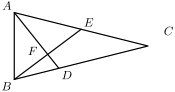
In triangle is the midpoint of side and is a point on side such that and intersect at The ratio of the area of to the area of quadrilateral is
none of these
Small Hint:
Area ratios are unchanged by an affine transformation, so convenient coordinates may be used
Big Hint:
Find the ratio , then compare the small triangles with
Solution:
Scale the total area of to Since we have and The midpoint and trisection conditions give Hence Also Therefore and the requested ratio is
Therefore, the correct answer is A.
22.
For each real number let be the minimum of the numbers and Then the maximum value of is
Small Hint:
Sketch the three lines and follow their lower envelope
Big Hint:
The maximum occurs where the active increasing line meets the decreasing line
Solution:
The lower envelope is until it meets at then is until that line meets at and thereafter is Thus its maximum occurs at and equals
Therefore, the correct answer is E.
23.
Line segments drawn from the vertex opposite the hypotenuse of a right triangle to the points trisecting the hypotenuse have lengths and where is a real number such that The length of the hypotenuse is
not uniquely determined by the given information
Small Hint:
Put the hypotenuse on the -axis and assign coordinates to the right-angle vertex
Big Hint:
Add the squares of the two trisector-segment lengths so the unknown horizontal position cancels
Solution:
Let the hypotenuse have endpoints and and let the right-angle vertex be The right-angle condition gives The squared distances to and sum to This also equals Hence
Therefore, the correct answer is C.
24.
For some real number the polynomial is divisible by Which of the following numbers is closest to
Small Hint:
A repeated root appears as a squared linear factor
Big Hint:
Factor the cubic completely and then compare the repeated root with the listed decimals
Solution:
The polynomial factors as Thus the repeated root is and the nearest listed number is
Therefore, the correct answer is D.
25.
In the nondecreasing sequence of odd integers each positive odd integer appears times. It is a fact that there are integers and such that, for all positive integers where denotes the largest integer not exceeding The sum equals
Small Hint:
The first positive odd integers have sum
Big Hint:
Express the least with using a floor of
Solution:
The final occurrence of is in position Therefore Thus and so
Therefore, the correct answer is C.
26.
Four balls of radius are mutually tangent, three resting on the floor and the fourth resting on the others. A tetrahedron, each of whose edges has length is circumscribed around the balls. Then equals
Small Hint:
The four ball centers form a regular tetrahedron of edge
Big Hint:
The outer faces are parallel to the corresponding center-tetrahedron faces and one radius farther away
Solution:
The ball centers form a regular tetrahedron of edge Its inradius is Each face of the circumscribed tetrahedron is parallel to the corresponding face of this center tetrahedron and lies one unit farther from the common center. By similarity, Hence
Therefore, the correct answer is E.
27.
The sum equals
none of these
Small Hint:
Call the two cube roots and , and compute
Big Hint:
Use
Solution:
Let the two real cube roots be and Then If then so The only real solution is which is not listed.
Therefore, the correct answer is E.
28.
The polynomial is not divisible by if equals
Small Hint:
Evaluate the polynomial at a nonreal cube root of unity
Big Hint:
Use and consider modulo
Solution:
Let Since the polynomial evaluated at is This is unless in which case it is The latter occurs exactly when is divisible by Among the choices only is divisible by so that is the value for which divisibility fails.
Therefore, the correct answer is C.
29.
How many ordered triples of integers satisfy the system of equations below?
a finite number greater than two
infinitely many
Small Hint:
Add all three equations before trying to solve for the variables
Big Hint:
Rewrite the resulting quadratic form as a sum of two squares and reduce modulo
Solution:
Adding the three equations gives or A square is congruent to or so a sum of two squares cannot be congruent to But a contradiction. Thus there are no integer triples.
Therefore, the correct answer is A.
30.
A six digit number (base ) is squarish if it satisfies the following conditions:
(i) none of its digits is zero;
(ii) it is a perfect square; and
(iii) the first two digits, the middle two digits and the last two digits of the number are all perfect squares when considered as two digit numbers.
How many squarish numbers are there?
Small Hint:
List the two-digit perfect squares having no zero digit
Big Hint:
Use the first pair to restrict the square root to a short interval, then filter by the final pair
Solution:
Each two-digit block must belong to Restricting the square root by the first block and retaining only squares with an allowed final block leaves the following possible middle blocks:
first block possible middle blocks
Only the middle block is allowed, producing Thus there are squarish numbers.
Therefore, the correct answer is B.