
1979 AMC 12 Solutions
Scroll down to view professionally curated solutions from LIVE by Po-Shen Loh, print PDF solutions, view answer key, or take the full timed exam.
All problems are used with official legal permission of the Mathematical Association of America (MAA).
1.
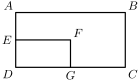
If rectangle has area square meters and and are the midpoints of sides and respectively, then the area of rectangle in square meters is
Small Hint:
The two midpoint conditions halve the relevant side lengths
Big Hint:
Compare the area scale factor of with that of
Solution:
The side lengths of are one half the corresponding side lengths of Its area is therefore of which is
Therefore, the correct answer is D.
2.
For all nonzero real numbers and such that equals
Small Hint:
Combine the two reciprocals over the denominator
Big Hint:
Use the given equation to replace
Solution:
We have because
Therefore, the correct answer is D.
3.
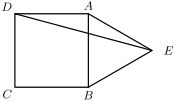
In the adjoining figure, is a square, is an equilateral triangle and point is outside square What is the measure of in degrees?
Small Hint:
Compare and
Big Hint:
Find , then use the base angles of isosceles
Solution:
The square and equilateral triangle give Also Thus is isosceles, and each base angle is
Therefore, the correct answer is C.
4.
For all real numbers equals
Small Hint:
Expand from the innermost parentheses outward
Big Hint:
Track the outer two factors of separately
Solution:
Expanding from the inside gives
Therefore, the correct answer is E.
5.
Find the sum of the digits of the largest even three digit number (in base ten representation) which is not changed when its units and hundreds digits are interchanged.
Small Hint:
The hundreds and units digits must be equal
Big Hint:
Maximize the equal outer digits subject to the number being even, then maximize the tens digit
Solution:
The equal hundreds and units digit must be even. The largest possible nonzero such digit is and the tens digit can be Thus the largest number is whose digit sum is
Therefore, the correct answer is D.
6.
Small Hint:
Write each fraction as plus a reciprocal power of
Big Hint:
Sum as a finite geometric series
Solution:
Each numerator is one more than its denominator, so the expression is The parenthesized geometric sum is Therefore the value is
Therefore, the correct answer is A.
7.
The square of an integer is called a perfect square. If is a perfect square, the next larger perfect square is
Small Hint:
Write for a nonnegative integer
Big Hint:
Expand the next square and replace by
Solution:
Let with The next larger perfect square is
Therefore, the correct answer is E.
8.
Find the area of the smallest region bounded by the graphs of and
Small Hint:
The two rays of meet at the center of the circle
Big Hint:
Find the smaller central angle between the rays and
Solution:
The two rays meet the circle at angles and so the smallest bounded region is a sector of the radius- circle. Its area is
Therefore, the correct answer is C.
9.
The product of and equals
Small Hint:
Rewrite both radicands as powers of
Big Hint:
Add the exponents and , then separate the integer part
Solution:
Writing both radicals as powers of gives
Therefore, the correct answer is E.
10.
If is a regular hexagon whose apothem (distance from the center to the midpoint of a side) is and is the midpoint of side for then the area of quadrilateral is
Small Hint:
The points lie on a circle of radius equal to the apothem
Big Hint:
Join the center to the four consecutive side midpoints and decompose the quadrilateral
Solution:
Let be the center. Consecutive apothems and have length and form a angle, so each is equilateral of side The quadrilateral is the union of three such triangles, and hence has area
Therefore, the correct answer is D.
11.
Find a positive integral solution to the equation
The equation has no positive integral solutions.
Small Hint:
Use the sums of the first odd and first even positive integers
Big Hint:
The fraction simplifies to
Solution:
The numerator is and the denominator is Thus which gives so
Therefore, the correct answer is B.
12.
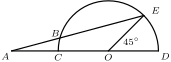
In the adjoining figure, is the diameter of a semicircle with center Point lies on the extension of past point lies on the semicircle, and is the point of intersection (distinct from ) of line segment with the semicircle. If length equals length and the measure of is then the measure of is
Small Hint:
Let and use
Big Hint:
Express in two ways using the isosceles triangles and the central angle
Solution:
Let Since so Also hence and On the other hand, so Therefore giving
Therefore, the correct answer is B.
13.
The inequality is satisfied if and only if
or (or both inequalities hold)
or (or both inequalities hold)
and
Small Hint:
Replace by
Big Hint:
Separate the cases and , then combine the resulting regions
Solution:
If the inequality becomes or If it becomes or Combining the two cases gives exactly or with overlap allowed.
Therefore, the correct answer is A.
14.
In a certain sequence of numbers, the first number is and, for all the product of the first numbers in the sequence is The sum of the third and the fifth numbers in the sequence is
Small Hint:
Divide the product of the first terms by the product of the first terms
Big Hint:
This gives the th term directly as a ratio of two squares
Solution:
For the th term is Therefore and whose sum is
Therefore, the correct answer is C.
15.
Two identical jars are filled with alcohol solutions, the ratio of the volume of alcohol to the volume of water being in one jar and in the other jar. If the entire contents of the two jars are mixed together, the ratio of the volume of alcohol to the volume of water in the mixture is
Small Hint:
Assign the same total volume to each jar and convert each ratio to alcohol and water fractions
Big Hint:
Add the two alcohol amounts and the two water amounts before forming their ratio
Solution:
For equal total volumes, the alcohol fractions are and while the water fractions are and Their ratio is
Therefore, the correct answer is E.
16.
A circle with area is contained in the interior of a larger circle with area If the radius of the larger circle is and if is an arithmetic progression, then the radius of the smaller circle is
Small Hint:
Use the middle-term condition for the three areas in arithmetic progression
Big Hint:
Express the larger circle’s area as a multiple of
Solution:
The progression condition gives so Hence the larger area is and If the smaller radius is then so
Therefore, the correct answer is E.
17.
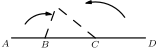
Points and are distinct and lie, in the given order, on a straight line. Line segments and have lengths and respectively. If line segments and may be rotated about points and respectively, so that points and coincide, to form a triangle with positive area, then which of the following three inequalities must be satisfied?
only
only
and only
and only
and
Small Hint:
After the rotations, identify the three side lengths of the new triangle
Big Hint:
Apply all three strict triangle inequalities to and
Solution:
The new triangle has side lengths and Its triangle inequalities give Thus I and II must hold, while III must fail.
Therefore, the correct answer is C.
18.
To the nearest thousandth, is and is Which of the following is the best approximation of
Small Hint:
Use
Big Hint:
Apply change of base, then compare the decimal result with the five fractions
Solution:
We have Therefore Of the choices, is closest.
Therefore, the correct answer is C.
19.
Find the sum of the squares of all real numbers satisfying the equation
Small Hint:
Rewrite as a single power with exponent
Big Hint:
Determine the two real values whose th powers equal
Solution:
Since Thus The real solutions are and and the sum of their squares is
Therefore, the correct answer is A.
20.
If and then the radian measure of equals
Small Hint:
First solve the given product equation for
Big Hint:
Use the tangent addition formula on the two positive inverse-tangent angles
Solution:
Substituting gives If and then Both angles are positive and their sum is less than so
Therefore, the correct answer is C.
21.
The length of the hypotenuse of a right triangle is and the radius of the inscribed circle is The ratio of the area of the circle to the area of the triangle is
none of these
Small Hint:
Use the formula for a triangle’s area
Big Hint:
For a right triangle, relate the sum of the legs to and
Solution:
If the legs are and then the right-triangle inradius identity is Hence the semiperimeter is The triangle’s area is while the circle’s area is Their ratio is
Therefore, the correct answer is B.
22.
Find the number of pairs of integers which satisfy the equation
infinitely many
Small Hint:
Factor the left side as
Big Hint:
Compare the two sides modulo
Solution:
The left side is which is divisible by for every integer The right side is which is congruent to Therefore no integer pair satisfies the equation.
Therefore, the correct answer is A.
23.
The edges of a regular tetrahedron with vertices and each have length one. Find the least possible distance between a pair of points and where is on edge and is on edge
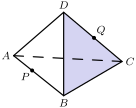
Small Hint:
Use symmetric coordinates for a regular tetrahedron with vertices
Big Hint:
Parameterize points on the two opposite edges and minimize the squared distance
Solution:
Before scaling, take These edges have length so scale by Points on and have forms and Before scaling, minimized at After scaling, the minimum squared distance is so the distance is
Therefore, the correct answer is C.
24.
A polygon is called “simple” if it is not self-intersecting. Sides and of simple quadrilateral have lengths and respectively. If vertex angles and are obtuse and then side has length
Small Hint:
Place and , then use the signs forced by the obtuse angles
Big Hint:
Determine coordinates for and from the -- ratios
Solution:
Put and Since is obtuse and we may take The simple configuration and the obtuse angle at give Thus
Therefore, the correct answer is E.
25.
If and are the quotient and remainder, respectively, when the polynomial is divided by and if and are the quotient and remainder, respectively, when is divided by then equals
Small Hint:
Let and express the first quotient using
Big Hint:
Apply the remainder theorem to at
Solution:
Let Since the first remainder is Therefore the second remainder is
Therefore, the correct answer is B.
26.
The function satisfies the functional equation for every pair of real numbers. If then the number of integers for which is
infinite
Small Hint:
Set one variable equal to to get a recurrence for consecutive integer inputs
Big Hint:
Find , solve the recurrence for all integers, and then impose
Solution:
Setting gives Setting gives Extending the recurrence in both directions yields, for every integer Thus is equivalent to The integer solutions are and and after excluding exactly one remains.
Therefore, the correct answer is B.
27.
An ordered pair of integers, each of which has absolute value less than or equal to five, is chosen at random, with each such ordered pair having an equal likelihood of being chosen. What is the probability that the equation will not have distinct positive real roots?
none of these
Small Hint:
Distinct positive roots require and
Big Hint:
Count the qualifying values for each then take the complement among pairs
Solution:
There are ordered pairs. Distinct positive roots require and For and there are no choices; for and there are respectively and choices of Thus only pairs produce distinct positive roots, so the requested probability is which is not listed.
Therefore, the correct answer is E.
28.
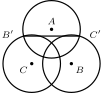
Circles with centers and each have radius where The distance between each pair of centers is If is the point of intersection of circle and circle which is outside circle and if is the point of intersection of circle and circle which is outside circle then length equals
none of these
Small Hint:
Introduce the analogous point outside circle ; symmetry makes equilateral
Big Hint:
Use the common centroid and the altitude of an isosceles triangle with sides and
Solution:
Let be the analogous outer intersection of the circles centered at and Then and are concentric equilateral triangles. If is their common centroid and is the midpoint of then Similarity gives Hence
Therefore, the correct answer is D.
29.
For each positive number let The minimum value of is
Small Hint:
Set and write in terms of
Big Hint:
Factor the numerator as a difference of squares, then use
Solution:
Let and Since the numerator is The denominator is so For with equality at Thus the minimum is
Therefore, the correct answer is E.
30.
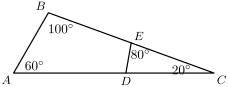
In is the midpoint of side and is on side If the length of is and and then the area of plus twice the area of equals
Small Hint:
Extend to so that , creating an equilateral triangle
Big Hint:
Choose on with ; compare with
Solution:
Extend through to with Then is equilateral. Choose on so that The angle conditions give while Since is the midpoint of the similarity scale is so Decomposing the equilateral triangle gives Dividing by yields
Therefore, the correct answer is B.