
1977 AMC 12 Solutions
Scroll down to view professionally curated solutions from LIVE by Po-Shen Loh, print PDF solutions, view answer key, or take the full timed exam.
All problems are used with official legal permission of the Mathematical Association of America (MAA).
1.
If and then equals
Small Hint:
Express every term in terms of
Big Hint:
Use first to obtain
Solution:
Since we have Therefore
Therefore, the correct answer is D.
2.
Which one of the following statements is false? All equilateral triangles are
equiangular
isosceles
regular polygons
congruent to each other
similar to each other
Small Hint:
Separate properties determined by angles from properties determined by size
Big Hint:
Compare two equilateral triangles having different side lengths
Solution:
Every equilateral triangle is equiangular, isosceles, regular, and similar to every other equilateral triangle. Two equilateral triangles with different side lengths are not congruent, however.
Therefore, the correct answer is D.
3.
A man has in pennies, nickels, dimes, quarters and half dollars. If he has an equal number of coins of each kind, then the total number of coins he has is
Small Hint:
Find the value of one coin of each of the five types
Big Hint:
The five coins in one complete set are worth cents
Solution:
One coin of each kind is worth cents. Since there are three coins of each of the five kinds, or coins.
Therefore, the correct answer is E.
4.
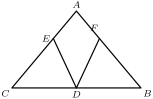
In triangle and If points and lie on sides and respectively, and and then equals
none of these
Small Hint:
First determine the two base angles of
Big Hint:
Use the two given equal-length pairs to find and
Solution:
The base angles of are each Since triangle has vertex angle so Similarly, gives The three angles above the straight line sum to so
Therefore, the correct answer is C.
5.
The set of all points such that the sum of the (undirected) distances from to two fixed points and equals the distance between and is
the line segment from to
the line passing through and
the perpendicular bisector of the line segment from to
an ellipse having positive area
a parabola
Small Hint:
Apply the triangle inequality to and
Big Hint:
Recall when equality holds in the triangle inequality
Solution:
The triangle inequality gives Equality holds exactly when are collinear with between and including the endpoints. Thus the locus is the segment from to
Therefore, the correct answer is A.
6.
If and are not zero, then equals
none of these
Small Hint:
Rewrite the outside reciprocal using a single fraction
Big Hint:
Combine the two reciprocals inside the brackets over a common denominator
Solution:
We have Their product is
Therefore, the correct answer is D.
7.
If then equals
Small Hint:
Let and use
Big Hint:
Factor into a linear factor, a second linear factor, and a quadratic factor
Solution:
Let Since it follows that
Therefore, the correct answer is E.
8.
For every triple of nonzero real numbers, form the number The set of all numbers formed is
none of these
Small Hint:
Each of the first three fractions is either or
Big Hint:
The sign of the final fraction is the product of the first three signs
Solution:
Let be the signs of The expression is If all three signs are positive it is and if all are negative it is If the signs are mixed, direct cancellation gives Hence the set is
Therefore, the correct answer is B.
9.
In the adjoining figure and arc arc and arc all have equal length. Find the measure of

Small Hint:
Assign one variable to each of the three equal arcs and another to arc
Big Hint:
Use both the full-circle arc sum and the external-secant angle theorem at
Solution:
Let each of arcs measure and let arc measure Then Solving gives The inscribed angle subtends arc so it measures
Therefore, the correct answer is B.
10.
If then equals
Small Hint:
A polynomial’s coefficient sum is obtained by evaluating it at a particular input
Big Hint:
Substitute into the given identity
Solution:
Setting makes the right side the desired coefficient sum. Thus
Therefore, the correct answer is E.
11.
For each real number let be the largest integer not exceeding (i.e., the integer such that ). Which of the following statements is (are) true?
for all
for all and
for all and
none
only
and only
only
all
Small Hint:
Prove the translation statement directly from
Big Hint:
Test the other two claims using noninteger values between and
Solution:
If then so is true. Taking gives and Thus and are false.
Therefore, the correct answer is B.
12.
Al’s age is more than the sum of Bob’s age and Carl’s age, and the square of Al’s age is more than the square of the sum of Bob’s age and Carl’s age. The sum of the ages of Al, Bob and Carl is
Small Hint:
Let be the sum of Bob’s and Carl’s ages
Big Hint:
Factor and use the known value of
Solution:
Let be Al’s age and the sum of the other two ages. Then and Hence the requested total is
Therefore, the correct answer is D.
13.
If is a sequence of positive numbers such that for all positive integers then the sequence is a geometric progression
for all positive values of and
if and only if
if and only if
if and only if
if and only if
Small Hint:
Write out and in terms of
Big Hint:
Equate the first three successive ratios and use positivity
Solution:
The next terms are and If the sequence is geometric, then Thus and Positivity forces Conversely, these initial values produce the constant geometric sequence
Therefore, the correct answer is E.
14.
How many pairs of integers satisfy the equation
more than
Small Hint:
Move all terms to one side and add
Big Hint:
Factor the equation into a product of two integers equal to
Solution:
Rearranging and completing the product gives The integer factor pairs of are and producing and Thus there are two ordered pairs.
Therefore, the correct answer is B.
15.
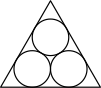
Each of the three circles in the adjoining figure is externally tangent to the other two, and each side of the triangle is tangent to two of the circles. If each circle has radius three, then the perimeter of the triangle is
Small Hint:
The three circle centers form an equilateral triangle of side
Big Hint:
View the outer sides as parallel offsets and compare the inradii of two equilateral triangles
Solution:
The circle centers form an equilateral triangle of side whose inradius is Each side of the outer triangle is a parallel tangent line three units farther out, so the outer triangle has inradius An equilateral triangle of inradius has side hence each outer side is The perimeter is
Therefore, the correct answer is D.
16.
If then the sum equals
Small Hint:
Compare the term indexed by with the term indexed by
Big Hint:
Count the even and odd indices from through
Solution:
Let Then Every even-indexed term equals and every odd-indexed term equals There are even indices and odd indices, so the sum is
Therefore, the correct answer is D.
17.
Three fair dice are tossed at random (i.e., all faces have the same probability of coming up). What is the probability that the three numbers turned up can be arranged to form an arithmetic progression with common difference one?
Small Hint:
List the possible three-element sets of consecutive die values
Big Hint:
Each qualifying set has six orderings among the ordered outcomes
Solution:
The possible sets are and Each has orderings, so of the outcomes work. The probability is
Therefore, the correct answer is B.
18.
If then
Small Hint:
Rewrite every logarithm using the same base
Big Hint:
Adjacent numerators and denominators cancel in the product
Solution:
By change of base,
Therefore, the correct answer is B.
19.
Let be the point of intersection of the diagonals of convex quadrilateral and let and be the centers of the circles circumscribing triangles and respectively. Then
is a parallelogram
is a parallelogram if and only if is a rhombus
is a parallelogram if and only if is a rectangle
is a parallelogram if and only if is a parallelogram
none of the above are true
Small Hint:
Two adjacent circumcenters lie on the perpendicular bisector of the side shared by their triangles
Big Hint:
Use the fact that are collinear and are collinear
Solution:
Both and lie on the perpendicular bisector of while both and lie on the perpendicular bisector of Since are collinear, these bisectors are parallel, so Likewise, lie on the perpendicular bisector of and lie on that of Since are collinear, Therefore is always a parallelogram.
Therefore, the correct answer is A.
20.
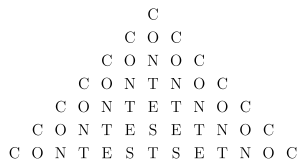
For how many paths consisting of a sequence of horizontal and/or vertical line segments, with each segment connecting a pair of adjacent letters in the diagram below, is the word CONTEST spelled out as the path is traversed from beginning to end?
none of these
Small Hint:
Reverse each path, starting from the central in the bottom row
Big Hint:
Count the left-going and right-going families separately, then correct for their common path
Solution:
Reverse the paths and spell TSETNOC from the central bottom In the family whose horizontal moves go left, each of the six steps has two choices: up or left. This gives paths. By symmetry, paths have horizontal moves going right. The all-vertical central path belongs to both families, so the total is This number is not among the first four choices.
Therefore, the correct answer is E.
21.
For how many values of the coefficient do the equations have a common real solution?
infinitely many
Small Hint:
Subtract the two equations to obtain a factored condition
Big Hint:
Check separately the cases and
Solution:
Subtracting the second equation from the first gives If the common equation is which has no real roots. Otherwise and substitution into gives This value works, so exactly one value of qualifies.
Therefore, the correct answer is B.
22.
If is a real-valued function of the real variable and is not identically zero, and for all and then for all and
there is a positive number such that
Small Hint:
First substitute
Big Hint:
Next set and
Solution:
Setting gives so Now set and The equation becomes and hence for every real
Therefore, the correct answer is C.
23.
If the solutions of the equation are the cubes of the solutions of the equation then
none of these
Small Hint:
Call the roots of the second equation and and apply Vieta’s formulas
Big Hint:
Use
Solution:
Let the roots of be Then and while the roots of the first equation are Thus Therefore
Therefore, the correct answer is B.
24.
Find the sum
Small Hint:
Decompose into two unit fractions
Big Hint:
The last denominator corresponds to
Solution:
For Hence the sum telescopes to
Therefore, the correct answer is D.
25.
Determine the largest positive integer such that is divisible by
none of these
Small Hint:
Count the factors of in
Big Hint:
Include contributions from multiples of and
Solution:
There are more factors of than of so the exponent of is Since is not listed, the correct choice is “none of these.”
Therefore, the correct answer is E.
26.
Let and be the lengths of sides and respectively, of quadrilateral If is the area of then
if and only if is convex
if and only if is a rectangle
if and only if is a rectangle
if and only if is a parallelogram
if and only if is a parallelogram
Small Hint:
Split the quadrilateral along each diagonal and bound every sine by
Big Hint:
Combine the two resulting area bounds and analyze when every bound is an equality
Solution:
Splitting along diagonal and using gives Splitting along similarly gives These bounds remain valid for a nonconvex quadrilateral by taking the appropriate difference of triangle areas. Adding them yields or Equality requires equality in all four sine bounds, so all four angles are right angles; conversely a rectangle gives equality. Thus the equality holds exactly for rectangles.
Therefore, the correct answer is B.
27.
There are two spherical balls of different sizes lying in two corners of a rectangular room, each touching two walls and the floor. If there is a point on each ball which is inches from each wall which that ball touches and inches from the floor, then the sum of the diameters of the balls is
inches
inches
inches
inches
not determined by the given information
Small Hint:
Place the corner at the origin with the walls and floor as coordinate planes
Big Hint:
A sphere of radius tangent to all three planes has center
Solution:
For radius the center is and the given point is Thus which simplifies to or The two radii are and so the sum of the diameters is inches.
Therefore, the correct answer is C.
28.
Let What is the remainder when the polynomial is divided by the polynomial
Small Hint:
Use
Big Hint:
Evaluate the remainder at the five roots of and use its degree bound
Solution:
Let be the remainder, so The five roots of satisfy and Hence and Therefore a polynomial of degree at most has five distinct roots. It must be identically zero, so
Therefore, the correct answer is A.
29.
Find the smallest integer such that for all real numbers and
There is no such integer
Small Hint:
Apply Cauchy-Schwarz to the three numbers
Big Hint:
Use equal nonzero values of to test sharpness
Solution:
By Cauchy-Schwarz, Equality occurs when so no smaller value can work. Thus the smallest integer is
Therefore, the correct answer is B.
30.
If and are the lengths of a side, a shortest diagonal and a longest diagonal, respectively, of a regular nonagon (see adjoining figure), then

Small Hint:
Write the three chord lengths using the nonagon’s circumradius
Big Hint:
Compare with using the sum-to-product identity
Solution:
If the circumradius is the three chords subtend central angles respectively. Thus The sum-to-product identity gives Multiplying by yields
Therefore, the correct answer is A.