
1976 AMC 12 Solutions
Scroll down to view professionally curated solutions from LIVE by Po-Shen Loh, print PDF solutions, view answer key, or take the full timed exam.
All problems are used with official legal permission of the Mathematical Association of America (MAA).
1.
If one minus the reciprocal of equals the reciprocal of then equals
Small Hint:
Multiply the equation by which cannot be zero
Big Hint:
After clearing the denominator, solve
Solution:
The equation is Multiplying by gives so
Therefore, the correct answer is B.
2.
For how many real numbers is a real number?
none
one
two
a finite number greater than two
infinitely many
Small Hint:
A real square root requires a nonnegative radicand
Big Hint:
The quantity can be nonnegative only when the square vanishes
Solution:
Since its negative is at most It is nonnegative only when which occurs for the single value
Therefore, the correct answer is B.
3.
The sum of the distances from one vertex of a square with sides of length two to the midpoints of each of the sides of the square is
Small Hint:
Place the chosen vertex at and the other vertices at and
Big Hint:
Two midpoints are one unit away, while each opposite-side midpoint forms legs and
Solution:
The two midpoints on sides meeting the chosen vertex are each at distance The other two midpoints have coordinate differences and so each is at distance The sum is
Therefore, the correct answer is E.
4.
Let a geometric progression with terms have first term one, common ratio and sum where and are not zero. The sum of the geometric progression formed by replacing each term of the original progression by its reciprocal is
Small Hint:
Write the reciprocal sum as
Big Hint:
Factor after reversing the order of the powers
Solution:
Let be the reciprocal sum. Multiplying it by reverses the original terms: Hence This also holds when
Therefore, the correct answer is C.
5.
How many integers greater than ten and less than one hundred, written in base ten notation, are increased by nine when their digits are reversed?
Small Hint:
Represent the tens and units digits by and
Big Hint:
The increase is
Solution:
The condition is so The possibilities are and giving integers.
Therefore, the correct answer is C.
6.
If is a real number and the negative of one of the solutions of is a solution of then the solutions of are
Small Hint:
Call the first root and substitute into the second equation
Big Hint:
The two resulting equations differ only in the sign of
Solution:
For such a root Subtracting gives Thus the first equation is with roots and
Therefore, the correct answer is C.
7.
If is a real number, then the quantity is positive if and only if
or
Small Hint:
A product is positive when its two factors have the same sign
Big Hint:
Analyze the intervals cut by and
Solution:
Both factors are positive exactly when giving Both are negative when and which reduces to The endpoints make the product zero.
Therefore, the correct answer is E.
8.
A point in the plane, both of whose rectangular coordinates are integers with absolute value less than or equal to four, is chosen at random, with all such points having an equal probability of being chosen. What is the probability that the distance from the point to the origin is at most two units?
the square of a rational number
Small Hint:
There are choices for each coordinate
Big Hint:
Count integer pairs satisfying by considering and
Solution:
There are possible points. Within distance are the origin; the four points the four points and the four points Thus points qualify, for probability
Therefore, the correct answer is A.
9.
In triangle is the midpoint of is the midpoint of and is the midpoint of If the area of is then the area of is
Small Hint:
Compare the base with and the height from with the height from
Big Hint:
The two ratios are and
Solution:
Since is the midpoint of and is the midpoint of Since is the midpoint of its distance from line is half that of Therefore
Therefore, the correct answer is D.
10.
If and are real numbers and and then the equation has a solution
for all choices of and
if and only if and
if and only if
if and only if
if and only if
Small Hint:
Expand both compositions before trying to solve for
Big Hint:
The coefficients of are automatically equal, leaving a condition on the constant terms
Solution:
We have The -terms cancel for every so a solution exists exactly when Rearranging gives
Therefore, the correct answer is D.
11.
Which of the following statements is (are) equivalent to the statement “If the pink elephant on planet alpha has purple eyes, then the wild pig on planet beta does not have a long nose”?
“If the wild pig on planet beta has a long nose, then the pink elephant on planet alpha has purple eyes.”
“If the pink elephant on planet alpha does not have purple eyes, then the wild pig on planet beta does not have a long nose.”
“If the wild pig on planet beta has a long nose, then the pink elephant on planet alpha does not have purple eyes.”
“The pink elephant on planet alpha does not have purple eyes, or the wild pig on planet beta does not have a long nose.”
The word “or” is used here in the inclusive sense (as is customary in mathematical writing).
and only
and only
and only
and only
only
Small Hint:
Write the original implication as
Big Hint:
Use both its contrapositive and the equivalent disjunction
Solution:
Let mean the elephant has purple eyes and mean the pig has a long nose. The original statement is equivalent to its contrapositive which is and to which is Statements and are converses and need not follow.
Therefore, the correct answer is B.
12.
A supermarket has crates of apples. Each crate contains at least apples and at most apples. What is the largest integer such that there must be at least crates containing the same number of apples?
Small Hint:
Count the possible apple totals from through , inclusive
Big Hint:
If every total occurred at most five times, there would be at most crates
Solution:
There are possible apple counts. Since some count occurs at least times. This is sharp: distribute crates so that three counts occur times and the other twenty-two occur times. Thus the largest guaranteed is
Therefore, the correct answer is C.
13.
If cows give cans of milk in days, how many days will it take cows to give cans of milk?
none of these
Small Hint:
First find the number of cans produced per cow-day
Big Hint:
Set
Solution:
The production rate is cans per cow-day. If the new time is then Hence
Therefore, the correct answer is A.
14.
The measures of the interior angles of a convex polygon are in arithmetic progression. If the smallest angle is and the largest angle is then the number of sides the polygon has is
Small Hint:
The average of an arithmetic progression is the average of its first and last terms
Big Hint:
Equate with the interior-angle sum
Solution:
The average angle is so the angle sum is A convex -gon has angle sum hence and
Therefore, the correct answer is A.
15.
If is the remainder when each of the numbers and is divided by where is an integer greater than one, then equals
Small Hint:
A common remainder means divides every pairwise difference
Big Hint:
Use and
Solution:
The divisor divides both and Their greatest common divisor is a prime, so Since we have and
Therefore, the correct answer is B.
16.
In triangles and lengths and are all equal. Length is twice the length of the altitude of from to Which of the following statements is (are) true?
and must be complementary.
and must be supplementary.
The area of must equal the area of
The area of must equal twice the area of
only
only
only
and only
and only
Small Hint:
Drop altitudes from and ; each altitude bisects the base of its isosceles triangle
Big Hint:
Compare a half of with a half of as right triangles
Solution:
Let the equal sides have length let and let the altitude from be In the isosceles triangles, the altitude from bisects while the altitude from bisects A half of has hypotenuse and leg a half of has the same hypotenuse and altitude leg The two right triangles are congruent with their legs interchanged. Thus their relevant acute angles are complementary, so the full vertex angles and sum to The corresponding half-areas are equal as well, hence the full triangle areas are equal. Statements and hold.
Therefore, the correct answer is E.
17.
If is an acute angle and then equals
Small Hint:
Square the expression
Big Hint:
Use and the fact that the desired sum is positive
Solution:
We have Both sine and cosine are positive for acute so the sum is
Therefore, the correct answer is A.
18.
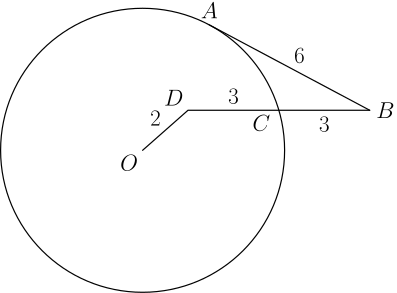
In the adjoining figure, is tangent at to the circle with center point is interior to the circle; and intersects the circle at If and then the radius of the circle is
Small Hint:
Extend through to meet the circle again at
Big Hint:
Use first, then use the power of interior point
Solution:
Extend through to meet the circle at Since and the tangent-secant theorem gives so and The power of gives hence Thus and
Therefore, the correct answer is E.
19.
A polynomial has remainder three when divided by and remainder five when divided by The remainder when is divided by is
Small Hint:
The desired remainder has degree less than two, so write it as
Big Hint:
Use the remainder theorem at and
Solution:
Let the remainder be Since and we have and Thus and so the remainder is
Therefore, the correct answer is B.
20.
Let and be positive real numbers distinct from one. Then
for all values of and
if and only if
if and only if
if and only if
none of these
Small Hint:
Move all terms to one side and factor the quadratic in the two logarithms
Big Hint:
Translate each factor equation into a relation between the bases using change of base
Solution:
Factoring gives Since change of base shows that the first factor vanishes when while the second vanishes when Thus the equation holds under either of two conditions, and no listed “if and only if” statement describes their union.
Therefore, the correct answer is E.
21.
What is the smallest positive odd integer such that the product is greater than (In the product the denominators of the exponents are all sevens, and the numerators are the successive odd integers from to )
Small Hint:
Combine the powers by summing the odd numerators
Big Hint:
The odd-number sum equals compare with
Solution:
The product is For the exponent is less than so the product is less than All smaller positive odd also fail. For the exponent is so the product exceeds Thus the first allowable odd is
Therefore, the correct answer is B.
22.
Given an equilateral triangle with side of length consider the locus of all points in the plane of the triangle such that the sum of the squares of the distances from to the vertices of the triangle is a fixed number This locus
is a circle if
contains only three points if and is a circle if
is a circle with positive radius only if
contains only a finite number of points for any value of
is none of these
Small Hint:
Let be the centroid and express the sum using
Big Hint:
For an equilateral triangle, the sum equals
Solution:
For vertices and with centroid put The standard centroid identity gives In an equilateral triangle, each so Hence The locus is empty for one point for and a circle of positive radius for
Therefore, the correct answer is A.
23.
For integers and such that let Then is an integer
for all and
for all even values of and but not for all and
for all odd values of and but not for all and
if or but not for all odd values of and
if is divisible by but not for all even values of and
Small Hint:
Split into
Big Hint:
Try rewriting the expression as a difference of two adjacent binomial coefficients
Solution:
Using and writing the given expression becomes This is an integer for every permitted and
Therefore, the correct answer is A.
24.
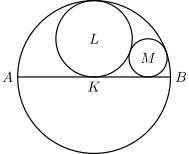
In the adjoining figure, circle has diameter circle is tangent to circle and to at the center of circle and circle is tangent to circle to circle and to The ratio of the area of circle to the area of circle is
not an integer
Small Hint:
Scale the radius of to so circle has radius
Big Hint:
If has radius and center use its tangencies to both larger circles
Solution:
Take to have center and radius with the -axis. Then has center and radius If has center and radius internal tangency to and external tangency to give These simplify to and so The radius ratio is hence the area ratio is
Therefore, the correct answer is C.
25.
For a sequence define and, for all integers If then for all
if
if but not if
if but not if
if but not if
for no value of
Small Hint:
Each forward difference lowers the degree of a polynomial sequence by one
Big Hint:
Compute through the constant third difference to see when zero first appears
Solution:
Directly, Thus the fourth differences vanish for all but the third differences do not.
Therefore, the correct answer is D.
26.
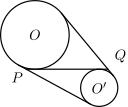
In the adjoining figure, every point of circle is exterior to circle Let and be the points of intersection of an internal common tangent with the two external common tangents. Then the length of is
the average of the lengths of the internal and external common tangents
equal to the length of an external common tangent if and only if circles and have equal radii
always equal to the length of an external common tangent
greater than the length of an external common tangent
the geometric mean of the lengths of the internal and external common tangents
Small Hint:
Mark the tangency point on each of the three tangent lines
Big Hint:
From either or tangent segments to the same circle have equal lengths
Solution:
Let the internal tangent touch and at and Let the external tangent through touch them at and and let the one through touch them at and Equal tangent segments from a point give Along the internal tangent, and Adding, Along the external tangents, and Therefore The two external common tangent segments have equal length, so and hence
Therefore, the correct answer is C.
27.
If then equals
none of these
Small Hint:
Square the numerator of the large fraction before simplifying it
Big Hint:
Recognize as
Solution:
Let be the first fraction. Its numerator squared is Thus and Also Hence
Therefore, the correct answer is A.
28.
Lines are distinct. All lines a positive integer, are parallel to each other. All lines a positive integer, pass through a given point The maximum number of points of intersection of pairs of lines from the complete set is
Small Hint:
Start with intersections in general position
Big Hint:
Remove the pairs among the parallel lines and collapse the pairs among the concurrent lines to one point
Solution:
There are indices divisible by and congruent to Starting from the parallel group contributes no intersections, removing The concurrent group’s pairs all give one point rather than distinct points, removing another All remaining intersections can be chosen distinct, so the maximum is
Therefore, the correct answer is B.
29.
Ann and Barbara were comparing their ages and found that Barbara is as old as Ann was when Barbara was as old as Ann had been when Barbara was half as old as Ann is. If the sum of their present ages is years, then Ann’s age is
Small Hint:
Let Ann’s and Barbara’s present ages be and with
Big Hint:
Translate each “when” by subtracting the same elapsed time from both ages
Solution:
Let Ann’s and Barbara’s present ages be and and let their constant age difference be At the first referenced time Ann was so Barbara was At the earlier referenced time Ann was that age so Barbara was The final clause says this last age was Hence which gives Together with this yields and
Therefore, the correct answer is B.
30.
How many distinct ordered triples satisfy the equations
none
Small Hint:
Rescale the variables by setting and
Big Hint:
The new variables have elementary symmetric sums and
Solution:
Set and Dividing the first two equations by gives while Thus and are the three roots of This polynomial factors as so they are and in any order. Their permutations produce distinct ordered triples
Therefore, the correct answer is E.