
1975 AMC 12 Solutions
Scroll down to view professionally curated solutions from LIVE by Po-Shen Loh, print PDF solutions, view answer key, or take the full timed exam.
All problems are used with official legal permission of the Mathematical Association of America (MAA).
1.
The value of is
Small Hint:
Evaluate the nested denominator from the inside outward
Big Hint:
The three successive inner values are and
Solution:
Working outward, The given value is therefore
Therefore, the correct answer is B.
2.
For which real values of are the simultaneous equations satisfied by at least one pair of real numbers
all
all
all
all
no values of
Small Hint:
Two nonvertical lines fail to meet only when they are parallel and distinct
Big Hint:
Set the slopes and equal
Solution:
The lines fail to intersect only if which gives Their -intercepts are and so at that value they are distinct parallel lines. Every other gives one intersection.
Therefore, the correct answer is D.
3.
Which of the following inequalities are satisfied for all real numbers which satisfy and
I.
II.
III.
None are satisfied.
only
only
only
All are satisfied.
Small Hint:
The variables are real, so increasing a number need not increase its square or its products
Big Hint:
Try
Solution:
Take and The required three coordinate inequalities hold. But I becomes II becomes and III becomes all false. Thus none is universally true.
Therefore, the correct answer is A.
4.
If the side of one square is the diagonal of a second square, what is the ratio of the area of the first square to the area of the second?
Small Hint:
If the first side is then the second square has diagonal
Big Hint:
A square with diagonal has area
Solution:
Let the first square have side The second has diagonal so its side is and its area is The ratio is
Therefore, the correct answer is A.
5.
The polynomial is expanded in decreasing powers of The second and third terms have equal values when evaluated at and where and are positive numbers whose sum is one. What is the value of
Small Hint:
Write the second and third binomial terms explicitly
Big Hint:
After canceling common positive factors, combine with
Solution:
The terms are and Their equality, with gives Since we get and
Therefore, the correct answer is B.
6.
The sum of the first eighty positive odd integers subtracted from the sum of the first eighty positive even integers is
Small Hint:
Pair the th even number with the th odd number
Big Hint:
Each difference is the same
Solution:
The desired difference is It is the sum of ones, hence
Therefore, the correct answer is E.
7.
For which nonzero real numbers is a positive integer?
for negative only
for positive only
only for an even integer
for all nonzero real numbers
for no nonzero real numbers
Small Hint:
Evaluate the quotient separately for and
Big Hint:
For replace by before evaluating the outer absolute value
Solution:
If the quotient is If then so and the quotient is Neither value is a positive integer.
Therefore, the correct answer is E.
8.
If the statement “All shirts in this store are on sale.” is false, then which of the following statements must be true?
I. All shirts in this store are at non-sale prices.
II. There is some shirt in this store not on sale.
III. No shirt in this store is on sale.
IV. Not all shirts in this store are on sale.
Note: Originally, statement I read: All shirts in this store are not on sale.
only
only
and only
and only
and only
Small Hint:
Negating “all” asserts the existence of a counterexample
Big Hint:
The false statement does not say that every shirt fails to be on sale
Solution:
The negation of “Every shirt is on sale” is “Some shirt is not on sale,” which is II and is equivalently phrased by IV. Statements I and III make the stronger claim that no shirt is on sale, which need not follow.
Therefore, the correct answer is D.
9.
Let and be arithmetic progressions such that and Find the sum of the first one hundred terms of the progression
not enough information given to solve the problem
Small Hint:
The termwise sum of two arithmetic progressions is arithmetic
Big Hint:
Its first and hundredth terms are both
Solution:
Let This is an arithmetic progression with and Equal endpoint terms force its common difference to be so all terms equal Their sum is
Therefore, the correct answer is C.
10.
The sum of the digits in base ten of where is a positive integer, is
Small Hint:
Set and square
Big Hint:
The three nonzero digits occur in distinct places, so there are no carries
Solution:
For Its only nonzero digits are so their sum is
Therefore, the correct answer is A.
11.
Let be an interior point of circle other than the center of Form all chords of which pass through and determine their midpoints. The locus of these midpoints is
a circle with one point deleted
a circle if the distance from to the center of is less than one half the radius of otherwise a circular arc of less than
a semicircle with one point deleted
a semicircle
a circle
Small Hint:
Join a chord midpoint to the circle’s center
Big Hint:
Since is perpendicular to the chord through
Solution:
If is a chord midpoint and is the center, then is perpendicular to the chord, so unless Thus lies on the circle with diameter Conversely, each nonendpoint on that circle gives so the line cuts a chord of whose midpoint is The endpoint gives the chord through perpendicular to while gives the diameter through and
Therefore, the correct answer is E.
12.
If and which of the following conclusions is correct?
or
or
or
Small Hint:
Factor and use
Big Hint:
Substitute after dividing by
Solution:
Factoring and dividing by gives With so Hence or
Therefore, the correct answer is B.
13.
The equation has
no real roots
exactly two distinct negative roots
exactly one negative root
no negative roots, but at least one positive root
none of these
Small Hint:
Determine the sign of every term when
Big Hint:
Compare the polynomial’s values at and
Solution:
For each of and is positive, so there is no negative root. At the polynomial is while at it is Continuity therefore gives a positive root between and
Therefore, the correct answer is D.
14.
If the whatsis is so when the whosis is is and the so and so is is so, what is the whosis whatsis when the whosis is so, the so and so is so so, and the is is two (whatsis, whosis, is and so are variables taking positive values)?
whosis is so
whosis
is
so
so and so
Small Hint:
Replace whatsis, whosis, is, and so by
Big Hint:
The condition and positivity force
Solution:
The first condition says that and imply Since the latter equation gives In the requested case, and so positivity gives Hence and
Therefore, the correct answer is E.
15.
In the sequence of numbers each term after the first two is equal to the term preceding it minus the term preceding that. The sum of the first one hundred terms of the sequence is
Small Hint:
Generate terms until the initial pair returns
Big Hint:
The six-term period has sum
Solution:
The sequence begins and repeats every terms, with period sum The first terms sum to and the last four sum to
Therefore, the correct answer is A.
16.
If the first term of an infinite geometric series is a positive integer, the common ratio is the reciprocal of a positive integer, and the sum of the series is then the sum of the first two terms of the series is
Small Hint:
Write the first term as and the ratio as
Big Hint:
From use that are positive integers and
Solution:
Let the first term be and the ratio Convergence gives and Thus divides so and The first two terms sum to
Therefore, the correct answer is C.
17.
A man can commute either by train or by bus. If he goes to work on the train in the morning, he comes home on the bus in the afternoon; and if he comes home in the afternoon on the train, he took the bus in the morning. During a total of working days, the man took the bus to work in the morning times, came home by bus in the afternoon times, and commuted by train (either morning or afternoon) times. Find
not enough information given to solve the problem
Small Hint:
There are exactly two one-way trips on every working day
Big Hint:
Count all bus trips and all train trips together
Solution:
There were bus trips and train trips, hence one-way trips in all. Since each working day contributes two trips, and The conditional statements are consistent but not needed for this count.
Therefore, the correct answer is D.
18.
A positive integer with three digits in its base ten representation is chosen at random, with each three-digit number having an equal chance of being chosen. The probability that is an integer is
Small Hint:
An integral base- logarithm means is a power of
Big Hint:
List the powers of from through
Solution:
There are three-digit integers. The three powers of among them are and Thus the probability is
Therefore, the correct answer is D.
19.
Which positive numbers satisfy the equation
and only
and only
only numbers of the form where and are positive integers
all positive
none of these
Small Hint:
Apply the change-of-base formula to both logarithms on the left
Big Hint:
After cancellation, remember which positive base is forbidden
Solution:
For change of base makes the left side Canceling leaves The expression is undefined at
Therefore, the correct answer is D.
20.
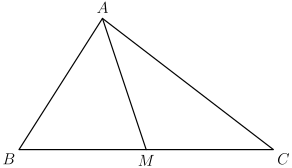
In the adjoining figure triangle is such that and If is the midpoint of and what is the length of
not enough information given to solve the problem
Small Hint:
Use the relation between a triangle’s three sides and a median
Big Hint:
Apollonius’ theorem gives
Solution:
Let so By Apollonius’ theorem, Hence and
Therefore, the correct answer is B.
21.
Suppose is defined for all real numbers for all and for all and Which of the following statements are true?
I.
II. for all
III. for all
IV. if
and only
and only
and only
and only
All are true.
Small Hint:
Substitute and then add three times
Big Hint:
Test the monotonicity claim with the constant function
Solution:
Taking and using positivity gives Taking gives Also so positivity permits the positive cube root in III. But satisfies the functional equation and is not strictly increasing, so IV need not hold.
Therefore, the correct answer is D.
22.
If and are primes and has distinct positive integral roots, then which of the following statements are true?
I. The difference of the roots is odd.
II. At least one root is prime.
III. is prime.
IV. is prime.
only
only
and only
and only
All are true.
Small Hint:
The product of the two positive integer roots is the prime
Big Hint:
The roots must be and their prime sum forces
Solution:
The positive integer roots have product so they are and Their sum is which is prime only when giving and roots Their difference is one root is prime, and therefore all four statements hold.
Therefore, the correct answer is E.
23.
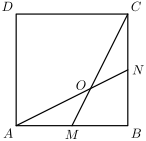
In the adjoining figure and are adjacent sides of square is the midpoint of is the midpoint of and and intersect at The ratio of the area of to the area of is
Small Hint:
In triangle both and are medians
Big Hint:
Use coordinates for the square and locate the centroid
Solution:
Take Since is the centroid of triangle Triangles and each have area Removing them from the unit square leaves
Therefore, the correct answer is C.
24.
In triangle and where The circle with center and radius intersects at and intersects extended if necessary, at and at ( may coincide with ). Then
for no values of
only if
only if
only if
for all such that
Small Hint:
Because first study the isosceles triangle
Big Hint:
Whether lies on or its extension, angle chasing gives
Solution:
Since triangle is isosceles. For lies between ; the exterior-angle theorem in triangle gives so For lies beyond ; then hence At and the conclusion is immediate. Thus triangle is always isosceles, so
Therefore, the correct answer is E.
25.
A woman, her brother, her son and her daughter are chess players (all relations by birth). The worst player’s twin (who is one of the four players) and the best player are of opposite sex. The worst player and the best player are the same age. Who is the worst player?
the woman
her son
her brother
her daughter
No solution is consistent with the given information.
Small Hint:
List the only possible same-generation twin pairs among the four people
Big Hint:
If the son is worst, his twin is the daughter and the best can be the brother
Solution:
If the son is worst, the daughter can be his twin and the brother can be best; the son and brother may have the same age, so all conditions can hold. If the woman is worst, the brother is her twin and the daughter must be best, but mother and daughter cannot be the same age. If the brother is worst, the woman is his twin and the son must be best, again impossible in age. If the daughter is worst, her twin is the son and the woman must be best, also impossible in age. Thus only the son works.
Therefore, the correct answer is B.
26.
In acute triangle the bisector of meets side at The circle with center and radius intersects side at and the circle with center and radius intersects side at Then it is always true that
is a trapezoid
is parallel to
Small Hint:
Use and the angle bisector theorem
Big Hint:
Show that and apply the converse of the side-splitter theorem
Solution:
The angle bisector theorem gives Since and we have Therefore and divide and proportionally from and so the converse of the side-splitter theorem gives
Therefore, the correct answer is C.
27.
If and are distinct roots of then equals
none of these
Small Hint:
Use Vieta to find and
Big Hint:
First compute then add the three equations satisfied by the roots
Solution:
Vieta gives and Thus Each root satisfies Summing over the three roots yields This is not among choices A–D.
Therefore, the correct answer is E.
28.
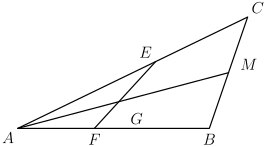
In triangle shown in the adjoining figure, is the midpoint of side and Points and are taken on and respectively, and lines and intersect at If then equals
not enough information given to solve the problem
Small Hint:
Represent by vectors from
Big Hint:
If then equate the coefficients of a point on and on
Solution:
Put at the origin and write the position vectors of as If then and so Write Because also lies on the median its and coefficients are equal: Hence Along and so
Therefore, the correct answer is A.
29.
What is the smallest integer larger than
Small Hint:
Pair the expression with its conjugate
Big Hint:
Their sum is an integer, while the conjugate term lies strictly between and
Solution:
Let and Adding their sixth powers cancels all odd radical terms: Since we have Thus the smallest larger integer is
Therefore, the correct answer is C.
30.
Let Then equals
none of these
Small Hint:
Let and
Big Hint:
Use and , then add the equations
Solution:
Set and The double-angle identities give Adding yields Since division gives Thus
Therefore, the correct answer is B.