
1974 AMC 12 Solutions
Scroll down to view professionally curated solutions from LIVE by Po-Shen Loh, print PDF solutions, view answer key, or take the full timed exam.
All problems are used with official legal permission of the Mathematical Association of America (MAA).
1.
If or and or then is equivalent to
none of these
Small Hint:
Clear all three denominators at once
Big Hint:
After multiplying by isolate the terms containing and factor
Solution:
Multiplying by gives so Since
Therefore, the correct answer is D.
2.
Let and be such that and Then equals
Small Hint:
Both given numbers satisfy the same quadratic equation
Big Hint:
Move to the left and use the sum-of-roots formula
Solution:
The distinct numbers are the two roots of By Vieta’s formulas, their sum is
Therefore, the correct answer is B.
3.
The coefficient of in the polynomial expansion of is
none of these
Small Hint:
A degree- term must select degrees from the four factors
Big Hint:
Choose which factor contributes ; the other three contribute
Solution:
The only way four selected terms can have total degree is to choose once and three times. There are choices for the first factor, so the coefficient is
Therefore, the correct answer is A.
4.
What is the remainder when is divided by
Small Hint:
For division by evaluate the polynomial at
Big Hint:
The exponent is odd
Solution:
By the polynomial remainder theorem, the remainder is
Therefore, the correct answer is D.
5.
Given a quadrilateral inscribed in a circle with side extended beyond to point if and find
Small Hint:
Opposite angles of a cyclic quadrilateral are supplementary
Big Hint:
The desired exterior angle is also supplementary to
Solution:
Because is cyclic, Since extends as well. Hence The given angle is unnecessary.
Therefore, the correct answer is B.
6.
For positive real numbers and define then
“” is commutative but not associative
“” is associative but not commutative
“” is neither commutative nor associative
“” is commutative and associative
none of these
Small Hint:
The formula is visibly unchanged when and are interchanged
Big Hint:
Rewrite the operation through its reciprocal:
Solution:
Symmetry in makes the operation commutative. Also, Thus both and have reciprocal so they are equal. The operation is associative too.
Therefore, the correct answer is D.
7.
A town’s population increased by people, and then this new population decreased by The town now had less people than it did before the increase. What is the original population?
none of these
Small Hint:
Let be the original population and apply the decrease to
Big Hint:
The final population is both and
Solution:
Let the original population be Then Therefore giving
Therefore, the correct answer is D.
8.
What is the smallest prime number dividing the sum
none of these
9.
The integers greater than one are arranged in five columns as follows:
(Four consecutive integers appear in each row; in the first, third and other odd numbered rows, the integers appear in the last four columns and increase from left to right; in the second, fourth and other even numbered rows, the integers appear in the first four columns and increase from right to left.)
In which column will the number fall?
first
second
third
fourth
fifth
Small Hint:
Look at where the displayed multiples of occur
Big Hint:
Each two-row cycle contains eight consecutive integers
Solution:
Each pair of rows is a repeating block of eight integers. In every such block, its multiple of lies in the second column, as do and Since it also lies in the second column.
Therefore, the correct answer is B.
10.
What is the smallest integral value of such that has no real roots?
Small Hint:
First rewrite the equation in standard quadratic form
Big Hint:
No real roots means the discriminant is negative
Solution:
The equation is Its discriminant is This is negative exactly when so the least integer possible is
Therefore, the correct answer is B.
11.
If and are two points on the line whose equation is then the distance between and in terms of and is
Small Hint:
Use the line equation to express in terms of
Big Hint:
Substitute into the distance formula
Solution:
Since both points are on the line, Their distance is therefore
Therefore, the correct answer is A.
12.
If and when then equals
Small Hint:
Choose a nonzero for which
Big Hint:
The equation determines directly
Solution:
If then and either corresponding is nonzero. Hence
Therefore, the correct answer is B.
13.
Which of the following is equivalent to “If is true then is false”?
“ is true or is false.”
“If is false then is true.”
“If is false then is true.”
“If is true then is false.”
“If is true then is true.”
Small Hint:
An implication is equivalent to its contrapositive
Big Hint:
Reverse the implication and negate both “ true” and “ false”
Solution:
The contrapositive of “ true implies false” is “ not false implies not true.” This is exactly “If is true then is false.”
Therefore, the correct answer is D.
14.
Which statement is correct?
If then
If then
If then
If then
If then
Small Hint:
For a negative compare first with zero
Big Hint:
Simple test values such as and reject the other implications
Solution:
If then so choice A always holds. The values and respectively disprove B, C, D, and E.
Therefore, the correct answer is A.
15.
If then equals
Small Hint:
Resolve the inner absolute value first using
Big Hint:
After replacing by determine the sign of
Solution:
Since so Thus becomes which is because
Therefore, the correct answer is B.
16.
A circle of radius is inscribed in a right isosceles triangle, and a circle of radius is circumscribed about the triangle. Then equals
Small Hint:
Let each leg have length and express both radii in terms of
Big Hint:
For a right triangle, the circumradius is half the hypotenuse; the inradius is
Solution:
With both legs of length and hypotenuse Therefore
Therefore, the correct answer is A.
17.
If then equals
Small Hint:
Compute the fourth power of each conjugate base
Big Hint:
Both and equal
Solution:
Since we have Likewise and Hence each twentieth power equals and their difference is
Therefore, the correct answer is C.
18.
If and then, in terms of and equals
Small Hint:
Convert every logarithm to base
Big Hint:
The givens imply and
Solution:
From Therefore Since
Therefore, the correct answer is D.
19.
In the adjoining figure is a square and is an equilateral triangle. If the area of is one square inch, then the area of in square inches is

Small Hint:
The square has side set by comparing the equal sides and
Big Hint:
Equate with
Solution:
The square has side Since symmetry of their squared lengths gives Also, Equating these because is equilateral gives The root in is
The triangle’s side has square so its area is
Therefore, the correct answer is A.
20.
Let then
Small Hint:
Rationalize each denominator separately
Big Hint:
Every denominator is a difference of square roots whose squares differ by
Solution:
Rationalizing the five terms gives Thus
Therefore, the correct answer is D.
21.
In a geometric series of positive terms the difference between the fifth and fourth terms is and the difference between the second and first terms is What is the sum of the first five terms of this series?
none of these
Small Hint:
Write the first term as and the common ratio as
Big Hint:
Divide by
Solution:
Let the first term be and the ratio be The conditions give Their quotient gives so Then hence The sum is
Therefore, the correct answer is B.
22.
The minimum value of is attained when is
none of these
Small Hint:
Combine the sine and cosine into one shifted sine with amplitude
Big Hint:
Use
Solution:
Let Then equals Its minimum occurs when so for an integer None of the first four choices has this form.
Therefore, the correct answer is E.
23.
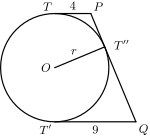
In the adjoining figure and are parallel tangents to a circle of radius with and the points of tangency. is a third tangent with as point of tangency. If and then is
a number other than or
not determinable from the given information
Small Hint:
The center lies on each angle bisector formed by two tangents from the same external point
Big Hint:
Show that and use the altitude-to-hypotenuse theorem at
Solution:
The radii to the tangency points make congruent right triangles from each external point, so and bisect the two tangent angles. Because the other two tangents are parallel, these half-angles add to hence
Thus is the altitude to the hypotenuse Equal tangent segments give and The altitude theorem yields so
Therefore, the correct answer is B.
24.
A fair die is rolled six times. The probability of rolling at least a five at least five times is
none of these
Small Hint:
A roll is a success with probability
Big Hint:
Add the disjoint cases of exactly five successes and exactly six successes
Solution:
Let a success be a or so its probability is The desired probability is
Therefore, the correct answer is A.
25.
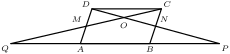
In parallelogram of the accompanying diagram, line is drawn bisecting at and meeting (extended) at From vertex line is drawn bisecting side at and meeting (extended) at Lines and meet at If the area of parallelogram is then the area of triangle is equal to
Small Hint:
Use and
Big Hint:
The midpoint lines meet the baseline at and ; then find ’s height
Solution:
Choose coordinates and so The midpoints are Extending and to gives and
Parameterizing and shows their intersection is Thus and the height from is so
Therefore, the correct answer is C.
26.
The number of distinct positive integral divisors of excluding and is
none of these
Small Hint:
Factor into powers of and
Big Hint:
Choose each prime exponent independently from through then remove two divisors
Solution:
Because a divisor independently chooses each of three exponents from There are divisors. Excluding and leaves
Therefore, the correct answer is C.
27.
If for all real then the statement:
“ whenever and and ”
is true when
The statement is never true.
Small Hint:
Factor in terms of
Big Hint:
The condition becomes whenever
Solution:
We have If and then as required. If one can choose strictly between and so the statement fails. Thus the exact condition is
Therefore, the correct answer is A.
28.
Which of the following is satisfied by all numbers of the form where is or is or is or
or
Small Hint:
Separate the cases and
Big Hint:
Bound the remaining terms by the infinite geometric tail
Solution:
If then If then while Hence every such lies in one of the two stated outer thirds.
Therefore, the correct answer is D.
29.
For let be the sum of the first terms of the arithmetic progression whose first term is and whose common difference is then is
Small Hint:
Use the -term arithmetic-series formula for a fixed
Big Hint:
Simplify before summing over
Solution:
For each Since therefore
Therefore, the correct answer is B.
30.
A line segment is divided so that the lesser part is to the greater part as the greater part is to the whole. If is the ratio of the lesser part to the greater part, then the value of is
Small Hint:
Translate the division condition into
Big Hint:
From derive and simplify from the innermost exponent outward
Solution:
Scale the greater part to making the lesser part The condition gives so Consequently Working outward, the exponent of the outer becomes The whole expression is therefore
Therefore, the correct answer is A.