
1973 AMC 12 Solutions
Scroll down to view professionally curated solutions from LIVE by Po-Shen Loh, print PDF solutions, view answer key, or take the full timed exam.
All problems are used with official legal permission of the Mathematical Association of America (MAA).
1.
A chord which is the perpendicular bisector of a radius of length in a circle has length
none of these
Small Hint:
The chord meets the radius halfway from the center and at a right angle
Big Hint:
Find half the chord with the Pythagorean theorem, then double it
Solution:
Let be the midpoint of the chord and also the midpoint of the radius. The distance from the center to is while the circle’s radius is If is one endpoint of the chord, then The full chord has length
Therefore, the correct answer is D.
2.
One thousand unit cubes are fastened together to form a large cube with edge length units; this is painted and then separated into the original cubes. The number of these unit cubes which have at least one face painted is
Small Hint:
Count the cubes with no painted face instead
Big Hint:
Removing the outer layer leaves an cube
Solution:
The unpainted cubes are precisely the interior cube. Therefore the number having at least one painted face is
Therefore, the correct answer is C.
3.
The stronger Goldbach conjecture states that any even integer greater than can be written as the sum of two different prime numbers. For such representations of the even number the largest possible difference between the two primes is
Note: The regular Goldbach conjecture states that any even integer greater than is expressible as a sum of two primes. Neither this conjecture nor the stronger version has been settled.
Small Hint:
For a fixed sum, maximize the difference by minimizing the smaller prime
Big Hint:
Test the primes until the complement to is prime
Solution:
For primes with the difference is largest when is as small as possible. The complements of and are and none prime. For the complement is which is prime. Thus the largest difference is
Therefore, the correct answer is B.
4.
Two congruent -- triangles are placed so that they overlap partly and their hypotenuses coincide. If the hypotenuse of each triangle is the area common to both triangles is
Small Hint:
Place the common hypotenuse on the -axis and reverse which endpoint has the angle
Big Hint:
The upper boundary of the overlap consists of two lines making angles with the hypotenuse
Solution:
Put the common hypotenuse from to The two triangles have their third vertices at and Their common region is the triangle with base and apex where and meet. This occurs at with height Hence the common area is
Therefore, the correct answer is D.
5.
Of the following five statements, to about the binary operation of averaging (arithmetic mean),
Averaging is associative
Averaging is commutative
Averaging distributes over addition
Addition distributes over averaging
Averaging has an identity element
those which are always true are
All
and only
and only
and only
and only
Small Hint:
Write the averaging operation as
Big Hint:
Expand each proposed identity; one counterexample is enough to reject a property
Solution:
Let Commutativity is immediate. Also so addition distributes over averaging.
Associativity fails because Averaging does not distribute over addition since generally Finally, an identity would require for every or which is impossible for a fixed Thus only and always hold.
Therefore, the correct answer is D.
6.
If is the base representation of the square of the number whose base representation is then when written in base equals
Small Hint:
Translate and into base-ten polynomial expressions
Big Hint:
After solving the resulting quadratic, enforce that a base containing digit must exceed
Solution:
In base ten, Therefore A base is positive and must exceed so
Therefore, the correct answer is C.
7.
The sum of all the integers between and which end in is
Small Hint:
The integers form an arithmetic sequence from through
Big Hint:
Use the common difference to count the terms, then pair the first and last
Solution:
The sequence is It has terms. Its sum is therefore
Therefore, the correct answer is A.
8.
If pint of paint is needed to paint a statue ft. high, then the number of pints it will take to paint (to the same thickness) statues similar to the original but only ft. high is
Small Hint:
Paint required scales with surface area, not volume
Big Hint:
Reducing every length by a factor of reduces the paint per statue by the square of that factor
Solution:
A -ft. statue has linear scale relative to the original, so its surface area and paint requirement are as large. The small statues therefore require pints.
Therefore, the correct answer is E.
9.
In with right angle at altitude and median trisect the right angle. If the area of is then the area of is
Small Hint:
Compare the right triangles and using the trisection angles
Big Hint:
After locating and on compare with the whole base
Solution:
Since both and are right at The trisection gives equal acute angles at and the triangles share side so they are congruent. Hence
Because is the midpoint of Along the hypotenuse the order is and Thus Triangles and have bases on the same line and the same altitude from so their areas are in the ratio Therefore the area of is
Therefore, the correct answer is E.
10.
If is a real number, then the simultaneous system has no solution if and only if is equal to
or
Small Hint:
Add all three equations and inspect the coefficient of
Big Hint:
For every remaining value of try the symmetric choice
Solution:
Adding the equations gives When this becomes so no solution exists. If the symmetric assignment satisfies all three equations. Hence the system has no solution exactly when
Therefore, the correct answer is A.
11.
A circle with a circumscribed and an inscribed square centered at the origin of a rectangular coordinate system with positive - and -axes and is shown in each figure to below.
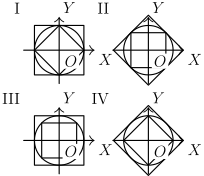
The inequalities are represented geometrically by the figure numbered
Geometric representation: An inequality for all is represented by a figure showing, for a typical real number the containment
none of these
Small Hint:
Identify the shapes of the sublevel sets for and
Big Hint:
The inequality reverses the order of containment of the corresponding sublevel sets
Solution:
For a fixed positive the set is an axis-aligned square. The set is its circumscribed circle, and is the diamond circumscribed about that circle. Thus the required nesting is an inner axis-aligned square, then a circle, then an outer diamond, which is figure
Therefore, the correct answer is B.
12.
The average (arithmetic mean) age of a group consisting of doctors and lawyers is If the doctors average and the lawyers years old, then the ratio of the number of doctors to the number of lawyers is
Small Hint:
Let and be the numbers of doctors and lawyers
Big Hint:
Equate the total age to
Solution:
If there are doctors and lawyers, then Thus so
Therefore, the correct answer is D.
13.
The fraction is equal to
Small Hint:
All quantities are positive, so compare the square of the fraction with the squares of the choices
Big Hint:
Use
Solution:
The fraction is positive, and its square is Therefore the original fraction is
Therefore, the correct answer is D.
14.
Each valve and when open, releases water into a tank at its own constant rate. With all three valves open, the tank fills in hour, with only valves and open it takes hours, and with only valves and open it takes hours. The number of hours required with only valves and open is
Small Hint:
Let be the fractions of the tank filled per hour by the three valves
Big Hint:
Combine and to find
Solution:
Let be the hourly rates in tankfuls. Then Twice the first equation minus the other two gives Thus valves and fill the tank in hours.
Therefore, the correct answer is C.
15.
A sector with acute central angle is cut from a circle of radius The radius of the circle circumscribed about the sector is
Small Hint:
Treat the sector’s two radii and chord as an isosceles triangle
Big Hint:
Express the chord using then apply the extended sine rule
Solution:
The two radii and the sector’s chord form an isosceles triangle with equal sides and vertex angle Its base has length If is the triangle’s circumradius, the extended sine rule gives Since
Therefore, the correct answer is D.
16.
If the sum of all the angles except one of a convex polygon is then the number of sides of the polygon must be
Small Hint:
Let the omitted interior angle be and the number of sides be
Big Hint:
Use to trap the integer in an interval of length
Solution:
If the omitted angle is then convexity gives Hence so This is The only possible integer is so
Therefore, the correct answer is B.
17.
If is an acute angle and then equals
Small Hint:
Use
Big Hint:
Once is known, apply and use that is acute
Solution:
The half-angle identity gives Therefore Because is acute, its tangent is positive, so
Therefore, the correct answer is E.
18.
If is a prime number, then divides without remainder
never
sometimes only
always
only if
none of these
Small Hint:
Factor
Big Hint:
Among the three consecutive integers locate factors of and
Solution:
A prime is odd, so and are consecutive even integers. One is divisible by making their product divisible by Among the three consecutive integers one is divisible by It cannot be since is prime, so also divides Because and are relatively prime, is always divisible by
Therefore, the correct answer is C.
19.
Define for positive and to be where is the greatest integer for which Then the quotient is equal to
Small Hint:
Write both generalized factorials as nine explicit factors
Big Hint:
Factor from every numerator term and from every denominator term
Solution:
The two products are Their quotient is therefore
Therefore, the correct answer is D.
20.
A cowboy is miles south of a stream which flows due east. He is also miles west and miles north of his cabin. He wishes to water his horse at the stream and return home. The shortest distance (in miles) he can travel and accomplish this is
Small Hint:
Reflect the cowboy’s starting point across the straight stream
Big Hint:
After reflection, the two-leg trip through the stream becomes one straight segment to the cabin
Solution:
Take the stream as the -axis and put the cowboy at His cabin is then Reflect across the stream to For any point on the stream, so minimizing is the same as minimizing This occurs when are collinear. The minimum distance is
Therefore, the correct answer is C.
21.
The number of sets of two or more consecutive positive integers whose sum is is
Small Hint:
If there are terms beginning with double the sum to obtain
Big Hint:
Check divisors and enforce that is a positive integer
Solution:
For consecutive positive integers starting at Positivity gives so the possible divisors of are From only and give positive even right-hand sides. They yield the sets and Hence there are sets.
Therefore, the correct answer is B.
22.
The set of all real solutions of the inequality is
(empty)
Small Hint:
Interpret the two absolute values as the distances from to and to
Big Hint:
Between and the sum is constant; outside that interval it increases by twice the distance from the nearer endpoint
Solution:
For the sum of the distances from to and is If lies a distance outside this interval, the sum is Thus Extending the interval by at each end gives
Therefore, the correct answer is A.
23.
There are two cards; one is red on both sides and the other is red on one side and blue on the other. The cards have the same probability of being chosen, and one is chosen and placed on the table. If the upper side of the card on the table is red, then the probability that the under-side is also red is
Small Hint:
Condition on the individual card sides that could be showing red
Big Hint:
There are three equally likely visible red faces; determine the color behind each
Solution:
Among outcomes having a red upper side, either of the two red faces of the red-red card or the red face of the red-blue card can be uppermost. These three visible red faces are equally likely. The underside is red in the first two cases and blue in the third, so the conditional probability is
Therefore, the correct answer is D.
24.
The check for a luncheon of sandwiches, cups of coffee and one piece of pie came to The check for a luncheon consisting of sandwiches, cups of coffee and one piece of pie came to at the same place. The cost of a luncheon consisting of one sandwich, one cup of coffee and one piece of pie at the same place will come to
Small Hint:
Let be the three item prices; only is required
Big Hint:
A suitable linear combination of and isolates the desired sum
Solution:
Let be the prices of a sandwich, coffee, and pie. The checks give Three times the first equation minus twice the second gives The requested luncheon costs
Therefore, the correct answer is D.
25.
A circular grass plot feet in diameter is cut by a straight gravel path feet wide, one edge of which passes through the center of the plot. The number of square feet in the remaining grass area is
Small Hint:
Bisect the path by the perpendicular diameter of the circular plot
Big Hint:
Each half of the path is a sector together with a -- triangle
Solution:
The plot has radius At the path’s other edge, the perpendicular distance from the center is so the radius to an intersection point makes a angle with the edge through the center. Half of the path consists of a sector of radius and a right triangle with legs and Its area is Thus the whole path has area and the remaining grass area is
Therefore, the correct answer is E.
26.
The number of terms in an A.P. (Arithmetic Progression) is even. The sums of the odd- and even-numbered terms are and respectively. If the last term exceeds the first by the number of terms in the A.P. is
Small Hint:
Write the number of terms as and the common difference as
Big Hint:
Pair each odd-numbered term with the following even-numbered term to get
Solution:
Let the progression have terms and common difference Pairing each odd-numbered term with its successor shows that The difference between the last and first terms is Since subtraction gives Hence and the progression has terms.
Therefore, the correct answer is E.
27.
Cars and travel the same distance. Car travels half that distance at miles per hour and half at miles per hour. Car travels half the time at miles per hour and half at miles per hour. The average speed of Car is miles per hour and that of Car is miles per hour. Then we always have
Small Hint:
Car ’s average is the harmonic mean of and while Car ’s is their arithmetic mean
Big Hint:
Subtract the two means and factor the numerator as a square
Solution:
Car ’s equal-distance average and Car ’s equal-time average are Their difference is Thus with equality possible when
Therefore, the correct answer is A.
28.
If and are in geometric progression (G.P.) with and is an integer, then form a sequence
which is a G.P.
which is an arithmetic progression (A.P.)
in which the reciprocals of the terms form an A.P.
in which the second and third terms are the th powers of the first and second respectively
none of these
Small Hint:
Take reciprocals and use
Big Hint:
Apply logarithms to the geometric-progression relation
Solution:
By change of base, Since are in geometric progression, Taking logarithms to base gives Hence the reciprocals of the three given terms form an arithmetic progression.
Therefore, the correct answer is C.
29.
Two boys start moving from the same point on a circular track but in opposite directions. Their speeds are ft. per sec. and ft. per sec. If they start at the same time and finish when they first meet at the point again, then the number of times they meet, excluding the start and finish, is
infinity
none of these
Small Hint:
Because and are relatively prime, determine when both boys first complete whole numbers of laps
Big Hint:
Before that finish time, meetings occur whenever their combined distance is another whole lap
Solution:
Let the track length be Since the first positive time when both boys are back at is : they have completed and laps. Their relative speed is so before time they meet at Thus there are meetings excluding the start and finish.
Therefore, the correct answer is A.
30.
Let denote the greatest integer not exceeding where and Then we have
the point does not belong to for any
for all
is contained in the first quadrant for all
the center of for any is on the line
none of the other statements is true
Small Hint:
Recognize as the fractional part of
Big Hint:
Interpret the equation for as a disk and identify its center and radius
Solution:
The fractional part satisfies The set is the closed disk centered at with radius Its area is so which in particular gives The origin lies on every such disk, the disk extends below the -axis when and its center is generally not on
Therefore, the correct answer is B.
31.
In the following equation, each of the letters represents uniquely a different digit in base ten: The sum equals
Small Hint:
Use
Big Hint:
The prime must divide one of the two-digit factors; test its two-digit multiples ending in the common digit
Solution:
Since the prime divides one of and A two-digit multiple of is or The value is impossible: the other two-digit factor ending in is at least and Hence one factor is so
The units digit of the product is the units digit of so Thus the product is and the other factor is The four digits are whose sum is
Therefore, the correct answer is C.
32.
The volume of a pyramid whose base is an equilateral triangle of side length and whose other edges are each of length is
none of these
Small Hint:
The altitude from the apex meets the base at the equilateral triangle’s circumcenter
Big Hint:
Use the base circumradius and a lateral edge to find the height
Solution:
The base area is Because the apex is equally distant from all three base vertices, its perpendicular projection is the base circumcenter. The circumradius of the equilateral base is If is the pyramid’s height, then so The volume is
Therefore, the correct answer is A.
33.
When one ounce of water is added to a mixture of acid and water, the new mixture is acid. When one ounce of acid is added to the new mixture, the result is acid. The percentage of acid in the original mixture is
Small Hint:
Let and be the original ounces of water and acid
Big Hint:
Write one concentration equation after adding water and another after subsequently adding acid
Solution:
Let the original mixture contain ounces of water and ounces of acid. The two additions give These simplify to Hence and The original acid percentage was
Therefore, the correct answer is C.
34.
A plane flew straight against a wind between two towns in minutes and returned with that wind in minutes less than it would take in still air. The number of minutes (two answers) for the return trip was
or
or
or
or
or
Small Hint:
Let be the return time; the still-air time is then
Big Hint:
The plane’s still-air speed is the average of its against-wind and with-wind ground speeds
Solution:
Let the distance be and the return time be minutes. The against-wind and with-wind speeds are and Their average is the still-air speed Therefore Clearing denominators gives Both positive values are consistent with the stated conditions, so the two return times are and minutes.
Therefore, the correct answer is C.
35.
In the unit circle shown in the figure, chords and are parallel to the unit radius of the circle with center at Chords and are each units long and chord is units long.
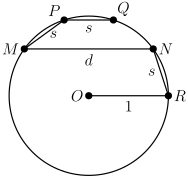
Of the three equations those which are necessarily true are
only
only
only
and only
and
Small Hint:
Use symmetry across the vertical diameter to see that the upper semicircle is divided into five equal chords
Big Hint:
Write and then relate each to the square of the other
Solution:
Let be the left endpoint of the horizontal diameter. Reflection across the vertical diameter shows that and Together with the given equal chords, the upper semicircle is split into five equal arcs. Each subtends at Thus
Using the double-angle identities, Adding these equations gives Since it follows that Substituting into yields Therefore and All three equations are necessarily true.
Therefore, the correct answer is E.