
1972 AMC 12 Solutions
Scroll down to view professionally curated solutions from LIVE by Po-Shen Loh, print PDF solutions, view answer key, or take the full timed exam.
All problems are used with official legal permission of the Mathematical Association of America (MAA).
1.
The lengths in inches of the three sides of each of four triangles and are as follows: Of these four given triangles, the only right triangles are:
and
and
and
and
and
Small Hint:
Compare the square of each longest side with the sum of the squares of the other two sides
Big Hint:
Clear the halves in triangles and before comparing
Solution:
For triangles and the relevant equalities are For These values are unequal. Thus precisely and are right triangles.
Therefore, the correct answer is D.
2.
If a dealer could get his goods for less while keeping his selling price fixed, his profit, based on cost, would be increased to from his present profit of which is:
Small Hint:
Let the present cost be and express the same selling price in two ways
Big Hint:
The reduced cost is and its profit rate is
Solution:
The fixed selling price gives Simplifying yields so and
Therefore, the correct answer is B.
3.
If where then is equal to:
Small Hint:
Compute before taking the reciprocal
Big Hint:
The number satisfies
Solution:
Directly, Its reciprocal is therefore also
Therefore, the correct answer is B.
4.
The number of solutions to where is a subset of is:
None of these
Small Hint:
The elements and are forced
Big Hint:
Each of may independently be included or omitted
Solution:
Every valid contains while each of may be chosen independently. Hence there are possible sets.
Therefore, the correct answer is D.
5.
From among those which have the greatest and the next to the greatest values, in that order, are:
None of these
Small Hint:
Compare two roots by raising both positive numbers to a common power
Big Hint:
First compare with , then compare with each remaining number
Solution:
Raising to convenient common powers gives and Thus is greatest and is next.
Therefore, the correct answer is A.
6.
If then the value of is:
only
only
or
Small Hint:
Set
Big Hint:
Factor and convert each positive root back to
Solution:
Let Then Thus or so is respectively or
Therefore, the correct answer is C.
7.
If then is equal to:
Small Hint:
Simplify the quotient of the two fractions in the requested ratio
Big Hint:
From , obtain
Solution:
The requested ratio has quotient Also so Therefore
Therefore, the correct answer is E.
8.
If where and are real, then:
and
None of these
Small Hint:
Separate the cases and
Big Hint:
One case forces , while the other forces
Solution:
If the equation gives hence If it gives Therefore every solution satisfies either or which is expressed by
Therefore, the correct answer is D.
9.
Ann and Sue bought identical boxes of stationery. Ann used hers to write -sheet letters and Sue used hers to write -sheet letters. Ann used all the envelopes and had sheets of paper left, while Sue used all of the sheets of paper and had envelopes left. The number of sheets of paper in each box was:
Small Hint:
Let and be the numbers of sheets and envelopes in a box
Big Hint:
Ann gives , while Sue gives
Solution:
Let and denote sheets and envelopes per box. The two accounts give and Adding yields so
Therefore, the correct answer is A.
10.
For real, the inequality is equivalent to:
or
or
or
Small Hint:
The upper bound places within units of
Big Hint:
The lower bound removes the open interval of points less than unit from
Solution:
The condition gives The condition gives or Their intersection is
Therefore, the correct answer is D.
11.
The value(s) of for which the following pair of equations may have a real common solution, are:
only
no
all
Small Hint:
Eliminate between the equations
Big Hint:
After finding the two candidate -values, check whether the corresponding is nonnegative
Solution:
From the second equation, Substitution into the first gives If then If then so no real exists. Thus only is possible.
Therefore, the correct answer is A.
12.
The number of cubic feet in the volume of a cube is the same as the number of square inches in its surface area. The length of the edge expressed as a number of feet is:
Small Hint:
If the edge is feet, its length in inches is
Big Hint:
Equate the numerical values and
Solution:
Let the edge length be feet, or inches. The stated numerical equality is Since division by gives
Therefore, the correct answer is B.
13.
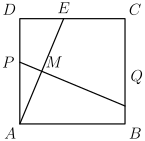
Inside square with sides of length inches, segment is drawn, where is the point on which is inches from The perpendicular bisector of is drawn and intersects and at points and respectively. The ratio of segment to is:
Small Hint:
Draw through a line parallel to
Big Hint:
The horizontal distances from to and are and
Solution:
Because is the midpoint of its horizontal distance from is Its distance from is The two right triangles cut from line by the horizontal through are similar, so their hypotenuses are in the ratio of these horizontal legs:
Therefore, the correct answer is C.
14.
A triangle has angles of and If the side opposite the angle has length then the side opposite the angle has length:
Small Hint:
Relate the two sides with the Law of Sines
Big Hint:
Use and
Solution:
If is the side opposite the Law of Sines gives Therefore
Therefore, the correct answer is B.
15.
A contractor estimated that one of his two bricklayers would take hours to build a certain wall and the other hours. However, he knew from experience that when they worked together, their combined output fell by bricks per hour. Being in a hurry, he put both men on the job and found that it took exactly hours to build the wall. The number of bricks in the wall was:
Small Hint:
Let be the number of bricks in the wall
Big Hint:
Their actual combined hourly rate is
Solution:
If the wall contains bricks, the individual rates are and Thus Multiplying by and simplifying gives hence
Therefore, the correct answer is C.
16.
There are two positive numbers that may be inserted between and such that the first three are in geometric progression while the last three are in arithmetic progression. The sum of those two positive numbers is:
Small Hint:
Call the inserted numbers and in that order
Big Hint:
Use and
Solution:
The progression conditions give and Eliminating yields Positivity gives and then Their sum is
Therefore, the correct answer is B.
17.
A piece of string is cut in two at a point selected at random. The probability that the longer piece is at least times as large as the shorter piece is:
Small Hint:
Normalize the string length to and let the cut be units from one end
Big Hint:
Near either endpoint, solve
Solution:
Take the string to have length Near one endpoint, the condition is so The same interval occurs at the other endpoint. Their total length, hence the probability, is
Therefore, the correct answer is E.
18.
Let be a trapezoid with the measure of base twice that of base and let be the point of intersection of the diagonals. If the measure of diagonal is then that of segment is equal to:
Small Hint:
Triangles and are similar
Big Hint:
The base ratio also equals
Solution:
Since triangles and are similar. Hence Thus so
Therefore, the correct answer is A.
19.
The sum of the first terms of the sequence in terms of is:
Small Hint:
The -th parenthesized sum is
Big Hint:
Sum and
Solution:
The -th term is the geometric sum Therefore the desired total is
Therefore, the correct answer is D.
20.
If where and then is equal to:
Small Hint:
Model the tangent as the ratio of legs and
Big Hint:
The corresponding hypotenuse simplifies because
Solution:
Use a right triangle with opposite leg and adjacent leg Its hypotenuse is Hence
Therefore, the correct answer is E.
21.
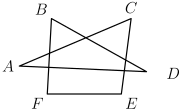
If the sum of the measures in degrees of angles and in the figure is then is equal to:
Small Hint:
Name the two intersections of with and
Big Hint:
Combine the angle sums of the central quadrilateral and the two triangles attached to it
Solution:
Let and In quadrilateral The triangles and give and using the supplementary angles at and Adding yields Thus
Therefore, the correct answer is C.
22.
If are imaginary roots of the equation where and are real numbers, then in terms of and is:
Small Hint:
The conjugate is another root
Big Hint:
Because the coefficient is zero, determine the third root and then use the sum of pairwise products
Solution:
The conjugate root is Since the sum of the three roots is the third root is By Vieta’s formulas,
Therefore, the correct answer is E.
23.
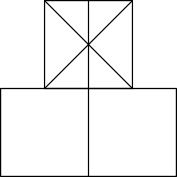
The radius of the smallest circle containing the symmetric figure composed of unit squares shown is:
None of these
Small Hint:
By symmetry, place the circle’s center on the vertical axis of the figure
Big Hint:
Equate its distances to a lower outer corner and an upper outer corner
Solution:
Put the midpoint of the bottom edge at A lower outer corner is and an upper outer corner is By symmetry the center of the smallest enclosing circle is At the optimum both types of outer corner lie on the circle, so This gives Hence
Therefore, the correct answer is D.
24.
A man walked a certain distance at a constant rate. If he had gone mile per hour faster, he would have walked the distance in four-fifths of the time; if he had gone mile per hour slower, he would have been hours longer on the road. The distance in miles he walked was:
Small Hint:
Let the actual speed and time be and
Big Hint:
First use to determine
Solution:
Let the actual speed and time be and The faster case gives so The slower case then gives whence The distance was
Therefore, the correct answer is B.
25.
Inscribed in a circle is a quadrilateral having sides of lengths and taken consecutively. The diameter of this circle has length:
Small Hint:
Notice two scaled Pythagorean triples among the four side lengths
Big Hint:
The pair and the pair share the same possible hypotenuse
Solution:
The consecutive sides may be labeled Since triangles and are right triangles with common hypotenuse Their union is the cyclic quadrilateral, and a right triangle’s hypotenuse is a diameter of its circumcircle. Thus the diameter is
Therefore, the correct answer is C.
26.
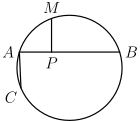
In the circle shown, is the midpoint of arc and segment is perpendicular to chord at If the measure of chord is and that of segment is then segment has measure equal to:
Small Hint:
Copy arc to an arc ending at a new point between and
Big Hint:
Drop ; use equal arcs to identify a rectangle and equal horizontal end segments
Solution:
Choose on arc so that arcs and are equal, and drop Then The remaining equal arcs and give equal corresponding chord projections, so Also is a rectangle, hence Therefore
Therefore, the correct answer is E.
27.
If the area of is square units and the geometric mean (mean proportional) between sides and is inches, then is equal to:
Small Hint:
The geometric-mean condition determines the product
Big Hint:
Use
Solution:
The geometric-mean condition says Therefore so
Therefore, the correct answer is D.
28.
A circular disc with diameter is placed on an checkerboard with width so that the centers coincide. The number of checkerboard squares which are completely covered by the disc is:
Small Hint:
No square touching the outside border can be completely covered
Big Hint:
Among the interior squares, test the four corner squares separately
Solution:
The border squares are not fully covered. Consider the remaining interior grid and measure distances in square side lengths, so the disc has radius The four outer corners of this interior grid are at distance from the center, so those four corner squares are not fully covered. Every other interior square lies within the disc: its farthest possible corner is at distance at most Hence squares are completely covered.
Therefore, the correct answer is E.
29.
If for then in terms of is:
Small Hint:
Substitute the rational expression into
Big Hint:
Its numerator and denominator factor as and
Solution:
Let Then Consequently
Therefore, the correct answer is C.
30.
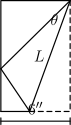
A rectangular piece of paper inches wide is folded as in the diagram so that one corner touches the opposite side. The length in inches of the crease in terms of angle is:
None of these
Small Hint:
Let be the height of the rectangular sheet and use the equal lengths created by the fold
Big Hint:
The diagram gives and
Solution:
Let be the sheet’s height. The congruent right triangles created by reflecting the folded corner across the crease give so They also give Hence
Therefore, the correct answer is A.
31.
When the number is divided by the remainder in the division is:
Small Hint:
Use
Big Hint:
Write
Solution:
Since
Therefore, the correct answer is C.
32.
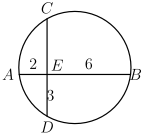
Chords and in the circle shown intersect at and are perpendicular to each other. If segments and have measures and respectively, then the length of the diameter of the circle is:
Small Hint:
First use
Big Hint:
Place at the origin; the center is at the intersection of the two chord perpendicular bisectors
Solution:
The intersecting-chords theorem gives so Put and The perpendicular bisectors of and meet at Thus and the diameter is
Therefore, the correct answer is B.
33.
The minimum value of the quotient of a (base ten) number of three different nonzero digits divided by the sum of its digits is:
Small Hint:
Let the hundreds, tens, and units digits be and and consider which position should contain the largest digit
Big Hint:
At a minimum ; then maximize and minimize subject to distinct nonzero digits
Solution:
Let denote the quotient. Then Interchanging with a larger digit in either earlier position decreases the quotient, so the units digit must be the largest. Increasing that units digit lowers a quotient greater than so Then This is minimized by taking the largest available and then the smallest The number is and
Therefore, the correct answer is C.
34.
Three times Dick’s age plus Tom’s age equals twice Harry’s age. Double the cube of Harry’s age is equal to three times the cube of Dick’s age added to the cube of Tom’s age. Their respective ages are relatively prime to each other. The sum of the squares of their ages is:
Small Hint:
Let the ages be and and rewrite the linear equation as
Big Hint:
Factor both differences of cubes after rewriting the cubic equation
Solution:
The equations are Rewrite them as and Canceling the equal positive factors gives so The linear equation then gives and pairwise relative primality forces The requested sum is
Therefore, the correct answer is A.
35.
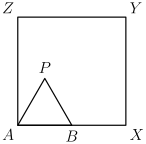
Equilateral triangle with side of length inches is placed inside square with side of length inches so that is on side The triangle is rotated clockwise about then and so on along the sides of the square until and all return to their original positions. The length of the path in inches traversed by vertex is equal to:
Small Hint:
Track the orientation after one eight-pivot circuit of the square
Big Hint:
Three circuits are needed; classify the pivots according to whether is fixed or moves through a or arc
Solution:
One circuit of the square uses pivots and changes the triangle’s orientation by of a full turn. Therefore circuits, or pivots, are required to restore the entire triangle. In of those pivots the rotation is about so does not move. In the other eight arcs subtend and eight subtend all with radius Hence the total path length is
Therefore, the correct answer is D.