
1971 AMC 12 Problems
Scroll down and press Start to try the exam! Or, go to the printable PDF, answer key, or professional solutions curated by LIVE by Po-Shen Loh.
All problems are used with official legal permission of the Mathematical Association of America (MAA).
Or jump straight to a single problem with its solution: 1 · 2 · 3 · 4 · 5 · 6 · 7 · 8 · 9 · 10 · 11 · 12 · 13 · 14 · 15 · 16 · 17 · 18 · 19 · 20 · 21 · 22 · 23 · 24 · 25 · 26 · 27 · 28 · 29 · 30 · 31 · 32 · 33 · 34 · 35
Want to learn professionally through interactive video classes?
Timed
1:15:00
1.
The number of digits in the number is:
Answer: B
Small Hint:
Pair as many factors of and as possible
Big Hint:
Rewrite the number as
Solution:
We have and which has digits.
Therefore, the correct answer is B.
2.
If men take days to lay bricks, then the number of days it will take men working at the same rate to lay bricks is:
Answer: D
Small Hint:
Find the number of bricks laid by one man in one day
Big Hint:
The rate is bricks per man-day
Solution:
The rate is bricks per man-day. Thus men lay bricks per day, so laying bricks takes days.
Therefore, the correct answer is D.
3.
If the point lies on the straight line joining the points and in the -plane, then is equal to:
Answer: E
Small Hint:
Find the slope through the two given fixed points
Big Hint:
The line has equation
Solution:
The slope through and is so the line is Substituting gives hence
Therefore, the correct answer is E.
4.
After simple interest for two months at per annum was credited, a Boy Scout Troop had a total of in the Council Treasury. The interest credited was a number of dollars plus the following number of cents:
Answer: A
Small Hint:
Two months is one-sixth of a year
Big Hint:
If is the principal, solve
Solution:
If is the principal, then Hence so the interest is and its cents part is
Therefore, the correct answer is A.
5.
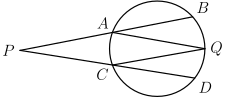
Points and lie on the circle shown, and the measures of arcs and are and respectively. The sum of the measures of angles and is:
None of these
Answer: C
Small Hint:
Use the external-secant formula for angle
Big Hint:
Adding angle cancels the unknown intercepted arc
Solution:
Let The external-secant formula gives while the inscribed-angle theorem gives Therefore
Therefore, the correct answer is C.
6.
Let be a symbol denoting the binary operation on the set of all nonzero real numbers as follows: for any Which statement is not true?
is commutative over
is associative over
is an identity element for in
Every element of has an inverse for
is an inverse for of the element of
Answer: E
Small Hint:
First determine the identity from
Big Hint:
An inverse of must satisfy
Solution:
The operation is commutative, and so it is associative. Its identity is The inverse of must satisfy so it is not
Therefore, the correct answer is E.
7.
is equal to:
Answer: C
Small Hint:
Factor out the term with the smallest power of
Big Hint:
Use
Solution:
Factoring gives
Therefore, the correct answer is C.
8.
The solution set of is the set of all values of such that:
or
or
Answer: B
Small Hint:
Move to the left and factor
Big Hint:
The product is negative between its roots
Solution:
The inequality is The roots are and and the upward-opening quadratic is negative between them.
Therefore, the correct answer is B.
9.
An uncrossed belt is fitted without slack around two circular pulleys with radii of inches and inches. If the distance between the points of contact of the belt with the pulleys is inches, then the distance between the centers of the pulleys in inches is:
Answer: D
Small Hint:
Join the centers and use the difference of the radii
Big Hint:
The center distance is the hypotenuse of a right triangle with legs and
Solution:
The common external tangent and the radii to its contact points form a right triangle whose legs are and Thus the center distance is
Therefore, the correct answer is D.
10.
Each of a group of girls is blonde or brunette and is blue-eyed or brown-eyed. If are blue-eyed blondes, are brunettes, and are brown-eyed, then the number of brown-eyed brunettes is:
Answer: E
Small Hint:
First find the total number of blondes
Big Hint:
Subtract the brown-eyed blondes from all brown-eyed girls
Solution:
There are blondes, of whom are brown-eyed. Hence the number of brown-eyed brunettes is
Therefore, the correct answer is E.
11.
The numeral in base represents the same number as in base Assuming both bases are positive integers, the least possible value of written as a Roman numeral, is:
Answer: D
Small Hint:
Translate the numerals into
Big Hint:
Both bases exceed ; solve for the least valid pair
Solution:
The equality is or Since both digits must be valid, Reducing modulo gives The first valid value is which gives Thus written
Therefore, the correct answer is D.
12.
For each integer define positive integers to be congruent if they leave the same nonnegative remainder when divided by If and are congruent in one such system, then in that same system, is congruent to:
Answer: B
Small Hint:
The modulus divides the difference of any two congruent integers
Big Hint:
Use the differences and
Solution:
The modulus divides both and Since this forces Then
Therefore, the correct answer is B.
13.
If is evaluated correct to decimal places, then the digit in the fifth decimal place is:
Answer: E
Small Hint:
Write
Big Hint:
In the binomial expansion, retain terms large enough to affect the fifth decimal place
Solution:
The binomial expansion gives which rounds to The fifth decimal digit is
Therefore, the correct answer is E.
14.
The number is exactly divisible by two numbers between and These numbers are:
Answer: C
Small Hint:
Use the fact that divides whenever is divisible by
Big Hint:
Recognize and that is divisible by
Solution:
Because is divisible by the number is divisible by Also and is divisible by so is divisible by Thus the two numbers are and
Therefore, the correct answer is C.
15.
An aquarium on a level table has rectangular faces and is inches wide and inches high. When it was tilted, the water in it just covered an -inch by -inch end but only three-fourths of the rectangular bottom. The depth of the water when the bottom was again made level was:
inches
inches
inches
inches
inches
Answer: B
Small Hint:
Compare the water volume in the tilted and level positions
Big Hint:
The tilted side view is a triangle with height and base three-fourths of the aquarium length
Solution:
Let the aquarium length be and the level-water depth be In the tilted position the longitudinal cross-section of the water is a triangle with base and height Therefore so inches.
Therefore, the correct answer is B.
16.
After finding the average of scores, a student carelessly included the average with the scores and found the average of these numbers. The ratio of the second average to the true average was:
None of these
Answer: A
Small Hint:
Call the original average
Big Hint:
The original sum is , and the extra number is also
Solution:
If the true average is then the original sum is Including itself gives a sum of over numbers, so the new average is still The ratio is
Therefore, the correct answer is A.
17.
A circular disk is divided by equally spaced radii and one secant line. The maximum number of nonoverlapping areas into which the disk can be divided is:
Answer: E
Small Hint:
Begin with the sectors made by the radii
Big Hint:
A secant can cross at most of the radii, so count the pieces of the secant chord
Solution:
The radii first make sectors. A secant not through the center can meet at most one radius in each of opposite pairs, hence at most radii. Those intersections divide the secant chord into pieces, each of which adds one region. The maximum is therefore
Therefore, the correct answer is E.
18.
The current in a river flows steadily at miles per hour. A motorboat traveling at a constant rate in still water goes downstream miles and then returns to its starting point. The trip takes one hour, excluding turning time. The ratio of the downstream rate to the upstream rate is:
Answer: D
Small Hint:
Let be the boat’s still-water speed
Big Hint:
Solve
Solution:
If is the still-water speed, then This simplifies to so the positive admissible solution is The downstream and upstream rates are and whose ratio is
Therefore, the correct answer is D.
19.
If the line intersects the ellipse exactly once, then the value of is:
Answer: C
Small Hint:
Substitute the line equation into the ellipse
Big Hint:
Exactly one intersection means the resulting quadratic has discriminant zero
Solution:
Substitution gives Tangency requires its discriminant to vanish: Thus so
Therefore, the correct answer is C.
20.
The sum of the squares of the roots of the equation is The absolute value of is equal to:
None of these
Answer: E
Small Hint:
Use the sum and product of the two roots
Big Hint:
If the roots are then and
Solution:
For roots Vieta’s formulas give and Hence Therefore which is not among choices A-D because choice A is
Therefore, the correct answer is E.
21.
If then is equal to:
22.
If is one of the imaginary roots of then is equal to:
Answer: A
Small Hint:
Use
Big Hint:
Replace by and by
Solution:
Because and we have Thus Their product is
Therefore, the correct answer is A.
23.
Teams and are playing a series of games. If either team has an equal chance to win any game, and Team must win two games while Team must win three games to win the series, then the odds favoring Team to win the series are:
to
to
to
to
to
Answer: A
Small Hint:
It is shorter to enumerate the ways Team can lose
Big Hint:
Before ’s second win, can finish as BBB, ABBB, BABB, or BBAB
Solution:
Team loses in the sequences BBB, ABBB, BABB, and BBAB. Their total probability is Thus Team wins with probability so the odds in its favor are
Therefore, the correct answer is A.
24.
Pascal’s triangle is an array of positive integers, shown below, in which the first row is the second row is two ’s, each row begins and ends with and each other entry is the sum of the two entries above it.
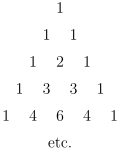
The quotient of the number of entries in the first rows which are not ’s and the number of ’s is:
None of these
Answer: D
Small Hint:
Count all entries and then subtract the boundary ’s
Big Hint:
The first rows contain entries and boundary ’s
Solution:
The first rows contain entries. There are boundary ’s, so the number of other entries is Dividing by gives
Therefore, the correct answer is D.
25.
A teenage boy wrote his own age after his father’s. From this new four-place number, he subtracted the absolute value of the difference of their ages to get The sum of their ages was:
Answer: D
Small Hint:
Let the father’s age be and the boy’s age be
Big Hint:
The concatenated number is , so use
Solution:
Let the father and boy be and years old. Since The boy is a teenager, so Reducing modulo gives hence Then and
Therefore, the correct answer is D.
26.
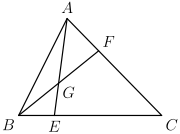
In triangle point divides side in the ratio Let be the point where side meets where is the midpoint of Then divides in the ratio:
Answer: B
Small Hint:
Assign endpoint masses so that
Big Hint:
The midpoint condition makes the masses at and equal
Solution:
Use mass points. Since assign masses and to and so the mass at is Because is the midpoint of the mass at is also Therefore
Therefore, the correct answer is B.
27.
A box contains chips, each of which is red, white, or blue. The number of blue chips is at least half the number of white chips and at most one-third the number of red chips. The number which are white or blue is at least The minimum number of red chips is:
Answer: E
Small Hint:
Let the counts be and translate every condition into an inequality
Big Hint:
From and , find the least possible integer
Solution:
Let the counts be The conditions give Hence so and Equality is possible with so the minimum is
Therefore, the correct answer is E.
28.
Nine lines parallel to the base of a triangle divide the other sides each into equal segments and the area into distinct parts. If the area of the largest of these parts is then the area of the original triangle is:
Answer: C
Small Hint:
The largest part is the bottom strip
Big Hint:
The smaller triangle above that strip has linear scale
Solution:
If the whole area is the triangle above the bottom strip is similar to the original with scale so its area is Thus the largest strip has area giving
Therefore, the correct answer is C.
29.
Given the progression the least positive integer such that the product of the first terms exceeds is:
Answer: E
Small Hint:
Add the exponents when multiplying the terms
Big Hint:
Require , noting that equality is not enough
Solution:
The product is It exceeds exactly when For there is equality, while works.
Therefore, the correct answer is E.
30.
Given the linear fractional transformation define for Assuming it follows that is equal to:
None of these
Answer: D
Small Hint:
Cancel five iterates by composing with the inverse transformation
Big Hint:
If , then once is the identity
Solution:
The transformation is invertible. From composing with shows that is the identity. Solving for gives Since iterates have period Direct composition gives
Therefore, the correct answer is D.
31.
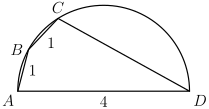
Quadrilateral is inscribed in a circle with side a diameter of length If sides and each have length then side has length:
Answer: A
Small Hint:
Equal chords and subtend equal central angles
Big Hint:
If half of either central angle is , then and
Solution:
The circle has radius Let the central angles subtending the equal chords and each be Then so The remaining central angle from to along the semicircle is hence
Therefore, the correct answer is A.
32.
If then is equal to:
Answer: A
Small Hint:
Set
Big Hint:
Apply the difference-of-squares identity repeatedly through the factor
Solution:
Let Then Therefore
Therefore, the correct answer is A.
33.
If is the product of quantities in geometric progression, their sum, and the sum of their reciprocals, then in terms of and is:
Answer: B
Small Hint:
Write the progression as
Big Hint:
Show that , whose power is the product
Solution:
Write the terms as Reversing the reciprocal sum gives so Meanwhile
Therefore, the correct answer is B.
34.
An ordinary clock in a factory is running slow so that the minute hand passes the hour hand at the usual dial positions ( o’clock, etc.) but only every minutes. At time and one-half for overtime, the extra pay to which a -per-hour worker should be entitled after working a normal -hour day by that slow-running clock is:
Answer: B
Small Hint:
A normal clock’s hands pass every minutes
Big Hint:
Eleven slow-clock intervals total displayed hours but hours minutes of real time
Solution:
Successive hand-overlaps are real minutes apart, while this slow clock displays minutes between them. Thus displayed hours correspond to real minutes, since Eight displayed hours therefore take hours minutes, so the overtime is minutes. At per hour, that pays
Therefore, the correct answer is B.
35.
Each circle in an infinite sequence with decreasing radii is tangent externally to the one following it and to both sides of a given right angle. The ratio of the area of the first circle to the sum of the areas of all the other circles in the sequence is:
Answer: C
Small Hint:
The centers lie on the angle bisector; find the ratio of consecutive radii
Big Hint:
The radius ratio is , so the area ratio is its square
Solution:
If consecutive radii are their centers lie on the angle bisector at distances and from the vertex. External tangency gives so The ratio of successive areas is Therefore the first area divided by the sum of all later areas is
Therefore, the correct answer is C.