
1970 AMC 12 Solutions
Scroll down to view professionally curated solutions from LIVE by Po-Shen Loh, print PDF solutions, view answer key, or take the full timed exam.
All problems are used with official legal permission of the Mathematical Association of America (MAA).
1.
The fourth power of is:
Small Hint:
Simplify from the innermost radical outward
Big Hint:
After the innermost radical becomes square twice
Solution:
The innermost radical is so the given number is Its fourth power is
Therefore, the correct answer is E.
2.
A square and a circle have equal perimeters. The ratio of the area of the circle to the area of the square is:
Small Hint:
Let the common perimeter be
Big Hint:
Express the circle radius and square side in terms of , then divide their areas
Solution:
If the common perimeter is then the circle has radius and the square has side Therefore
Therefore, the correct answer is A.
3.
If and then in terms of is:
Small Hint:
Solve the first equation for
Big Hint:
Use and simplify
Solution:
From we get so
Therefore, the correct answer is C.
4.
Let be the set of all numbers which are the sum of the squares of three consecutive integers. Then we can say that:
No member of is divisible by
No member of is divisible by but some member is divisible by
No member of is divisible by or by
No member of is divisible by or by
None of these
Small Hint:
Write the integers as
Big Hint:
Their squared sum is examine it modulo and test a residue modulo
Solution:
The sum is It is always congruent to so no member of is divisible by On the other hand, taking gives which is divisible by
Therefore, the correct answer is B.
5.
If then where is equal to:
Small Hint:
Use and
Big Hint:
The numerator vanishes while the denominator does not
Solution:
Because and
Therefore, the correct answer is D.
6.
The smallest value of for real values of is:
None of these
Small Hint:
Complete the square
Big Hint:
Rewrite the expression as
Solution:
Completing the square gives Since the minimum occurs at and equals
Therefore, the correct answer is B.
7.
Inside square with side quarter-circle arcs with radii and centers at and are drawn. These arcs intersect at a point inside the square. How far is from side
Small Hint:
The two radii to and side form an equilateral triangle
Big Hint:
The altitude from to is ; subtract it from the square’s height
Solution:
Since triangle is equilateral. Thus the perpendicular distance from to is The distance between the parallel sides and is so the requested distance is
Therefore, the correct answer is E.
8.
If and then:
Small Hint:
Rewrite as and as
Big Hint:
Convert both logarithms to base
Solution:
Using and
Therefore, the correct answer is B.
9.
Points and are on line segment and both points are on the same side of the midpoint of Point divides in the ratio and divides in the ratio If then the length of segment is:
Small Hint:
Express and as fractions of
Big Hint:
Use and , then subtract
Solution:
The division ratios give Because the two points are on the same side of the midpoint, Since we obtain
Therefore, the correct answer is C.
10.
Let be an infinite repeating decimal with the digits and repeating. When is written as a fraction in lowest terms, the denominator exceeds the numerator by:
Small Hint:
Separate the initial from the repeating tail
Big Hint:
The tail is
Solution:
We have The denominator exceeds the numerator by
Therefore, the correct answer is D.
11.
If two factors of are and the value of is:
Small Hint:
Apply the factor theorem at and
Big Hint:
Solve and
Solution:
The factor theorem gives Subtracting the second equation from the first gives so and then Hence
Therefore, the correct answer is E.
12.
A circle with radius is tangent to sides and of rectangle and passes through the midpoint of diagonal The area of the rectangle, in terms of is:
Small Hint:
Tangency to the two opposite sides makes one side of the rectangle equal to
Big Hint:
The line from the third tangency point through the center bisects the diagonal, making the corresponding chord a diameter
Solution:
Let the circle be tangent to the parallel sides and Their separation is its diameter, so Let be the tangency point on let be the center, and let be the midpoint of
The line is parallel to and halfway between and so is the midpoint of and the line contains Since lies on the circle and are collinear, Thus is a midsegment of triangle so Therefore the area is
Therefore, the correct answer is C.
13.
Given the binary operation defined by for all positive numbers and Then for all positive we have:
None of these
Small Hint:
Replace every using the definition before comparing the two sides
Big Hint:
For choice D, both sides simplify to a power with exponent
Solution:
For choice D, Thus that identity always holds. The other choices would assert false general identities such as or
Therefore, the correct answer is D.
14.
Consider where and are positive numbers. If the roots of this equation differ by then equals:
Small Hint:
Use the quadratic formula to express the difference of the roots
Big Hint:
The difference has magnitude
Solution:
The two roots differ in absolute value by Hence so Since is positive,
Therefore, the correct answer is A.
15.
Lines in the -plane are drawn through the point and the trisection points of the line segment joining the points and One of these lines has the equation:
Small Hint:
Find the two trisection points by moving one-third and two-thirds of the displacement vector
Big Hint:
The trisection points are and ; find the line from either one to
Solution:
The displacement from to is The trisection points are therefore and The line through and has slope so or
Therefore, the correct answer is E.
16.
If is a function such that and such that for then is equal to:
Small Hint:
Compute the terms one at a time beginning with
Big Hint:
Use the recurrence successively for
Solution:
Applying the recurrence successively, and
Therefore, the correct answer is C.
17.
If then for all and such that and we have:
None of these
Small Hint:
Because the hypothesis gives only
Big Hint:
Test the remaining claims with both positive and negative choices of
Solution:
Since the hypothesis is equivalent to Then so A is false. Taking makes B and D false. Taking makes C false because Thus none of A-D follows in every case.
Therefore, the correct answer is E.
18.
is equal to:
Small Hint:
Recognize each radicand as a squared binomial
Big Hint:
Use
Solution:
Since and both and are positive, the difference is
Therefore, the correct answer is A.
19.
The sum of an infinite geometric series with common ratio such that is and the sum of the squares of the terms of this series is The first term of the series is:
Small Hint:
If the first term is write one equation for each infinite sum
Big Hint:
Use and , then cancel a factor of
Solution:
Let the first term be Then Since dividing the second equation by the first gives Thus Solving gives and
Therefore, the correct answer is C.
20.
Lines and lie in a plane. is the midpoint of line segment and and are perpendicular to Then we:
always have
always have
sometimes have but not always
always have
always have
Small Hint:
Put on the -axis
Big Hint:
Use and ; compare squared distances from their midpoint
Solution:
Choose coordinates Then The horizontal displacements from to and are opposites, while the vertical displacements are equal. Therefore so always.
Therefore, the correct answer is A.
21.
On an auto trip, the distance read from the instrument panel was miles. With snow tires on for the return trip over the same route, the reading was miles. Find, to the nearest hundredth of an inch, the increase in radius of the wheels if the original radius was inches.
Small Hint:
For a fixed true distance, the odometer reading is inversely proportional to wheel radius
Big Hint:
If the radii are use
Solution:
For a fixed true distance, the odometer reading is proportional to the number of wheel revolutions. Thus With the increase is To the nearest hundredth this is inch.
Therefore, the correct answer is B.
22.
If the sum of the first positive integers is more than the sum of the first positive integers, then the sum of the first positive integers is:
Small Hint:
Use
Big Hint:
The given difference simplifies to
Solution:
Let Then Since this gives Hence and the positive solution is Therefore
Therefore, the correct answer is A.
23.
The number ( is written in base ), when written in the base system, ends in exactly zeros. The value of is:
Small Hint:
A trailing base- zero contributes one factor of
Big Hint:
Compare the exponents of and in
Solution:
The prime exponents in are Each factor of uses two factors of and one of Hence the number of trailing base- zeros is
Therefore, the correct answer is D.
24.
An equilateral triangle and a regular hexagon have equal perimeters. If the area of the triangle is then the area of the hexagon is:
Small Hint:
Let the hexagon side be ; equal perimeters make the triangle side
Big Hint:
The triangle splits into four small equilateral triangles of side , while the hexagon splits into six
Solution:
Let the hexagon side be Its perimeter is so the equilateral triangle has side The large triangle consists of equilateral triangles of side while the hexagon consists of Their area ratio is therefore Since the triangle’s area is the hexagon’s area is
Therefore, the correct answer is B.
25.
For every real number let be the greatest integer which is less than or equal to If the postal rate for first class mail is six cents for every ounce or portion thereof, then the cost in cents of first-class postage on a letter weighing ounces is always:
Small Hint:
The number of charged ounces is the least integer at least
Big Hint:
Use the identity
Solution:
Charging for every ounce or portion thereof means the number of charged ounces is The floor and ceiling functions satisfy Thus the cost is
Therefore, the correct answer is E.
26.
The number of distinct points in the -plane common to the graphs of and is:
infinite
Small Hint:
Each product equation represents a union of two lines
Big Hint:
Check the intersection of the two lines in each pair before considering all four pairings
Solution:
The first graph is the union of and those two lines meet at The second graph is the union of and these also meet at In fact, substituting satisfies all four line equations. Since the four lines have distinct slopes, no other point can belong to a line from each graph. There is exactly one common point.
Therefore, the correct answer is B.
27.
In a triangle, the area is numerically equal to the perimeter. What is the radius of the inscribed circle?
Small Hint:
Express the area in terms of the inradius and semiperimeter
Big Hint:
Use and perimeter
Solution:
If is the inradius and the semiperimeter, the triangle’s area is Its perimeter is The given equality yields Since we obtain
Therefore, the correct answer is A.
28.
In triangle the median from vertex is perpendicular to the median from vertex If the lengths of sides and are and respectively, then the length of side is:
Small Hint:
Place the centroid at the origin and let the position vectors of be perpendicular vectors
Big Hint:
Then so and
Solution:
Place the centroid at the origin. Let the position vectors of and be and The two medians lie along and so Also the centroid condition gives
Let and Then and Adding appropriate multiples gives Finally, so
Therefore, the correct answer is A.
29.
It is now between and o’clock, and six minutes from now, the minute hand of a watch will be exactly opposite the place where the hour hand was three minutes ago. What is the exact time now?
Small Hint:
Let be the number of minutes after now
Big Hint:
In minute-space units, the future minute hand is at , while the point opposite the past hour hand is at
Solution:
Let be the number of minutes after now. Six minutes from now, the minute hand is minute spaces clockwise from Three minutes ago, the hour hand was minute spaces past the so the point opposite it was minute spaces past Hence Solving gives so the time is
Therefore, the correct answer is D.
30.
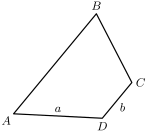
In the accompanying figure, segments and are parallel, the measure of angle is twice that of angle and the measures of segments and are and respectively. Then the measure of is equal to:
Small Hint:
Bisect angle and let the bisector meet at
Big Hint:
Angle chasing makes isosceles, while is a parallelogram
Solution:
Let the bisector of meet at Because each half has measure Since the alternate interior angle also equals Thus triangle is isosceles and Also and so is a parallelogram. Hence Therefore
Therefore, the correct answer is E.
31.
If a number is selected at random from the set of all five-digit numbers in which the sum of the digits is equal to what is the probability that this number will be divisible by
Small Hint:
Start from ; a digit sum of means a total deficit of
Big Hint:
The possibilities are one or two s; apply the divisibility-by- alternating-sum test
Solution:
The maximum five-digit digit sum is so a sum of has total deficit from Either one digit is and the others are , giving numbers, or two digits are and the others are , giving numbers. Thus there are numbers total.
Using the divisibility-by- test, exactly are divisible by The probability is therefore
Therefore, the correct answer is B.
32.
and travel around a circular track at uniform speeds in opposite directions, starting from diametrically opposite points. If they start at the same time, meet first after has travelled yards, and meet a second time yards before completes one lap, then the circumference of the track in yards is:
Small Hint:
Let the circumference be and compare the two runners’ traveled-distance ratios at each meeting
Big Hint:
At the first meeting their distances are and ; at the second they are and
Solution:
Let the circumference be At the first meeting, has traveled yards and has traveled so their speed ratio is At the second meeting, is yards short of one lap, so it has traveled By then their combined distance is so has traveled Hence Cross-multiplying gives so the circumference is yards.
Therefore, the correct answer is C.
33.
Find the sum of the digits of all the numerals in the sequence
Small Hint:
First sum the digits from through
Big Hint:
In each of the four positions, every digit appears exactly times
Solution:
Write the integers from through using four digits with leading zeros. In each of the four positions, every digit appears times. Thus their total digit sum is Replacing by adds so the requested sum is
Therefore, the correct answer is A.
34.
The greatest integer that will divide and and leave the same remainder is:
an odd multiple of greater than
an even multiple of greater than
Small Hint:
A common remainder means the divisor divides every pairwise difference
Big Hint:
Find the GCD of and
Solution:
A divisor leaves the same remainder on all three numbers exactly when it divides their differences. The two successive differences are Therefore the greatest possible divisor is
Therefore, the correct answer is C.
35.
A retiring employee receives an annual pension proportional to the square root of the number of years of his service. Had he served years more, his pension would have been dollars greater, whereas, had he served years more (), his pension would have been dollars greater than the original annual pension. Find his annual pension in terms of and
Small Hint:
Let the current pension be and write the two hypothetical pensions
Big Hint:
Square and , then eliminate both and
Solution:
Let the current pension be Since and squaring and using gives the first line below. Multiplying its equations by and respectively, and subtracting gives the second: Hence
Therefore, the correct answer is D.