
1968 AMC 12 Problems
Scroll down and press Start to try the exam! Or, go to the printable PDF, answer key, or professional solutions curated by LIVE by Po-Shen Loh.
All problems are used with official legal permission of the Mathematical Association of America (MAA).
Or jump straight to a single problem with its solution: 1 · 2 · 3 · 4 · 5 · 6 · 7 · 8 · 9 · 10 · 11 · 12 · 13 · 14 · 15 · 16 · 17 · 18 · 19 · 20 · 21 · 22 · 23 · 24 · 25 · 26 · 27 · 28 · 29 · 30 · 31 · 32 · 33 · 34 · 35
Want to learn professionally through interactive video classes?
Timed
1:15:00
1.
Let units be the increase in the circumference of a circle resulting from an increase of units in the diameter. Then equals:
Answer: D
Small Hint:
Write circumference as
Big Hint:
Replace by and subtract
Solution:
The original circumference is After the diameter increases by it is The increase is therefore
Therefore, the correct answer is D.
2.
The real value of such that divided by equals is:
Answer: B
Small Hint:
Combine the quotient because its powers have the same exponent
Big Hint:
Write both sides as powers of
Solution:
The left side is while Hence so
Therefore, the correct answer is B.
3.
A straight line passing through the point is perpendicular to the line Its equation is:
Answer: A
Small Hint:
The given line has slope
Big Hint:
Use the negative reciprocal slope through
Solution:
The given line has slope so a perpendicular line has slope Through its equation is or
Therefore, the correct answer is A.
4.
Define an operation for positive real numbers by Then equals:
Answer: C
Small Hint:
Evaluate the inner operation first
Big Hint:
After finding substitute it as the second input
Solution:
First, Therefore which equals
Therefore, the correct answer is C.
5.
6.
Let side of convex quadrilateral be extended through and let side be extended through to meet in point Let represent the degree-sum of angles and and let represent the degree-sum of angles and If then:
sometimes, sometimes
sometimes, sometimes
Answer: E
Small Hint:
Express both sums using angle
Big Hint:
Apply the triangle angle sum to and
Solution:
In triangle Since lies on and lies on triangle gives as well. Thus and
Therefore, the correct answer is E.
7.
Let be the intersection point of medians and of triangle If is inches, then in inches, is:
undetermined
Answer: E
Small Hint:
A centroid gives a ratio only along each individual median
Big Hint:
Knowing part of does not determine the length of
Solution:
The centroid divides each median in a ratio, so determines It gives no relation between the lengths of the two different medians and Triangles with can have different so is undetermined.
Therefore, the correct answer is E.
8.
A positive number is mistakenly divided by instead of being multiplied by Based on the correct answer, the error thus committed, to the nearest percent, is:
Answer: B
Small Hint:
Let the number be and compare with
Big Hint:
Divide the absolute error by the correct result
Solution:
The correct result is while the mistaken result is Relative to the correct result, the error is
Therefore, the correct answer is B.
9.
The sum of the real values of satisfying is:
Answer: E
Small Hint:
Square both sides; both sides are nonnegative
Big Hint:
Use the sum of the roots of the resulting quadratic
Solution:
Squaring gives or Both roots satisfy the original absolute-value equation, and their sum is
Therefore, the correct answer is E.
10.
Assume that, for a certain school, it is true that
Some students are not honest.
All fraternity members are honest.
A necessary conclusion is:
Some students are fraternity members
Some fraternity members are not students
Some students are not fraternity members
No fraternity member is a student
No student is a fraternity member
Answer: C
Small Hint:
Choose a student whose existence is guaranteed by statement
Big Hint:
Could that dishonest student be a fraternity member under statement
Solution:
Statement guarantees a dishonest student. Statement says every fraternity member is honest, so that dishonest student cannot be a fraternity member. Hence some student is not a fraternity member.
Therefore, the correct answer is C.
11.
If an arc of on circle has the same length as an arc of on circle the ratio of the area of circle to that of circle is:
none of these
Answer: B
Small Hint:
Equate for the two arcs
Big Hint:
Square the resulting radius ratio to get the area ratio
Solution:
Equal arc lengths give so Circle areas scale as the squares of the radii, giving
Therefore, the correct answer is B.
12.
A circle passes through the vertices of a triangle with side-lengths The radius of the circle is:
Answer: C
Small Hint:
The side lengths are times a familiar Pythagorean triple
Big Hint:
A right triangle’s hypotenuse is the circumcircle’s diameter
Solution:
The sides are so the triangle is right with hypotenuse The hypotenuse is the circumdiameter, making the radius
Therefore, the correct answer is C.
13.
If and are the roots of then the sum of the roots is:
undetermined
Answer: B
Small Hint:
Use both the sum and product forms of Vieta’s formulas
Big Hint:
The product equation and determine
Solution:
Because the roots are Vieta gives and Since the second equation gives and then Their sum is
Therefore, the correct answer is B.
14.
If and are nonzero numbers such that and then equals:
Answer: E
Small Hint:
Multiply each equation by its denominator
Big Hint:
Both equations produce an expression for
Solution:
The equations give and Therefore so
Therefore, the correct answer is E.
15.
Let be the product of any three consecutive positive odd integers. The largest integer dividing all such is:
Answer: D
Small Hint:
Among three consecutive odd integers, inspect residues modulo
Big Hint:
Use two examples to rule out every larger common divisor
Solution:
Three consecutive odd integers occupy three consecutive residues modulo so one is divisible by Thus every product is divisible by The products and have greatest common divisor so no larger integer always divides the product.
Therefore, the correct answer is D.
16.
If is such that and then:
or
or
Answer: E
Small Hint:
Combine the conditions as
Big Hint:
Treat positive and negative separately when taking reciprocals
Solution:
For gives while the other inequality is automatic. For gives while the first is automatic. Thus or
Therefore, the correct answer is E.
17.
Let where is a positive integer. If the set of possible values of is:
18.
Side of triangle has length inches. Line is drawn parallel to so that is on segment and is on segment Line extended bisects angle If has length inches, then the length of in inches, is:
Answer: D
Small Hint:
Put on the extension of beyond , so the bisector condition is
Big Hint:
After showing use similarity of and
Solution:
Put on the extension of beyond The bisector condition gives Since we have Also, rays and are opposite, as are rays and so Thus triangle is isosceles and Similar triangles and give Hence so
Therefore, the correct answer is D.
19.
Let be the number of ways that dollars can be changed into dimes and quarters, with at least one of each coin being used. Then equals:
Answer: E
Small Hint:
In cents, solve
Big Hint:
Use parity to write , then enforce positive coin counts
Solution:
The equation reduces to Thus must be even; write giving Positivity requires so there are ways.
Therefore, the correct answer is E.
20.
The measures of the interior angles of a convex polygon of sides are in arithmetic progression. If the common difference is and the largest angle is then equals:
Answer: A
Small Hint:
Write the smallest angle as
Big Hint:
Equate the arithmetic-series sum to
Solution:
The smallest angle is The angle sum is times and it equals This simplifies to Thus
Therefore, the correct answer is A.
21.
If then the units digit in the value of is:
Answer: D
Small Hint:
Every factorial from onward ends in zero
Big Hint:
Only add the units digits of the first four terms
Solution:
For is divisible by Only the first four terms matter. Their sum is whose units digit is
Therefore, the correct answer is D.
22.
A segment of length is divided into four segments. Then there exists a quadrilateral with the four segments as sides if and only if each segment is:
equal to
equal to or greater than and less than
greater than and less than
greater than and less than
less than
Answer: E
Small Hint:
A nondegenerate quadrilateral exists exactly when the longest side is shorter than the other three combined
Big Hint:
The four lengths sum to
Solution:
A simple nondegenerate quadrilateral exists exactly when each side is less than the sum of the other three. Since the total is this condition is or for every segment.
Therefore, the correct answer is E.
23.
If all the logarithms are real numbers, the equality
is satisfied for:
all real values of
no real values of
all real values of except
no real values of except
all real values of except
Answer: B
Small Hint:
Combine the two logarithms on the left
Big Hint:
Solve the resulting algebraic equation, then test its domain
Solution:
Combining logarithms would require This gives But then so the logarithm on the left is not real. Hence there are no real solutions.
Therefore, the correct answer is B.
24.
A painting is to be placed into a wooden frame with the longer dimension vertical. The wood at the top and bottom is twice as wide as the wood on the sides. If the frame area equals that of the painting itself, the ratio of the smaller to the larger dimension of the framed painting is:
Answer: C
Small Hint:
Let each side strip have width , so each top strip has width
Big Hint:
Set the outside area equal to twice
Solution:
The outside dimensions are and Since the frame area equals the painting area, This gives so The dimensions are and with ratio
Therefore, the correct answer is C.
25.
Ace runs with constant speed and Flash runs times as fast, Flash gives Ace a head start of yards, and, at a given signal, they start off in the same direction. Then the number of yards Flash must run to catch Ace is:
Answer: C
Small Hint:
If Ace’s speed is the closing speed is
Big Hint:
Multiply the catch-up time by Flash’s speed
Solution:
If Ace runs at speed Flash runs at so their closing speed is The catch-up time is during which Flash runs
Therefore, the correct answer is C.
26.
Let where is the smallest positive integer such that Then the sum of the digits of is:
Answer: E
Small Hint:
The sum is
Big Hint:
Compare and with one million
Solution:
We have For this is while for it is Thus whose digit sum is
Therefore, the correct answer is E.
27.
Let
Here Then equals:
Answer: B
Small Hint:
Pair terms as
Big Hint:
For even for odd
Solution:
Pairing gives for even and for odd Hence and their sum is
Therefore, the correct answer is B.
28.
If the arithmetic mean of and is double their geometric mean, with then a possible value for the ratio to the nearest integer, is:
none of these
Answer: D
Small Hint:
Set and divide the mean equation by
Big Hint:
The equation becomes quadratic after squaring
Solution:
Let The condition gives so The root greater than is whose nearest integer is
Therefore, the correct answer is D.
29.
Given the three numbers with Arranged in order of increasing magnitude, they are:
Answer: A
Small Hint:
For compare powers by comparing their positive exponents
Big Hint:
First show , then compare
Solution:
Since and raising to the exponent gives For a base between and a larger exponent gives a smaller value. Because we have Thus
Therefore, the correct answer is A.
30.
Convex polygons and are drawn in the same plane with and sides, respectively, If and do not have any line segment in common, then the maximum number of intersections of and is:
none of these
Answer: A
Small Hint:
A line segment can enter and leave a convex polygon at most once
Big Hint:
Apply that bound to each side of the polygon with fewer sides
Solution:
Each side of lies on a line, and its intersection with the convex region is a single segment or empty. Thus that side crosses the boundary of at most twice. Across sides there are at most and a suitable thin convex -gon crossing a convex -gon attains this bound.
Therefore, the correct answer is A.
31.
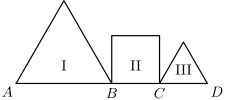
In this diagram, not drawn to scale, figures and are equilateral triangular regions with respective areas of and square inches. Figure is a square region with area square inches. Let the length of segment be decreased by of itself, while the lengths of and remain unchanged. The percent decrease in the area of the square is:
Answer: D
Small Hint:
Convert the three given areas into the side lengths
Big Hint:
The decrease in is absorbed entirely by the square’s side
Solution:
From The square has and the smaller equilateral triangle also has Thus Decreasing it by removes from whose new length is The square’s area falls from to a decrease.
Therefore, the correct answer is D.
32.
and move uniformly along two straight paths intersecting at right angles in point When is at is yards short of In minutes they are equidistant from and in minutes more they are again equidistant from Then the ratio of ’s speed to ’s speed is:
Answer: C
Small Hint:
Let the speeds be ; at
Big Hint:
At has passed so
Solution:
Let the speeds of be At so At has passed and so Hence and
Therefore, the correct answer is C.
33.
A number has three digits when expressed in base When is expressed in base the digits are reversed. Then the middle digit is:
Answer: A
Small Hint:
Call the base- digits and equate to
Big Hint:
Rearrange to and use the digit bounds
Solution:
Let Then so With and the only possibility is Indeed,
Therefore, the correct answer is A.
34.
With members voting, the House of Representatives defeated a bill. A re-vote, with the same members voting, resulted in passage of the bill by twice the margin by which it was originally defeated. The number voting for the bill on the re-vote was of the number voting against it originally. How many more members voted for the bill the second time than voted for it the first time?
Answer: B
Small Hint:
Let the original and second numbers voting for be and
Big Hint:
Use and
Solution:
Let be the original and second numbers voting for the bill. The ratio condition gives The passage margin is twice the original defeat margin, so or Solving gives so more members voted for it.
Therefore, the correct answer is B.
35.
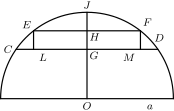
In this diagram the center of the circle is the radius is inches, chord is parallel to chord are collinear, and is the midpoint of Let (square inches) represent the area of trapezoid and let (square inches) represent the area of rectangle Then, as and are translated upward so that increases toward the value while always equals the ratio becomes arbitrarily close to:
Small Hint:
Let so and
Big Hint:
Express the two half-chords with the Pythagorean theorem, then let approach
Solution:
Let Then and The half-chords are Since both figures have height As approaches the latter fraction approaches Thus approaches
Therefore, the correct answer is D.