
1966 AMC 12 Solutions
Scroll down to view professionally curated solutions from LIVE by Po-Shen Loh, print PDF solutions, view answer key, or take the full timed exam.
All problems are used with official legal permission of the Mathematical Association of America (MAA).
1.
Given that the ratio of to is constant, and when then, when equals:
Small Hint:
Use and to find the constant ratio
Big Hint:
Keep equal to that ratio when
Solution:
The given pair makes the ratio Therefore, when so and
Therefore, the correct answer is C.
2.
When the base of a triangle is increased and the altitude to this base is decreased the change in area is:
increase
increase
decrease
decrease
Small Hint:
The area is proportional to the product of base and altitude
Big Hint:
Multiply the scale factors and
Solution:
The new area is times the old area. It is therefore smaller.
Thus, the correct answer is E.
3.
If the arithmetic mean of two numbers is and their geometric mean is then an equation with the given two numbers as roots is:
Small Hint:
The two numbers have sum and product
Big Hint:
Roots with sum and product satisfy
Solution:
If the numbers are and then gives while gives The monic equation with those roots is or
Therefore, the correct answer is D.
4.
Circle is circumscribed about a given square and circle is inscribed in the given square. If is the ratio of the area of circle to that of circle then equals:
Small Hint:
For square side compare radii and
Big Hint:
Circle areas are proportional to the squares of their radii
Solution:
For square side the outer circle has radius while the inner circle has radius Hence
Therefore, the correct answer is B.
5.
The number of values of satisfying the equation
is:
zero
one
two
three
an integer greater than
Small Hint:
Factor numerator and denominator before solving
Big Hint:
Do not admit values that make the original denominator zero
Solution:
The denominator requires and On that domain, The remaining equation gives which is excluded. Thus there are no solutions.
Therefore, the correct answer is A.
6.
is a diameter of a circle centered at is a point on the circle such that angle is If the diameter of the circle is inches, the length of chord expressed in inches, is:
none of these
Small Hint:
Because is a diameter,
Big Hint:
Split isosceles triangle into two -- triangles
Solution:
The radius is and A chord subtending has length
Therefore, the correct answer is C.
7.
Let
be an identity in The numerical value of is:
Small Hint:
Combine the two fractions over
Big Hint:
Compare the coefficient of and the constant term
Solution:
Combining the right side gives numerator Thus and Hence and
Therefore, the correct answer is A.
8.
The length of the common chord of two intersecting circles is feet. If the radii are feet and feet, a possible value for the distance between the centers of the circles, expressed in feet, is:
undetermined
Small Hint:
The line of centers perpendicularly bisects the common chord
Big Hint:
Find each center’s distance from the chord using half-chord
Solution:
The half-chord has length The two perpendicular distances from the centers to its line are If the centers lie on opposite sides of the chord, their distance is which is a possible value.
Therefore, the correct answer is B.
9.
10.
If the sum of two numbers is and their product is then the sum of their cubes is, where
Small Hint:
Use
Big Hint:
Substitute the given sum and product directly
Solution:
If the numbers are and then
Therefore, the correct answer is E.
11.
The sides of triangle are in the ratio is the angle-bisector drawn to the shortest side dividing it into segments and If the length of is then the length of the longer segment of is:
Small Hint:
Since is the shortest side, the adjacent sides are in ratio
Big Hint:
Apply the angle-bisector theorem to
Solution:
The sides adjacent to angle are in ratio By the angle-bisector theorem, The longer of the two parts is therefore
Therefore, the correct answer is C.
12.
The number of real values of that satisfy the equation
is:
greater than
Small Hint:
Rewrite every term with base
Big Hint:
Compare the total exponent on each side before trying to solve for
Solution:
In base the left exponent is and the right exponent is The equation is an identity for every real so it has more than three real solutions.
Therefore, the correct answer is E.
13.
The number of points with positive rational coordinates selected from the set of points in the -plane such that is:
infinite
Small Hint:
Try fixing one positive rational coordinate
Big Hint:
There are infinitely many positive rational numbers in an interval
Solution:
For example, set Every positive rational then gives an allowed point and there are infinitely many such rationals.
Therefore, the correct answer is E.
14.
The length of rectangle is inches and its width is inches. Diagonal is divided into three equal segments by points and The area of triangle expressed in square inches, is:
Small Hint:
Place the rectangle at and
Big Hint:
The trisection points of diagonal have easy coordinates
Solution:
Take and Then and The determinant formula gives
Therefore, the correct answer is C.
15.
If and then:
and
and
Small Hint:
Subtract from the first inequality
Big Hint:
Subtract from the second inequality
Solution:
From we get so From we get
Therefore, the correct answer is D.
16.
If
and are real numbers, then equals:
Small Hint:
Rewrite both equations with bases and
Big Hint:
Equate exponents to obtain two linear equations in and
Solution:
The first equation becomes so The second becomes so Solving gives and hence
Therefore, the correct answer is B.
17.
The number of distinct points common to the curves and is:
Small Hint:
Use the first equation to substitute for in the second
Big Hint:
After finding count both possible signs of
Solution:
From the first equation, Substitution into the second gives so Then giving the two points and
Therefore, the correct answer is C.
18.
In a given arithmetic sequence the first term is the last term is and the sum of all the terms is The common difference is:
Small Hint:
Use to find the number of terms
Big Hint:
Then use
Solution:
The sum formula gives so Therefore and
Thus, the correct answer is A.
19.
Let be the sum of the first terms of the arithmetic sequence and let be the sum of the first terms of the arithmetic sequence Then for:
no value of
one value of
two values of
four values of
more than four values of
Small Hint:
Write a sum formula for each progression
Big Hint:
Cancel the positive factor after equating the sums
Solution:
The two sums are Equality gives Since a number of terms is positive, only works, so there is one value.
Therefore, the correct answer is B.
20.
If the proposition “” is true, the negation of the proposition “For real values of and if then ” is:
If then
If then
If then
If then
If then
Small Hint:
The negation of a true conclusion is its opposite statement
Big Hint:
Under the stated assumption negate the conclusion
Solution:
The stated premise is assumed true. Negating the implication therefore negates its conclusion: becomes Thus the required statement is “If then ”
Therefore, the correct answer is C.
21.
An “-pointed star” is formed as follows: the sides of a convex polygon are numbered consecutively for all values of sides and are non-parallel, sides and being respectively identical with sides and prolong the pairs of sides numbered and until they meet. (A figure is shown for the case )
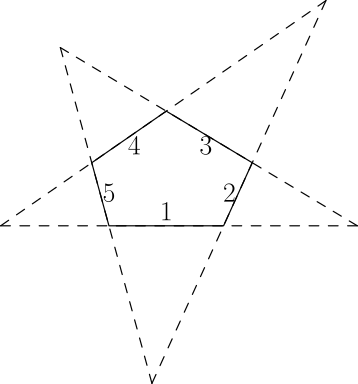
Let be the degree-sum of the interior angles at the points of the star; then equals:
Small Hint:
Relate each star-tip angle to two adjacent interior angles of the original polygon
Big Hint:
The original polygon’s interior-angle sum is degrees
Solution:
Let the original polygon’s interior angles be The star angle made from sides and equals Summing cyclically counts each twice. Hence
Therefore, the correct answer is E.
22.
Consider the statements:
where we allow and to be real or complex numbers. Those statements for which there exist solutions other than and are:
only
only
only
only
Small Hint:
One nonzero example is enough for each statement
Big Hint:
Try for equal positive values for and for and
Solution:
Every statement has a nonzero solution. For use For use giving For both and use Thus all four statements qualify.
Therefore, the correct answer is A.
23.
If is real and then the complete set of values of for which is real, is:
or
or
or
Small Hint:
Treat the equation as a quadratic in
Big Hint:
Require its discriminant to be nonnegative
Solution:
As a quadratic in the equation has discriminant This is nonnegative exactly when or
Therefore, the correct answer is A.
24.
If and then equals:
a number greater than and less than
Small Hint:
Write both logarithms using natural logs
Big Hint:
The equality gives ; use
Solution:
Change of base gives so Equality of the logs themselves would give which is excluded. Hence and Thus
Therefore, the correct answer is B.
25.
If for and then equals:
Small Hint:
Simplify the recurrence to
Big Hint:
Count the increments from to
Solution:
Each step adds There are steps from to so
Therefore, the correct answer is D.
26.
Let be a positive integer and let the lines and intersect in a point whose coordinates are integers. Then can be:
only
only
only
only
one of the integers and one other positive integer
Small Hint:
Substitute into the first line
Big Hint:
For integer the number must divide
Solution:
Substitution gives Thus must be a positive divisor of Among divisors greater than only is congruent to Hence so
Therefore, the correct answer is C.
27.
At his usual rate a man rows miles downstream in five hours less time than it takes him to return. If he doubles his usual rate, the time downstream is only one hour less than the time upstream. In miles per hour, the rate of the stream’s current is:
Small Hint:
Let be the rower’s still-water speed and the current speed
Big Hint:
Translate the two time differences using speeds and
Solution:
The two time differences give These simplify to and Substituting into the second gives Since we have
Therefore, the correct answer is A.
28.
Five points are taken in order on a straight line with distances and is a point on the line between and and such that Then equals:
Small Hint:
Write Then and
Big Hint:
Cross-multiply the two given ratios after making those substitutions
Solution:
Let The given ratio becomes Cross-multiplication cancels the terms and yields Therefore
Thus, the correct answer is B.
29.
The number of positive integers less than divisible by neither nor is:
Small Hint:
There are positive integers below
Big Hint:
Subtract multiples of and , then add back multiples of
Solution:
By inclusion-exclusion, the count is
Therefore, the correct answer is B.
30.
If three of the roots of are and then the value of is:
Small Hint:
The missing coefficient makes the sum of all four roots zero
Big Hint:
Use the fourth root to compute the pairwise sum and product
Solution:
The fourth root is because the root sum is zero. The sum of pairwise products is while the product is Thus
Therefore, the correct answer is D.
31.
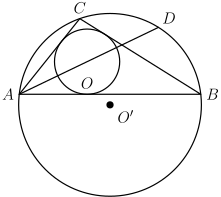
Triangle is inscribed in a circle with center A circle with center is inscribed in triangle is drawn, and extended to intersect the larger circle in Then we must have:
Small Hint:
Line bisects so is the midpoint of arc
Big Hint:
Compare angles in triangle to show
Solution:
Because is an angle bisector, the inscribed angles and are equal. Hence arcs and , and therefore chords and are equal.
Let and Then In triangle the exterior angle also equals Thus so
Therefore, the correct answer is D.
32.
Let be the midpoint of side of triangle Let be a point on between and and let be drawn parallel to and intersecting at If the ratio of the area of triangle to that of triangle is denoted by then:
depending upon the position of
independent of the position of
depending upon the position of
depending upon the position of
independent of the position of
Small Hint:
Triangles and have equal bases on parallel lines
Big Hint:
Add their areas to and use that is a median
Solution:
Since triangles and have the same base and equal altitudes, so their areas are equal. Hence Because is a median, Thus for every allowed
Therefore, the correct answer is B.
33.
If and the number of distinct values of satisfying the equation
is:
Small Hint:
Both sides contain the numerator after combining terms
Big Hint:
Factor the equation into that numerator times a difference of reciprocals
Solution:
Let Combining each side gives The first factor gives The second gives or giving and The hypotheses ensure that all three are defined and distinct.
Therefore, the correct answer is D.
34.
Let be the speed in miles per hour at which a wheel, feet in circumference, travels. If the time for a complete rotation of the wheel is shortened by of a second, the speed is increased by miles per hour. Then is:
Small Hint:
At miles per hour, one rotation takes seconds
Big Hint:
Set
Solution:
Since feet is mile, one rotation at mph takes seconds. Thus This reduces to or The positive speed is
Therefore, the correct answer is B.
35.
Let be an interior point of triangle and let If then:
for every triangle and
for every triangle and
for every triangle and
for every triangle and
neither nor nor nor applies to every triangle
Small Hint:
Add and
Big Hint:
Extend to side to prove and cycle
Solution:
Adding the three strict triangle inequalities gives
For the upper bound, extend to on Then and so cancellation gives Cycling and adding yields Therefore and
Thus, the correct answer is C.
36.
Let
be an identity in If we let then equals:
Small Hint:
Evaluate the polynomial at and
Big Hint:
Adding those two values cancels all odd-degree coefficients
Solution:
Let Then is the sum of all coefficients, while is the even-coefficient sum minus the odd-coefficient sum. Therefore
Therefore, the correct answer is E.
37.
Three men, Alpha, Beta, and Gamma, working together, do a job in hours less time than Alpha alone, in hour less time than Beta alone, and in one-half the time needed by Gamma when working alone. Let be the number of hours needed by Alpha and Beta, working together, to do the job. Then equals:
Small Hint:
Let be the time all three take together
Big Hint:
Their individual times are and ; add reciprocal rates
Solution:
If all three together take hours, then This simplifies to so Alpha and Beta alone take and hours, so their combined rate is Hence
Therefore, the correct answer is C.
38.
In triangle the medians and to sides and respectively, intersect in point is the midpoint of side and intersects in If the area of triangle is then the area of triangle is:
Small Hint:
Use an affine model and
Big Hint:
Find and compare the two areas
Solution:
Area ratios are affine-invariant, so take and Then Line is and it meets median at Thus while Their ratio is so
Therefore, the correct answer is D.
39.
In base the expanded fraction becomes and the expanded fraction becomes In base fraction when expanded, becomes while fraction becomes The sum of and each written in base ten, is:
Small Hint:
A repeating pair in base equals
Big Hint:
Add the equations for and then subtract them
Solution:
The two descriptions give Adding yields or Subtracting yields or Solving gives whose sum is
Therefore, the correct answer is E.
40.
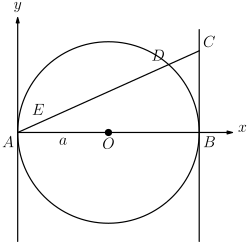
In this figure is a diameter of a circle, centered at with radius A chord is drawn and extended to meet the tangent to the circle at in point Point is taken on so that If the coordinates of are then:
Small Hint:
Drop perpendiculars from and to diameter
Big Hint:
Use between the two parallel tangents, then combine the altitude theorem with similar triangles
Solution:
Drop perpendiculars and to Since and the tangents through are parallel, their projections give Hence In right triangle the altitude theorem gives Similar triangles and give so Substitution and cancellation yield
Therefore, the correct answer is A.