
1958 AMC 12 Solutions
Scroll down to view professionally curated solutions from LIVE by Po-Shen Loh, print PDF solutions, view answer key, or take the full timed exam.
All problems are used with official legal permission of the Mathematical Association of America (MAA).
1.
The value of is:
Small Hint:
Evaluate the innermost difference before using the exponent
Big Hint:
An exponent of means to take a reciprocal
Solution:
Since its reciprocal is also Therefore
Thus, the correct answer is C.
2.
If then equals:
Small Hint:
Combine over a common denominator
Big Hint:
After finding take the reciprocal to obtain
Solution:
Combining the fractions, Taking reciprocals gives
Therefore, the correct answer is D.
3.
Of the following expressions, the one equal to is:
Small Hint:
Rewrite every negative power as a reciprocal
Big Hint:
Express over the common denominator
Solution:
We have Hence
Thus, the correct answer is B.
4.
In the expression each is replaced by The resulting expression, evaluated for equals:
none of these
Small Hint:
Let and simplify
Big Hint:
Combine the numerator and denominator of the composed fraction separately
Solution:
Let Then At the value is which is not listed.
Therefore, the correct answer is E.
5.
The expression equals:
Small Hint:
Rationalize the two reciprocal terms before adding them
Big Hint:
The two reciprocals simplify to quantities whose sum is
Solution:
Rationalizing gives Their sum is Therefore the whole expression is
Thus, the correct answer is A.
6.
The arithmetic mean between and when is:
if
only if
Small Hint:
Add the two given expressions and divide by
Big Hint:
The -terms cancel in the numerator
Solution:
The arithmetic mean is
Therefore, the correct answer is B.
7.
A straight line joins the points and Its -intercept is:
Small Hint:
First find the slope through the two given points
Big Hint:
Use one point to write the line equation, then set
Solution:
The slope is Using the line is Setting gives
Thus, the correct answer is A.
8.
Which of these four numbers, is (are) rational?
none
all
the first and fourth
only the fourth
only the first
Small Hint:
Evaluate each radical separately and remember that is irrational
Big Hint:
The last expression uses and
Solution:
The first number is which is irrational. The cube root of is irrational. Also is irrational. The fourth number is which is rational.
Therefore, only the fourth is rational, and the correct answer is D.
9.
A value of satisfying the equation is:
Small Hint:
Expand
Big Hint:
The -terms cancel, leaving a linear equation in
Solution:
Expanding the right side, Cancelling and solving gives
Therefore, the correct answer is C.
10.
For what real values of other than does the equation have real roots?
k<0
k>0
all values of
no values of
Small Hint:
Use the discriminant condition for a quadratic to have real roots
Big Hint:
Compute and use the restriction
Solution:
The discriminant is For every nonzero real this is negative, so the quadratic has no real roots.
Thus, the correct answer is E.
11.
The number of roots satisfying the equation is:
unlimited
Small Hint:
Move both sides to one side and factor the common radical
Big Hint:
Check separately when the radical is zero and when its remaining factor is zero
Solution:
Factoring gives Thus either or giving Both values lie in the domain and satisfy the original equation.
Therefore, there are two roots, and the correct answer is C.
12.
If then equals:
Small Hint:
Take logarithms of both sides of the equation
Big Hint:
Use and isolate
Solution:
Taking logarithms, Therefore
Thus, the correct answer is A.
13.
The sum of two numbers is their product is The sum of their reciprocals is:
Small Hint:
Call the numbers and , but do not solve for them individually
Big Hint:
Use
Solution:
If the numbers are and then
Therefore, the correct answer is B.
14.
At a dance party a group of boys and girls exchange dances as follows: one boy dances with girls, a second boy dances with girls, and so on, the last boy dancing with all the girls. If represents the number of boys and the number of girls, then:
It is impossible to determine a relation between and without knowing
Small Hint:
The numbers of partners form the sequence
Big Hint:
There are terms, so express the last term using the arithmetic-sequence formula
Solution:
The last of the terms in the sequence is This last number equals the total number of girls. Hence or
Thus, the correct answer is C.
15.
A quadrilateral is inscribed in a circle. If an angle is inscribed into each of the four segments outside the quadrilateral, the sum of these four angles, expressed in degrees, is:
Small Hint:
Let the four arcs cut off by the quadrilateral’s sides have measures summing to
Big Hint:
An angle in the outside segment of a side subtends the complementary major arc
Solution:
Let the four minor arcs cut off by the sides have measures whose sum is The angle in the outside segment corresponding to arc subtends the other arc, so its measure is The sum of the four angles is therefore
Thus, the correct answer is D.
16.
The area of a circle inscribed in a regular hexagon is The area of the hexagon is:
Small Hint:
The circle’s radius is the apothem of the regular hexagon
Big Hint:
For apothem the hexagon side is
Solution:
The circle has radius which is the hexagon’s apothem. Thus the side length is Using one-half the product of perimeter and apothem, the hexagon’s area is
Therefore, the correct answer is D.
17.
If is positive and then:
has no minimum or maximum value
the maximum value of is
the minimum value of is
the maximum value of is
the minimum value of is
Small Hint:
Subtract from both sides
Big Hint:
Double the resulting inequality and combine
Solution:
The inequality gives so Hence and the minimum possible value of is
Therefore, the correct answer is E.
18.
The area of a circle is doubled when its radius is increased by Then equals:
Small Hint:
Translate the doubled-area condition into
Big Hint:
After taking positive square roots, solve
Solution:
The doubled-area condition is Since the radii are positive, Thus
Thus, the correct answer is A.
19.
The sides of a right triangle are and and the hypotenuse is A perpendicular from the vertex divides into segments and adjacent respectively to and If then the ratio of to is:
Small Hint:
Use the projection relations and
Big Hint:
Divide the two projection equations to express in terms of
Solution:
Similarity from the altitude-to-hypotenuse construction gives Therefore
Thus, the correct answer is B.
20.
If then equals:
Small Hint:
Factor from the left side
Big Hint:
Once rewrite both sides as powers of
Solution:
We have so Thus giving Therefore
Therefore, the correct answer is C.
21.
In the accompanying figure and are equal chords of a circle with center Arc is a quarter-circle. Then the ratio of the area of triangle to the area of triangle is:
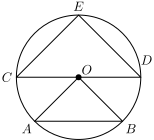
Small Hint:
The equal chords from make the pictured triangle symmetric about the perpendicular diameter
Big Hint:
Compare each triangle’s base-height area in terms of the circle radius
Solution:
Let the circle have radius In the pictured configuration, is a diameter and is the endpoint of the perpendicular radius, so Since arc is a quarter-circle, and The requested ratio is therefore
Thus, the correct answer is E.
22.
A particle is placed on the parabola at a point whose ordinate is It is allowed to roll along the parabola until it reaches the nearest point whose ordinate is The horizontal distance traveled by the particle (the numerical value of the difference in the abscissas of and ) is:
Small Hint:
Find the two -coordinates where the parabola has ordinate and the two where it has ordinate
Big Hint:
Pair each upper point with the nearer lower point on the same branch
Solution:
For so or For so or The nearest lower point to is and the nearest to is Either horizontal distance is
Therefore, the correct answer is C.
23.
If, in the expression increases or decreases by a positive amount the expression changes by an amount:
Small Hint:
Compute and for
Big Hint:
The constant term cancels in both differences
Solution:
For an increase, For a decrease, Together these changes are
Thus, the correct answer is A.
24.
A man travels feet due north at minutes per mile. He returns due south to his starting point at miles per minute. The average rate in miles per hour for the entire trip is:
impossible to determine without knowing the value of
Small Hint:
Convert both stated rates to miles per hour
Big Hint:
For equal distances, divide twice the one-way distance by the sum of the two travel times
Solution:
The northbound rate is mph, and the southbound rate is mph. For equal distances, the round-trip average is The distance cancels.
Therefore, the correct answer is B.
25.
If then equals:
Small Hint:
Use the chain identity
Big Hint:
Convert the resulting logarithmic equation to exponential form
Solution:
By the change-of-base identity, Hence so
Thus, the correct answer is E.
26.
A set of numbers has the sum Each number of the set is increased by then multiplied by and then decreased by The sum of the numbers in the new set thus obtained is:
Small Hint:
Apply all three operations to a typical original number
Big Hint:
After simplifying the transformed number, sum over all entries
Solution:
An original number becomes Summing over the original numbers therefore gives
Thus, the correct answer is B.
27.
The points and are on the same straight line. The value(s) of is (are):
or
or
Small Hint:
Compute the slope through the first two points
Big Hint:
Equate that slope to the slope from to
Solution:
The slope through the first two points is Thus which gives and
Therefore, the correct answer is A.
28.
A -quart radiator is filled with water. Four quarts are removed and replaced with pure antifreeze liquid. Then four quarts of the mixture are removed and replaced with pure antifreeze. This is done a third and a fourth time. The fractional part of the final mixture that is water is:
Small Hint:
Each removal takes away the same fraction of whatever water remains
Big Hint:
After one replacement, of the previous water remains
Solution:
Each removal takes one-fourth of the well-mixed radiator contents, so it leaves three-fourths of the water then present. After four replacements, the water fraction is
Therefore, the correct answer is B.
29.
In a general triangle (as shown), lines and are drawn. Which of the following angle relations is true?
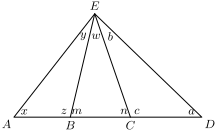
Small Hint:
Write the angle sum in triangle
Big Hint:
Write the angle sum in triangle , then compare the two equations
Solution:
Triangle gives Triangle gives Equating the left sides and cancelling yields
Thus, the correct answer is E.
30.
If and then equals:
Small Hint:
Combine using the common denominator
Big Hint:
Use to find , then add
Solution:
Since so Therefore
Therefore, the correct answer is C.
31.
The altitude drawn to the base of an isosceles triangle is and the perimeter is The area of the triangle is:
Small Hint:
Let each equal side be and half the base be
Big Hint:
Use and
Solution:
Let each equal side be and half the base be The perimeter gives The altitude bisects the base, so Thus giving Hence so the base is The area is
Therefore, the correct answer is B.
32.
With a rancher is to buy steers at each and cows at each. If the number of steers and the number of cows are both positive integers, then:
this problem has no solution
there are two solutions with exceeding
there are two solutions with exceeding
there is one solution with exceeding
there is one solution with exceeding
Small Hint:
Write and reduce it modulo
Big Hint:
The congruence and positivity leave only one possible positive value of
Solution:
The purchase equation is Reducing modulo gives Since is positive and the only possibility is Then There is one solution, and
Thus, the correct answer is E.
33.
For one root of to be double the other, the coefficients must be related as follows:
Small Hint:
Represent the two roots as and
Big Hint:
Apply Vieta’s formulas to their sum and product, then eliminate
Solution:
Let the roots be and Vieta’s formulas give Squaring the first relation yields Dividing this by the second relation gives or
Therefore, the correct answer is B.
34.
The numerator of a fraction is the denominator is and can have any value between and both included. The values of for which the numerator is greater than the denominator are:
Small Hint:
Compare the numerator and denominator directly by solving
Big Hint:
Intersect the resulting inequality with the given interval
Solution:
The required comparison gives so and Intersecting this with gives
Thus, the correct answer is A.
35.
A triangle is formed by joining three points whose coordinates are integers. If the -unit and the -unit are each inch, then the area of the triangle, in square inches:
must be an integer
may be irrational
must be irrational
must be rational
will be an integer only if the triangle is equilateral
Small Hint:
Translate one vertex to the origin and use the coordinate determinant for twice the area
Big Hint:
The determinant of integer coordinates is an integer
Solution:
After translating one vertex to the origin, write the other two as and with all coordinates integers. The area is Since is an integer, the area is an integer or a half-integer, and in either case it is rational.
Therefore, the correct answer is D.
36.
The sides of a triangle are and units. If an altitude is dropped upon the side of length the larger segment cut off on this side is:
Small Hint:
Let the altitude divide the side of length into and
Big Hint:
Equate the two expressions for the square of the altitude
Solution:
Let be the segment adjacent to the side of length If the altitude has length then Cancelling and solving gives The other segment is which is the larger one.
Thus, the correct answer is D.
37.
The first term of an arithmetic series of consecutive integers is The sum of terms of this series may be expressed as:
Small Hint:
Find the last term after increases from the first term
Big Hint:
Use the arithmetic-series average of the first and last terms
Solution:
The last term is The average of the first and last terms is Therefore the sum is
Therefore, the correct answer is A.
38.
Let be the distance from the origin to a point with coordinates and Designate the ratio by and the ratio by Then the values of are limited to the numbers:
less than and greater than both excluded
less than and greater than both included
between and both excluded
between and both included
and only
Small Hint:
Use to relate
Big Hint:
Rewrite as
Solution:
Since Thus Because this expression ranges from through with both endpoints included.
Thus, the correct answer is D.
39.
We may say concerning the solution of that:
there is only one root
the sum of the roots is
the sum of the roots is
the product of the roots is
the product of the roots is
Small Hint:
Set , so
Big Hint:
Factor the resulting quadratic in , then translate the admissible value back to
Solution:
Let Then The nonnegative solution is so and Their sum is
Therefore, the correct answer is C.
40.
Given and the general relation for Then equals:
Small Hint:
Use the recurrence first with to find
Big Hint:
Then use it with to solve for
Solution:
For so For which gives
Thus, the correct answer is B.
41.
The roots of are and For the roots of
to be and must equal:
Small Hint:
For the new monic quadratic, is the negative of the sum
Big Hint:
Write and use Vieta’s formulas for the original quadratic
Solution:
For the original quadratic, Hence The coefficient is the negative of this sum, so
Therefore, the correct answer is C.
42.
In a circle with center chord equals chord Chord cuts in If and then equals:
Small Hint:
Compare triangles and
Big Hint:
Angles and subtend the equal chords and
Solution:
Because lies on and triangles and share angle Also subtends chord while subtends chord Since these angles are equal. Thus Corresponding sides give Therefore so
Thus, the correct answer is E.
43.
is the hypotenuse of a right triangle Median and median The length of is:
Small Hint:
Let the legs opposite and have squared lengths and
Big Hint:
Use the two median formulas together with the Pythagorean relation for the hypotenuse
Solution:
Let and Since the right angle is at The median formulas give Solving yields and Therefore
Thus, the correct answer is D.
44.
Given the true statements:
If is greater than then is greater than
If is less than then is greater than
A valid conclusion is:
If is less than then is greater than
If is greater than then is less than
If is less than then is greater than
If is greater than then is less than
none of these
Small Hint:
Represent the comparisons as propositions and distinguish each implication from its converse
Big Hint:
The second premise’s hypothesis is incompatible with the first premise’s conclusion, but that alone does not chain the implications
Solution:
Let mean mean mean and mean The premises are The statements and cannot both hold. The contrapositives are and None of the four proposed implications follows. For example, knowing gives and hence but says nothing about knowing gives not
Therefore, the correct answer is E.
45.
A check is written for dollars and cents, and both two-digit numbers. In error it is cashed for dollars and cents, the incorrect amount exceeding the correct amount by Then:
cannot exceed
can equal
the amount of the check cannot be a multiple of
the incorrect amount can equal twice the correct amount
the sum of the digits of the correct amount is divisible by
Small Hint:
Write the correct and incorrect amounts in cents
Big Hint:
Their difference simplifies to
Solution:
In cents, the incorrect amount minus the correct amount is Since is cents, so The two-digit values satisfy this relation and have Thus that equality can occur.
Therefore, the correct answer is B.
46.
For values of less than but greater than the expression
has:
no maximum or minimum value
a minimum value of
a maximum value of
a minimum value of
a maximum value of
Small Hint:
Set which is negative on the given interval
Big Hint:
Rewrite the expression as and use the negative- form of AM-GM
Solution:
Set Then and the expression becomes For with equality when That value is allowed and corresponds to Hence the expression is at most and its maximum is
Thus, the correct answer is E.
47.
is a rectangle (see the accompanying diagram) with any point on and and Then is equal to:
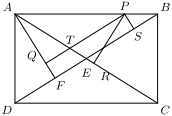
Small Hint:
Because and identify the small parallelogram near and
Big Hint:
Use the intersection to compare the right triangles and
Solution:
Since and we have Also so Thus quadrilateral is a rectangle, and Let The diagonals of a rectangle make equal angles with side so giving The right triangles and are similar because they share the angle at Since their hypotenuses and are equal, Therefore
Thus, the correct answer is D.
48.
Diameter of a circle with center is units. is a point units from and on is a point units from and on is any point on the circle. Then the broken-line path from to to
has the same length for all positions of
exceeds units for all positions of
cannot exceed units
is shortest when is a right triangle
is longest when is equidistant from and
Small Hint:
Place the center at the origin and the diameter on the -axis, so and
Big Hint:
For on the circle, compare and
Solution:
Place and with Then Therefore This is largest when exactly when
Therefore, the correct answer is E.
49.
In the expansion of there are dissimilar terms. The number of dissimilar terms in the expansion of is:
Small Hint:
A term is determined by nonnegative exponents whose sum is
Big Hint:
Count the solutions of by stars and bars
Solution:
Each distinct term is for nonnegative integers satisfying By stars and bars, the number of such triples is
Thus, the correct answer is D.
50.
In this diagram a scheme is indicated for associating all the points of segment with those of segment and reciprocally. To describe this association scheme analytically, let be the distance from a point on to and let be the distance from the associated point of to Then for any pair of associated points, if equals:
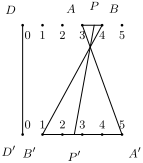
Small Hint:
The perspective lines in the diagram associate with and with
Big Hint:
Because the two numbered segments are parallel, the induced relation between and is linear
Solution:
The two numbered segments are parallel, so projection through the fixed intersection point gives a linear relation between and The endpoint associations shown are and The slope is so If then
Therefore, the correct answer is C.