
1954 AMC 12 Solutions
Scroll down to view professionally curated solutions from LIVE by Po-Shen Loh, print PDF solutions, view answer key, or take the full timed exam.
All problems are used with official legal permission of the Mathematical Association of America (MAA).
1.
The square of is:
Small Hint:
Use
Big Hint:
The constant cancels with the inside the squared radical
Solution:
Expanding gives
Thus, the correct answer is E.
2.
The equation can be transformed by eliminating fractions to the equation The roots of the latter equation are and Then the roots of the first equation are:
and
only
only
neither nor
and some other root
Small Hint:
Check both roots against the denominator in the original equation
Big Hint:
Clearing a denominator can introduce a value at which the original expression is undefined
Solution:
The transformed quadratic factors as However, the original equation has denominator so it is undefined at Substitution of is valid and satisfies the original equation.
Thus, the only root is and the correct answer is C.
3.
If varies as the cube of and varies as the fifth root of then varies as the th power of where is:
Small Hint:
Write and
Big Hint:
Substitute the second variation law into the first and multiply the exponents
Solution:
Since is proportional to its cube is proportional to Because is proportional to Hence
Thus, the correct answer is C.
4.
If the Highest Common Divisor of and is diminished by it will equal:
Small Hint:
Use the Euclidean algorithm or factor the two numbers
Big Hint:
Their greatest common divisor is
Solution:
The Euclidean algorithm gives Diminishing this by gives
Thus, the correct answer is E.
5.
A regular hexagon is inscribed in a circle of radius inches. Its area is:
sq. in.
sq. in.
sq. in.
sq. in.
sq. in.
Small Hint:
An inscribed regular hexagon has side length equal to the circle’s radius
Big Hint:
Divide the hexagon into six equilateral triangles of side
Solution:
The hexagon consists of six equilateral triangles of side Its area is square inches.
Thus, the correct answer is A.
6.
The value of is:
Small Hint:
Evaluate each of the four terms separately, using
Big Hint:
The real fifth root of is , so
Solution:
For permissible the four terms are Therefore the expression is
Thus, the correct answer is D.
7.
A housewife saved in buying a dress on sale. If she spent for the dress, she saved about:
Small Hint:
Add the savings to the sale price to recover the original price
Big Hint:
Compute as a percentage
Solution:
The original price was The fraction saved was or about
Thus, the correct answer is B.
8.
The base of a triangle is twice as long as a side of a square and their areas are the same. Then the ratio of the altitude of the triangle to the side of the square is:
Small Hint:
Let the square’s side be and the triangle’s altitude be
Big Hint:
Equate with
Solution:
If the square side is the triangle base is Equal areas give Thus so the requested ratio is
The correct answer is C.
9.
A point is outside a circle and is inches from the center. A secant from cuts the circle at and so that the external segment of the secant is inches and is inches. The radius of the circle is:
in.
in.
in.
in.
in.
Small Hint:
The secant power is the external length times the whole secant length
Big Hint:
Equate with
Solution:
The power of is It is also so Hence and inches.
Thus, the correct answer is C.
10.
The sum of the numerical coefficients in the expansion of the binomial is:
Small Hint:
The coefficient sum is obtained by choosing convenient values of and
Big Hint:
Set
Solution:
Setting makes every monomial equal to so the value of the expansion equals the sum of its coefficients. Thus the sum is
The correct answer is C.
11.
A merchant placed on display some dresses, each with a marked price. He then posted a sign “ off on these dresses.” The cost of the dresses was of the price at which he actually sold them. Then the ratio of the cost to the marked price was:
Small Hint:
The selling price is of the marked price
Big Hint:
The cost is of that selling price
Solution:
If the marked price is then the selling price is The cost is therefore The cost-to-marked-price ratio is
Thus, the correct answer is A.
12.
The solution of the equations is:
and
and
There is no solution
There are an unlimited number of solutions
and
Small Hint:
Compare the second left-hand side with twice the first
Big Hint:
Doubling the first equation would require the right-hand side to be , not
Solution:
The left side of the second equation is exactly twice the left side of the first, but its right side is not twice The equations would require the same expression to equal both and which is impossible.
Thus, there is no solution, and the correct answer is C.
13.
A quadrilateral is inscribed in a circle. If angles are inscribed in the four arcs cut off by the sides of the quadrilateral, without intersecting the sides between vertices, their sum will be:
Small Hint:
Let the four consecutive arc measures be
Big Hint:
An angle whose vertex lies in the arc of measure intercepts the other three arcs, of total measure
Solution:
Let the four arcs have measures whose sum is The angle placed in the arc of measure intercepts the other three arcs, so it measures and similarly for the others. Their sum is
Thus, the correct answer is B.
14.
When simplified equals:
Small Hint:
Put over the denominator
Big Hint:
The numerator becomes
Solution:
For Because its square root is
Thus, the correct answer is E.
15.
equals:
Small Hint:
Write
Big Hint:
Use and
Solution:
Using logarithm laws,
Thus, the correct answer is D.
16.
If then equals:
Small Hint:
Substitute into the polynomial before subtracting
Big Hint:
After cancellation, factor out
Solution:
Expanding and canceling gives
Thus, the correct answer is D.
17.
The graph of the function goes:
up to the right and down to the left
down to the right and up to the left
up to the right and up to the left
down to the right and down to the left
none of these ways
Small Hint:
The constant shifts the graph vertically but does not change its end behavior
Big Hint:
A positive odd-degree leading term tends to on the right and on the left
Solution:
The leading term controls the end behavior. As tends to tends to as tends to tends to Thus the graph goes up to the right and down to the left.
The correct answer is A.
18.
Of the following sets, the one that includes all values of which will satisfy is:
Small Hint:
Collect the -terms on one side and constants on the other
Big Hint:
Adding to both sides gives
Solution:
Adding to both sides gives so
Thus, the correct answer is D.
19.
If the three points of contact of a circle inscribed in a triangle are joined, the angles of the resulting triangle:
are always equal to
are always one obtuse angle and two unequal acute angles
are always one obtuse angle and two equal acute angles
are always acute angles
are always unequal to each other
Small Hint:
Join the incenter to two adjacent points of tangency
Big Hint:
The angle of the contact triangle opposite vertex angle is
Solution:
The radii to two adjacent tangency points are perpendicular to the corresponding sides. The central angle between those radii is The relevant angle of the contact triangle is half the intercepted arc, giving The other two angles are and Since every triangle angle lies strictly between and all three are acute.
Thus, the correct answer is D.
20.
The equation has:
no negative real roots
no positive real roots
no real roots
positive and negative roots
positive and negative root
Small Hint:
Test the small negative integers suggested by the constant term
Big Hint:
The polynomial factors as
Solution:
The polynomial factors as Its roots are so it has no positive real roots.
Thus, the correct answer is B.
21.
The roots of the equation can be found by solving:
Small Hint:
Multiply by to remove the negative exponent
Big Hint:
Isolate the radical in before squaring
Solution:
Multiplying by gives Squaring and simplifying, so
Thus, the correct answer is C.
22.
The expression cannot be evaluated for or since division by zero is not allowed. For other values of
The expression takes on many different values.
The expression has only the value
The expression has only the value
The expression always has a value between and
The expression has a value greater than or less than
Small Hint:
Combine the two fractions over their common denominator
Big Hint:
The numerator factors as
Solution:
Combining the numerators gives For the allowed values the factors cancel and the expression equals
Thus, the correct answer is B.
23.
If the margin made on an article costing dollars and selling for dollars is then the margin is given by:
Small Hint:
Use together with
Big Hint:
Express in terms of , then divide by
Solution:
Since Therefore
Thus, the correct answer is D.
24.
The values of for which the equation will have real and equal roots are:
and
only
and
and
only
Small Hint:
Combine the linear terms to write the coefficient of as
Big Hint:
Set the discriminant equal to zero
Solution:
A repeated real root requires Thus so The two values are and
Thus, the correct answer is A.
25.
The two roots of the equation are and:
Small Hint:
Use the product of the roots rather than solving the quadratic
Big Hint:
The product is the constant coefficient divided by the leading coefficient
Solution:
By Vieta’s formulas, the product of the two roots is Since one root is the other root equals this product.
Thus, the correct answer is D.
26.
The straight line is divided at so that Circles are described on and as diameters and a common tangent meets produced at Then equals:
the diameter of the smaller circle
the radius of the smaller circle
the radius of the larger circle
the difference of the two radii
Small Hint:
The point is the external center of similitude of the two circles
Big Hint:
Let and compare the distances from to the two centers in the ratio
Solution:
Let so and Measured from the circle centers are at and and their radii are in the ratio If the common external tangent makes the external center of similitude, so Hence and which is the radius of the smaller circle.
Thus, the correct answer is B.
27.
A right circular cone has for its base a circle having the same radius as a given sphere. The volume of the cone is one-half that of the sphere. The ratio of the altitude of the cone to the radius of its base is:
28.
If and the value of is:
Small Hint:
The given ratios imply
Big Hint:
Write and
Solution:
Multiplying the two given ratios, Put and Then
Thus, the correct answer is B.
29.
If the ratio of the legs of a right triangle is then the ratio of the corresponding segments of the hypotenuse made by a perpendicular upon it from the vertex is:
Small Hint:
The two hypotenuse segments are the projections of the legs
Big Hint:
By similarity, their ratio is the ratio of the squares of the corresponding legs
Solution:
If the legs have lengths and their projections on the hypotenuse have lengths and Their ratio is therefore With this is
Thus, the correct answer is A.
30.
and together can do a job in days; and can do it in four days; and and in days. The number of days required for to do the job alone is:
Small Hint:
Let be the fractions of the job completed per day
Big Hint:
Add and , then subtract
Solution:
Let be the individual daily rates. Then Thus so Therefore needs days.
Thus, the correct answer is B.
31.
In triangle Point is within the triangle with The number of degrees in angle is:
Small Hint:
The base angles of triangle are both
Big Hint:
If the equal angles are then the other part of angle is
Solution:
The base angles of the isosceles triangle are Put Then In triangle
Thus, the correct answer is A.
32.
The factors of are:
Small Hint:
Add and subtract to form a difference of squares
Big Hint:
Write
Solution:
Using a difference of squares,
Thus, the correct answer is E.
33.
A bank charges for a loan of The borrower receives and repays the loan in installments of a month. The interest rate is approximately:
Small Hint:
The charge is interest on a balance that decreases by each month
Big Hint:
Approximate the average outstanding principal by the average of and
Solution:
The balance decreases in equal steps from to so its average outstanding value is approximately The annual charge is therefore about The nearest choice is
Thus, the correct answer is D.
34.
The fraction
equals
is less than by
is less than by
is greater than by
is greater than by
Small Hint:
Write as
Big Hint:
Subtract this terminating decimal from using the denominator
Solution:
Exactly, Thus is greater by the stated amount.
Thus, the correct answer is D.
35.
In the right triangle shown the sum of the distances and is equal to the sum of the distances and If and then equals:
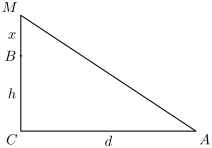
Small Hint:
Use the Pythagorean theorem to express in terms of
Big Hint:
From isolate the radical and square
Solution:
The condition and the Pythagorean theorem give After isolating the radical and squaring, Cancelling common terms leaves so
Thus, the correct answer is A.
36.
A boat has a speed of mph in still water. In a stream that has a current of mph it travels a certain distance downstream and returns. The ratio of the average speed for the round trip to the speed in still water is:
Small Hint:
The downstream and upstream speeds are mph and mph
Big Hint:
For equal distances, divide twice the distance by
Solution:
For a one-way distance the total time is Thus the round-trip average speed is Its ratio to is
Thus, the correct answer is C.
37.
Given triangle with bisecting extended to and a right angle, then:
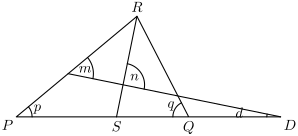
none of these is correct
Small Hint:
The bisected angle at measures before it is halved
Big Hint:
Since the transversal is perpendicular to the angle bisector, complements half of
Solution:
The angle at is Because bisects this angle, the angle between and is The line forming is perpendicular to so
Thus, the correct answer is B.
38.
If and the value of when is approximately:
Small Hint:
Divide by to obtain
Big Hint:
Use and divide by
Solution:
The equation reduces to so
Thus, the correct answer is B.
39.
The locus of the midpoint of a line segment that is drawn from a given external point to a given circle with center and radius is:
a straight line perpendicular to
a straight line parallel to
a circle with center and radius
a circle with center at the midpoint of and radius
a circle with center at the midpoint of and radius
Small Hint:
Let the variable endpoint on the given circle be and its midpoint with be
Big Hint:
The map is a dilation centered at with scale factor
Solution:
As the endpoint moves on the circle centered at its midpoint with the fixed point is the image of under a dilation of scale centered at Therefore the locus is a circle whose center is the midpoint of and whose radius is
Thus, the correct answer is E.
40.
If then equals:
Small Hint:
Set , so the given condition is
Big Hint:
Use
Solution:
Let The standard cubic identity gives Since this expression is
Thus, the correct answer is C.
41.
The sum of all the roots of is:
Small Hint:
Use Vieta’s formula for the sum of the roots of a cubic
Big Hint:
Negate the coefficient of and divide by the coefficient of
Solution:
For the sum of the roots is Here it is
Thus, the correct answer is B.
42.
Consider the graphs of and on the same set of axes. These parabolas have exactly the same shape. Then:
the graphs coincide.
the graph of is lower than the graph of
the graph of is to the left of the graph of
the graph of is to the right of the graph of
the graph of is higher than the graph of
Small Hint:
Find the -coordinate of each vertex using
Big Hint:
Graph has vertex , whereas graph has vertex
Solution:
The vertex of has -coordinate Thus graph has its vertex at while graph has its vertex at Their vertex heights are equal, so graph is the same parabola shifted to the right.
Thus, the correct answer is D.
43.
The hypotenuse of a right triangle is inches and the radius of the inscribed circle is inch. The perimeter of the triangle in inches is:
Small Hint:
For a right triangle with legs and hypotenuse the inradius is
Big Hint:
Substitute and to find
Solution:
For a right triangle, With and this gives Hence the perimeter is
Thus, the correct answer is B.
44.
A man born in the first half of the nineteenth century was years old in the year He was born in:
Small Hint:
His birth year is
Big Hint:
Use the requirement that is a nineteenth-century year and test the nearby integer
Solution:
The year must lie in the nineteenth century, so because while the neighboring squares fall outside the relevant range. His birth year is therefore which is in the first half of the century.
Thus, the correct answer is E.
45.
In a rhombus line segments are drawn within the rhombus, parallel to diagonal and terminated in the sides of the rhombus. A graph is drawn showing the length of a segment as a function of its distance from vertex The graph is:
a straight line passing through the origin.
a straight line cutting across the upper right quadrant.
two line segments forming an upright
two line segments forming an inverted
none of these.
Small Hint:
Imagine moving a segment parallel to from toward the opposite vertex
Big Hint:
Its length grows linearly to the full diagonal and then decreases linearly to zero
Solution:
Starting at the parallel cross section has length and grows linearly until it reaches the diagonal Continuing toward the opposite vertex, its length decreases linearly back to The graph is therefore made of two line segments forming an inverted
Thus, the correct answer is D.
46.
In the diagram, if points and are points of tangency, then equals:
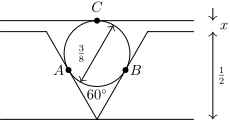
Small Hint:
The marked -inch measure is the circle’s diameter
Big Hint:
With radius the center is inch above the vertex because
Solution:
The radius is inch. The center lies on the angle bisector. The perpendicular radius to either sloping side and the segment from the vertex to the center form a right triangle with a angle, so the center is inch above the vertex. Hence the top tangent is inch above the vertex. Since the ledge is inch above the vertex,
Thus, the correct answer is E.
47.
At the midpoint of line segment which is units long, a perpendicular is erected with length units. An arc is described from with a radius equal to meeting at Then and are the roots of:
Small Hint:
The sum is
Big Hint:
Use in right triangle to show
Solution:
Let Since the Pythagorean theorem gives Also, Their sum is and their product is Therefore they are the roots of
Thus, the correct answer is B.
48.
A train, an hour after starting, meets with an accident which detains it a half hour, after which it proceeds at of its former rate and arrives hours late. Had the accident happened miles farther along the line, it would have arrived only hours late. The length of the trip in miles was:
Small Hint:
Let the normal speed be and the trip length be ; slowing to adds one-third of the normal time on the affected distance
Big Hint:
Use the two late-arrival equations to find first , then
Solution:
Let the normal speed be and the trip length be Traveling a distance at rather than adds one-third of its normal travel time. In the first case, so If the accident happens miles farther along, Substituting gives hence and
Thus, the correct answer is C.
49.
The difference of the squares of two odd numbers is always divisible by If and and are the odd numbers, to prove the given statement we put the difference of the squares in the form:
Small Hint:
Expand the two squares and group each variable with its successor
Big Hint:
Each product and is even
Solution:
Expanding and regrouping, Each of and is even, so their difference is even. The displayed expression is consequently divisible by
Thus, the correct answer is C.
50.
The times between and o’clock, correct to the nearest minute, when the hands of a clock will form an angle of degrees are:
and
and
and
and
and
Small Hint:
At minutes after the signed separation of the hands is
Big Hint:
Solve for both values of
Solution:
At minutes after the hour hand is at and the minute hand is at Thus The two solutions are To the nearest minute, the times are and
Thus, the correct answer is A.