
2025 AMC 10B Solutions
Scroll down to view professionally curated solutions from LIVE by Po-Shen Loh, print PDF solutions, view answer key, or take the full timed exam.
All problems are used with official legal permission of the Mathematical Association of America (MAA).
1.
The instructions on a -gram bag of coffee beans say that proper brewing of a large mug of pour-over coffee requires grams of coffee beans. What is the greatest number of properly brewed large mugs of coffee that can be made from the coffee beans in that bag?
Small Hint:
Each mug uses grams, so divide the total mass by
Big Hint:
A partial mug does not count, so round down to a whole number
Solution:
Each mug needs grams, so we divide: A half mug isn’t a mug, so round down. That leaves Thus, B is the correct answer.
2.
Jerry wrote down the ones digit of each of the first positive squares: What is the sum of all the numbers Jerry wrote down?
Small Hint:
The ones digit of depends only on the ones digit of so the list repeats every terms
Big Hint:
One full block sums to there are full blocks and leftover terms
Solution:
The ones digit of depends only on the ones digit of so the list repeats every terms: One block sums to Now so we get full blocks plus the first five terms: Therefore, the answer is D.
3.
A Pascal-like triangle has as the top row and followed by as the second row. In each subsequent row the first number is the last number is and, as in the standard Pascal’s Triangle, each other number in the row is the sum of the two numbers directly above it. The first four rows are shown below.
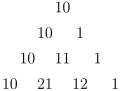
What is the sum of the digits of the sum of the numbers in the th row?
Small Hint:
Track only the row sums. Each interior entry is counted by both of the two entries below it
Big Hint:
Show for with then compute
Solution:
Let be the sum of row Each entry in row feeds the two entries just below it, and the fixed border numbers and exactly make up for the terms lost at the edges. So for With this gives so Its digits sum to Thus, D is the correct answer.
4.
The value of the two-digit number in base seven equals the value of the two-digit number in base nine. What is
Small Hint:
By place value, in base seven is and in base nine is
Big Hint:
The equation reduces to find digits with a valid base-seven digit
Solution:
By place value, in base seven is and in base nine is Set them equal: so that is Thus and Because these are two-digit numerals, because is a base-seven digit, Hence and so Therefore, the answer is A.
5.
In and Let be the center of the circle containing points and What is the degree measure of
Small Hint:
is the circumcenter, so Relate the central angle to the inscribed angle
Big Hint:
Because is obtuse, then use the isosceles triangle
Solution:
Since is the circumcenter, The inscribed angle subtends arc and because is obtuse, the central angle is Triangle is isosceles, so (The lengths and never enter.) Thus, C is the correct answer.
6.
The line divides the square region defined by and into an upper region and a lower region. The line divides the lower region into two regions of equal area. Then can be written as where and are positive integers. What is
Small Hint:
The lower region left of is a trapezoid with vertical sides and and width
Big Hint:
The total lower area is so set equal to half of it, and solve the quadratic
Solution:
The lower region has area The slice with is a trapezoid of area We want that to be half the total, namely so and Then and Therefore, the answer is C.
7.
Frances stands meters directly south of a locked gate in a fence that runs east-west. Immediately behind the fence is a box of chocolates, located meters east of the locked gate. An unlocked gate lies meters east of the box, and another unlocked gate lies meters west of the locked gate. Frances can reach the box by walking toward an unlocked gate, passing through it, and walking toward the box. It happens that the total distance Frances would travel would be the same via either unlocked gate. What is the value of
Small Hint:
Put the locked gate at the origin and Frances at each route is a straight walk to a gate plus a walk along the fence to the box
Big Hint:
The west route totals set it equal to and square
Solution:
Put the fence on the -axis, the locked gate at the origin, and Frances at Then the box is at the east gate at and the west gate at The east route is the west route is Set them equal: Square and simplify to get so Thus, C is the correct answer.
8.
Emmy says to Max, “I ordered math club sweatshirts today.” Max asks, “How much did each shirt cost?” Emmy responds, “I’ll give you a hint. The total cost was where and are digits and ” After a pause, Max says, “That was a good price.” What is
Small Hint:
Write the total in cents: is cents, and it must be divisible by
Big Hint:
Reduce the condition modulo to test digits to find the unique
Solution:
In cents the total is Split evenly among shirts, so it’s divisible by Now and so we need which reduces to The only digit solution with is since That’s or a shirt, so Therefore, the answer is C.
9.
How many ordered triples of integers satisfy the following system of inequalities?
Small Hint:
The last three inequalities are symmetric in let
Big Hint:
Then with equal parity and count such triples
Solution:
Let The last three inequalities say the first says and Since and so on, must all share the same parity. Now count triples with each part equal parity, and sum in The even ones are the permutations of of and of giving The only odd one is That’s in all, and each yields a unique Thus, C is the correct answer.
10.
Let and let What is the sum of all integer values of for which is also an integer?
Small Hint:
Both cubics have as a root; factor each and cancel common factors
Big Hint:
The ratio simplifies to it is an integer only when divides
Solution:
Factor both cubics: and Away from where vanishes or the ratio is the common factors cancel and That’s an integer only when so or But kills so only survives, and the sum is Therefore, the answer is A.
11.
On Monday, students went to the tutoring center at the same time, and each one was randomly assigned to one of the tutors on duty. On Tuesday, the same students showed up, the same tutors were on duty, and the students were again randomly assigned to the tutors. What is the probability that exactly students met with the same tutor both Monday and Tuesday?
Small Hint:
Each day’s assignment is a permutation; comparing the two days is like a single random permutation, and “same tutor” means a fixed point
Big Hint:
Choose the matched students in ways and derange the other (there are derangements); divide by
Solution:
Each day’s assignment is a permutation of the students among the tutors. Comparing the two days, the number who keep the same tutor is the number of fixed points of itself a uniformly random permutation of elements. We want exactly fixed points, so choose those in ways and derange the other where The probability is Thus, B is the correct answer.
12.
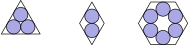
The figure below shows an equilateral triangle, a rhombus with a angle, and a regular hexagon, each of them containing some mutually tangent congruent disks. Let and respectively, denote the ratio in each case of the total area of the disks to the area of the enclosing polygon.
Which of the following is true?
Small Hint:
For a disk tangent to two sides meeting at angle its center is at distance from the vertex
Big Hint:
Use the tangency conditions to write each disk radius in terms of the polygon’s size, then compute (disk area) / (polygon area) in each case
Solution:
Take the triangle with side Three disks of radius give so For the rhombus with side the two disks sit on the long diagonal so and For the hexagon with side each of the six disks touches a side at its midpoint, again giving and So Therefore, the answer is C.
13.
The altitude to the hypotenuse of a -- right triangle is divided into two segments of lengths by the median to the shortest side of the triangle. What is the ratio
Small Hint:
Set the right angle at the origin with legs along the axes (short leg long leg ); find the foot of the altitude and the median line
Big Hint:
Intersect the altitude with the median to the short side, then take the ratio of the near segment to the whole altitude
Solution:
Place the right angle at the short leg with and the long leg with The altitude from to hypotenuse has foot and runs along The median from to the midpoint of meets that altitude at This cuts (length ) into and so and Thus, A is the correct answer.
14.
Nine athletes, no two of whom are the same height, try out for the basketball team. One at a time, they draw a wristband at random, without replacement, from a bag containing blue bands, red bands, and green bands. They are divided into a blue group, a red group, and a green group. The tallest member of each group is named the group captain. What is the probability that the group captains are the three tallest athletes?
Small Hint:
The captains are the three tallest exactly when the three tallest end up in three different groups
Big Hint:
Assign the top three to slots one at a time: the probabilities that each new one lands in a fresh group are then
Solution:
The captains are the three tallest exactly when those three land in three different groups, since each is then the tallest of its own group. Drop them into the slots one at a time ( per group). The second tallest misses the first’s group with probability and the third misses both with probability So the probability is Therefore, the answer is C.
15.
The sum
can be expressed as where and are relatively prime positive integers. What is
Small Hint:
Factor the denominator as and use partial fractions
Big Hint:
The pieces telescope; only leave a remainder
Solution:
Factor then split into partial fractions: Summing over all the coefficient of cancels for so only the first few terms survive: So Thus, D is the correct answer.
16.
A circle has been divided into sectors of different sizes. Then of the sectors are painted red, painted green, and painted blue so that no two neighboring sectors are painted the same color. One such coloring is shown below.
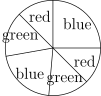
How many different colorings are possible?
Small Hint:
The unequal sectors form a fixed cycle of positions; you need proper colorings using each color exactly twice
Big Hint:
A -cycle has proper -colorings; remove those that do not use each color exactly twice
Solution:
The six unequal sectors form a fixed cycle of distinguishable positions, so we want proper -colorings of a -cycle that use each color exactly twice. There are proper -colorings altogether. Of these, use only two colors: choose the missing color in ways, then alternate the other two colors in ways. Another have color counts : choose the color used three times in ways, choose one of the alternating sets of positions for it, choose the color used twice in ways, and choose its positions among the other in ways. The remaining use each color exactly twice. Therefore, the answer is D.
17.
Consider a decreasing sequence of positive integers that satisfies the following conditions. The average of the first terms in the sequence is For all the average of the first terms in the sequence is less than the average of the first terms in the sequence.
What is the greatest possible value of
Small Hint:
Let be the average of the first terms; the conditions give for
Big Hint:
Then for require it to stay a positive integer
Solution:
Let be the average of the first terms. Then and for so The partial sum is and for the terms are namely These stay positive as long as that is with This bound is attainable: take which is decreasing, sums to and lies above Thus the greatest possible value is so B is the correct answer.
18.
What is the ones digit of the sum (Recall that denotes the greatest integer less than or equal to )
Small Hint:
for the values
Big Hint:
Since sum for to and add the final term
Solution:
For each on the integers Since the terms with contribute and tacks on That sum is so the total is Its ones digit is Therefore, the answer is D.
19.
A container has a square bottom, a open square top, and four congruent trapezoidal sides, as shown. Starting when the container is empty, a hose that runs water at a constant rate takes minutes to fill the container up to the midline of the trapezoids.
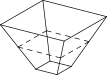
How many more minutes will it take to fill the remainder of the container?
Small Hint:
The container is a piece of a pyramid; the volume from the apex up to side length scales as
Big Hint:
Volumes split as (up to the midline, side ) and (remainder); scale the minutes
Solution:
The container is a square frustum: a horizontal slice at height fraction has side Extend the sides up to their apex, and the volume out to where the side length is scales as So the whole container is parts, the piece up to the midline (side ) is parts, and the rest is parts. Those parts take minutes, so each part is minutes. The remaining parts take minutes. Thus, D is the correct answer.
20.
Four congruent semicircles are inscribed in a square of side length so that their diameters are on the sides of the square, one endpoint of each diameter is at a vertex of the square, and adjacent semicircles are tangent to each other. A small circle centered at the center of the square is tangent to each of the four semicircles, as shown below.
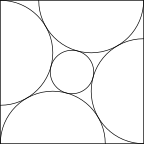
The diameter of the small circle can be written as where and are integers. What is
Small Hint:
First find the semicircle radius from the tangency of two adjacent semicircles whose diameters start at neighboring vertices
Big Hint:
The small radius equals (distance from the square’s center to a semicircle’s center) minus then factor into two binomials
Solution:
Let each semicircle have radius with centers like and Adjacent semicircles are tangent, so these centers are apart: This gives so The small circle of radius sits at and it’s tangent to a semicircle when its distance to that center equals That distance is so and the diameter is So Therefore, the answer is A.
21.
Each of the squares in a grid is to be colored red, blue, or yellow in such a way that each red square shares an edge with at least one blue square, each blue square shares an edge with at least one yellow square, and each yellow square shares an edge with at least one red square. Colorings that can be obtained from one another by rotations and/or reflections are to be considered the same. How many different colorings are possible?
Small Hint:
The rules form a directed cycle: red needs a blue neighbor, blue needs a yellow, yellow needs a red
Big Hint:
Count all valid colorings of the fixed labeled grid, then group them by the rotations and reflections of the square
Solution:
First count colorings of a grid whose positions are distinguished. Fix the center square as red and list the four edge-middle colors cyclically. Up to a rotation or reflection, the only possible edge patterns are and The first has placements and possible cyclic corner strings, and the second has placements and possible corner strings, and Thus there are colorings with a red center. The center has possible colors, so there are labeled colorings.
Now apply Burnside’s lemma. The identity fixes all colorings. No nonidentity rotation fixes a valid coloring. Each of the two reflections across a horizontal or vertical axis fixes colorings, while each diagonal reflection fixes none. Therefore, the number of colorings up to rotations and reflections is Thus, C is the correct answer.
22.
A seven-digit positive integer is chosen at random. What is the probability that the number is divisible by given that the sum of its digits is
Small Hint:
A digit sum of is below the maximum so the digits are all except a total shortfall of
Big Hint:
For divisibility by use the alternating digit sum; express it through the shortfalls on the odd- versus even-position digits
Solution:
A digit sum of means all seven digits are except for a total deficit of which gives numbers. For divisibility by we need where sums the odd-position digits and the even ones. Write the deficits as Then a multiple of only when So all of the deficit falls on the even positions, giving ways. The probability is Therefore, the answer is A.
23.
A rectangular grid of squares has rows and columns. Each square has room for two numbers. Horace and Vera each fill in the grid by putting the numbers from through into the squares. Horace fills the grid horizontally: he puts through in order from left to right into row puts through into row in order from left to right, and continues similarly through row Vera fills the grid vertically: she puts through in order from top to bottom into column then through into column in order from top to bottom, and continues similarly through column How many squares get two copies of the same number?
Small Hint:
At row column Horace writes and Vera writes set them equal
Big Hint:
The equation reduces to find the columns that make an integer in range
Solution:
At row column Horace writes and Vera writes Set them equal and simplify to get so an integer exactly when For that’s values, and runs all within range. So squares match. Thus, C is the correct answer.
24.
A frog hops along the number line according to the following rules. It starts at If it is at then it moves to with probability and it disappears with probability For or if it is at then it moves to with probability it moves to with probability and it disappears with probability
What is the probability that the frog reaches
Small Hint:
Let be the probability of ever reaching starting from with set up one equation per state
Big Hint:
Use and for then solve the system
Solution:
Let be the probability of reaching from position with The rules give and Work upward: and These unwind to and finally Therefore, the answer is E.
25.
Square has sides of length Points and lie on and respectively, with and A path begins along the line segment from to and continues by reflecting against the sides of (with congruent incoming and outgoing angles), as shown in the figure. If the path hits a vertex of the square, then it terminates there; otherwise it continues forever.
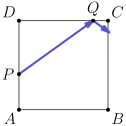
At which vertex does the path terminate?
The path continues forever.
Small Hint:
Reflecting billiard paths is easiest by “unfolding”: follow a straight line through a grid of reflected copies of the square
Big Hint:
Find the first grid corner the line hits; the parities of and determine which actual vertex it is
Solution:
Place so and The initial direction is Unfold the billiard into a grid of reflected copies and follow the straight line from At a grid corner the horizontal coordinate gives The vertical coordinate then requires so The first positive possibility is giving and the unfolded corner Crossing cells across (odd) puts it on the side and cells up (even) puts it on That’s vertex Thus, B is the correct answer.