
2025 AMC 10A Solutions
Scroll down to view professionally curated solutions from LIVE by Po-Shen Loh, print PDF solutions, view answer key, or take the full timed exam.
All problems are used with official legal permission of the Mathematical Association of America (MAA).
1.
Andy and Betsy both live in Mathville. Andy leaves Mathville on his bicycle at traveling due north at a steady miles per hour. Betsy leaves on her bicycle from the same point at traveling due east at a steady miles per hour. At what time will they be exactly the same distance from their common starting point?
Small Hint:
Let be the hours since Andy started; Andy has gone miles and Betsy miles
Big Hint:
Set the two distances equal and solve for
Solution:
Let be the hours since Andy has gone miles north. Betsy starts an hour later, so she’s gone miles east. We want these equal: That gives so Three hours past is Thus, E is the correct answer.
2.
A box contains pounds of a nut mix that is percent peanuts, percent cashews, and percent almonds. A second nut mix containing percent peanuts, percent cashews, and percent almonds is added to the box resulting in a new nut mix that is percent peanuts. How many pounds of cashews are now in the box?
Small Hint:
The box starts with pounds of peanuts and pounds of cashews
Big Hint:
If pounds of the second mix is added, peanuts become out of set this fraction to
Solution:
The starting -pound mix holds pounds of peanuts and pounds of cashews. Add pounds of the second mix, which is peanuts. We want the new peanut fraction to be so This means giving Those pounds bring more pounds of cashews, so the box now has Therefore, the answer is B.
3.
How many isosceles triangles are there with positive area whose side lengths are all positive integers and whose longest side has length
Small Hint:
Split into the case where two sides equal and the case where is the unique longest side
Big Hint:
In the second case the two equal sides satisfy and
Solution:
Split into two cases. Say two sides both equal Then the third side can be any integer from to which is triangles. Now suppose is the unique longest side. The two equal legs must satisfy by the triangle inequality, and So runs from to giving triangles. Adding up, Thus, D is the correct answer.
4.
A team of students is going to compete against a team of teachers in a trivia contest. The total number of students and teachers is Ash, a cousin of one of the students, wants to join the contest. If Ash plays with the students, the average age on that team will increase from to If Ash plays with the teachers, the average age on that team will decrease from to How old is Ash?
Small Hint:
Let be the number of students; their ages sum to and the teachers’ to
Big Hint:
Ash’s age is and also set them equal
Solution:
Let be the number of students. If Ash joins them, his age is If he joins the teachers instead (there are of them), his age is Both describe the same Ash, so That gives and Ash is Therefore, the answer is A.
5.
Consider the sequence of positive integers
What is the th term in this sequence?
Small Hint:
The sequence rises from up to a peak and falls back; group it into blocks by peak value
Big Hint:
The block that peaks at has terms and ends at cumulative position
Solution:
Group the sequence into blocks. Block reads which is terms and ends on So after block we’ve used terms. Notice That’s exactly the end of block whose last term is Thus, E is the correct answer.
6.
In an equilateral triangle each interior angle is trisected by a pair of rays. The intersection of the interiors of the middle -angle at each vertex is the interior of a convex hexagon. What is the degree measure of the smallest angle of this hexagon?
Small Hint:
Each vertex angle splits into three pieces; consider triangles formed by trisectors from two vertices on one side
Big Hint:
Use the triangle angle sum at the intersections with base-angle pairs and
Solution:
Label the equilateral triangle Each angle splits into three pieces. Take the outermost trisectors from and : they meet at base angles so the hexagon vertex there has angle The innermost trisectors from and meet at base angles giving apex and by vertical angles that’s the opposite hexagon angle. So the six angles alternate and The smallest is Therefore, the answer is C.
7.
Suppose and are real numbers. When the polynomial is divided by the remainder is When the polynomial is divided by the remainder is What is
Small Hint:
By the Remainder Theorem, evaluate the polynomial at and
Big Hint:
This gives and
Solution:
By the Remainder Theorem, just plug in. We get so And so Subtract the first from the second: hence Then Thus, E is the correct answer.
8.
Agnes writes the following four statements on a blank piece of paper.
• At least one of these statements is true.
• At least two of these statements are true.
• At least two of these statements are false.
• At least one of these statements is false.
Each statement is either true or false. How many false statements did Agnes write on the paper?
Small Hint:
Test the assumption that the third statement (“at least two are false”) is true and look for a contradiction
Big Hint:
Then check whether exactly one false statement is fully consistent
Solution:
Number them: at least one true, at least two true, at least two false, at least one false. Suppose is true. Then at least two statements are false. But then and all read as true, which leaves at most one false statement. That’s a contradiction, so must be false. Now and are all true, and each matches reality with just one false statement. So exactly statement is false. Therefore, the answer is B.
9.
Let For how many real numbers does the graph of pass through the point
more than
Small Hint:
The graph of passes through exactly when
Big Hint:
Factor and count solutions of ; note that exceeds
Solution:
The graph passes through exactly when Let so we count solutions of Factor with roots On the function is positive and so continuity gives one root on each side of On the function is negative, while for it increases from to infinity, giving one more root. A cubic equation has at most real roots, so these are all the solutions. Each gives one so there are values. Thus, C is the correct answer.
10.
A semicircle has diameter and chord of length parallel to A smaller semicircle with diameter on and tangent to is cut from the larger semicircle, as shown below.
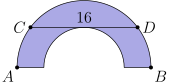
What is the area of the resulting figure, shown shaded?
Small Hint:
With large radius and small radius the shaded area is
Big Hint:
Let be the center and the midpoint of then and so
Solution:
Let be the center on and the midpoint of chord Set for the small radius and for the large one. Since the Pythagorean theorem in triangle gives The shaded area is the big semicircle minus the small one: Therefore, the answer is C.
11.
The sequence is arithmetic. The sequence is geometric. Both sequences are strictly increasing and contain only integers, and is as small as possible. What is the value of
Small Hint:
Write from the arithmetic sequence and from the geometric one
Big Hint:
Since test increasing integer ratios until
Solution:
From the arithmetic sequence, so From the geometric one, for some integer ratio We want the smallest such so test Only works, since That forces and the sequences are and So Thus, E is the correct answer.
12.
Carlos uses a -digit passcode to unlock his computer. In his passcode, exactly one digit is even, exactly one (possibly different) digit is prime, and no digit is How many -digit passcodes satisfy these conditions?
Small Hint:
Place the single even digit in one of positions and multiply by the other three digits are odd
Big Hint:
Split on whether the one prime digit is the even one () or an odd one ( or )
Solution:
No digit is so digits run from to Put the single even digit in the first slot for now and multiply by at the end to place it. Split on that even digit. If it’s the prime then the three odd digits all have to be non-prime, so each is or giving ways. Otherwise the even digit is or ( choices), and exactly one of the odd digits is prime, worth or ( choices) in one of the odd positions, while the other two odds come from ( ways). That’s Altogether, Therefore, the answer is D.
13.
In the figure below, the outside square contains infinitely many squares, each of them with the same center and sides parallel to the outside square. The ratio of the side length of a square to the side length of the next inner square is where The spaces between squares are alternately shaded, as shown in the figure (which is not necessarily drawn to scale).

The area of the shaded portion of the figure is of the area of the original square. What is
Small Hint:
Take the outer side to be the square sides are and the shaded area is
Big Hint:
Sum this geometric series with ratio and set it equal to
Solution:
Let the outer side be The squares have sides and the shaded rings alternate, so the shaded area is We’re told this equals so Then giving Thus, D is the correct answer.
14.
Six chairs are arranged around a round table. Two students and two teachers randomly select four of the chairs to sit in. What is the probability that the two students will sit in two adjacent chairs and the two teachers will also sit in two adjacent chairs?
Small Hint:
Seat one student; the probability the other student takes one of the two adjacent chairs is
Big Hint:
Given the students are adjacent, count how many of the teacher seatings are adjacent
Solution:
Seat the first student anywhere. The second student lands next to them with probability since two of the remaining five chairs are adjacent. Now the teachers fill two of the four leftover chairs. Of the ways to do that, exactly are adjacent pairs. So the probability is Therefore, the answer is B.
15.
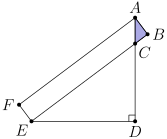
In the figure below, is a rectangle, and What is the area of
Small Hint:
Let Then and
Big Hint:
Use to set up a proportion, then solve for
Solution:
Let Since is a rectangle with and and we get and The triangles and are similar, so Clear denominators and square to get which factors as The positive root is So the area is Thus, A is the correct answer.
16.
There are three jars. Each of three coins is placed in one of the three jars, chosen at random and independently of the placements of the other coins. What is the expected number of coins in a jar with the most coins?
Small Hint:
There are equally likely placements; classify each by how the coins are distributed
Big Hint:
Count placements with max (all in one jar), max (one per jar), and max (the rest)
Solution:
There are equally likely placements. Of these, pile all coins into one jar (max ), and put one coin in each jar (max ). The other split - (max ). So the expected maximum is Therefore, the answer is D.
17.
Let be the unique positive integer such that dividing by leaves a remainder of and dividing by leaves a remainder of What is the tens digit of
Small Hint:
Both and are multiples of
Big Hint:
So is their difference; reduce it by subtracting further multiples, and remember since the remainder is
Solution:
Subtract off the remainders. Both and are multiples of so their difference is too. Now which makes a multiple of as well. The remainder means and the only divisor of bigger than is itself. So and its tens digit is Thus, E is the correct answer.
18.
The harmonic mean of a collection of numbers is the reciprocal of the arithmetic mean of the reciprocals of the numbers in the collection. For example, the harmonic mean of and is
What is the harmonic mean of all the real roots of the th degree polynomial
Small Hint:
For each factor Vieta gives root sum and product so the reciprocal-sum is their quotient
Big Hint:
The harmonic mean is the number of roots divided by the total sum of reciprocals
Solution:
Look at one factor Its discriminant is positive, so it has two distinct real roots. Roots from different factors are also distinct: a common root for indices and would satisfy but By Vieta, the two reciprocals from one factor sum to Summing over all factors, the reciprocals total There are real roots in all, so the harmonic mean is Therefore, the answer is B.
19.
An array of numbers is constructed beginning with the numbers in the top row. Each adjacent pair of numbers is summed to produce a number in the next row. Each row will begin and end with the numbers and respectively. The first three rows are shown below.
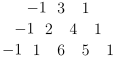
If the process continues, one of the rows will sum to In that row, what is the third number from the left?
Small Hint:
Each interior entry feeds two sums below, so each row’s total doubles; the top row sums to
Big Hint:
Track the third diagonal from the left, which accumulates the second diagonal
Solution:
Each interior entry feeds two entries below, and the end values and cancel in the sum. So every row’s total doubles the one above. The top row sums to and so this is the th row (counting the top as row ). Track the diagonals from the left. The second diagonal is dropping by each row. The third diagonal adds these up: for it equals Plug in : Thus, A is the correct answer.
20.
A silo (right circular cylinder) with diameter meters stands in a field. MacDonald is located meters west and meters south of the center of the silo. McGregor is located meters east and meters south of the center of the silo. The line of sight between MacDonald and McGregor is tangent to the silo. The value of can be written as where and are positive integers, is not divisible by the square of any prime, and is relatively prime to the greatest common divisor of and What is
Small Hint:
Put the silo’s center at the origin; the line of sight is tangent to the circle of radius
Big Hint:
Along the tangent line where each of and is a tangent length from a point to the circle
Solution:
Put the silo’s center at the origin with radius Then MacDonald is at and McGregor at The tangent length from is and from it is The tangent point sits between the two men, so But also Squaring twice and simplifying gives Its positive root, which satisfies the original tangent-length equation, is Therefore Thus, A is the correct answer.
21.
A set of numbers is called sum-free if whenever and are (not necessarily distinct) elements of the set, is not an element of the set. For example, and the empty set are sum-free, but is not. What is the greatest possible number of elements in a sum-free subset of
Small Hint:
Both and are sum-free, each with elements
Big Hint:
If is the largest element, pair to as each pair contributes at most one element
Solution:
We can reach The odds are sum-free, since two odds sum to an even. So is since any two of those sum past Each has elements. Now let be the largest element of any sum-free subset. For at most one member of can be chosen, because the two sum to If is even, cannot be chosen either, since it can be used twice and Thus besides there are at most chosen elements, for a total of at most Therefore the greatest possible size is Thus, C is the correct answer.
22.
A circle of radius is surrounded by three circles, whose radii are and all externally tangent to the inner circle and externally tangent to each other, as shown in the diagram below.

What is
Small Hint:
The centers of the radius- circles are pairwise apart, forming a right triangle
Big Hint:
Place the right angle at the origin and write distance equations for the inner center, or apply the four-circle curvature relation
Solution:
The three outer centers are pairwise and apart, a -- right triangle. Now apply Descartes’ Circle Theorem with curvatures and all mutually tangent: Inverting, Therefore, the answer is B.
23.
Triangle has side lengths and The bisector of and the altitude to side intersect at point What is
Small Hint:
Let the bisector of meet at the Angle Bisector Theorem gives and
Big Hint:
Show so is isosceles; then angle-chase to find isosceles with
Solution:
Let the bisector of hit at By the Angle Bisector Theorem, and since we get and Triangles and share with adjacent sides in the common ratio so they are similar by SAS. Hence making isosceles. Put Because the altitude through is perpendicular to both and equal Thus is isosceles, so Since lies on we get Thus, D is the correct answer.
24.
Call a positive integer fair if no digit is used more than once, it has no s, and no digit is adjacent to two greater digits. For example, and are fair, but and are not fair. How many fair positive integers are there?
Small Hint:
A fair number’s digits increase up to its largest digit and then decrease
Big Hint:
For digits, choose the digit set () and decide which of the smaller digits go left of ()
Solution:
A fair number’s digits must increase up to its largest digit and then decrease. Indeed, the first ascent after any descent would begin at a digit smaller than both of its neighbors. For digits, choose the digit set from to in ways. Each of the digits below independently goes on the increasing left side or the decreasing right side, after which its position is forced. Hence the total is Therefore, the answer is C.
25.
A point is chosen at random inside square The probability that is neither the shortest nor the longest side of can be written as where and are positive integers, and is not divisible by the square of a prime. What is
Small Hint:
Set is the middle length when either or
Big Hint:
The boundaries are the circle (about ) and the vertical line use the sector where is equilateral
Solution:
Place and on the unit square. is the middle length when or These regions are bounded by the circle centered at with radius (where ) and the line (where ). Let be where the circle meets Then is equilateral, so The larger region has area and the smaller has area They add to Thus Thus, A is the correct answer.