
2024 AMC 10B Solutions
Scroll down to view professionally curated solutions from LIVE by Po-Shen Loh, print PDF solutions, view answer key, or take the full timed exam.
All problems are used with official legal permission of the Mathematical Association of America (MAA).
1.
In a long line of people arranged left to right, the th person from the left is also the th person from the right. How many people are in the line?
Small Hint:
There are people to the left of this person and to the right
Big Hint:
Add the two counts, but do not count this one person twice
Solution:
There are people to the left of this spot and to the right. Add those two groups plus the person themselves: Or, just as fast, the two positions overlap on one person, so Thus, B is the correct answer.
2.
What is
Small Hint:
Write
Big Hint:
Notice that equals
Solution:
Write But too, so The two terms are the same. That makes Therefore, the answer is B.
3.
For how many integer values of is
Small Hint:
Divide by : the inequality is
Big Hint:
so ranges over the integers with
Solution:
Divide by to get The integers that fit run from up to and there are of them. Thus, E is the correct answer.
4.
Balls numbered are deposited in bins, labeled and using the following procedure. Ball is deposited in bin and balls and are deposited in bin The next balls are deposited in bin the next in bin and so on, cycling back to bin after balls are deposited in bin (For example, balls numbered are deposited in bin at step of this process.) In which bin is ball deposited?
Small Hint:
Group has balls, so groups through use balls
Big Hint:
Find the group containing ball then read its bin from with group corresponding to
Solution:
Group holds balls, so the first groups swallow of them. Now and which puts ball in group (balls through ). The bins cycle so group lands in bin number For that’s bin Therefore, the answer is D.
5.
In the following expression, Melanie changed some of the plus signs to minus signs:
When the new expression was evaluated, it was negative. What is the least number of plus signs that Melanie could have changed to minus signs?
Small Hint:
The full sum is flipping a term lowers the sum by
Big Hint:
To go below with the fewest flips, flip the largest terms; their doubled total must exceed
Solution:
The full sum is Flipping a term drops the total by so to go negative the flipped terms have to add up to more than The greedy move is to flip the biggest odd numbers: flipping the top gives We want At it’s only but at it jumps to So flips do it. Thus, B is the correct answer.
6.
A rectangle has integer side lengths and an area of What is the least possible perimeter of the rectangle?
Small Hint:
For a fixed area, the perimeter is smallest when the two sides are as close to equal as possible
Big Hint:
look for a factor pair near
Solution:
The perimeter with is smallest when and are as close together as possible. Factor The divisor pair nearest is which gives perimeter Therefore, the answer is B.
7.
What is the remainder when is divided by
Small Hint:
Factor out
Big Hint:
The remaining factor is check its relationship to
Solution:
Pull out the common power: And so the product is a multiple of The remainder is Thus, A is the correct answer.
8.
Let be the product of all the positive integer divisors of What is the units digit of
Small Hint:
A number with divisors has divisor product equal to itself raised to the power
Big Hint:
has divisors, so track only the units digit
Solution:
Since has divisors, we can pair each divisor with its complement, so Only the units digit matters, and ends in so does too. Therefore, the answer is D.
9.
Real numbers and have arithmetic mean The arithmetic mean of and is What is the arithmetic mean of and
Small Hint:
Mean means mean means
Big Hint:
Use
Solution:
The means tell us and Square the first: so and Their mean is Thus, A is the correct answer.
10.
Quadrilateral is a parallelogram, and is the midpoint of the side Let be the intersection of lines and What is the ratio of the area of quadrilateral to the area of triangle
Small Hint:
Area ratios are unchanged by an affine map, so compute with
Big Hint:
Find as the intersection of line with line then use the shoelace formula
Solution:
Area ratios don’t change under an affine map, so drop in convenient coordinates: which makes Line is and line runs from to they cross at The shoelace formula gives quadrilateral area and triangle area So the ratio is Therefore, the answer is A.
11.
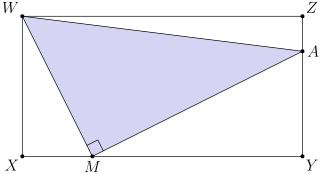
In the figure below is a rectangle with and Point lies on point lies on and is a right angle. The areas of and are equal. What is the area of
Small Hint:
Set with and
Big Hint:
Perpendicularity gives equal areas give
Solution:
Set so and The right angle means which gives that is Equal areas and force so Substitute back and Taking leaves and Then Thus, C is the correct answer.
12.
A group of students from different countries meet at a mathematics competition. Each student speaks the same number of languages, and, for every pair of students and student speaks some language that student does not speak, and student speaks some language that student does not speak. What is the least possible total number of languages spoken by all the students?
Small Hint:
Give each student the set of languages they speak; the condition means no set contains another
Big Hint:
Equal-size distinct sets never contain one another, so you need for some
Solution:
Give each student the set of languages they speak. The condition says no one’s set sits inside another’s. Everyone speaks the same number of languages, and two distinct -element sets can never contain each other, so all we need is different -subsets of the languages, i.e. With the best we can manage is short of But So languages are both enough and necessary. Therefore, the answer is A.
13.
Positive integers and satisfy the equation What is the minimum possible value of
Small Hint:
so
Big Hint:
Then and with minimize
Solution:
Since we have Squaring the given equation shows that is rational. Thus and have the same squarefree part: write and where is squarefree and are positive integers. Then so and Therefore which is smallest when and are as close as possible. Taking and gives Thus, B is the correct answer.
14.
A dartboard is the region in the coordinate plane consisting of points such that A target is the region where A dart is thrown and lands at a random point in The probability that the dart lands in can be expressed as where and are relatively prime positive integers. What is
Small Hint:
is a square of diagonal and is the annulus
Big Hint:
The outer radius equals the distance from the origin to each edge of so sits entirely inside
Solution:
is the square with area The target condition unpacks to that is an annulus of area Does it fit inside The distance from the origin to an edge is exactly the outer radius, so yes, the annulus sits inside the square. The probability is giving Therefore, the answer is B.
15.
A list of real numbers consists of as well as with The range of the list is and the mean and median are both positive integers. How many ordered triples are possible?
infinitely many
Small Hint:
The six given numbers sum to so must make the total a multiple of
Big Hint:
Range fixes the smallest and largest values; then require the th smallest number to be a positive integer
Solution:
The six fixed numbers total If the mean is the integer then Because the fixed entries already run from to the range condition gives three cases.
If then The bounds on force or For the median is for we have so and the median is integral only when giving
If then Here gives median For we have the median is integral only when giving
The remaining case has and The total lies between and so and The median can be an integer only when giving Hence exactly ordered triples work. Thus, C is the correct answer.
16.
Jerry likes to play with numbers. One day, he wrote all the integers from to on the whiteboard. Then he repeatedly chose four numbers on the whiteboard, erased them, and replaced them by either their sum or their product. (For example, Jerry’s first step might have been to erase and and then write either their sum, or their product, on the whiteboard.) After repeatedly performing this operation, Jerry noticed that all the remaining numbers on the whiteboard were odd. What is the maximum possible number of integers on the whiteboard at that time?
Small Hint:
Each move turns numbers into so the count drops by maximizing the count means minimizing the moves
Big Hint:
There are even entries, and any move decreases their number by at most
Solution:
Among there are even numbers and odd numbers. Each operation replaces entries by so the total count falls by If a move consumes even entries, its output is either odd, reducing the even count by or even, reducing it by In either case the even count falls by at most Therefore eliminating all even entries takes at least moves. This is achievable: use sums containing one odd and three evens, then one sum containing three odds and the final even. Every output is odd. Thus the maximum remaining count is Therefore, the answer is A.
17.
In a race among snails, there is at most one tie, but that tie can involve any number of snails. For example, the result of the race might be that Dazzler is first; Abby, Cyrus, and Elroy are tied for second; and Bruna is fifth. How many different results of the race are possible?
Small Hint:
Count results with no tie separately from results with exactly one tied group
Big Hint:
For a tied group of snails, choose them in ways and order the resulting blocks in ways
Solution:
If nobody ties, the snails finish in orders. Now allow exactly one tied group of size with Choose the group in ways, then treat it as one block, leaving blocks to arrange in ways. Summing over Add the no-tie count: Thus, D is the correct answer.
18.
How many different remainders can result when the th power of an integer is divided by
Small Hint:
and split into coprime to and divisible by
Big Hint:
If then if is divisible by then is divisible by
Solution:
Here and If Euler’s theorem gives And if is divisible by then carries a factor of hence of so That leaves only two possible remainders, and Therefore, the answer is B.
19.
In the following table, each question mark is to be replaced by “Possible” or “Not Possible” to indicate whether a nonvertical line with the given slope can contain the given number of lattice points (points both of whose coordinates are integers). How many of the entries will be “Possible”?

Small Hint:
Two lattice points on a line force its slope to be rational; so an irrational slope allows at most one lattice point
Big Hint:
A rational-slope line through one lattice point passes through infinitely many, so it has either or infinitely many
Solution:
Any two lattice points give a rational slope. So a line with irrational slope holds at most one lattice point: it can have (say ) or exactly (say ), never two. A line with rational slope (zero included) through a lattice point also passes through for its reduced slope so it hits infinitely many; such a line has either lattice points (shift it by an irrational intercept) or more than two, never exactly one or two. So each row gives exactly two “Possible” entries. For zero and nonzero rational slope those are the “zero” and “more than two” columns; for irrational slope, the “zero” and “exactly one” columns. That’s in all. Thus, C is the correct answer.
20.
Three different pairs of shoes are placed in a row so that no left shoe is next to a right shoe from a different pair. In how many ways can these six shoes be lined up?
Small Hint:
The rule says: wherever a left shoe touches a right shoe, they must be mates from the same pair
Big Hint:
Case on the left/right pattern of the six spots; each place where the side switches pins down one pair
Solution:
Wherever an meets an in the side pattern, those two shoes must be mates. Thus an interior run cannot have length its lone shoe would have to be the mate of both neighbors. With three ’s and three ’s, the only possible patterns are and For either one-switch pattern, choose the pair at the switch and order the remaining shoes, giving arrangements. Each of the other six patterns has assignments of the three pairs to its switches. Hence the total is Therefore, the answer is A.
21.
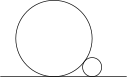
Two straight pipes (circular cylinders), with radii and lie parallel and in contact on a flat floor. The figure below shows a head-on view. What is the sum of the possible radii of a third parallel pipe lying on the same floor and in contact with both?
Small Hint:
For two circles of radii and resting on a line and touching each other, their floor contact points are apart
Big Hint:
The new pipe’s contact point is from the big pipe’s and from the small pipe’s; it can sit between them or outside
Solution:
Two circles of radii and resting on the floor and touching each other have contact points a horizontal distance apart. So the radius- and radius- pipes touch the floor apart. A third pipe of radius sits from the big pipe’s contact point and from the small pipe’s. Nestled between them, so and Sitting past the small pipe, so (Past the big pipe can’t happen.) The sum is Thus, C is the correct answer.
22.
A group of people will be partitioned into indistinguishable -person committees. Each committee will have one chairperson and one secretary. The number of different ways to make these assignments can be written as where and are positive integers and is not divisible by What is
Small Hint:
The number of ways is the partition count times chair/secretary choices per committee
Big Hint:
Count factors of in each piece using Legendre’s formula on and
Solution:
Split people into indistinguishable groups of in ways, then each committee picks a chairperson and a secretary in ways, a factor of Now count factors of In there are the denominator contributes and contributes The exponent is so Therefore, the answer is A.
23.
The Fibonacci numbers are defined by and for What is
24.
Let
How many of the values of and are integers?
Small Hint:
Over the common denominator
Big Hint:
Check separately for even and odd
Solution:
Put everything over If is even, every term up top is divisible by If is odd, then and so the numerator is Either way is an integer, so all values are integers. Therefore, the answer is E.
25.
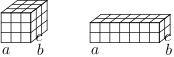
Each of bricks (right rectangular prisms) has dimensions where and are pairwise relatively prime positive integers. These bricks are arranged to form a block, as shown on the left below. A th brick with the same dimensions is introduced, and these bricks are reconfigured into a block, shown on the right. The new block is unit taller, unit wider, and unit deeper than the old one. What is
Small Hint:
The old block has side lengths the new block has side lengths for some assignment of to
Big Hint:
Relabel so the new side lengths are no one of these can equal with the same letter
Solution:
Relabel the brick dimensions so the new block has sides These must be the three old side lengths each increased by A new side cannot match the old side with the same letter: has no positive integer solution, while and would give negative lengths. Therefore the matching must be one of the two three-cycles. In one orientation, The last two equations give and Substituting into the first gives so The other cycle merely exchanges and These lengths are pairwise relatively prime, and Thus, E is the correct answer.