
2021 AMC 10B Fall Solutions
Scroll down to view professionally curated solutions from LIVE by Po-Shen Loh, print PDF solutions, view answer key, or take the full timed exam.
All problems are used with official legal permission of the Mathematical Association of America (MAA).
1.
What is the value of
Small Hint:
Each digit appears once in each place value
Big Hint:
The digit sum in each column is
Solution:
We can add each individual digit, yielding
We can also get the sum by noticing that each digit has a sum of so the sum is equal to
Thus, the answer is E .
2.
What is the area of the shaded figure shown below?
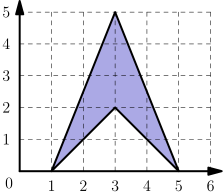
Small Hint:
Find the large triangle area and subtract the small triangle area
Big Hint:
Both triangles have base
Solution:
The area is a triangle of area since we subtract the area of a smaller triangle from a larger triangle.
Thus, the answer is B .
3.
The expression is equal to the fraction in which and are positive integers whose greatest common divisor is What is
Small Hint:
Use a common denominator
Big Hint:
The numerator is
Solution:
We can rewrite this as
This can be simplified to
Since is coprime with both and we know is the numerator.
Thus, the answer is E .
4.
At noon on a certain day, Minneapolis is degrees warmer than St. Louis. At the temperature in Minneapolis has fallen by degrees while the temperature in St. Louis has risen by degrees, at which time the temperatures in the two cities differ by degrees. What is the product of all possible values of
Small Hint:
After the temperature changes, the difference is
Big Hint:
Solve
Solution:
Let be the noon temperature difference. At the new difference is
The temperatures then differ by degrees, so Hence or and the product of all possible values is
Thus, the answer is C .
5.
Let Which of the following is equal to
Small Hint:
Write as a power of
Big Hint:
Solution:
Since we have
Therefore
Thus, the answer is E .
6.
The least positive integer with exactly distinct positive divisors can be written in the form where and are integers and is not a divisor of What is
Small Hint:
Big Hint:
To minimize the number, put the larger exponent on the smaller prime
Solution:
Before starting, note that if we can represent the prime factorization of an integer as then there are distinct positive factors.
If the number in question has factors, by the previous logic, and as the prime factorization of then our number must be or
The smallest number we can make in either of these is making in the first configuration, yielding
Therefore, so
Thus, the answer is B .
7.
Call a fraction not necessarily in simplest form, special if and are positive integers whose sum is How many distinct integers can be written as the sum of two, not necessarily different, special fractions?
Small Hint:
A special fraction can be written as
Big Hint:
Check pairs of denominators whose fractional parts cancel
Solution:
A special fraction with denominator equals where We need integer values of
Taking a check of the fourteen possible denominators gives the following pairs that produce integers: Their distinct sums are
There are such integers.
Thus, the answer is C .
8.
The greatest prime number that is a divisor of is because What is the sum of the digits of the greatest prime number that is a divisor of
Small Hint:
Big Hint:
Use
Solution:
We know Since we get Therefore, is the largest prime factor, and the sum of its digits is
Thus, the answer is C .
9.
The knights in a certain kingdom come in two colors. of them are red, and the rest are blue. Furthermore, of the knights are magical, and the fraction of red knights who are magical is times the fraction of blue knights who are magical. What fraction of red knights are magical?
Small Hint:
Let the blue magical fraction be
Big Hint:
The total magical fraction is a weighted average of and
Solution:
Let be the fraction of blue knights who are magical. Then the fraction of red knights who are magical is
The total magical fraction is a weighted average over the red and blue groups:
Thus so The red magical fraction is
Thus, the answer is C .
10.
Forty slips of paper numbered to are placed in a hat. Alice and Bob each draw one number from the hat without replacement, keeping their numbers hidden from each other. Alice says, “I can’t tell who has the larger number.” Then Bob says, “I know who has the larger number.” Alice says, “You do? Is your number prime?” Bob replies, “Yes.” Alice says, “In that case, if I multiply your number by and add my number, the result is a perfect square.” What is the sum of the two numbers drawn from the hat?
Small Hint:
Alice’s first statement rules out and
Big Hint:
Bob can know only if his number is one of the new extremes
Solution:
If Alice had drawn or she would know who had the larger number. Her first statement tells Bob that Alice has neither nor
Bob can then know who has the larger number only if his number is or Since Bob says his number is prime, his number must be
Now plus Alice’s number is a square between and The only square in that interval is so Alice’s number is The sum is
Thus, the answer is A .
11.
A regular hexagon of side length is inscribed in a circle. Each minor arc of the circle determined by a side of the hexagon is reflected over that side. What is the area of the region bounded by these reflected arcs?
Small Hint:
Compare the reflected-arc region with the original circle
Big Hint:
The hexagon is the average of the two regions
Solution:
The original circle is made from the regular hexagon plus equal circular segments. Reflecting each minor arc over its side puts those same segments inside the hexagon instead.
Therefore the average of the circle’s area and the reflected-arc region’s area is the area of the regular hexagon. The hexagon has area and the circle has radius so its area is
If the desired area is then so
Thus, the answer is B .
12.
Which of the following conditions is sufficient to guarantee that integers and satisfy the equation
x > y and
and
and
and
Small Hint:
Rewrite the expression using squared differences
Big Hint:
The three squared differences must sum to
Solution:
Let Expanding gives
For the value to be the three nonnegative square terms must sum to Since are integers, this means the squared differences are
Thus two of the variables must be equal, and the third must differ from them by The condition and guarantees exactly that.
Thus, the answer is D .
13.
A square with side length is inscribed in an isosceles triangle with one side of the square along the base of the triangle. A square with side length has two vertices on the other square and the other two on sides of the triangle, as shown. What is the area of the triangle?
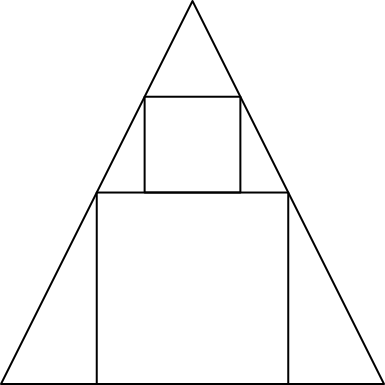
Small Hint:
Use similar triangles to relate widths at different heights
Big Hint:
The triangle widths are and at heights separated by
Solution:
Let the isosceles triangle have height and base By similarity, horizontal widths in the triangle are proportional to distance from the top vertex.
The top side of the larger square has width and is units from the top. The top side of the smaller square has width and is units from the top. Hence
Solving gives Also so The area is
Thus, the answer is B .
14.
Una rolls standard -sided dice simultaneously and calculates the product of the numbers obtained. What is the probability that the product is divisible by
Small Hint:
Count the complement: product not divisible by
Big Hint:
The complement has either no factor of or exactly one factor of
Solution:
Count the complement, where the product is not divisible by This happens if the product has no factor of or exactly one factor of
All dice odd has probability Exactly one factor of means exactly one die is or and the other five dice are odd. This has probability
The complement has probability so the desired probability is
Thus, the answer is C .
15.
In square points and lie on and respectively. Segments and intersect at right angles at with and What is the area of the square?
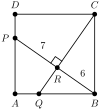
Small Hint:
by the triangle
Big Hint:
Use the altitude theorem in right triangle
Solution:
Since and we have The right-angle and square-angle chasing gives so
Because point is the foot of the altitude from to the hypotenuse of right triangle Thus and
So and are and Because lies on we have Congruence gives while the right-triangle projection formulas give and Hence so and Therefore,
The area of the square is
Thus, the answer is D .
16.
Five balls are arranged around a circle. Chris chooses two adjacent balls at random and interchanges them. Then Silva does the same, with her choice of adjacent balls to interchange being independent of Chris’s. What is the expected number of balls that occupy their original positions after these two successive transpositions?
Small Hint:
Case on how Silva’s swap overlaps Chris’s swap
Big Hint:
The overlap sizes have probabilities
Solution:
After Chris chooses an adjacent pair, Silva has equally likely adjacent pairs to choose.
If Silva chooses the same pair, all balls return to their original positions. This has probability
If Silva chooses a pair sharing exactly one ball with Chris’s pair, then balls are in their original positions. There are such pairs, so this has probability
If Silva chooses a disjoint adjacent pair, then ball is in its original position. This also has probability
The expected number is
Thus, the answer is D .
17.
Distinct lines and lie in the -plane. They intersect at the origin. Point is reflected about line to point and then is reflected about line to point The equation of line is and the coordinates of are What is the equation of line
Small Hint:
Two reflections through intersecting lines equal a rotation
Big Hint:
Compare the angle change from to
Solution:
Two reflections across lines through the origin are equivalent to a rotation by twice the angle from the first reflecting line to the second.
The point is sent to which is a clockwise rotation. Therefore line is clockwise from line
The slope of is If then
Thus line is or
Thus, the answer is D .
18.
Three identical square sheets of paper each with side length are stacked on top of each other. The middle sheet is rotated clockwise about its center and the top sheet is rotated clockwise about its center, resulting in the -sided polygon shown in the figure below.
The area of this polygon can be expressed in the form where and are positive integers, and is not divisible by the square of any prime. What is
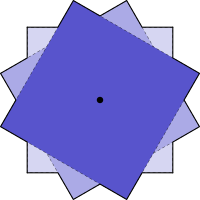
Small Hint:
Split the polygon into congruent triangles
Big Hint:
Each small triangle has angles
Solution:
The boundary can be split into congruent triangles. Each has angles and
For one such triangle, draw the altitude from the center-side direction. The altitude is half the side length of a square. The adjacent right triangle has a angle, so the part cut off from a length base is
Thus each small triangle has base and height giving area
The total area is Hence
Thus, the answer is E .
19.
Let be the positive integer a -digit number where each digit is a Let be the leading digit of the th root of What is
Small Hint:
Bound between and
Big Hint:
For each root, factor out the largest power of
Solution:
The number satisfies Multiplying or dividing by a power of only shifts the decimal point, so we only need the leading factor left after taking out the largest convenient power of
For has leading factor between and so
For the leading factor is between and so For the leading factor is between and so
For since the leading factor is between and Since
For the leading factor is between and so The sum is
Thus, the answer is A .
20.
In a particular game, each of players rolls a standard -sided die. The winner is the player who rolls the highest number. If there is a tie for the highest roll, those involved in the tie will roll again and this process will continue until one player wins. Hugo is one of the players in this game. What is the probability that Hugo’s first roll was a given that he won the game?
Small Hint:
Use
Big Hint:
Case on how many other players also rolled
Solution:
By symmetry, Therefore, the requested conditional probability is four times the probability that Hugo first rolls and eventually wins.
If Hugo rolls then no other player can roll Case on how many of the other three players also roll If other players tie Hugo, then Hugo wins the eventual tiebreaker with probability
Thus
Multiplying by gives
Thus, the answer is C .
21.
Regular polygons with and sides are inscribed in the same circle. No two of the polygons share a vertex, and no three of their sides intersect at a common point. At how many points inside the circle do two of their sides intersect?
Small Hint:
Count intersections separately for each pair of polygons
Big Hint:
A -gon and larger regular polygon intersect in boundary points
Solution:
For a regular -gon and a regular -gon inscribed in the same circle with and no shared vertices, their boundaries intersect in points. Each side of the smaller polygon is crossed twice by the boundary of the larger polygon.
Therefore, sum over all pairs of polygons. The -gon contributes intersections with each of the -, -, and -gons. The -gon contributes intersections with each of the - and -gons. The -gon contributes with the -gon.
The total is
Thus, the answer is E .
22.
For each integer let be the sum of all products where and are integers and What is the sum of the least values of such that is divisible by
Small Hint:
Find how changes when terms with are added
Big Hint:
Only changes the value modulo
Solution:
When passing from to the new terms are for Their sum is
Modulo this increment is when or and is when
Since the sequence becomes divisible by after the third occurrence of a number congruent to namely at Then stays divisible by for and the same pattern repeats every in
The ten least values are Their sum is
Thus, the answer is B .
23.
Each of the sides and the diagonals of a regular pentagon are randomly and independently colored red or blue with equal probability. What is the probability that there will be a triangle whose vertices are among the vertices of the pentagon such that all of its sides have the same color?
Small Hint:
Count the colorings with no monochromatic triangle
Big Hint:
At each vertex, each color must appear on exactly incident edges
Solution:
Count the complement: colorings of the edges of with no monochromatic triangle.
At any vertex, if incident edges had the same color, then the edges among their other endpoints would all have to be the other color, making a monochromatic triangle. Thus each vertex has exactly red and blue incident edges.
So the red edges form a -regular graph on vertices, which must be a -cycle. The number of labeled -cycles is
There are total colorings, so the desired probability is
Thus, the answer is D .
24.
A cube is constructed from white unit cubes and blue unit cubes. How many different ways are there to construct the cube using these smaller cubes? (Two constructions are considered the same if one can be rotated to match the other.)
Small Hint:
This is the number of -vertex subsets of a cube up to rotation
Big Hint:
Burnside over the rotations of the cube
Solution:
This is the number of ways to choose which of the cube vertices are blue, up to cube rotation. Use Burnside’s lemma on the rotations of the cube.
The identity fixes colorings. The quarter-turn face rotations each fix The half-turn face rotations each fix The rotations about opposite vertices each fix The half-turn rotations about opposite edges each fix
Thus the number of inequivalent constructions is
Thus, the answer is A .
25.
A rectangle with side lengths and a square with side length and a rectangle are inscribed inside a larger square as shown. The sum of all possible values for the area of can be written in the form where and are relatively prime positive integers. What is
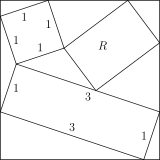
Small Hint:
Use the slope of the rectangle to set
Big Hint:
The similar-triangle equation factors as
Solution:
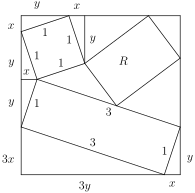
Use similar triangles as shown in the diagram. The left side of the large square has length and the bottom side has length Since these are equal, so The side length of the large square is therefore
In the upper part of the figure, let the marked horizontal segment be The two right triangles formed by the sides of rectangle have parallel corresponding sides and equal hypotenuses, so they are congruent. This gives the lengths shown below.
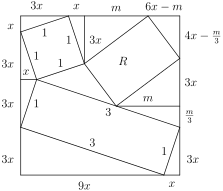
Similar triangles give Hence so
If rectangle has side length in both directions, so its area is If its side lengths are and so its area is
The two possible areas sum to Since the rectangle gives we have The sum of the possible areas is
Thus and the answer is E .